

Lewis Waterman helped turn the fountain pen from a messy risk into a tool people could count on. In 1884, he received U.S. Patent No. 293,545 for a feed design that balanced ink flow out with air flow back in. That fix helped power a pen company that grew from about 500 pens in 1884 to about 1,000 pens per day by 1901.
If you want the short version, here it is:
- His main idea: a three-fissure feed that kept ink moving in a more steady way
- Why it mattered: older pens often skipped, dried up, or spilled ink
- What he built: the Ideal Pen Company, later the L.E. Waterman Company
- What’s fact vs. legend: the story about a lost insurance contract is probably not documented fact
- Why people still care: he helped set the basic standard for a fountain pen that starts, writes, and stays clean
A few points stand out. Waterman was not just a pen maker. He was a teacher, salesman, and insurance agent, so he knew what happened when a pen failed at the wrong time. He also backed his pens with a 100% refund guarantee for five years, which showed buyers he knew trust had to be earned.
The big takeaway: I see Waterman’s story as a simple one. He solved a plain writing problem, turned that fix into a business, and shaped what many people still want from a fountain pen today: steady ink flow, fewer leaks, and a pen that is ready when you pick it up.
Early Life and the Writing Problems He Faced
Lewis Waterman Before Pen Making
Lewis Edson Waterman (1836–1901) worked as a teacher, salesman, and insurance agent before he got into pen making. Those jobs weren’t random stops along the way. They put him face to face with a simple problem: writing tools had to work when the moment mattered. Today, finding reliable fountain pens for beginners is much easier than it was in the 1800s.
As a teacher of Pitman shorthand, he needed a pen that could keep up with fast note-taking. In insurance, the stakes were different but just as clear. He often had to get contracts signed on the spot. A pen that skipped, flooded, or stalled wasn’t just annoying. It could disrupt the job in front of him.
That day-to-day friction shaped the problem he would soon try to fix.
Why Nineteenth-Century Pens Were Unreliable
Nineteenth-century pens had a bad habit of failing at the worst time. Joseph Bourque, author, summed it up this way:
"The newfangled barrel-filled reservoir pen had a tendency to dump ink onto the page."
At the center of the issue was airflow. As ink moved out of the reservoir, air needed to move in smoothly. When that didn’t happen, the pen could either starve for ink or flood the page. It’s a small bit of mechanics, but it made a big mess in practice.
For Waterman, this wasn’t some distant technical flaw. He ran into it in working life, where speed and dependability mattered.
The Lost Contract Story: What Is Known and What Is Not
The well-known story that a leaking pen cost Waterman an insurance contract is probably legend, not documented fact. It’s the kind of story people remember because it feels neat and dramatic. The record is less tidy.
What is documented is that Waterman entered the pen business in 1883 as a salesman for the Holland Pen Company. The ink-blot story didn’t appear in print until decades later. Even so, the larger point still holds: he was focused on control, and that focus led to the feed design that made his name.
sbb-itb-1dd4fe9
The Capillary Feed: How It Worked and Why It Mattered
How the Three Fissure Feed Controlled Ink Flow
Waterman fixed ink flow by managing two things at once: how ink moved forward and how air moved back. He cut three very thin grooves, called fissures, into the feed channel under the nib. Those narrow grooves used capillary action to pull ink in a steady way toward the tip. Around them, a wider channel let air return to the reservoir at a controlled pace, which kept pressure in balance.
"The release of ink by a fountain pen has been referred to as a 'controlled leak,' and it is the feed that exercises that control." - Richard Binder
He was careful with the patent language too. He did not lock himself into one exact fissure count, which made it harder for others to dodge the patent by changing the number of channels. That balance is what made the pen steady enough for daily use.
The 1884 U.S. Patent and Early Production
In 1884, Waterman received Patent No. 293,545 for the feed. At first, production was small-scale and hands-on. He put the pens together by hand in a back room on Fulton Street. In 1884, he made about 500 pens.
To win over buyers who had little reason to trust reservoir pens, he offered a 100% refund guarantee for five years. That was a bold move. But once the feed proved it could do the job, Waterman had more than an invention - he had the base for a business.
Why the Design Mattered
Before Waterman’s feed, carrying a reservoir pen in your coat pocket was a bit of a gamble. Maybe it would write well. Maybe it would leave ink on your clothes. If you were signing contracts or writing letters while out and about, that kind of uncertainty got in the way.
The three-fissure feed changed that. It gave users a pocket fountain pen that started with less fuss, leaked less often, and wrote when it was needed. For the first time, a pocket fountain pen was practical. And that steady performance set up the growth and brand-building that came later.
The Ideal Fountain Pen
From Small Workshop to Major Pen Brand
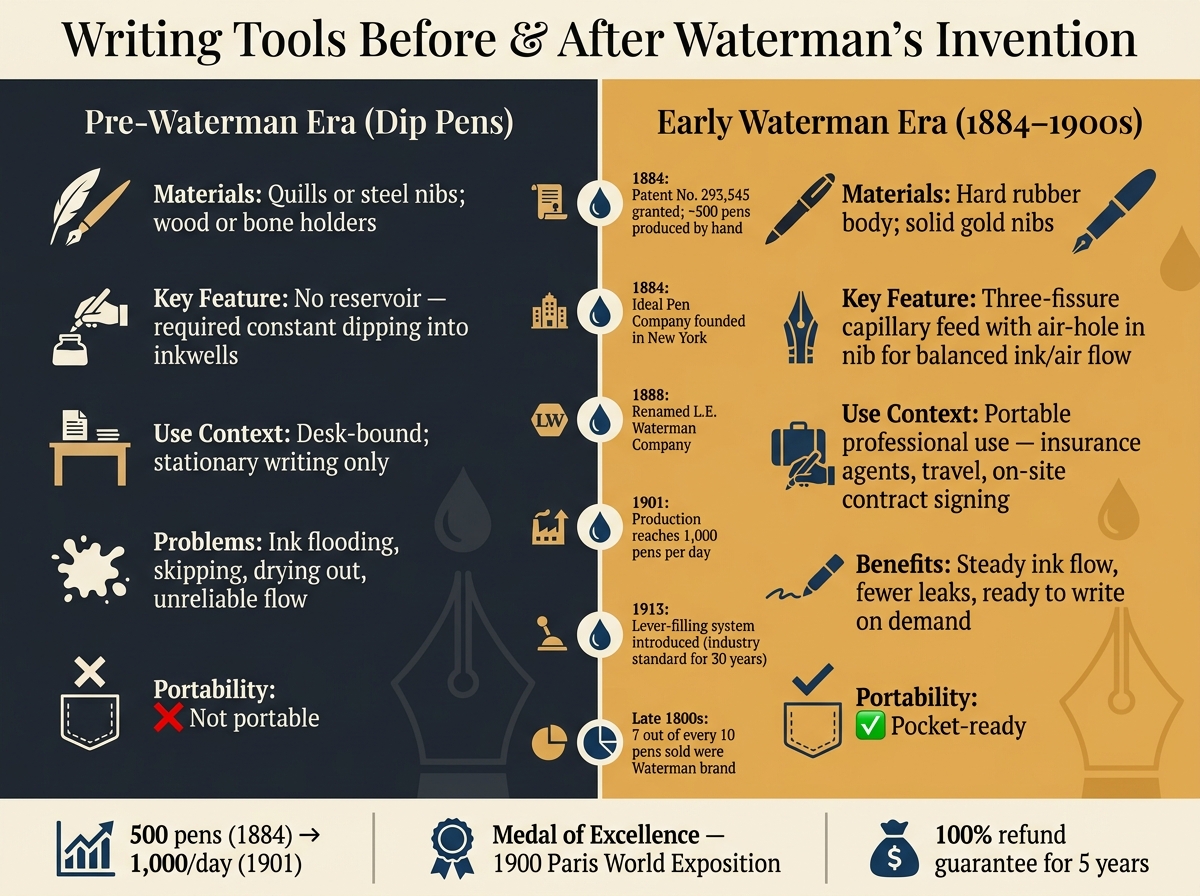
Writing Tools Before & After Waterman: The Fountain Pen Revolution
The Ideal Pen Company and Early Growth
Once the feed problem was solved, Waterman turned that fix into a company. He started the Ideal Pen Company in New York in 1884, and the business was later renamed the L.E. Waterman Company in 1888. The growth was fast. Sales climbed from 500 pens in 1884 to 1,000 a day by 1901. After Waterman died, Frank D. Waterman pushed the company into overseas markets.
That rise wasn't just about a pen that worked. Waterman also gave people something that looked steady and trustworthy in the hand.
Materials, Branding, and Market Positioning
The name "Ideal" was a direct signal: this was meant to fix the mess and hassle of earlier reservoir pens. Early models used hard rubber bodies and solid gold nibs, and a Waterman Ideal fountain pen sold for less than $10 in the late 19th century. That mix of function, price, and polished presentation helped the pen win over working professionals, especially insurance agents who had to sign contracts on-site.
"For the first time it became practical to carry around in a pocket a slim, reliable, affordable, and graceful writing instrument - the Ideal fountain pen." - Joseph Bourque
Waterman later moved beyond plain utility. The company added decorative metal work and luxury overlays for buyers who wanted a pen to make a statement. Its ads matched that shift. Slogans like "Dip No More" appeared alongside endorsements from well-known figures such as Oliver Wendell Holmes. A Waterman pen also won the Medal of Excellence at the 1900 Paris World Exposition, which helped build its standing around the world.
Writing Tools Before and After Waterman
The change stands out when you put the tools next to each other.
| Era | Typical Materials | Key Technical Feature | Primary Use Context |
|---|---|---|---|
| Pre-Waterman (Dip Pens) | Quills or steel nibs; wood or bone holders | No reservoir; required constant dipping into inkwells | Desk-bound; stationary writing |
| Early Waterman (1884–1900s) | Hard rubber; solid gold nibs | Three-fissure capillary feed; air-hole in nib | Portable professional use (e.g., insurance agents, travel) |
Dip pens kept writers tied to a desk. Waterman's design changed that by making a pocket pen far more practical for daily work and travel.
The lever-filling system, introduced in 1913, became the industry standard for the next 30 years. That blend of function and status shaped what people came to expect from a fountain pen.
Waterman's Legacy for Modern Fountain Pen Users
How Waterman Changed Expectations for Fountain Pens
Waterman’s fix still shapes what people expect from a fountain pen. Before that change, fountain pens could be messy and hard to trust. He made them dependable enough for daily writing.
By the late 19th century, Waterman had become the top pen brand, producing seven out of every ten pens sold. That jump matters because it shows how much reliability changed the market. People didn’t just want a pen that looked good. They wanted one that worked when they picked it up.
That’s a big reason Waterman still means something to both collectors and people who write with fountain pens every day.
What Modern Enthusiasts Still Look For
The basics haven’t changed much. People still want a pen that starts right away, keeps a steady ink flow, and feels balanced in the hand.
Waterman’s advertising said it plainly:
"It never soils the fingers... It is always ready, without any pounding or shaking." - Lewis Waterman
That promise still sounds familiar because it lines up with what fountain pen users care about now. No skips. No fuss. No ink where it shouldn’t be. Proper fountain pen maintenance helps ensure this reliability over time.
Vintage Waterman gold nibs are also still sought after for their flexibility and personal feel. For many users, that kind of nib makes writing feel less like using a tool and more like putting your own mark on the page.
Closing Summary and Present-Day Relevance
Waterman solved a plain, everyday problem and built a company around that answer. In the process, he shaped what a reliable fountain pen should feel like in actual use.
His company’s early work - starting with the three-fissure feed and later filling systems such as the lever filler - gave later makers a standard to follow. Waterman didn’t just sell pens. He helped set the baseline for what users came to expect from them.
FAQs
How did Waterman’s feed stop leaks?
Waterman cut down on leaks by fixing pressure imbalances inside the pen’s reservoir.
His feed used thin grooves to draw ink to the nib through capillary action, while a larger channel let air move in as the ink level dropped.
That balance stopped the sudden ink "gushing" that made earlier pens leak. He later added wells to catch extra ink and keep the flow more even.
Did Lewis Waterman really lose a contract because of a pen leak?
No. That story is a widely repeated myth.
Historical research shows it’s not true.
What actually happened is much simpler: Waterman got into the pen business after taking over Frank Holland’s venture and improving its design.
Why was Waterman’s pen such a big deal in the 1880s?
Because it fixed a major problem: unreliable ink flow. Earlier reservoir pens often leaked, blotted the page, or just stopped writing. Vacuum locks and air pressure problems kept getting in the way.
In 1884, Waterman introduced the three-fissure feed system. It used capillary action to balance air coming in with ink going out. The result was a steady, controlled flow.
That change made the fountain pen practical for everyday writing. It also made it far more dependable when people needed it most.