

Fountain pen nib problems like skipping, scratchiness, and poor ink flow can be frustrating, but most of these issues are easy to fix at home. Here's what you need to know:
- Skipping: Caused by dried ink, debris, or misaligned tines. Fix it by flushing with water, using a brass shim, or adjusting the tines.
- Scratchiness: Often due to uneven tines or rough nib tips. Realign the tines or smooth the nib with a brown paper bag or micro-mesh pad.
- Ink Starvation: Results from clogged feeds, misaligned nibs, or tight tines. Clean thoroughly, check alignment, or widen the slit with a brass shim.
- Hard Starts and Railroading: Usually linked to dried ink or splayed tines. Flush the pen, adjust the tines, or apply light pressure to fix.
- Baby’s Bottom: Overly rounded nib tips cause skipping. This requires careful smoothing or replacing the nib.
Regular cleaning and proper storage prevent most nib issues. If problems persist, consider professional help or replacing the nib. Brands like Fountain Pen Revolution provide affordable nib replacements, making it easy to restore your pen's performance.
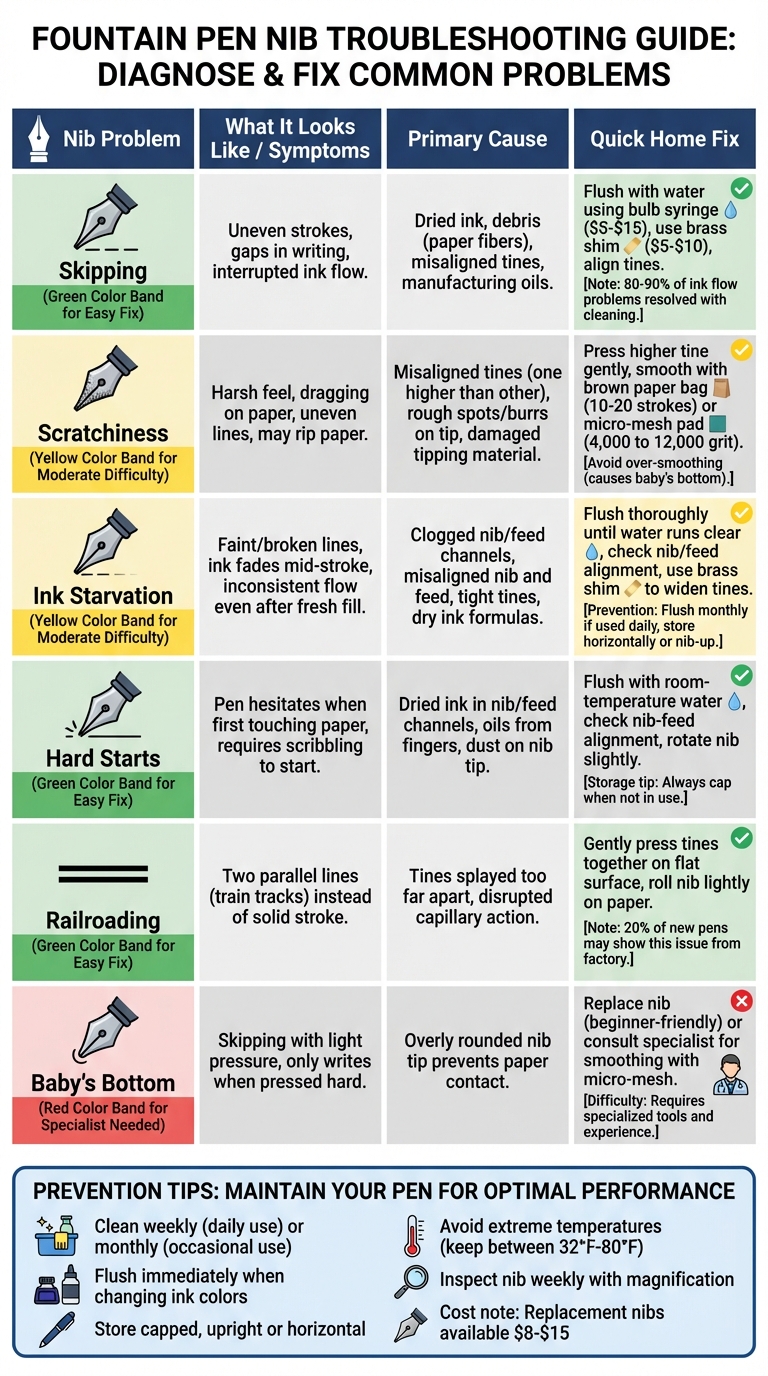
Common Fountain Pen Nib Problems: Causes and Quick Fixes Guide
Nib Tuning 101 - How to Troubleshoot and Fix your Nib*
Skipping Issues
Skipping happens when the ink flow is interrupted, leading to uneven strokes and gaps in your writing.
What Causes Skipping
Skipping is often caused by debris like paper fibers, dried ink, or leftover manufacturing oils. Misaligned tines on the nib can also disrupt smooth ink flow. Interestingly, experts estimate that 80–90% of ink flow problems can be resolved with a simple cleaning.
To check for misaligned tines, hold your nib up to a light source. The tips of the tines should touch evenly and align perfectly. Once you identify the issue, a few careful adjustments can often bring your pen back to smooth, consistent performance.
How to Fix Skipping
Start with a basic cleaning. Disassemble your pen according to the manufacturer’s instructions, and flush the nib and feed with cool water. You can use a bulb syringe (available for $5–$15 at most U.S. stores) or repeatedly fill and expel water until it runs clear. If ink residue is particularly stubborn, soak the nib section in water for a few hours, adding a drop of mild dish soap if necessary. For those in areas with hard tap water, distilled water can help prevent mineral buildup.
If cleaning doesn’t solve it, try using a brass shim (usually $5–$10 per pack) to remove debris lodged between the tines. Insert the shim at the breather hole and carefully slide it toward the tip, checking for any tight or loose spots. Next, inspect the tines under strong light. If one sits higher than the other, gently press it down with your fingernail just behind the tip, making small adjustments until they align. Another trick is to place the nib on paper at a slight angle and rock it side to side for a few seconds to even out the tines.
For a quick, temporary fix, you can try applying a bit more pressure while writing to improve contact between the nib and paper. Switching to a wetter ink can also help bridge small gaps in the flow. Adjusting your grip to hold the pen more upright may reduce feed pressure and improve performance. To keep your pen in top shape, clean it regularly and check the alignment from time to time.
Scratchy Writing
A scratchy nib feels harsh against the paper, dragging instead of gliding. This can make writing not only uncomfortable but also frustrating, sometimes even ripping the paper or leaving uneven lines. While certain nibs - like extra-fine or italic styles - naturally provide some tactile feedback, actual scratchiness is sharp and unpleasant.
What Causes Scratchiness
The most common cause of scratchiness is misaligned tines. If one tine sits higher than the other, it creates an uneven edge that scrapes against the paper. Rough spots or burrs on the nib's tip - whether from the manufacturing process or general wear - can also make writing feel rough. Additionally, damage to the tipping material (the small iridium or gold alloy tip at the nib’s end) can result in a surface that no longer glides smoothly over the paper.
Before blaming the nib itself, it's worth flushing it with cool water. This helps remove dried ink, residual oils from manufacturing, or debris that might be interfering with its performance. Getting rid of these factors ensures the nib is ready for proper adjustment and smoothing.
How to Fix Scratchiness
If debris isn’t the issue, it’s time to look at the nib more closely. Hold it up to a light or use a magnifying glass to inspect the tip. The tines should be even, with neither side sitting higher than the other. For a quick test, lightly drag the nib sideways across your fingernail. If it catches on one side, that tine may be misaligned and causing the scratchiness.
To fix misaligned tines, gently press the higher tine just behind the tip. Make small adjustments, checking the alignment and how the nib feels on paper after each tweak. Tiny changes can make a big difference, so take your time.
If the tines are aligned but the nib still feels rough, smoothing may be necessary. A simple and beginner-friendly method is to use the inside of a brown paper bag, which acts as a mild abrasive. Gently rub the nib tip on the bag at a slight angle for 10–20 strokes, then test it on smooth paper. For more precision, use a micro-mesh pad. Start with a 4,000-grit pad and gradually work up to a 12,000-grit one to remove burrs while preserving the tipping material.
Be careful not to overdo it. Excessive smoothing can lead to "baby's bottom", a condition where the nib’s inner surface becomes too polished, causing problems like hard starts and skipping. If the nib has visible damage - such as chipped tipping, bent tines, or deep gouges - or if your adjustments don’t solve the issue, it’s best to seek help from a professional nibmeister or the manufacturer’s service team.
For budget-friendly pens, replacing the nib unit might be a simpler and more economical option. Brands like Fountain Pen Revolution offer affordable replacements, which can be a great choice, especially for beginners. Regular maintenance, however, is key to avoiding these problems altogether.
Ink Starvation and Poor Flow
If you've ever experienced faint or broken lines while writing, you're likely dealing with inconsistent ink delivery, commonly known as ink starvation. This happens when the ink in your pen's reservoir doesn't flow smoothly, causing the ink to fade mid-stroke or cut out entirely - even right after a fresh fill. Unlike the lighter ink flow you might see on highly absorbent paper, this issue persists across multiple high-quality papers.
What Causes Ink Starvation?
Several factors can lead to ink starvation:
- Clogged nib or feed channels: Dried ink or tiny paper fibers can block the pathways that carry ink from the reservoir to the paper. Often, the pen will write a few words after cleaning but then fade again.
- Misaligned nib and feed: If the nib slit and feed are not properly aligned, the ink flow can be disrupted. Similarly, if the cartridge or converter isn't securely in place, the ink supply may cut off when the pen is tilted or rotated.
- Ink properties: Some inks, especially drier formulas, can exacerbate flow issues when paired with tight feeds or fine nibs. Before making any mechanical adjustments, try switching to a wetter ink from a trusted brand to rule out ink-related problems.
Once you've identified the cause, you can take steps to restore smooth and consistent ink flow.
How to Fix Ink Starvation
Start with a basic flush. Remove the cartridge or converter, and repeatedly draw and expel room-temperature water through the nib and feed until the water runs clear. For stubborn clogs, soak the nib and feed in water for a few hours, changing the water occasionally.
If flushing doesn't solve the problem, inspect the nib and feed alignment. Use magnification to check that the nib slit is centered over the feed channel and that the nib's underside maintains close contact with the feed. If necessary, gently nudge the nib into proper alignment while supporting the feed to avoid damage.
For tight tines, use a brass shim. Insert the shim through the breather hole and slide it in and out several times to clear debris and slightly widen the slit. If the tines are especially tight, leave the shim in place briefly to encourage a slightly wider gap. Test the pen after each adjustment, stopping as soon as you achieve consistent, dark lines without flooding.
Here’s a quick troubleshooting guide:
| Cause | Quick Diagnostic | Primary Fix |
|---|---|---|
| Blocked nib/feed | Water doesn't run clear after flushing | Flush thoroughly or use a brass shim to clear |
| Misaligned nib/feed | Visible misalignment | Gently adjust the nib to align with the feed |
| Tight tines | Poor ink flow; tines appear too close | Use a brass shim or apply gentle fingertip pressure |
Preventing Ink Starvation
To keep your pen in good shape, flush it about once a month if you use it daily, or whenever you switch ink colors. Store your pen horizontally or with the nib pointing up if it's not in use for a while. Avoid exposing inked pens to high temperatures, like leaving them in a hot car, as heat can cause clogs.
If you notice recurring issues like alternating flooding and starvation or visible damage to the nib, it might be time to consult a nib specialist. For an affordable fix, companies like Fountain Pen Revolution offer replacement nibs and even complete pen units, which can be a cost-effective solution if repairs aren't feasible.
sbb-itb-1dd4fe9
Other Common Nib Problems
Fountain pen nibs can sometimes act up, showing issues like hard starts, railroading, or "baby's bottom." These problems often trace back to dried ink, alignment issues, or quirks from manufacturing. Catching these early and addressing them with simple fixes can keep your pen writing smoothly and reliably.
Hard Starts
If your pen hesitates to write when you first put it to paper, you’re likely dealing with a hard start. You may find yourself scribbling or pressing harder just to get the ink flowing. This usually happens because dried ink has clogged the nib or feed channels, especially if the pen hasn’t been used for a while. Oils from your fingers or dust on the nib tip can also block the ink flow.
The easiest fix? A good flush. Remove the cartridge or converter, then rinse the nib and feed with room-temperature water until it runs clear. If your pen was stored without its cap or left in a warm spot, dried ink could be the culprit. Also, check that the nib is properly aligned with the feed - sometimes, a slight rotation can make all the difference.
Railroading
Railroading creates those telltale thin, parallel lines in your writing, making it look like train tracks instead of a solid stroke. This happens when the nib’s tines spread too far apart, disrupting the capillary action that delivers ink evenly. Interestingly, troubleshooting guides mention that up to 20% of new pens might show this issue due to minor factory misalignments or shipping bumps.
To fix this at home, start by inspecting the nib under magnification to confirm the tines are splayed. Lay the nib face-up on a flat surface and gently press down on the top with your fingertip for a few seconds to nudge the tines closer together. Another trick is to roll the nib lightly on paper, which can help restore smooth ink flow with minimal effort. Always test your pen after each adjustment, and check the feed alignment if needed.
Baby's Bottom
"Baby's bottom" refers to a nib with an overly rounded tip, resembling the smooth curve of - you guessed it - a baby’s bottom. This shape prevents the nib from making proper contact with the paper, causing the pen to skip or stop writing altogether unless you apply heavy pressure.
To diagnose this, examine the nib tip under magnification. If it looks overly rounded with no clear contact point, you’re likely dealing with this issue. Fixing it involves carefully smoothing the edges to create a flat surface for better ink flow. However, this requires specialized tools like micro-mesh pads and some experience. If you’re new to nib adjustments, it’s often safer to replace the nib entirely. Brands like Fountain Pen Revolution offer affordable replacement nibs, allowing you to practice basic fixes like shimming for hard starts without risking an expensive nib.
| Nib Problem | What It Looks Like | Primary Cause | Quick Home Fix |
|---|---|---|---|
| Hard Starts | No ink flow when starting to write | Dried ink, blocked feed, oils on tip | Flush thoroughly, cap when stored, rotate nib |
| Railroading | Two parallel lines instead of a solid stroke | Tines splayed too far apart | Apply light fingertip pressure, roll on paper |
| Baby's Bottom | Skipping with light pressure; writes only when pressed hard | Overly rounded tipping material | Replace the nib or consult a specialist for smoothing |
To keep your pen in top shape, inspect the nib and feed weekly using magnification, and flush your pen monthly to clear out dried ink. When trying new inks, test them on scrap paper first. Store your pens upright or horizontally to avoid most nib issues. And if a problem persists or you spot visible damage, don’t hesitate to reach out to a nib specialist - it’s better to get professional help than risk worsening the issue.
Maintaining Your Fountain Pen for Best Performance
Keeping your fountain pen in good shape boils down to regular maintenance. Most nib issues - like skipping or scratchiness - are often caused by dried ink, dust, or debris that accumulates over time. The great news? A simple cleaning routine combined with smart storage habits can help you avoid these problems altogether.
Cleaning Schedule and Tools
How often you clean your fountain pen depends on how frequently you use it. If you use it daily, flushing the nib weekly is ideal. For occasional use, a monthly cleaning works fine. And whenever you switch ink colors, clean your pen right away to prevent clogs.
Here’s what you’ll need for proper maintenance:
- Clean water: Flush the nib and feed with room-temperature water until the water runs clear. This removes dried ink, oils, and any debris that might cause ink starvation or skipping.
- Brass shim: If you notice inconsistent ink flow or skipping, use a brass shim to clear blockages between the nib’s tines. Insert it gently and move it back and forth to dislodge any debris.
- Micro-mesh pad: If your nib feels scratchy, lightly polish the tip with a micro-mesh pad. Use gentle, circular motions and check frequently to avoid over-smoothing or misaligning the nib.
| Cleaning Tool | Purpose | When to Use It |
|---|---|---|
| Clean water | Flushes out dried ink, oils, and debris | Weekly for daily use; monthly for occasional use; immediately when changing inks |
| Brass shim | Clears blockages between nib tines | As needed for inconsistent flow or skipping |
| Micro-mesh pad | Smooths rough nib surfaces | Sparingly, when nib feels scratchy |
Once your pen is clean, proper storage is the next step to keeping it in top condition.
Storage and Handling Tips
How you store your pen after cleaning is just as important as cleaning itself. Always cap your pen to prevent ink from drying out or dust from accumulating. Store it either upright or horizontally in a dry place. Upright storage is especially helpful for maintaining proper capillary action and avoiding unnecessary pressure on the feed.
Temperature matters, too. Keep your pen in a stable environment - avoid exposing it to temperatures below 32°F or above 80°F. Extreme conditions can lead to ink evaporation or even damage to the feed. With careful storage, your pen will always be ready to deliver a smooth writing experience.
Fountain Pen Revolution Nib Options
Finding the right nib can make or break your fountain pen experience. Fountain Pen Revolution (FPR) offers a variety of nib options tailored to enhance your writing, whether you're new to fountain pens or a seasoned enthusiast. These choices help tackle common issues like skipping, scratchiness, and inconsistent ink flow.
Affordable Nibs and Starter Sets
FPR makes it easy to dive into the world of fountain pens with budget-friendly starter sets. For example, the FPR Jaipur V1 starts at $21.00, and the FPR Indus begins at $20.00. Complete sets are available from around $29, giving you everything you need to start writing right away.
Their steel nibs are designed for smooth ink flow, reducing the chances of skipping or ink starvation. Standard #5.5 and #6 steel nibs come in a variety of widths - extra-fine, fine, medium, and broad - so you can customize your pen to suit your handwriting style. Replacement nib units are priced between $8 and $15, making it affordable to experiment with different sizes and grinds.
For writers who press harder on paper, medium or broad steel nibs often feel smoother and more forgiving. On the other hand, if your handwriting is small or you frequently use office copy paper, a fine or extra-fine nib with a slightly drier ink flow can help reduce feathering and keep your lines sharp. Interested in flex writing? The FPR Quickdraw Flex, starting at $35.00, offers an authentic flex experience without breaking the bank.
If you're looking to elevate your writing even further, premium nib options await.
Premium Nib Options
For a smoother, more luxurious writing experience, FPR’s 14k gold nib collection is worth considering. The FPR Tanoshii Fountain Pen, featuring a 14k gold nib, is priced at $239.00 - far less than most premium gold-nib pens. Gold nibs not only resist corrosion and maintain their shape over time but also provide a softer, more enjoyable writing feel. They’re particularly great for reducing subtle issues like micro-skipping or scratchiness during extended writing sessions.
If you’re dealing with stubborn ink flow problems such as railroading or hard starts, the FPR-FNF #6 Two-tone Ultra Flex nib unit with an ebonite feed ($55.00) could be a game-changer. Ebonite feeds are known for their ability to deliver consistent ink flow, and this nib unit is JoWo-compatible, meaning you can easily swap it into a compatible pen body without needing special tools.
One of the best things about FPR nibs is their interchangeability. If a nib starts to show wear after months of use, replacing it is simple and far more cost-effective than buying a new pen or sending it in for professional tuning. With FPR, you’re never stuck with just one writing experience - switching things up is easy and affordable.
Conclusion
Fountain pen nib issues like skipping, scratchiness, hard starts, and ink starvation are fairly common, but the good news is that most of these can be fixed at home with a little care and attention. A simple routine, like flushing your pen with cool water every 4–6 weeks, can help clear out dried ink and debris, keeping the ink flow smooth. Make sure to cap your pen when it's not in use to protect it and maintain its performance. If your nib feels scratchy, take a closer look under magnification and gently adjust the tines to ensure they’re properly aligned. These small steps can go a long way in keeping your pen writing beautifully.
If you’ve tried the earlier troubleshooting tips and still notice visible nib damage or persistent railroading after cleaning, it might be time to seek professional help or replace the nib entirely. Replacing a nib is often quicker and more affordable than repair, especially for more budget-friendly pens. Brands like Fountain Pen Revolution offer replacement nibs and starter sets, making it easy to try out different sizes and styles without breaking the bank.
To avoid future problems, stick to a monthly cleaning schedule and take precautions like avoiding leaving your pen loose in bags or exposing it to heat, such as in a hot car. These simple habits will help ensure your fountain pen remains a reliable and enjoyable writing tool.
FAQs
What can I do to prevent common nib problems like skipping or scratchiness?
To keep your fountain pen in great shape and avoid nib troubles, it’s important to follow a few simple steps. First, clean and flush your pen regularly. This helps remove any dried ink or debris that might build up over time. Second, stick to high-quality ink that’s compatible with your pen. This ensures a smooth flow and reduces the risk of clogs. When writing, use a gentle touch - pressing too hard can damage the nib and affect its performance. Finally, store your pen horizontally or with the nib facing up when it’s not in use. This prevents leaks and keeps the ink from drying out. A little maintenance can make a big difference in keeping your pen writing effortlessly!
What basic tools do I need to maintain and repair fountain pen nibs at home?
To maintain and repair your fountain pen nibs at home, having the right tools on hand is essential. Start with a loupe or magnifying glass to carefully inspect the nib for any damage or misalignment. A soft cleaning cloth is perfect for wiping away dust and ink residue, keeping your pen clean and functional. For more advanced upkeep, consider using a nib wrench or a pair of small pliers to safely remove or adjust the nib. These straightforward tools can go a long way in ensuring your fountain pen stays in excellent working order.
How do I know when it’s time to replace my fountain pen nib instead of trying to fix it?
If your nib is badly bent, damaged, or continues to skip and struggle with ink flow even after several repair attempts, it’s probably time to replace it. Likewise, if the nib feels excessively scratchy or has worn down from frequent use, swapping it out can bring your pen back to its original performance. In many cases, a new nib is the easiest fix for ongoing problems.