

Most scratchy fountain pen nibs can be fixed in 5 checks: clean the pen, test better paper, align the tines, fix your writing angle, and smooth very lightly only if needed.
If I had to sum up the whole article in one line, it’s this: start with the low-risk fixes and stop as soon as the nib writes cleanly. In many cases, the problem is not damage at all. It’s old ink in the feed, rough paper, uneven tines, too much pressure, or a pen angle that makes one tine catch.
Here’s the full checklist at a glance:
- Step 1: Flush the pen with room-temperature water and test on smooth paper
- Step 2: Check tine alignment with a 10x loupe
- Step 3: Adjust angle, rotation, and pressure
- Step 4: Try very light smoothing, starting with the least aggressive option
- Step 5: Replace the nib if you see bends, cracks, or missing tipping
A few points matter most:
- A nib that catches in one direction often points to misaligned tines
- Most fountain pens write best around 40–55° to the page
- 12,000-grit micromesh can remove metal fast, so it’s the highest-risk smoothing option
- Repeated smoothing can make a fine nib write broader over time
- A $2.00 rubber grip tool may help with nib removal on friction-fit pens
Quick Comparison
| Step | What I check first | What it can fix | Risk |
|---|---|---|---|
| 1 | Water flush + better paper | Dried ink, debris, rough paper | Very low |
| 2 | Tine alignment | One-direction scratchiness | Low if done gently |
| 3 | Angle, rotation, pressure | User technique issues | Very low |
| 4 | Light smoothing | Mild roughness after alignment | Low to high, based on tool |
| 5 | Nib replacement | Bent, cracked, chipped, or worn nibs | Low if the nib is compatible |
Bottom line: I would clean first, inspect second, smooth last, and replace the nib if there’s clear damage. That approach cuts risk and gives you the best shot at a smooth writer without making the nib worse.
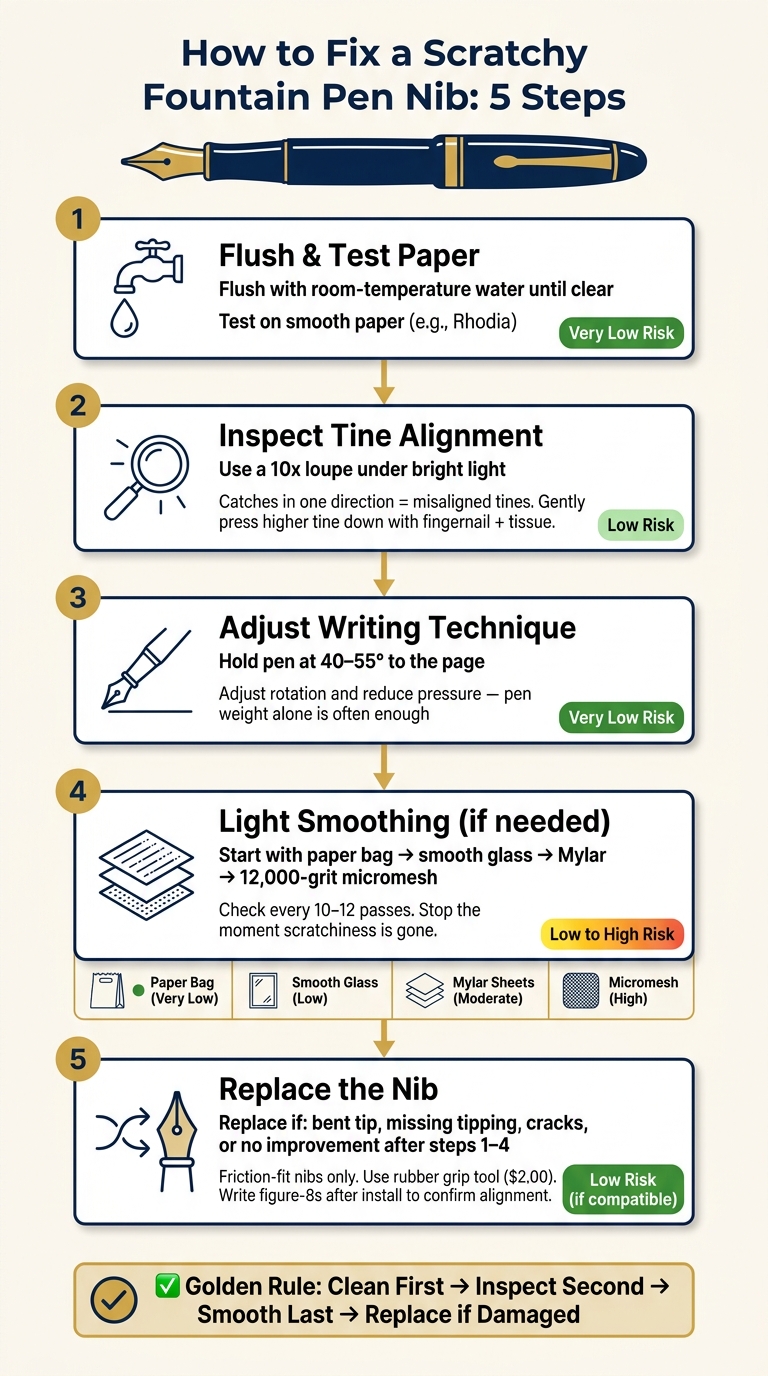
How to Fix a Scratchy Fountain Pen Nib: 5-Step Guide
How to smooth a scratchy fountain pen nib
sbb-itb-1dd4fe9
Steps 1 and 2: Rule Out Easy Causes and Inspect the Tines
Start with the simple stuff: cleaning and paper. A scratchy nib often has nothing to do with tine adjustment. Sometimes the problem is old ink, debris in the feed, or paper that makes a decent nib feel rough.
Step 1: Test Better Paper and Flush the Pen
Before you assume the nib is the issue, flush the pen with clean, room-temperature tap water. Keep going until the water runs clear. If you have a bulb syringe, use it. It makes the job easier and does a better job of pushing out dried ink or debris stuck in the feed. Start with water. Reach for pen flush only if residue won’t budge.
After cleaning, test the pen on a smooth, fountain-pen-friendly paper like Rhodia. This matters more than people think. Bad paper can make a good nib feel scratchy fast. If the rough feel disappears on better paper, you’ve probably found the cause.
If the pen still feels scratchy on good paper, move on to the tines.
Step 2: Check Tine Alignment
Use a 10x loupe to inspect the tines and feed (found in a fountain pen tuning kit). Hold the clean, dry nib under bright light and see if both tines sit at the same height. Then look at the tipping points and make sure they’re level too.
Misaligned tines usually feel scratchy in one direction, not all directions. If the nib catches on rightward strokes, the left tine is likely lower. If it catches on leftward strokes, the right tine is likely lower. Also check that the feed is centered under the nib. An off-center feed can create uneven pressure and feel a lot like tine misalignment.
How to Make Small, Safe Tine Adjustments
If one tine is clearly higher than the other, press the higher tine down gently with a clean fingernail. Put a small piece of tissue between your fingernail and the metal so you don’t mark the finish.
Go slowly. Make one small change, then test on paper right away. Write a few light strokes in each direction:
- up
- down
- left
- right
- diagonals
That quick check tells you whether the catch is getting better or not.
Do not smooth a misaligned nib. Align first, smooth later.
If the tines are aligned and the pen still drags, the next problem is technique, not repair.
Steps 3 and 4: Correct Writing Technique and Smooth the Nib
Step 3: Adjust Angle, Rotation, and Pressure
If alignment isn't the problem, look at how you're holding the pen. Most fountain pens for beginners write best at a 40–55 degree angle to the page. A more upright, ballpoint-style grip can make the nib dig into the paper fibers.
Rotation trips up a lot of people. It's easy to roll the pen a little to the left or right without noticing. When that happens, only one side of the tipping material touches the page, and that edge can catch. Try turning the pen a few degrees in each direction as you write. If it feels smooth at one angle but scratchy when rolled left or right, you've found the sweet spot.
Go light on pressure. In most cases, the pen's own weight is enough. Pressing down can spread the tines and make the nib feel scratchy. If the nib still catches after that, move on to the gentlest smoothing options.
Step 4: Start with Gentle Smoothing Methods
Begin with a paper bag. If the nib needs just a little more help, try a smooth piece of glass. In both cases, use very light pressure and hold the pen at your normal writing angle. Check the nib after every 10 to 12 passes.
When Advanced Abrasives Carry More Risk
Mylar sheets work well for final polishing, while 12,000-grit micromesh removes material fast and can ruin a nib if you overdo it. These tools are better for people who know when to stop the moment the scratchiness disappears.
| Method | Risk Level | Best Use Case |
|---|---|---|
| Paper Bag | Very Low | Mild smoothing and removing minor feedback |
| Smooth Glass | Low | Extremely gentle smoothing without removing metal |
| Mylar Sheets | Moderate | Final polishing to achieve a glassy writing feel |
| Micromesh (12,000-grit) | High | Correcting significant scratchiness; removes material quickly |
Stop as soon as the scratchiness is gone.
If smoothing doesn't fix the nib, stop there and replace it.
Step 5: Decide Whether to Replace the Nib
If cleaning, alignment, better technique, and gentle smoothing still didn't solve the problem, it's time to check for structural damage. At that point, trying to save the nib can do more harm than good. Sometimes the best move is simple: stop repairing and replace it.
Signs the Nib Should Not Be Repaired at Home
After cleaning, alignment checks, and light smoothing fail, inspect the nib under a loupe for structural damage.
A bent tip is a clear stop sign. The same goes for missing or chipped tipping material at the very end of the nib. Without that tipping, smoothing can wear through the bare metal fast. Cracks or creases in the nib body also fall into the do not repair at home category. And if the nib is still scratchy after you've cleaned it, checked alignment, and adjusted your technique, there's probably a structural problem that smoothing won't solve.
There's another issue here: every pass on an abrasive surface makes the nib a little broader. A fine nib can turn into a medium or even a bold nib during the process. So if you've already gone through several sessions with no change, replacement is the more practical choice.
If you spot any of these problems, stop and move to replacement.
How to Replace a Compatible Nib
Many pens use a friction-fit nib and feed, which means the parts are held in place by friction. Only remove nibs that are clearly friction-fit. If needed, use a rubber grip tool, hold the nib and feed together, and pull them straight out with steady pressure. The exact steps depend on the pen model, so check your pen before taking anything apart.
To install the new nib, slide the replacement nib and feed in so the nib stays centered over the feed channel. Once it's seated, write a few figure-8s to make sure the tines stayed aligned during installation. Test the pen right away after installation.
Low-Cost Nib Replacement Options
For steel nibs, replacement is often faster, cheaper, and safer than repeated repair attempts. Fountain Pen Revolution offers affordable replacement nibs. A rubber grip tool for safe nib removal costs $2.00.
If you find any of these damage signs, replace the nib.
Conclusion: How to Prevent a Scratchy Nib Going Forward
Once the nib is smooth, the goal is simple: keep doing what worked. Clean the pen on a regular basis, keep it capped when you're not using it, and use a light grip so the ink keeps flowing the way it should.
It also helps to use fountain-pen-friendly paper and avoid rotating the pen as you write. Every so often, take a quick look at tine alignment before a small problem turns into that scratchy feel again. If you have a loupe, check the nib now and then to spot tine drift early.
FAQs
How do I know if my nib is misaligned?
Inspect the nib head-on under 10x magnification in bright light. If one tine sits higher than the other, the nib is likely misaligned. You can also hold it up to a light source to check whether the slit is centered and whether the tines meet evenly.
Another common clue is a scratchy feel or snagging in certain writing directions. You can also lightly drag the nib across your fingernail to check for unevenness.
Can smoothing make my nib broader?
Yes. Smoothing takes off a tiny bit of metal each time the tipping material rubs against an abrasive surface like Micro-Mesh or sandpaper. Over time, that can make the nib write a bit broader.
To keep that from happening, use light pressure, make only a few strokes at a time, and test the nib often. That way, you’re less likely to over-polish the tip or reshape it past the line width you want.
When should I replace the nib?
Consider replacing the nib if the issue sticks around after you’ve made adjustments, or if the nib is physically damaged, like being bent or warped. If the damage is structural, it’s best to let a professional handle it. A DIY fix can do permanent damage.
If the nib needs major smoothing, or you just don’t feel good about adjusting it yourself, a professional repair or a low-cost replacement nib may be the better move. Fountain Pen Revolution offers affordable replacement nibs.