

A fountain pen converter lets you refill a cartridge-style pen from a bottle instead of tossing empty cartridges. If your pen supports one, a converter gives you more ink choices, lower cost per fill, and simple cleaning - though cartridges are still the easier pick for travel and fast swaps.
Here’s the short version:
- What it is: a refillable ink chamber that fits where a cartridge goes
- How it works: it pulls ink through the nib and feed by suction
- Common types: twist, piston, and squeeze
- Typical capacity: about 0.8 mL per fill
- What to check first: whether your pen uses a cartridge/converter system
- Main fit issue: standard international vs. brand-specific converters
- Best reason to use one: bottled ink gives you far more color options
- Best reason to skip one: cartridges are cleaner and easier to replace
Fountain Pen Converters Explained: Types & Filling Methods
While converters are the most common way to use bottled ink, some enthusiasts prefer to fill an eyedropper pen for maximum ink capacity.
sbb-itb-1dd4fe9
Quick Comparison
| Option | Refillable | Ink source | Upfront effort | Ink choices | Best for |
|---|---|---|---|---|---|
| Converter | Yes | Bottled ink | A bit more work | Many more options | Home, desk use, trying different inks |
| Cartridge | No | Prefilled cartridge | Very low | More limited | Travel, fast refills, low-maintenance use |
One key detail: not every cartridge-style pen takes the same converter. Some use standard international parts, while brands like Pilot, Lamy, and Sailor often use their own fit. So if you want to avoid leaks or a bad fit, I’d check the pen model before buying.
What a Fountain Pen Converter Is
A converter is a refillable ink reservoir that fits inside a cartridge-compatible pen.
The big draw is simple: you can use it again and again. Instead of tossing an empty cartridge, you refill the converter from a bottle of ink. That makes it a smart long-term add-on for a cartridge-compatible pen. It also opens the door to bottled ink, which gives you far more choice than most cartridges.
How a Converter Differs From a Cartridge
A cartridge comes prefilled by the manufacturer, sealed, and ready to pop in. Once it runs dry, you throw it away. A converter starts empty, and you fill it from a bottle whenever needed.
| Feature | Cartridge | Converter |
|---|---|---|
| Ink source | Pre-filled by manufacturer | Filled by user from a bottle |
| Reuse | Discarded when empty | Refillable and reusable |
| Ink selection | Limited to cartridge inks | Wider access to bottled inks |
| Convenience | Faster, cleaner | Slightly more steps to fill |
| Maintenance | Minimal | Periodic flushing needed |
The tradeoff is pretty clear. Cartridges are faster and cleaner. Converters ask for a bit more effort, but they give you access to a much broader range of ink colors and formulas, including many inks sold only in bottles.
Common Converter Styles
Converters use different mechanisms to create the pressure change that pulls ink upward. The most common types are twist, piston, and squeeze converters. Even though they feel different in the hand, they all do the same basic job: create suction and draw ink into the converter.
A twist converter uses a small screw mechanism to move an internal piston and make suction. A piston converter uses a plunging action to pull ink in. A squeeze converter uses a flexible sac: squeeze it, dip the nib, and let go. As the sac returns to shape, it pulls ink up into the converter.
Which one you use depends on your pen and what kind of filling feel you like. At the end of the day, that pressure change is what makes the whole thing work.
How Converters Draw Ink From a Bottle
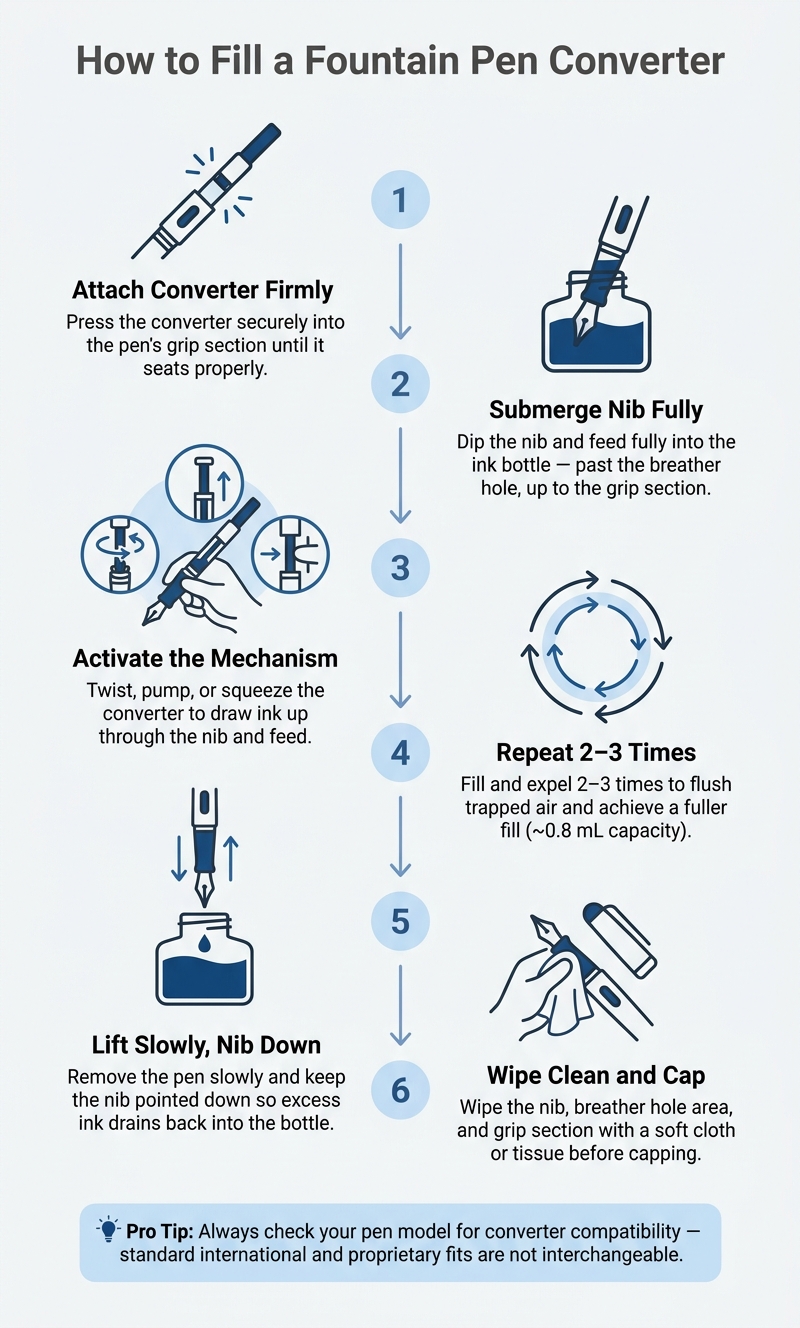
How to Fill a Fountain Pen Converter: Step-by-Step Guide
The ink path is pretty simple: bottle → nib and feed → converter reservoir. When you work the converter, it changes the air pressure inside the reservoir and pulls ink up through the nib and feed into the converter chamber. Once you start writing, the feed channels control how the ink moves to the nib.
Basic Filling Steps
A clean, full fill usually comes down to a simple routine. First, attach the converter firmly to the pen’s grip section. Then submerge the nib and feed fully in the ink bottle, past the breather hole and usually up to the grip section. If the nib and feed don’t go deep enough, the converter may pull in air instead of ink, which can leave you with only a partial fill.
With the nib fully under the ink, work the mechanism - twist, pump, or squeeze - to draw ink into the converter. Many people repeat the fill cycle once or twice in the same session to cut down on trapped air and get more ink into the chamber. Fountain Pen Revolution specifically recommends filling and emptying the converter two or three times to flush the feed and achieve a more complete fill. A standard converter typically holds around 0.8 mL of ink per fill.
When you lift the pen out of the bottle, go slowly and keep the nib pointed down for a moment so extra ink can drain back. Then wipe the nib, the area around the breather hole, and the grip section with a soft cloth or tissue before capping the pen.
Cleaning and Flushing a Converter
One of the big pluses of a converter is that routine cleaning is simple. Since the converter pulls liquid in and pushes it out the same way it handles ink, you can flush it with clean water using that same filling motion. No special tools needed. Fill with water, expel it, and repeat until the water runs clear.
This becomes most useful when you’re switching ink colors or cleaning a pen that has been sitting unused. Leftover ink can mix with a new color and make it look muddy, and dried ink in the feed can interfere with flow. A few rounds of flushing help clear both problems and keep the pen writing cleanly.
Which Pens Accept Converters
Before you buy a converter, make sure your pen can use one. Converters only work with cartridge/converter pens. If a pen uses a piston, vacuum, eyedropper, or lever-fill system, it usually doesn't have the connector a converter needs. And even among cartridge-style pens, some models still won't take one.
Standard International vs. Proprietary Fits
When it comes to fit, the part that matters is the connector inside the grip section. The pen's size, weight, or outside shape doesn't tell you much here. Two pens can look almost the same and still need different converters because the internal connector has a different shape or diameter.
If the pen does accept a converter, the next step is figuring out which connector type it uses. Most cartridge/converter pens fall into one of two broad groups: standard international (SI) or proprietary.
SI pens use a common connector spec, so one SI converter can often work across several brands. Proprietary pens use a connector made for a certain brand or even a certain model. In that case, you need the matching converter built for that pen.
| Aspect | Standard International | Proprietary |
|---|---|---|
| Cross-brand compatibility | Works across many brands that follow the standard | Fits only the specific brand or model it was made for |
| Converter availability | Usually easy to find and often more flexible | Limited to brand-specific options |
| Cartridge options | Short and long cartridges are common | Varies by brand and model |
Pilot, Lamy, and Sailor usually use proprietary converters. Kaweco and Faber-Castell commonly use standard international. That said, the exact fit still comes down to the specific pen model.
How to Check Compatibility Before Buying
Start with the product page. Check for the exact converter model or wording that says the pen uses a cartridge/converter filling system. Phrases like accepts standard international cartridges and converters are a good sign. If the listing names a converter outright, like Pilot CON-40 or Lamy Z28, that tells you what to buy.
One small warning here: don't try to force a converter that doesn't fit. That's a good way to crack the section or end up with leaks.
Why Choose a Converter and When Cartridges Make More Sense
Once you’ve confirmed the fit, the next call is simple: more ink options or more convenience. In plain English, it’s bottled-ink freedom versus cartridge ease.
Reasons Writers Prefer Converters
The biggest draw is ink choice. Bottled ink opens the door to far more colors, including shading inks, shimmer inks, and offbeat tones that almost never show up in cartridge form. If you like matching ink to a project, a notebook, or even your mood that day, a converter gives you a lot more room to play.
There’s also the cost side. Bottled ink usually costs less per milliliter, and a reusable converter can cut long-term spending and waste. You can also fill a converter only partway, which is handy when you want to test a new ink or keep mess to a minimum.
When Cartridges Are the Better Choice
Cartridges make more sense when speed and simplicity matter more than color choice. Swapping one out takes seconds. No bottle. No paper towels. No cleaning gear. That’s a big plus when you need a fast refill and want to get back to writing.
They’re also a good fit if you don’t use the pen often, especially for those starting out with beginner-friendly fountain pens. In that case, the extra work of filling and flushing a converter may feel like more trouble than it’s worth.
A lot depends on your routine: how often you refill, how often you clean, and whether you carry the pen with you.
Conclusion: Choosing the Right Filling Method for Your Pen
The best filling method comes down to how you write day to day.
A converter gives a compatible pen the freedom of bottled ink and can cut long-term cost. That matters most if you refill often and want more ink colors and brands to choose from.
The one step you can't skip is fit. Some pens use proprietary converters, so check the exact model before you buy. If the converter doesn't match, it may not install the right way. And if the seal isn't tight, you can end up with leaks or uneven ink flow. If you encounter issues, there are several quick fixes for a pen not writing to get it back in order.
At that point, the decision is pretty simple: convenience or flexibility. A converter makes sense for writers who want more ink options and don't mind a slightly more hands-on refill. Cartridges are the better choice for travel, fast swaps, or anyone who wants the cleanest refill with the least fuss.
A lot of writers do both. They use a converter at home or at their desk, then keep a cartridge nearby for travel or those just-in-case moments.
FAQs
Can any fountain pen use a converter?
No. Converters are made for fountain pens that support cartridge systems.
That said, compatibility can still vary. Some pens use Standard International converters, while others need proprietary ones. Things like barrel size, connector type, and attachment style matter too, so check your pen’s specs or the maker’s documentation before you buy.
Why is my converter not filling all the way?
Usually, this happens because air gets trapped or the suction isn’t complete. Keep the nib and breather hole fully under the ink the whole time you’re filling.
If you still see air bubbles, gently press the piston until a small drop of ink appears at the nib. Then draw the ink up again. Doing this two or three times will usually help fill the converter to its maximum capacity.
How often should I clean a converter?
Flush your converter with water every 4 to 6 weeks to keep your fountain pen writing smoothly.
You should also clean it well each time you switch ink colors. That helps stop clogs and leftover residue from building up inside the pen.
A simple cleaning routine helps maintain steady ink flow and keeps your pen in good shape.