

Twist filling mechanisms are systems used in fountain pens to draw ink into the reservoir using a rotating knob or barrel section. These designs are popular for their ability to hold more ink, their smooth barrel appearance, and their compatibility with bottled inks. They come in three main types:
- Twist Piston Fillers: Use the pen’s barrel as the ink reservoir with a screw-driven piston to control ink flow. Examples include the TWSBI Eco and Pelikan M200.
- Twist-Operated Piston Converters: Removable units compatible with cartridge pens, allowing flexibility for bottled ink use. Common brands include Sailor and Parker.
- Twist Vacuum Fillers: Use a plunger to create suction, filling the pen in a single motion. Notable models include the TWSBI Vac 700R and Pilot Custom 823.
Each type has unique features, but all require proper care, such as regular cleaning, lubrication, and careful handling to ensure long-term reliability. Whether you’re looking for the best fountain pens for beginners or are an enthusiast, these mechanisms offer a reliable way to enjoy the versatility of fountain pens.
TWSBI Fountain Pen Filling Video - Twist piston vs vacuum fill

sbb-itb-1dd4fe9
Types of Twist Filling Mechanisms
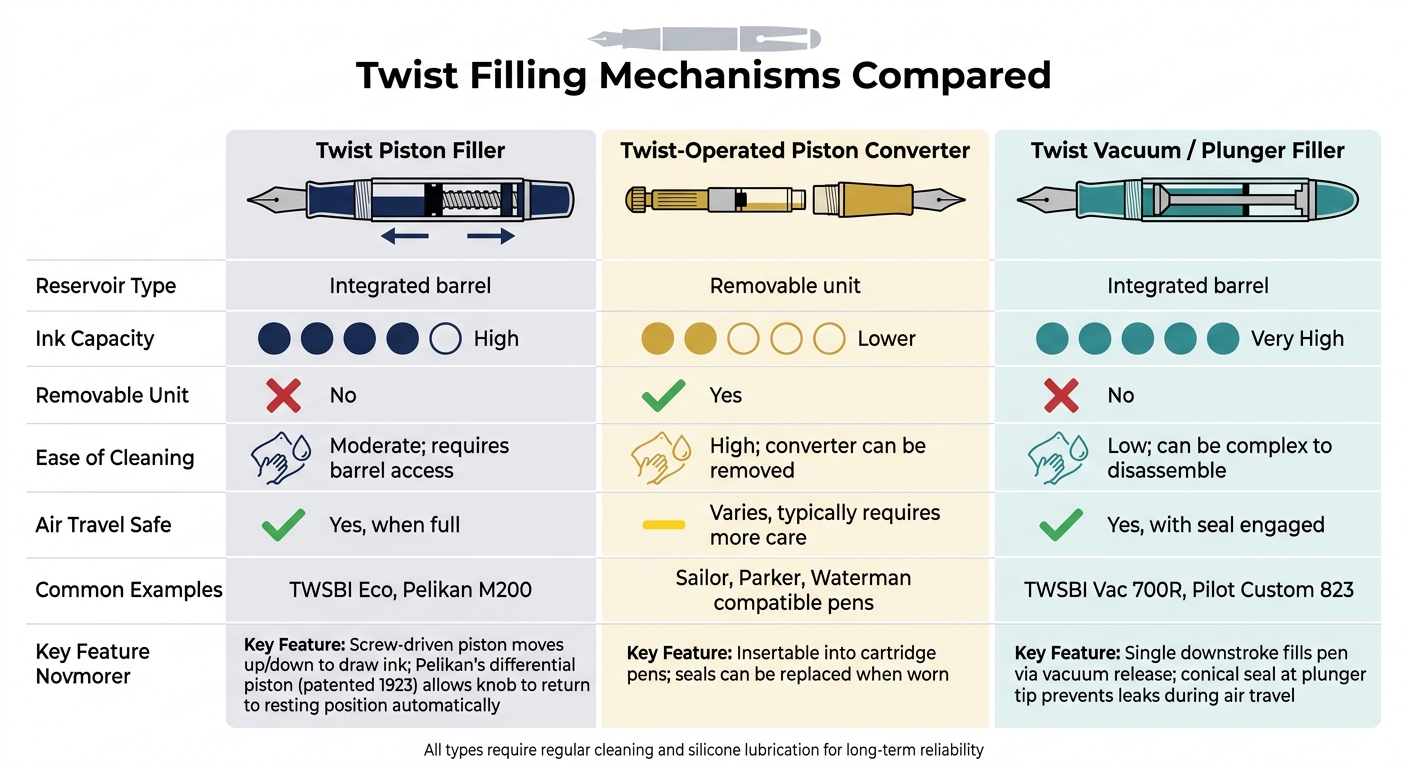
Twist Filling Mechanisms Compared: Piston vs. Converter vs. Vacuum
There are three main types of twist filling systems, each with a unique method for drawing ink.
Twist Piston Fillers
This mechanism uses the pen's barrel as the ink reservoir. Inside, a screw-driven piston moves up and down to control ink flow. By twisting the knob counterclockwise, the piston pushes air out of the barrel. Twisting it clockwise creates suction, pulling ink into the reservoir.
"The piston mechanism is the most common mechanism in modern non‐cartridge pens." - Captain Chang
A good example of this design is the TWSBI Eco, where the twist knob activates the piston directly. A standout innovation in this category is Pelikan's differential piston system, patented in 1923 by Theodor Kovàcs. Introduced in 1929, this system allows the knob to return to its resting position as the piston retracts, making the filling process smoother and more efficient.
Twist-Operated Piston Converters
Piston converters work similarly to integrated piston fillers but are removable units. These converters can be inserted into pens designed for cartridges, enabling the use of bottled ink without altering the pen permanently. This design also allows for easy replacement when seals wear out. Brands like Sailor, Parker, and Waterman produce pens compatible with these converters.
Twist Vacuum and Plunger Fillers
Vacuum fillers use a long metal rod with a plunger head to create suction. Twisting the blind cap releases the rod, allowing you to pull it back and push it down. On the downstroke, the plunger creates a partial vacuum in the barrel. When it reaches a slightly wider section near the end of its travel, the vacuum releases, and external air pressure forces ink into the pen in a single, quick motion.
"A piston plunger in the barrel creates a partial vacuum on the downstroke; near the end of the stroke the piston passes into an area of larger diameter, releasing the vacuum so that external air pressure forces ink into the pen." - Richard Binder, Pen Historian and Expert
Popular examples of this design include the TWSBI Vac 700R and Pilot Custom 823. Many vacuum fillers also feature a conical seal at the plunger tip. When the blind cap is tightened, this seal closes off the ink chamber from the feed, making it leak-resistant during air travel when cabin pressure changes.
Here’s a quick comparison of the three mechanisms:
| Mechanism Type | Reservoir | Ink Capacity | Common Examples |
|---|---|---|---|
| Twist Piston | Integrated barrel | High | TWSBI Eco, Pelikan M200 |
| Piston Converter | Removable unit | Lower | Sailor, Parker, Waterman |
| Vacuum/Plunger | Integrated barrel | Very high | TWSBI Vac 700R, Pilot Custom 823 |
Properly maintaining your fountain pen is essential for these systems to function correctly. The next section will provide detailed, step-by-step instructions for using these mechanisms effectively.
How to Use Twist Filling Mechanisms
Preparing the Pen and Workspace
Before you start filling your pen, take a moment to identify the thread direction of the mechanism. Most modern pens follow a standard counterclockwise twist, but some vintage models operate with left-hand threads, requiring a clockwise turn to function. Using the wrong direction can lead to jamming or even cracking the barrel.
"Turning it counterclockwise -- the normal direction for piston‐fillers and pens with blind caps -- will only jam the knob, and if forced, could easily shatter the pen." - vintagepens.com
Look closely at the knob for any directional arrows that indicate the correct way to twist. If no markings are present, gently test a clockwise turn first to avoid damage. To prepare your workspace, set up a clean, flat surface and place a paper towel underneath the pen. This setup helps manage any ink spills, which are common, especially for first-time users.
How to Fill a Twist Piston Pen
Filling a twist piston pen involves a few careful steps. Start by moving the piston forward toward the nib. As Rick Propas, also known as The Penguin, explains:
"Move the piston filling mechanism forward by twisting the knob at the end of the pen to the left."
This action expels any residual air from the pen barrel. Next, fully submerge the nib into your ink bottle. Slowly twist the knob clockwise to retract the piston, drawing ink into the pen. Be sure to keep the nib submerged throughout this process to prevent air bubbles from entering the barrel.
Once the pen is filled, twist the knob slightly to release a few drops of ink back into the bottle. This step helps reduce the risk of leaks caused by over-pressurization.
"When the barrel is filled, let five drops drip back into the bottle." - Rick Propas, The Penguin
How to Fill a Twist Vacuum or Plunger Pen
Vacuum and plunger pens, such as the TWSBI Vac 700R, have their own unique filling process. Begin by unlocking the blind cap - twist it to release and fully retract the plunger rod. Submerge the nib entirely into the ink bottle, then push the plunger down in one smooth motion. As the vacuum seal releases near the end of the stroke, ink will rush into the chamber, filling it almost instantly.
After filling, tighten the blind cap securely. This step engages the conical seal at the tip of the plunger, effectively closing off the ink chamber from the feed. This is especially important if you plan to travel by air, as it prevents ink from being forced out due to cabin pressure changes.
Maintaining Twist Filling Pens
After you've mastered the filling process, keeping your twist filling pen in top shape requires regular maintenance. Proper care ensures smooth operation and consistent ink flow.
Routine Cleaning and Flushing
To prevent ink buildup and clogs, regular flushing is essential. Here's how to do it:
- Twist the knob to compress the internal mechanism.
- Submerge the nib in clean water.
- Release the knob to draw the water in. Wait about 10 seconds for the mechanism to fully reinflate.
- Repeat until the expelled water runs clear.
For vintage twist-fillers with rubber sacs instead of pistons, be cautious when turning the knob:
"How far you turn the knob is a bit of a judgment call -- far enough to wring out the sac, but not so far as to rip it loose."
This delicate balance helps preserve older components.
Lubricating the Mechanism
If the piston feels stiff or gritty, it might need lubrication. Use a small amount of silicone grease - safe for rubber seals and long-lasting. Avoid petroleum-based products like Vaseline, as they can damage the rubber.
To apply silicone grease:
- Fully extend the piston.
- Place a tiny amount (about the size of a grain of rice) on the seal.
- Gently move the piston back and forth to distribute the grease evenly.
If the mechanism still feels rough, soak the pen to remove dried ink from the threads. Never force a stuck piston. As vintagepens.com warns:
"Do not force a stuck piston, as it can damage the screw mechanism or tear the seal."
Instead, soak the nib in water for several hours to soften dried ink before attempting to move the piston.
If these steps don't resolve the issue, check these fountain pen troubleshooting tips for further guidance.
Fixing Common Problems
Here’s a handy table to address frequent issues:
| Problem | Likely Cause | Fix |
|---|---|---|
| Knob won't turn | Wrong direction or dried ink | Check for a directional arrow on the knob; soak in water if needed. |
| Knob doesn't return on its own | High internal friction | Manually return the knob to its original position. |
| Poor ink flow after filling | Air bubble in the feed | Expel a few drops of ink and tap the nib gently downward. |
| Ink leaking from the barrel | Worn piston seal | Re-lubricate with silicone grease; replace the seal if needed. |
| Mechanism feels loose or skips | Over-tightened or stripped threads | Inspect threads; avoid forcing and consult a repair specialist. |
Pay close attention to the direction of the knob, especially with vintage models. Some older pens use left-hand threads, meaning you turn clockwise to operate - opposite of what feels natural. If you're unsure, apply gentle pressure in both directions to find the correct one.
Practical Tips for Twist Filling Pens
Choosing the Right Twist Filling Pen
When choosing a twist filling pen, think about how you’ll use it. If you often write for long periods or plan to take your pen on flights, piston and vacuum fillers are a great choice. They hold more ink than cartridge systems and have sealed ink chambers, which handle air pressure changes better. On the other hand, if you want something easier to clean, a twist-operated converter is a solid option since it can be quickly detached for maintenance.
However, keep in mind that twist fillers using internal rubber sacs can wear out faster. As FountainPen.it explains, "the main defect of this system... was the greater ease with which the rubber tank could break due to the considerable effort imposed on it by the torsion". If you’re looking for a more durable option, modern piston-based designs are a safer bet compared to vintage sac-style mechanisms.
Daily Care and Storage
Once you’ve found the right twist filling pen, proper care and using a fountain pen cleaning kit are key to keeping it in top condition. Store the pen horizontally or with the nib facing up to minimize strain on the seals and reduce the risk of leaks. Avoid exposing the pen to direct sunlight or leaving it in a hot car, as heat can speed up the breakdown of rubber parts. When refilling, always follow the instructions for your specific pen to maintain consistent ink flow and avoid accidental damage.
Twist Filling Pens at Fountain Pen Revolution

If you’re ready to buy or upgrade your twist filling pen, Fountain Pen Revolution offers a range of options to suit different needs. Starter sets begin at $35 and include a pen, ink, and accessories, making them perfect for beginners. For those looking to elevate their writing experience, premium handmade pens start at $44, while the Gold Nib Collection delivers a luxurious touch.
Beyond pens, Fountain Pen Revolution also stocks inks, nibs, pen stands, and cases. This means you can find everything you need to care for and enjoy your pen in one convenient shop.
Conclusion
Key Takeaways
Twist filling mechanisms provide a clean and efficient way to load ink while maintaining the sleek, uninterrupted design of the pen barrel. Whether you’re using a twist piston, a twist-operated converter, or a vacuum filler, these systems make it easy to load bottled ink with precision and control.
Maintaining these mechanisms is simple. Always ensure the nib is fully submerged before turning the knob, and let the reservoir expand completely before use. As vintagepens.com explains:
"How far you turn the knob is a bit of a judgment call -- far enough to wring out the sac, but not so far as to rip it loose."
With consistent care, your twist filling pen will remain smooth and reliable for years to come. Following these basic tips will help you get the best performance out of your pen every time.
Next Steps for Enthusiasts
Start using your twist filling pen with confidence. If you’re looking for the perfect pen to match your style and budget, check out Fountain Pen Revolution. They offer a variety of fountain pens, from beginner-friendly sets to handcrafted premium models. Plus, their selection of inks and accessories ensures you’ll have everything you need to get started right away.
FAQs
Which twist filling system is best for beginners?
The converter system is a popular choice for beginners because it's easy to use and dependable. To fill your pen, simply twist the converter knob to draw ink directly from a bottle. This no-fuss method is less likely to cause problems than more intricate systems, making it perfect for anyone just getting started with fountain pens.
How can I tell which way to twist the knob without damaging the pen?
Look for an arrow on the twist-filler’s knob to show the correct turning direction. Most twist-fillers use a left-hand thread, meaning turning the knob clockwise is usually the way to go. If there’s no arrow, start by gently turning it clockwise. Don’t force the knob - if you feel resistance, stop immediately and try again carefully to avoid causing any damage.
How often should I clean and lubricate a twist filler?
Regular upkeep is key to keeping your twist filler mechanism in top shape. If you use it frequently, aim to clean and lubricate it every 6 to 12 months. This routine maintenance ensures smooth operation and can help prolong the life of your pen.