

Piston filler fountain pens are known for their large ink capacity, smooth operation, and elegant design. Unlike cartridge or converter pens, these pens use a screw-driven plunger system to fill the entire barrel with ink. This guide breaks down the key features of piston fillers:
- Ink Capacity: Holds 2x more ink than standard cartridges, ideal for long writing sessions.
- Filling Mechanism: Twist a knob to draw ink directly from a bottle, ensuring precise and efficient fills.
- Materials: Barrels are often made of resin, acrylic, or premium materials like urushi lacquer. Metal components add durability.
- Maintenance: Regular lubrication with silicone grease keeps the piston running smoothly and prevents leaks.
- Design Options: Transparent "demonstrator" barrels allow ink level monitoring, while compact piston fillers offer portability.
Whether you're new to fountain pens or upgrading, piston fillers combine functionality and style, making them a favorite for daily writing.
Core Design and Mechanics
How the Piston Mechanism Works
The piston filler operates much like a built-in syringe. At the end of the pen's barrel, there's a turning knob connected to a threaded internal rod. When you twist the knob, the rod moves a piston head back and forth inside the barrel, allowing for precise ink filling.
Brian Goulet, Founder of Goulet Pens, explains it this way:
"A type of filling system that uses a retracting plunger inside a sealed tube to draw ink into the pen. A piston filling mechanism can either be screw or push operated, though the screw/twist type is the most common."
This screw-driven design has been a hallmark of high-quality European pens since the late 1930s. It offers both precision and efficiency, ensuring a controlled ink intake while maximizing the pen's capacity.
Ink Capacity and Writing Range
One of the standout features of piston fillers is their ability to hold significantly more ink compared to cartridge or converter pens. Since the barrel itself serves as the ink reservoir, this design allows for a much larger capacity. In fact, a typical piston filler can hold about twice the ink volume of a standard international cartridge. For instance, oversized models like the Pelikan Souverän M1000 can hold up to 1.5ml of ink.
This larger capacity translates into fewer interruptions for refills and ensures a steady ink flow, whether the pen is nearly full or almost empty. However, this performance relies heavily on the quality and maintenance of the piston mechanism.
Seals and Smooth Operation
At the heart of the piston mechanism is the seal, usually made of rubber or silicone. This seal presses tightly against the inner walls of the barrel, creating an airtight environment necessary for drawing ink into the pen.
The condition of the seal plays a big role in how smoothly the piston operates. A well-lubricated seal moves effortlessly, while a dry or worn-out seal can cause resistance or allow air to leak, compromising the vacuum. Applying a small amount of 100% silicone grease to the piston head is a simple fix for stiff movement and can significantly prolong the seal's lifespan.
One important tip: a fully filled piston pen is sensitive to pressure changes caused by heat or altitude. To avoid leaks through the nib, move the piston forward slightly after filling to release about five drops of ink back into the bottle. This small adjustment helps maintain stable performance.
sbb-itb-1dd4fe9
Guide to Piston-Filler Fountain Pens
Materials and Build Quality
The materials used in a piston filler pen play a major role in its performance, durability, and overall feel.
Barrel Materials
The barrel material directly influences the pen's weight, aesthetics, and strength. Most piston fillers are made from resin or acrylic, which are lightweight, crack-resistant, and come in a variety of colors and finishes. For a more distinctive look, some pens feature cellulose acetate barrels, known for their striking depth and classic striped designs, often reserved for higher-end models.
Luxury editions sometimes incorporate rare materials like urushi lacquer or mother of pearl (raden), applied by hand for a collectible finish. A standout example is the Pelikan Souverän M1000 White Ray. Limited to just 400 pieces, this pen features a barrel crafted with Japanese urushi lacquer and white mother of pearl stripes, created in collaboration with skilled raden and urushi artisans. It’s a true showcase of craftsmanship and artistry.
For practical, everyday use, demonstrator barrels made from clear or frosted acrylic offer a functional design. These transparent barrels let you easily monitor the ink level and watch the piston mechanism at work.
Metal Components and Durability
While the barrel provides style and structure, metal components ensure the pen's durability and smooth operation. Brass and stainless steel are commonly used for parts like the piston rod, threading, and nib housing. These materials hold up well under regular use and resist the corrosive effects of ink exposure.
Metal accents also add to the pen's aesthetic appeal. For example, Pelikan pens use specific trim colors to differentiate models: those ending in "0" feature gold-colored trims, while models ending in "5" use silver-colored metals like palladium or rhodium. These silver trims are not only visually appealing but also more resistant to wear compared to standard plating. Such thoughtful details contribute to the longevity and everyday comfort of premium piston fillers, which are designed to last a lifetime with proper care.
Seal and Gasket Design
The seal, a small synthetic ring on the piston head, plays a crucial role in maintaining the ink chamber's airtight integrity. This component ensures the vacuum needed to draw ink into the pen.
"Both items have a synthetic piston head that seals the fluid chamber from the rest of the filling mechanism. This seal is important, as it needs to create a vacuum to draw the ink into the body of the pen." - Goldspot Pens
Over time, seals can dry out or become stiff, so regular maintenance is key. Applying a small amount of 100% silicone grease to the piston head helps keep the mechanism running smoothly and extends the life of the seal. If the piston gets stuck, avoid forcing it, as this could cause damage. Instead, patience and proper lubrication will ensure the pen continues to perform as intended.
Usability Features for Daily Writing
Ink Visibility and Level Indicators
Piston fillers stand out for their practical usability, making them a favorite for daily writing. One standout feature is the translucent ink window often built into the pen barrel. This narrow strip lets you easily check the ink level without disassembling the pen. A classic example is the Lamy 2000, which has used this design since its debut in 1966, earning it a lasting reputation.
Some pens take visibility to the next level with full demonstrator barrels. These completely clear acrylic designs let you see the ink reservoir from every angle. Popular options in this category include the TWSBI ECO and Narwhal Original, both priced in the $50–$60 range. For those who prefer a middle ground, pens like the Pelikan M200 Golden Beryl feature semi-transparent, smoky resin barrels. These allow light to pass through while adding a touch of color.
Because piston fillers use the entire barrel as the ink reservoir, they typically hold more ink than other pen types. High-capacity models, such as the Pelikan Souverän M1000 and Leonardo Momento Magico, can store about 1.5 ml of ink - roughly double the capacity of a standard international cartridge. This means fewer refills and more time spent writing.
Filling and Cleaning the Pen
Filling a piston filler is refreshingly simple. Twist the knob at the end of the barrel to push the piston forward, dip the nib fully into the ink, and then twist the knob in the opposite direction to draw ink into the barrel. After a few tries, the process feels intuitive.
These pens are designed for maximum efficiency, filling the chamber completely. However, this efficiency comes with a caveat: changes in temperature or air pressure can cause ink to leak unexpectedly. To prevent this, it’s a good idea to release a few drops of ink after filling the pen. Rick Propas of The Penguin Pen explains:
"Piston fillers are, if properly set up, 100% efficient... changes in ambient temperature (a room warming up, putting the pen in a warm purse or pocket) and/or changes barometric pressure can cause flooding. For that reason we suggest that after you fill your pen you bleed off a few drops before proceeding."
Cleaning a piston filler is straightforward as well - flush the pen with water until it runs clear. Some models make this process even easier. For instance, Pelikan pens feature a removable nib unit, allowing direct access to the barrel. Similarly, certain Narwhal models let you remove the entire piston mechanism with a wrench for a deeper clean.
These practical features, combined with efficient filling and cleaning, make piston fillers a reliable choice for everyday use.
Grip Comfort and Ergonomics
Comfort is key when it comes to writing for long periods, and piston fillers are designed with ergonomics in mind. Factors like grip shape, barrel diameter, and weight distribution all contribute to ease of use. For example, entry-level models like the Pelikan Classic M200 are lightweight, tipping the scales at just 14 g (≈0.5 oz) and measuring about 12 mm (≈0.47 in) in diameter. This makes them ideal for extended writing sessions without causing fatigue.
On the other hand, larger models like the Pelikan Souverän M800 and M1000 include brass components, which add weight and create a more balanced, substantial feel in hand.
Choosing between gold vs steel nibs also plays a role in comfort. Steel nibs, commonly found in mid-range piston fillers, provide a smooth writing experience suitable for most tasks. Higher-end pens often feature 18kt gold nibs, which are 75% gold. These nibs offer a slight flexibility and responsiveness, reducing hand strain during long writing sessions.
Design Changes in Modern Piston Fillers
Classic vs. Current Designs
In the early days, piston fillers were constructed with cork or latex seals and basic plastic components. While functional at first, these materials often wore out, leading to leaks or stiff mechanisms over time. Modern piston fillers have tackled these shortcomings by using precision-engineered polymers and corrosion-resistant brass parts.
This shift is particularly noticeable in high-end models. Take Pelikan's M800 and M1000 as examples - both use brass piston mechanisms that offer a smoother and more reliable experience compared to the vintage all-plastic systems. As Makoba aptly put it:
"Pelikan pistons are smooth, precise, and durable... mechanisms are designed to last decades."
Another notable improvement is the introduction of demonstrator barrels. Unlike the traditional opaque designs, these transparent barrels let users easily check ink levels and observe the piston in action, blending functionality with visual appeal. These updates also lay the groundwork for better portability, which we'll dive into next.
Compact and Travel-Friendly Piston Fillers
Portability has become a key focus in the evolution of piston fillers. Designers have managed to shrink the overall size of these pens while maintaining their impressive ink capacity. For example, the Pelikan Classic M200 and Souverän M400 models, each about 5.0 inches long when capped and weighing only 0.5 ounces, are compact enough to fit comfortably in a shirt pocket or travel bag.
Despite their smaller size, these pens don't compromise on ink storage. This balance of portability and functionality makes them perfect for everyday use and broadens their appeal to a wider audience.
Affordable Piston Fillers by Fountain Pen Revolution

Piston fillers were once a hallmark of luxury, mostly seen in high-end European brands. That exclusivity has shifted thanks to brands like Fountain Pen Revolution, which now offers piston fillers starting at just $35. These pens combine practical materials with substantial ink capacity, making the once-premium mechanism accessible to beginners and seasoned enthusiasts alike. By lowering the cost barrier, Fountain Pen Revolution has made these advanced designs available to a broader range of fountain pen fans.
Choosing the Right Piston Filler Pen
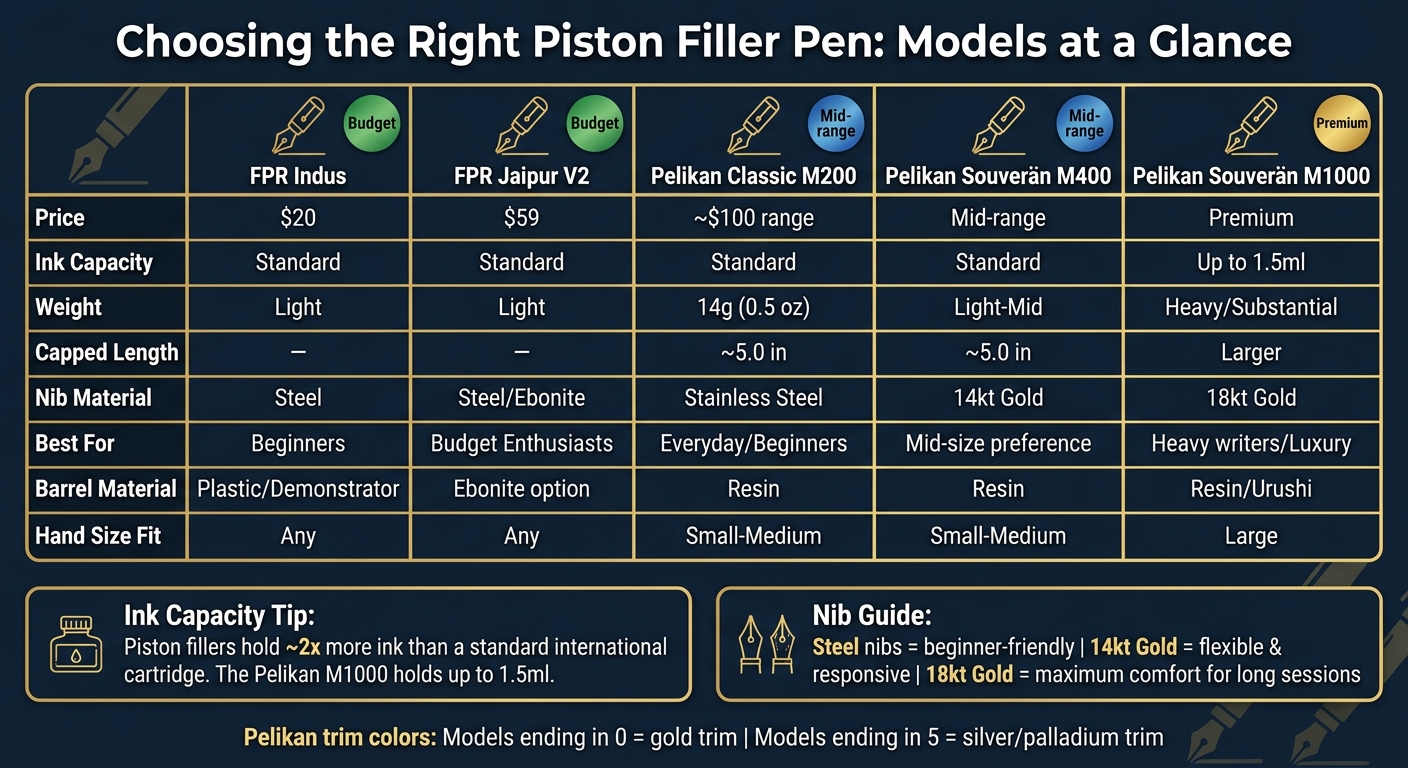
Piston Filler Pen Comparison: Models, Capacity & Key Specs
Key Takeaways
Piston filler pens stand out for their large ink capacity, dependable mechanics, and durability over time. The full-barrel reservoir design not only allows for extended periods of writing but also, in transparent or "demonstrator" models, makes it easy to check ink levels and ensure thorough cleaning after rinsing. The quality of materials plays a big role in the pen's performance, with brass components adding strength and polymer parts contributing to smooth operation. These features align with the design and functionality aspects highlighted earlier.
As Joshua Danley of Pelikan's Perch puts it:
"It is really quite a simple procedure that anyone can do in just a few minutes time."
What to Look for Before You Buy
When narrowing down your options, think about these factors to find the piston filler pen that best suits your needs:
- Size: Pick a pen that feels right in your hand. For example, in the Pelikan Souverän series, the M400 is ideal for smaller hands or those who prefer a lighter pen. The M600 provides a balanced mid-size option, while the M800 and M1000 cater to those who like a heavier, more substantial writing instrument.
- Nib material: The nib plays a key role in the writing experience. Stainless steel nibs, like those on the Pelikan M200, are beginner-friendly and forgiving. On the other hand, 14kt and 18kt gold nibs offer more flexibility and responsiveness, making them a favorite among seasoned writers.
- Budget: Decide how much you’re willing to spend. Fountain Pen Revolution offers affordable piston fillers, such as the FPR Indus for $20 and the FPR Jaipur V2 for $59. These options range from plastic demonstrator models to premium versions with ebonite barrels and feeds, making them a great starting point before committing to a higher-end pen.
FAQs
How do I know if my piston seal needs lubrication?
If your piston feels stiff, resists movement, or is difficult to turn - especially after the pen has been stored with ink for an extended period - it might be time for lubrication. Forcing the piston could damage the mechanism or compromise the seal, so it's best to avoid applying excessive pressure. Using an appropriate lubricant can help bring back smooth and effortless operation.
What ink is safest to use in a piston filler pen?
The best ink choice for a piston filler pen is fountain pen ink specifically made for these types of pens. This ink is carefully designed to avoid reactions with the pen's materials, ensuring smooth operation and helping maintain the pen's durability over time.
Can I fully disassemble a piston filler for deep cleaning?
Yes, piston fillers can be taken apart completely for thorough cleaning. This involves carefully disassembling the pen, servicing its components, and then putting it back together correctly. Using a step-by-step guide is crucial to prevent any damage and to maintain the pen's performance.