

If I want to write more with a fountain pen, the best move is simple: pick one short routine and repeat it at the same time each day. That is the big idea here.
This piece breaks fountain pen writing into 7 easy routines:
- Morning pages for clearing my head
- Ink testing notes for checking ink, nib, and paper
- Memory writing for life stories
- Scene starts for fiction openings
- One-sentence or list prompts for low-energy days
- Handwriting warm-ups for pen control
- Evening reflection for ending the day cleanly
Most sessions take 5 to 30 minutes. A few can stretch to 40 minutes. The point is not polished writing. The point is showing up, using the best fountain pens for beginners, ink, and notebook often enough that the habit starts to feel automatic.
A few stand-out facts from the article:
- Longhand may help memory work, which is one reason memory prompts can work well by hand.
- One sleep study cited found that writing next-day tasks before bed cut sleep onset by about 9 minutes.
- The lowest-pressure starting points are one-sentence/list prompts and handwriting warm-ups.
12 Ways to FILL Your Pen & Ink Journal!
sbb-itb-1dd4fe9
Quick Comparison
| Routine | Best for | Time | Best moment |
|---|---|---|---|
| Morning pages | Mental reset | 15–30 min | Morning |
| Ink testing notes | Pen and ink checks | 5–10 min | Anytime |
| Memory writing | Personal stories | 15–20 min | Anytime |
| Scene starts | Fiction openings | 10–25 min | Anytime |
| Creative writing prompts | Keeping the habit alive | 5–10 min | Any time of day |
| Handwriting warm-ups | Hand control and comfort | 5–15 min | Before other writing |
| Evening reflection | Review and reset | 10–20 min | Evening |
My takeaway: if I am busy, I should start with the smallest repeatable routine. If I have more time, I can add a longer one later.
Below is the full article.
Quick Comparison Table: 7 Prompt Routines at a Glance
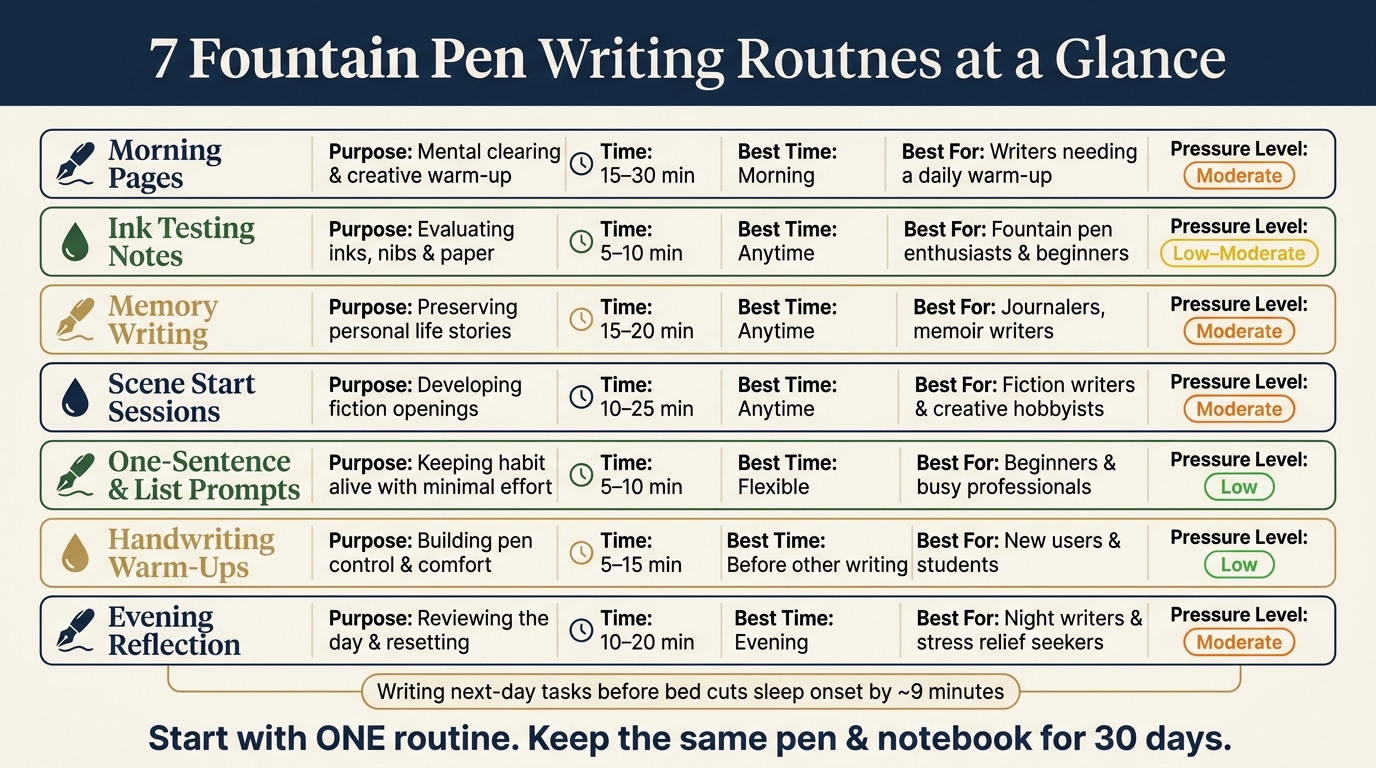
7 Fountain Pen Writing Routines: Quick Comparison Guide
Use this table to line up each routine with your time, experience level, and goal. Then choose one and begin there.
| Routine | Main Purpose | Ideal Session Length | Best Time of Day | Best Suited For | Pressure Level |
|---|---|---|---|---|---|
| Morning Pages | Mental clearing and creative warm-up | 15–30 minutes | Morning | Writers who want a daily warm-up and mental decluttering | Moderate |
| Ink Testing Notes | Evaluating inks, nibs, and paper behavior | 5–10 minutes | Anytime | Fountain pen enthusiasts and beginners exploring gear | Low–Moderate |
| Memory Writing | Preserving personal life stories | 15–20 minutes | Anytime | Journalers, memoir writers, and family historians | Moderate |
| Scene Start Sessions | Developing fiction openings, characters, and story ideas | 10–25 minutes | Anytime | Fiction writers and creative hobbyists | Moderate |
| One-Sentence & List Prompts | Keeping a daily writing habit with minimal effort | 5–10 minutes | Flexible - morning, lunch, or evening | Beginners, busy professionals, and low-energy days | Low |
| Handwriting Warm-Ups | Building pen control and handwriting comfort | 5–15 minutes | Before other writing sessions | New fountain pen users, students, and anyone writing by hand regularly | Low |
| Evening Reflection | Reviewing the day and resetting for tomorrow | 10–20 minutes | Evening | Night writers, gratitude journalers, and stress relief seekers | Moderate |
If you want the easiest way in, begin with the lowest-pressure options.
Pressure level matters most when you're new to this. One-Sentence & List Prompts and Handwriting Warm-Ups are a smart place to start because they're short, simple, and easy to do again tomorrow. If you want a bit more space on the page, Morning Pages and Memory Writing give you more room to think and wander.
Fountain Pen Revolution's affordable pens, nibs, and inks also make it easy to set aside one pen for each routine without a big upfront cost.
1. Morning Pages With Stream-of-Consciousness Prompts
If you want a high-volume routine with almost no editing, start here. Morning pages are a daily writing habit made popular by Julia Cameron in The Artist's Way. The idea is simple: write three pages by hand first thing in the morning. No set topic. No editing. No pressure to sound good. Just move whatever's in your head onto the page.
Best Use Case
This works best as a mental reset before the day picks up speed. It's a good fit if the blank page makes you freeze, if your mind feels crowded in the morning, or if you need a steady warm-up before more focused writing. Keep these pages private, and don't reread them for at least eight weeks.
Suggested Session Length
Three pages usually take about 20 to 40 minutes. If that feels like a lot, start smaller. What matters most is showing up often.
Prompt Style
Morning pages don't need fancy prompts. The whole point is to get the pen moving before your brain starts arguing with you. If you need a nudge, try one of these:
- What is on my mind now?
- What am I avoiding?
- What do I need to remember?
Answer once, then keep going. Write freely. If you hit a wall, write I don't know what to write until the next thought shows up. That's part of the process. Let the page wander.
Ideal Pen-and-Ink Setup
Writing several pages in one sitting calls for comfort and steady performance. A smooth fine or medium nib usually feels best for this kind of routine. Pair it with a fast-drying ink like Noodler's Black so your hand doesn't drag through wet lines, and use a notebook with paper that can handle fountain pen ink without feathering or bleed-through. Fountain Pen Revolution's affordable everyday pens are a solid pick if you want to dedicate one pen to morning pages. In practice, that's the move: keep one dependable pen set aside just for this habit.
Next, shift from freewriting to observation with ink testing notes.
2. Ink Testing Notes With Observation Prompts
An ink testing notes routine gives new samples and bottled inks a job to do. Load a pen, write a few lines, and note what you see. The goal is simple: test the ink, record how it behaves, and turn that into a repeatable note-taking habit. To keep comparisons clean, use the same test sentence, the same page layout, and the same notebook every time.
Best Use Case
This works best when you’ve just received new ink samples, when you’re rotating pens in your collection, or when you want to compare how an ink behaves on standard copy paper versus a nicer notebook paper. It’s also handy for left-handed writers who want to check dry time before putting a new ink into regular use.
Suggested Session Length
10–20 minutes is plenty for most sessions. Write your standard test sentence, add a small swatch, then lightly tap the ink at 5, 10, and 20 seconds to check dry time. If you’re testing several inks, pause between samples and stop before your handwriting starts to slip.
Prompt Style
Skip fuzzy impressions. Use clear observation prompts so your notes stay steady and easy to compare later.
- "Describe this color in three words. Does it lean warm or cool?"
- "Does the ink show shading within a stroke?"
- "At 5, 10, and 20 seconds, does the ink smudge when lightly tapped?"
- "Does the ink feather, ghost, or bleed through the page?"
- "Under bright light, does the dried ink show sheen or color shift?"
If you answer them in the same order each time, you can flip back through your notebook and compare inks side by side without guesswork.
Ideal Pen-and-Ink Setup
Use the same two nib sizes every time so the ink stays the variable, not the pen. Reusing the same page layout helps turn this into a proper daily routine. For paper, stick with one notebook or one paper type.
A dedicated ink testing notebook can make a big difference. One page per ink, plus a running index at the front, turns scattered test pages into a reference you’ll actually use. It also helps to record the date, pen model, nib size, and paper type next to each sample so later comparisons stay clear. Once the test page is done, move from observation to memory.
3. Memory Writing Sessions With Life Story Prompts
After testing ink and paper, shift from observation to memory with one focused prompt. The idea is simple: use one prompt to catch one memory in one sitting. A fountain pen helps here because it slows you down just enough for small details to show up. Harvard Health notes that longhand can activate brain areas tied to short- and long-term memory.
Best Use Case
This fits anyone who wants to record personal history without taking on a full memoir. It’s especially useful during life transitions - a move, a job change, a milestone birthday - when looking back tends to happen on its own.
It also works well for fiction and memoir writers. In a single session, you can pull up scenes, bits of dialogue, and emotional texture that are hard to make up on command. If you want the pages to hold up over time, use archival-friendly ink. And if a memory starts leaning toward dialogue or setting, save that thread for the fiction routine next.
Suggested Session Length
10–15 minutes is a good place to start. That’s usually enough time to get past the surface and reach names, smells, and other concrete details without wearing out your hand.
A simple rhythm helps:
- Spend 2–3 minutes reading the prompt and letting the memory come into focus
- Then write without stopping until the timer ends
- Skip editing and don’t pause to reread
Once the habit feels steady, extend the session to 20 minutes or more.
Prompt Style
The prompts that work best are narrow and sensory. Broad prompts like "write about your childhood" tend to stall people out. Specific prompts give your mind something it can grab.
Try prompts like:
- "Describe a kitchen from your childhood. What did the countertops feel like? What smells defined that space?"
- "Write about the first time you felt truly independent. What small details do you remember - sounds, textures, who was nearby?"
- "Think of someone who quietly influenced your life. Recall one ordinary day with them."
- "Write about a choice that scared you. What led up to it, and how do you see it now?"
A small trick can help: start with "I remember…". That opening often gets you past the part of your brain that wants to plan too much. It also helps to keep a running list of prompts at the back of your notebook, so you’re not stuck wondering what to write about next time.
Ideal Pen-and-Ink Setup
For longer sessions, comfort comes first. A lightweight pen with a medium or broad nib needs less pressure, which makes writing easier over time. Wet-writing inks also help during longer sessions.
For color, a dark blue-black or deep blue stays easy to read in any light. Fountain Pen Revolution sells affordable pens, nibs, and inks that can help you build a setup that feels good for this kind of work. Pair that with smooth, fountain-pen-friendly paper that resists feathering and keeps both sides of the page usable.
4. Scene Start Sessions With Fiction Prompts
A scene start session is a focused writing block where you draft the opening paragraphs, or the first page, of a fictional scene and then stop before trying to finish the whole story. The point is simple: practice starting a scene with confidence while getting a feel for how the character enters it, what the setting feels like, what mood is on the page, and where the conflict begins. Use the same four-question checklist each time: Where are we? What does the character want right now? What stands in their way? What changes by the end?
Writing by hand helps keep your attention on the opening itself instead of pulling you into the whole draft. And stopping after the opening makes the routine easy to come back to tomorrow.
That’s what makes this routine useful even on days when one page feels like enough.
Best Use Case
Scene start sessions are a good fit for writers who struggle to get into fiction fast. Instead of mapping an entire story, you draft one opening and stop.
Suggested Session Length
20–40 minutes is a solid range. Spend 5–10 minutes reading the prompt and picturing the scene. Write for 15–25 minutes. Then use the last 5 minutes to jot down one or two notes about what worked.
Once your timing is set, pick a prompt and begin.
Prompt Style
Use prompts that give you a clear situation with built-in tension, setting, or conflict:
- A character receives a letter they were sure would never arrive.
- Write an opening scene in an aging roadside motel at 2:15 a.m. during a severe thunderstorm.
- Start with a character who has just decided to quit - without telling anyone.
Keep 20–30 prompts in the back of your notebook so you can reuse them.
Ideal Pen-and-Ink Setup
A fine or medium nib will keep the page easy to read, while a stub nib can add a little emphasis. Pair it with a reliable, medium-wet ink in a dark, legible color like navy, dark teal, or black. Use 80–100 gsm paper to help cut bleed-through and feathering.
If you want a dedicated fiction pen, Fountain Pen Revolution's affordable fountain pens and nib options are a practical fit.
On days when you want less pressure, switch to short, one-sentence prompts.
5. Low-Pressure One-Sentence and List Prompts
If a full writing session feels like too much, make it smaller. One sentence. Or a short list. That's the whole routine.
The idea is simple: write for about 3 to 10 minutes, then stop. For fountain pen writers, that makes the habit easy to repeat. The limit helps on purpose. You're not trying to produce something polished. You're just getting the pen moving on days when your energy is low.
Best Use Case
This routine works best when time is tight or motivation is running low. It's a good fit for new fountain pen users who want to get used to nib feel and ink flow without committing to long entries. It also suits busy people - professionals, parents, or anyone with a packed schedule - who still want a steady daily habit.
It's also handy during dry spells. A small prompt with a clear boundary can get you past blank-page dread before it shuts the session down.
Suggested Session Length
Aim for about 3 to 10 minutes. On a hectic day, a date heading and one sentence is enough to keep the habit going. On a calmer day, a 3-item list might turn into 10 items if you're in the mood.
Set the minimum at:
- One sentence
- One 3-item list
Prompt Style
The prompts that work best here are sentence starters and short, constrained lists. A few easy ones to use right away:
- One-sentence: Summarize your day in one sentence as if writing a headline.
- One-sentence: Right now I feel ___ because ___.
- Gratitude list: List 3 things you're grateful for today.
- Priority check: If I only accomplish one thing today, it will be…
Keep a prompt list inside your notebook cover. That way, when your mind goes blank, you don't have to invent anything on the spot.
Ideal Pen-and-Ink Setup
For this routine, reliability matters most. You want a pen that starts right away, even after sitting capped for a day or two. A fine (F) or medium (M) steel nib keeps lines neat and easy to read in short entries, especially in smaller notebooks.
Pair it with a fast-drying, well-behaved ink that won't smear when you close the notebook right after writing. That's especially helpful for left-handed writers. Fountain Pen Revolution offers affordable pens and inks, which makes it easy to keep one low-cost, dependable setup just for this routine.
A pocket-size or A5 notebook also helps. The smaller page naturally fits short-form writing and cuts down on that feeling that you need to fill the whole page. If you want a little more time on the page, you can move from this quick start into a handwriting warm-up.
6. Handwriting Warm-Up Pages With Copywork Prompts
When you want a low-pressure routine that still wakes up your hand, use copywork. Copywork simply means copying a short quote, poem line, or sentence from a book by hand. You don't have to come up with anything new. The text does the work for you.
This pairs especially well with fountain pens because it rewards slow, deliberate writing. When you're not busy deciding what to say, you can pay attention to everything else - whether the nib glides or drags, how the ink shades on a broad stroke, or whether your grip has gotten too tight. Think of it as a short warm-up before the main event. It helps you get started, and the writing that follows usually feels smoother. Since the text stays fixed, it's also easy to repeat every day.
Best Use Case
This routine works well at the start of any writing session, especially before journaling, note-taking, or drafting. It's also a practical way to test a newly inked pen before you trust it for a longer entry.
For beginners, copywork takes away the pressure of making up original content while still building pen control and comfort with the nib. For more experienced writers, it's a steady way to settle into a comfortable posture, grip, and writing angle before a longer session.
Suggested Session Length
Aim for 5 to 10 minutes for a daily warm-up. Ten minutes a day builds pen control faster than one long weekly session. Beginners can start with 5 minutes - one short paragraph or a few sentences - and build from there.
If you have a long writing session ahead, 10 to 15 minutes of copywork gives your hand time to loosen up. It also helps you spot any ink-flow issues before they turn into a mid-session headache. If you notice skipping or clogging, it may be time to clean and maintain your fountain pen to restore performance.
Prompt Style
The best copywork prompts are texts you actually like rereading. A single sentence from a favorite novel or a four-line poem excerpt works well for short sessions. Pangrams - sentences that use every letter of the alphabet, like The quick brown fox jumps over the lazy dog - are especially useful because they test the nib across all stroke directions at once.
For a little variety, try copying the same quote in print and then in cursive. It's a simple way to add continuity to the routine without making it feel stale.
Ideal Pen-and-Ink Setup
A medium or broad nib, a smooth-flowing ink, and fountain-pen-friendly paper are enough. Many writers keep one dedicated copywork pen filled with a simple blue or black ink so there are no choices to make before they begin.
Fountain Pen Revolution offers affordable pens, nibs, and inks that make it easy to set up a low-cost, dependable copywork pen. That keeps the routine simple, repeatable, and focused on the pen. Use it before your main writing session for a smoother start.
7. Evening Reflection With Guided Review Prompts
Evening reflection is a short guided review you do at the end of the day - after dinner or right before bed - where you write down what mattered and leave it there. Stick with the same time, the same pen, and the same notebook each night. That consistency helps the habit feel almost automatic. If morning pages help clear your head, evening reflection helps close the day.
This is where fountain pens feel right at home. Writing by hand has a slower pace, and that fits the end-of-day mood. It also gives you a chance to notice how the pen is writing and how your handwriting shifts when you're tired.
Best Use Case
This routine works well for writers who have a hard time switching off at night or who want a simple daily habit with very little pressure. It's also a good fit for beginners because the prompts do most of the work. You don't have to sit there staring at an empty page, trying to figure out what to say.
It also pairs nicely with morning pages as a two-part system: mornings for intention, evenings for review.
Suggested Session Length
Aim for 5–15 minutes. In practice, even 5–10 minutes is enough to wrap up the day and keep the habit easy to repeat.
Prompt Style
The prompts that work best are clear and repeatable. Use the same four each night so the routine becomes second nature:
- Highlight: What was the best part of my day, and why?
- Challenge: What was the hardest part, and how did I handle it?
- Gratitude: Who or what am I most grateful for today?
- Tomorrow: What are my top three priorities for tomorrow?
If unfinished tasks are still bouncing around in your head, write those down too. That simple step can help settle your mind before sleep. In one study, writing worries and next-day tasks before bed shortened sleep onset by about 9 minutes compared with focusing only on what had already been accomplished.
Ideal Pen-and-Ink Setup
Pick a comfortable, reliable fountain pen that writes smoothly without much pressure. A fine or medium nib is often a smart choice because it stays easy to read and gives you good control for quick journaling.
For ink, darker and calmer colors tend to suit the mood - think deep blues, forest greens, or soft purples. Since you'll probably close the notebook soon after writing, use an ink with a dry time that's fast enough to cut down on smearing.
Fountain Pen Revolution's affordable pens, nibs, and inks make it simple to keep a dedicated evening pen ready to go. Next, match each routine to the pen, ink, and paper choices that make it easiest to repeat.
Pen, Ink, and Paper Notes for Each Routine Type
Different routines work better with different nib, ink, and paper pairings. When the setup feels easy, it's much easier to keep writing every day. Use the table below to find the simplest setup that fits each routine.
For long, repetitive sessions, comfort matters more than novelty. A lightweight pen with a fine or medium nib helps cut hand strain, especially when you're writing for a while. Pair it with a reliable ink that flows evenly. For paper, go with 90 gsm or more. Lighter copy paper tends to feather more.
Ink testing is a different animal. Here, you want range. Use broad, stub, and fine nibs so you can see more of how an ink behaves, then compare coated paper with standard paper.
Memory writing tends to work well with a fine to medium nib and archival ink on cream paper with a slight texture. That combo helps keep pages easy to read over time. For scene-start sessions, a wet medium or broad nib helps with fast drafting, while a stub or italic nib is handy for headings and scene labels.
A dedicated entry-level pen makes the one-sentence and list routine cheap and easy to repeat. Match it with a fast-drying ink and a moderately thick notebook to cut down on smudging and bleed-through.
For handwriting warm-ups, a stub nib makes problems with slant and spacing show up right away. That's the whole point of practice. Blue-black or black ink on smooth, lined paper keeps letterforms crisp and easy to check.
Read across each row for the fastest tool match.
| Routine | Nib Type | Ink Style | Paper Weight |
|---|---|---|---|
| Morning pages / Evening reflection | Fine or medium | Reliable ink that flows evenly | 90 gsm+ |
| Ink testing | Broad, stub, and fine (for comparison) | Any - testing properties | Coated (sheen) + standard (feathering) |
| Memory writing | Fine to medium | Warm, muted tones | Cream paper with a slight texture, 90 gsm+ |
| Scene starts / Fiction | Medium, broad, or stub | Moderately saturated; brighter color for edits | Slight texture, 80–90 gsm |
| One-sentence / List prompts | Fine or extra-fine | Fast-drying | 70–80 gsm ruled |
| Handwriting warm-ups / Copywork | Stub or italic | Blue-black or black | Smooth, lined |
Conclusion
The best prompt routine is the one you’ll actually repeat. Small sessions done again and again build fluency and comfort with the pen, and confidence. And when the routine stays fixed, it’s much easier to show up on busy days.
Start with one routine. Keep the same pen and notebook, too, so the habit stays simple. You might go with morning pages, ink testing, or a one-sentence routine, depending on what you want most: reflection, gear testing, or the easiest possible starting point.
Once you’ve picked one, stick with it for 30 days. Do it at the same time each day, like after breakfast or before bed. When it starts to feel automatic, add some variety little by little - maybe reflection on weekdays and a short scene-start or ink testing session on the weekend.
The goal is consistency, not polish. If you want an entry-level pen for that first habit, Fountain Pen Revolution offers everyday fountain pens and accessories.
Pick one routine. Ink the pen. Write.
FAQs
Which routine should I start with?
Start with a routine that feels manageable and low-pressure. Sticking with it matters more than length or complexity.
Good beginner options include:
- Writing for 5 to 10 minutes
- Jotting down a to-do list
- Copying a favorite quote
- Writing a few sentences about your day
The best routine is the one you’ll actually keep doing.
How do I make a fountain pen writing habit stick?
Start small. Set aside 5 to 10 minutes for low-pressure writing, like journaling, making a to-do list, or copying a favorite quote. The goal isn't to write something polished. It's just to make writing feel normal and easy.
It also helps to attach the habit to something you already do. For example, write right after your morning coffee. That way, it starts to feel automatic instead of like one more thing you have to remember.
Keep your pen somewhere visible and easy to grab. Track your progress in a simple way, and put your energy into consistency, not perfection. Missed a day? It happens. Just try not to miss two days in a row.
What pen, ink, and paper setup is best for daily writing?
For a dependable everyday setup, start with an affordable steel-nib fountain pen in a fine or medium nib size. Then pair it with fountain pen-friendly paper in the 80–120 gsm range, which helps cut down on feathering and bleed-through.
Next, pick a well-behaved, fast-drying ink so your writing stays crisp and smudge-free. When you write, hold the pen at a 40–55 degree angle and use a light, relaxed grip. That small tweak can make the pen feel smoother on the page and a lot less fussy.