

I look for 3 things before buying fountain pen ink: safety guidance, pen compatibility, and good results on paper. Start with ink labeled for fountain pens, check the exact formula’s label and Safety Data Sheet (SDS), and try a sample before buying a bottle.
Here’s my fountain pen buying checklist:
- Safety: I check warnings, preservatives, and allergy concerns. “Water-based” and “non-toxic” don’t mean harmless. Odor alone cannot tell me whether ink is safe.
- Pen care: I compare dye, pigment, iron-gall, and shimmer inks by flow and cleanup needs. I also check restrictions for my nib, feed, and filling system.
- Paper performance: I test feathering, bleed-through, show-through, and water resistance on the paper I use. For drying time, I check for smearing at 5, 10, 15, 30, and 60 seconds.
- Handling: I keep ink away from children, pets, food, and eyes, and follow the label’s spill and first-aid instructions.
My rule: <u>check safety claims separately from writing performance</u>. Ink can write well and still be a poor choice for your pen or your handling needs.
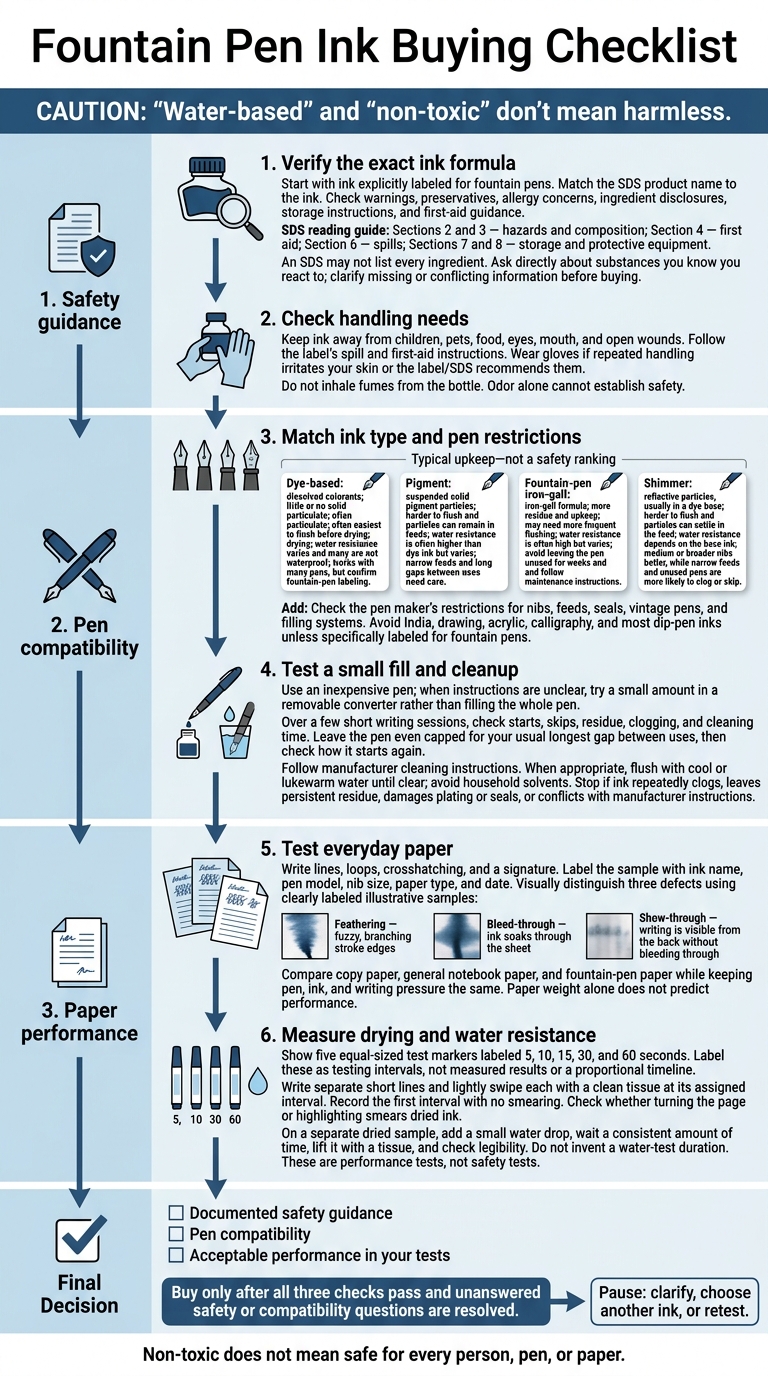
Fountain Pen Ink Buying Checklist
Review Ink Safety Information
Check Ingredients and Safety Claims
After reading the label, check the Safety Data Sheet (SDS) and ingredient disclosures.
Check the full formula - not just one ingredient. Review preservatives, allergy warnings, storage instructions, and first-aid guidance. Ask about any ingredient you know you react to. If details are missing or conflict, get clarification before buying.
| Information or claim | What it establishes | What it does not establish |
|---|---|---|
| Brand claim | What the maker says | What you still need to verify |
| ACMI AP seal | Toxicological evaluation and certification as non-injurious when used as intended | Permission to swallow ink, deliberately inhale it, or apply it to skin; fountain-pen compatibility |
| Safety Data Sheet (SDS) | Hazard, handling, storage, and first-aid information | A complete ingredient list or a guarantee of harmlessness |
| Ingredient disclosure | Potential sensitivity concerns | Proof that the ink is harmless or dangerous |
| Fountain-pen labeling | Fountain pens are the intended use | How the ink flows, cleans up, or behaves in your specific pen |
Make sure the SDS product name matches the ink. Read Sections 2 and 3 for hazards and composition, Section 4 for first aid, Section 6 for spills, and Sections 7 and 8 for storage and protective equipment. An SDS does not have to list every ingredient, so ask directly about any substance you know you react to.
Notice Odor During Use
Do not inhale fumes from the bottle. Smell alone cannot tell you whether ink is safe or dangerous.
If you notice a strong, irritating, solvent-like, or sour odor during normal filling, stop. Cap the bottle, ventilate the area, and contact the manufacturer. If headache, coughing, or dizziness persists, leave the area and seek medical or poison-control advice.
Handle Spills and Accidental Exposure
For ink on skin, remove contaminated clothing or jewelry, then wash with soap and running water. Do not use alcohol, bleach, or solvents to scrub away stains.
Keep ink away from eyes, mouth, food, open wounds, and children. Wear gloves if repeated handling irritates your skin or if the label or SDS recommends them. Stop using the ink if redness, itching, burning, or swelling develops.
If ink gets in your eyes, rinse with clean, lukewarm water for about 15 minutes and follow the SDS first-aid instructions. If ink is swallowed, do not induce vomiting.
For either exposure, contact U.S. Poison Control at 1-800-222-1222. Keep the bottle available and note the amount, exposure time, and symptoms. Call 911 for trouble breathing, seizures, loss of consciousness, or other serious symptoms.
Once the ink passes safety checks, test its flow and cleanup in your pen, then check compatibility with beginner fountain pens and performance on paper.
sbb-itb-1dd4fe9
Choose Ink That Works With Your Pen
Compare Dye, Pigment, Iron-Gall, and Shimmer Inks
Choose ink that fits your pen’s cleaning needs and the upkeep you’re willing to do. Ink type is a maintenance guide, not a safety guarantee. No category works with every pen. Complete the safety checks first, then match the ink to your pen’s feed and cleaning routine.
| Ink type | Particle content | Typical cleaning effort | Water resistance | Compatibility concerns |
|---|---|---|---|---|
| Dye-based | Dissolved colorants; little or no solid particulate | Often easiest to flush before it dries | Varies; many are not waterproof | Works with many pens; confirm fountain-pen labeling |
| Pigment | Suspended solid pigment particles | Harder to flush; particles can remain in feeds | Often higher than dye ink; varies | Check pen suitability; narrow feeds and long gaps between uses need care |
| Fountain-pen iron-gall | Iron-gall formula; more residue and upkeep | May need more frequent flushing | Often high; varies | Avoid leaving the pen unused for weeks; follow maintenance instructions |
| Shimmer | Reflective particles, usually in a dye base | Harder to flush; particles can settle in the feed | Depends on the base ink | Medium or broader nibs work better; narrow feeds and unused pens are more likely to clog or skip |
Choose pigment, shimmer, or iron-gall inks only if you can clean your pen often and thoroughly. Treat these categories as clues about upkeep, not labels that tell you what to buy.
Check Nibs, Feeds, and Filling Systems
Look for explicit fountain-pen labeling and the ink maker’s compatibility statement. Claims such as waterproof, archival, or permanent aren’t enough. Avoid India ink, drawing ink, acrylic ink, calligraphy ink, and most dip-pen inks unless they’re specifically labeled for fountain pens.
Check the pen maker’s restrictions for permanent inks, pigment inks, narrow feeds, vintage pens, seals, and filling systems.
Pick a filling system you can inspect and flush easily. Converters are the simplest option. Piston, vacuum, and eyedropper pens hold more ink but take longer to clean.
If the instructions aren’t clear, try a small amount in a removable converter rather than filling the whole pen. Test each pen-and-ink pairing, including whether the cleaning needs fit your routine. If the pairing looks workable, test a small fill before buying a full bottle.
Clean Before Changing Ink or Storing Your Pen
Use this checklist to help assess compatibility:
- Follow the pen maker’s instructions. Remove cartridges or converters only when permitted.
- Flush thoroughly before switching inks. Use cool or lukewarm water when appropriate, and keep rinsing until the water runs clear.
- Clean removable converters separately when permitted. Use gentle pressure to protect seals.
- Use an approved pen flush only when water isn’t enough and the pen maker permits it. Avoid household solvents.
- Let cleaned parts dry naturally before extended storage.
Test a small fill in an inexpensive pen. Over a few short writing sessions, check starts, skips, residue, clogging, and cleaning time. Leave the pen capped for your usual longest gap between uses, then check how it starts again.
Stop if the ink repeatedly clogs the pen, leaves persistent residue, damages plating or seals, or conflicts with the manufacturer’s instructions.
If the ink flushes out cleanly and the pen starts reliably, move on to paper testing.
Test Ink on Your Everyday Paper
Once your pen passes cleaning and flow checks, test an ink sample on the paper you use every day. This checks performance only.
Check Feathering, Bleed-Through, and Drying Time
Write lines, loops, crosshatching, and a signature. Label the sheet with the ink name, pen model, nib size, paper type, and date.
Check both sides of the sheet. Feathering creates fuzzy, branching edges around strokes. Bleed-through means ink soaks through the sheet. Show-through means you can see the writing on the back, but the ink hasn’t bled through. Record each separately, along with apparent line width, whether the pen starts writing promptly, any skips, and ink flow.
Absorbent paper can spread ink sideways and deeper into the sheet. Broader nibs and wetter feeds put down more ink, while heavy pressure can make the results worse. Use light, normal writing pressure - don’t press harder to force ink flow.
To measure drying time, write separate short lines. Lightly swipe each with a clean tissue after 5, 10, 15, 30, and 60 seconds. Record the first interval when the writing no longer smears. Then check whether turning the page or highlighting smears the dried ink. Once it’s dry, assess shading, sheen, or shimmer if those effects matter for your journal or notes.
For water resistance, put a small drop of water on a separate dried sample. Wait a consistent amount of time, lift the drop with a tissue, and check whether the writing remains legible. This is a performance test, not a safety test; rely on the maker’s safety information for safety claims.
Compare Copy, Notebook, and Fountain-Pen Paper
Keep the pen, ink, and writing pressure the same across all three paper types. Notebook paper varies, and paper weight alone doesn’t predict performance. Use the table as testing guidance, not a guarantee or safety rating.
For double-sided notes, check the back of the sheet carefully. If the results disappoint, change just one variable - such as nib width or paper - before testing again.
| Paper type | Typical feathering | Bleed-through and show-through | Drying behavior | Suitability for wetter inks |
|---|---|---|---|---|
| Copy paper, often 20 lb (75 gsm) | More likely with broad or wet pens | Show-through is common; wet applications may bleed | Often fast because the sheet readily absorbs ink | Limited; test with a fine nib and moderate-flow ink |
| General notebook paper | Low to high, depending on the stock | Thin sheets may show through; bleed-through varies | Varies with absorbency and coating | Test the exact notebook |
| Fountain-pen paper | Usually low | Bleed-through is usually low; thin sheets can still show through | Often slower; some wet combinations take 15–30 seconds | Generally better suited to broad nibs and wetter inks |
Keep your test notes handy when comparing inks before a purchase.
Conclusion: Ink Buying Checklist
Use your safety, pen, and paper notes to decide which ink to buy.
Review Your Findings Before Buying
- Check the label and safety sheet. Read the bottle label, SDS or safety sheet, ingredient disclosures, allergy warnings, spill instructions, and storage guidance before buying.
- Match the cleanup needs to your pen and routine. Confirm the ink type, water resistance, and compatibility with your nib, feed, and filling system. Buy only if you’re comfortable with cleaning and maintaining your pen.
- Review your test notes. Keep manufacturer claims separate from your own odor, stain, and flushing results. If you encounter stubborn residue, a fountain pen cleaning kit can help. Use your feathering, bleed-through, show-through, and drying results as the final performance check.
Resolve any unanswered safety or compatibility questions before buying. An ink should pass all three checks: documented safety guidance, pen compatibility, and acceptable performance in your tests.
Non-toxic does not mean safe for every person, pen, or paper.
FAQs
What if an ink has no available SDS?
If an ink doesn’t have an available Safety Data Sheet (SDS), check that its label clearly states it’s for fountain pens. Skip inks without that labeling. Dip pen, calligraphy, and drawing inks often contain shellac or acrylic binders that can permanently clog your pen’s feed.
If you’re unsure, protect your pen by choosing water-based, pH-neutral, non-toxic inks made specifically for fountain pens.
How often should I clean my pen?
If you write daily, flush your pen every 4–8 weeks or whenever you change ink colors. If you use it occasionally, rinse it every 1–2 months. Pigment-based, iron gall, and shimmer inks need more frequent cleaning: every 1–2 weeks to prevent clogs.
If your pen goes unused for more than a week, clean it before the ink dries. Give it a thorough cleaning before long-term storage. To flush it, use 8–16 fl oz of cool or lukewarm water.
Which ink properties matter for left-handed writers?
Drying time matters most for left-handed writers, whose hands often pass over text they’ve just written. Fast-drying inks help prevent smudges. Drier-flowing inks may also be a better fit because they tend to dry faster and smear less.
Pair faster-drying inks with finer nibs and absorbent paper to help the ink set sooner.