

If your pen skips or feels scratchy, I’d start with tuning. If you want a different line shape, I’d look at a grind. That’s the core split.
Here’s the short version:
- Tuning fixes how the nib writes now
- Grinding changes the nib tip shape for a new writing style
- Tuning is usually the first step
- Grinding is permanent because material is removed
- Wait times vary a lot: some shops list 12–15 weeks, and some backlogs can stretch to 8 months
- At pen shows, some work can be done in 15–30 minutes
If I were choosing between the two, I’d use this rule:
- Pick tuning for hard starts, skipping, scratchiness, or uneven flow
- Pick grinding for stub, italic, architect, or line variation
- If I’m new to fountain pens, I’d start with tuning first
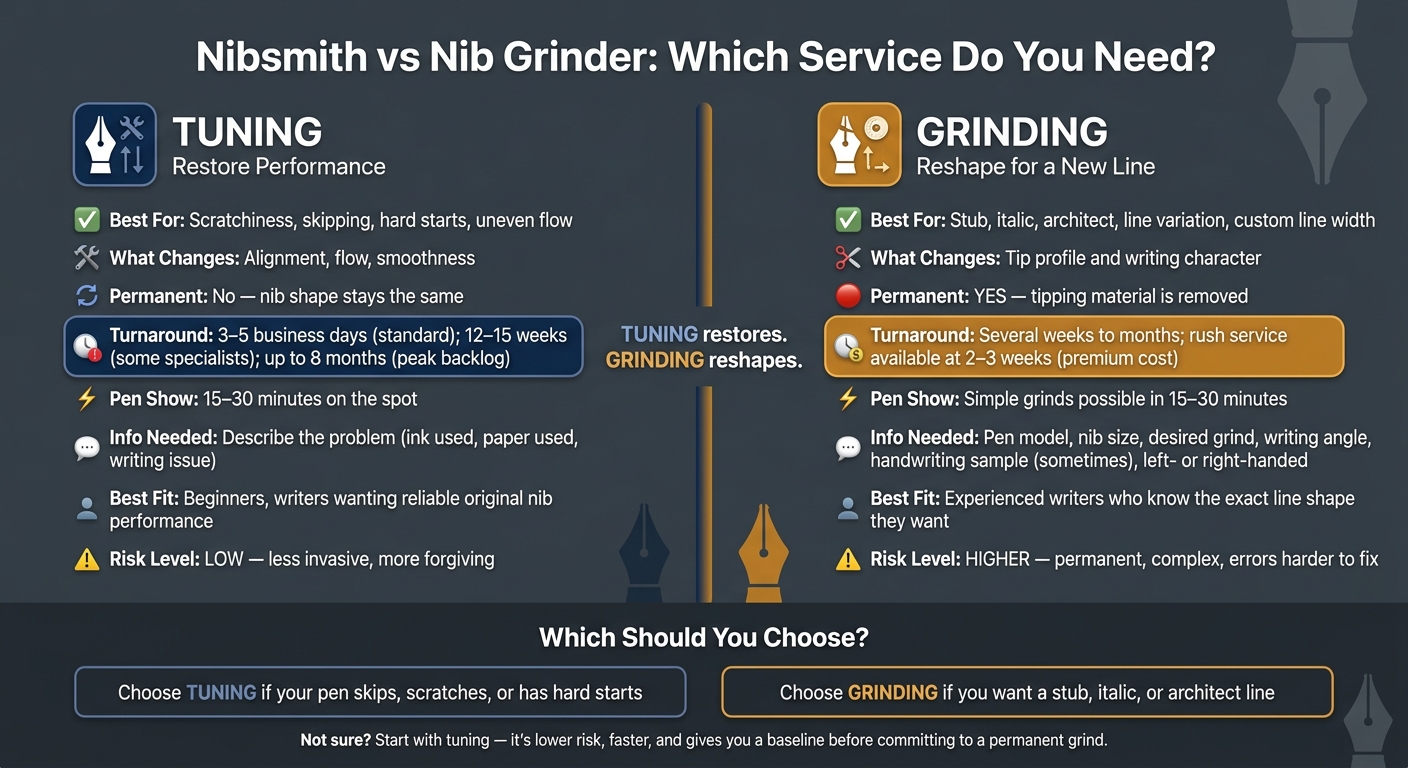
Nibsmith vs Nib Grinder: Which Service Do You Need?
Quick Comparison
| Service | Best for | What changes | Permanent | What I’d share before sending |
|---|---|---|---|---|
| Nibsmith-style tuning | Common performance issues | Alignment, flow, smoothness | No shape change | Writing issue, ink, paper |
| Nib grinder-style work | New line shape | Tip profile and writing character | Yes | Pen model, nib size, grind goal, ideal nib size, writing angle |
The bottom line: tuning restores; grinding reshapes. If I just want the pen to write the way it should, I’d choose tuning. If I already know I want a certain line on the page, I’d choose a grind.
sbb-itb-1dd4fe9
Nibsmith: What a Tuning-Focused Service Covers
Nibsmith is about getting a nib back to the way it was meant to write, not reshaping it into something else. Its main service is Tune & Smooth, which improves how the nib writes without changing the nib’s shape. In plain English, this is the starting point before you move to any work that changes the nib profile.
What Tune & Smooth Fixes
This service usually deals with the problems writers notice right away: scratchiness, uneven ink flow, hard starts, and tine misalignment. You’ll see these issues when a nib snags on the page, skips at the start of a stroke, or puts down ink in a patchy way.
Tune & Smooth keeps the nib’s original line width in place. Because the shape stays the same, non-custom orders, including Tune & Smooth, usually ship in 3–5 business days.
How Tuning Differs From a Full Regrind
Tuning is corrective. A regrind changes the nib itself. With a full regrind, tipping material is removed to make profiles like a stub, italic, or architect.
That difference matters. If your nib feels off, tuning is often the right fix. If you want a different writing style or line shape, that’s when a regrind comes into play. This is the split that sets up the grind-focused service model.
Nib Grinder: What a Grind-Focused Service Covers
Where tuning brings a nib back to proper performance, grinding changes the nib itself. A grind-focused service reshapes the tip to create a certain line width and a certain feel on the page.
Custom Grind Requests and Service Menu
A grind-focused menu may include Tune & Smooth, hard-start repair, and express handling. But the main draw is custom grind work.
This kind of reshaping changes the nib's form and line character to produce profiles like a stub, italic, or architect.
How to Communicate a Custom Grind Request
Custom work depends on the exact nib, so the request needs to be clear and specific. Start by email and include:
- your pen model
- nib size
- desired grind
That gives the service enough detail to confirm whether the work can be done and send a quote before anything starts.
Tuning vs Grinding: Key Differences Side by Side
Once you know what each service changes, the difference becomes pretty clear. Tuning fixes how the nib performs. Grinding changes the nib’s shape.
Comparison Table: Tuning vs Grinding
| Factor | Tuning | Grinding |
|---|---|---|
| Primary goal | Alignment, flow, and smoothness for the existing nib design | Reshape tipping to change line profile and character |
| Tipping material removed | Minimal - alignment and polishing only | Moderate to significant - permanent shape change |
| Common requests | Fix scratchiness, skipping, hard starts, inconsistent flow | Create italic, stub, or architect; change line width or variation |
| Best fit | Beginners and writers who want a reliable original nib | Writers who want a specific line shape or variation |
| Risk and complexity | Lower risk, less invasive, requires skillful diagnosis | Higher risk, more complex, permanent, needs detailed input |
Grinding permanently removes tipping material, which makes errors much harder to fix. Tuning is more forgiving because it adjusts alignment and flow, not the nib’s shape.
When a Simple Fix Is Better Than a Shape Change
Most writing issues - scratchiness, skipping, hard starts, and uneven flow - call for tuning, not a new grind. If your pen feels off, the problem is usually performance, not shape.
Grinding makes sense when you want the nib to write in a different way on purpose. For example, if you want bold downstrokes and thin cross-strokes, you need a stub or italic grind. Tuning can make a nib smoother and better behaved, but it can’t create that kind of line variation.
This split also changes turnaround time and the amount of detail you need to give before the work begins.
Turnaround, Communication, and Choosing the Right Service
Turnaround Times and Queue Factors
That gap shows up in turnaround too. In most cases, tuning is faster. Alignment, smoothing, and flow work often take anywhere from a few days to a couple of weeks after the pen arrives. Custom grinds usually take longer because each one is shaped for a specific writer.
The biggest factor is the queue. Some U.S. nib specialists list 12–15 weeks for standard service, while others report backlogs closer to 8 months during busy periods. Some studios offer rush service, which can cut the wait to 2–3 weeks, but you'll usually pay more for it.
If speed matters most, a pen show can be your best bet. Many technicians offer 15–30-minute appointment slots and can handle tuning or simple grinds on the spot.
What to Expect When Communicating Before Work Starts
Turnaround is only one piece of the choice. The intake process matters just as much.
Both tuning and custom grinding need clear communication up front, but they don't ask for the same kind of detail. With tuning, it's usually enough to explain what's going wrong. For example:
- scratchiness
- skipping
- hard starts
- the paper you use
- the ink you use
A custom grind needs more direction. You'll usually need to share the line profile you want, the target width, your usual writing angle, and whether you're left- or right-handed. Some nib grinders also ask for a handwriting sample so they can shape the nib around your natural stroke.
Here's the simple difference: tuning explains a problem; grinding explains a goal.
Before any work starts, the intake conversation should also confirm feasibility, tipping material, expected results, and whether a tune might fix the issue instead.
Conclusion: Which Service Model Fits You
If you're still figuring out what you like in a pen, start with tuning. It's lower risk, faster, and less expensive than a custom grind. It also gives you a clear baseline before you commit to a permanent shape change.
Start with tuning when you want steady, reliable performance. Choose grinding only when you already know the exact line shape you want.
FAQs
Can tuning change line variation?
Yes. Custom nib tuning can change line variation by reshaping the nib tip to create grinds like stub, italic, or architect. Each one changes how the pen meets the page, which leads to thinner and thicker strokes.
Tuning can also adjust flexibility, tine geometry, and ink flow so those line changes feel more even and controlled while writing.
How do I know if my nib can be ground safely?
Start with a careful inspection using a 10x loupe. Check that the tines are properly aligned first, because misalignment is a common cause of writing issues and should be fixed before any grinding.
Grinding removes tipping material for good. It can't be undone, and it may void your warranty. If you don't have experience, a professional is the safest option if you want to avoid permanent damage.
Should beginners get tuning before a custom grind?
Yes. Beginners should usually start with professional tuning before trying a custom grind.
Tuning fixes common problems like misaligned tines, scratchiness, and uneven ink flow. In many cases, that solves most writing issues without removing any material from the nib.
A well-tuned nib is usually more reliable day to day. By contrast, custom grinds often ask for a steady writing angle and even pressure. If you do want some customization, a simple stub grind is often the easier starting point because it’s more forgiving.