

Most fountain pens do not need pen cleaning solution on a set schedule. In most cases, I’d use plain water first and save pen flush for dried ink, stubborn residue, staining, or flow problems that water does not fix.
Here’s the short answer:
- Standard dye-based ink: flush with water every 4 to 8 weeks or when changing ink
- Pigment, waterproof, bulletproof, and iron gall ink: clean every 1 to 3 weeks
- Shimmer ink: clean every 1 to 2 weeks
- If a pen will sit unused for more than 1 to 2 weeks: empty it and flush it before storage
- For normal cleaning: about 5 to 6 water flushes is often enough
- Use pen cleaning solution only after water fails
That’s the big idea: ink type drives the schedule, while use, storage, and pen material change how often I need to step in. A daily-use pen may go longer with no trouble. A pen left sitting can clog fast, even with mild ink.
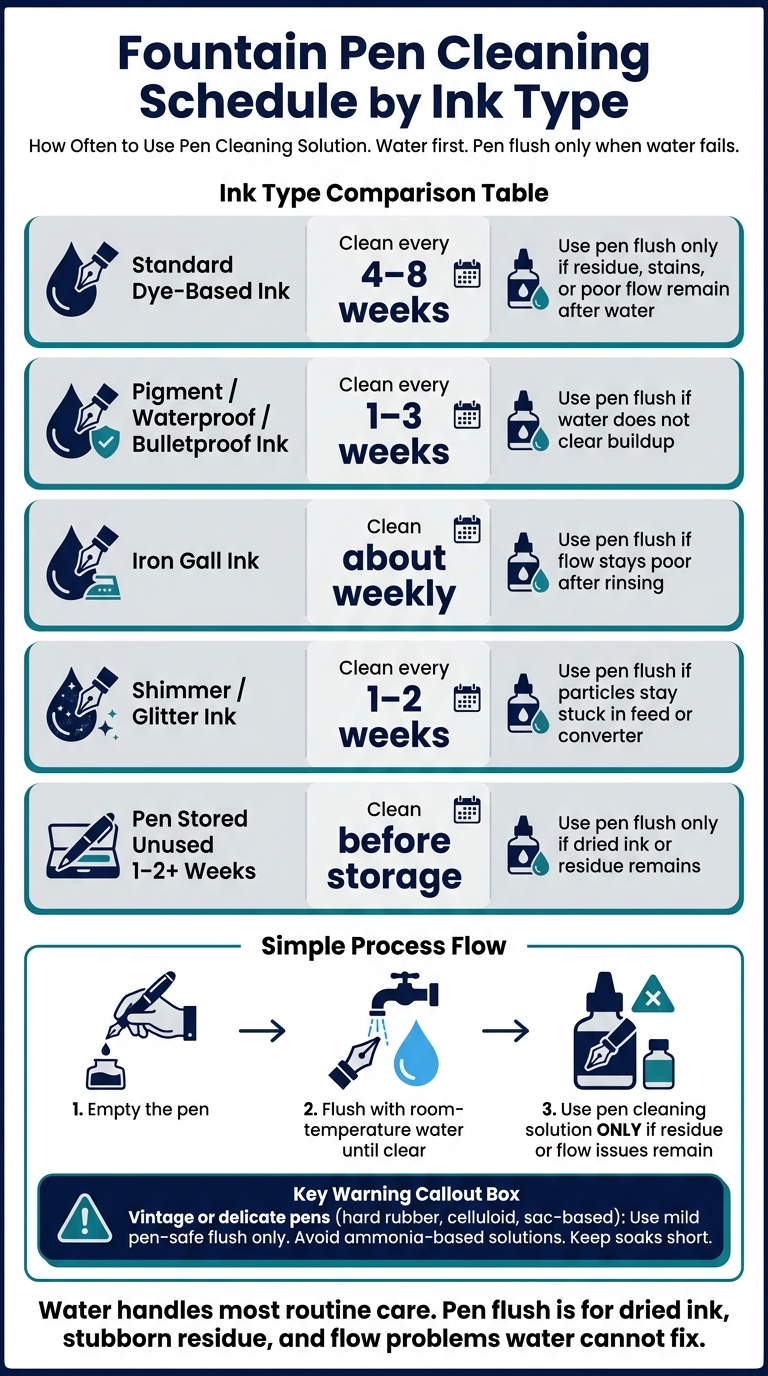
Fountain Pen Cleaning Schedule by Ink Type
How to Clean and Maintain A Fountain Pen - Cartridge, Converter, Piston and Vacuum Fillers
For more details on different filling systems, check out our fountain pen buying checklist.
sbb-itb-1dd4fe9
Quick Comparison
| Ink or situation | Usual cleaning timing | Start with water? | When I’d use pen cleaning solution |
|---|---|---|---|
| Standard dye-based ink | Every 4 to 8 weeks | Yes | If residue, stains, or poor flow remain |
| Pigment / waterproof / bulletproof | Every 1 to 3 weeks | Yes | If water does not clear buildup |
| Iron gall ink | About weekly | Yes | If flow stays poor after rinsing |
| Shimmer ink | Every 1 to 2 weeks | Yes | If particles stay stuck in feed or converter |
| Pen stored unused | Before storage if unused 1 to 2 weeks+ | Yes | Only if dried ink or residue remains |
| Vintage or delicate pen | As needed, gently | Yes | Only with a mild pen-safe flush, and briefly |
Bottom line: I wouldn’t treat pen flush like an every-cleaning product. Water handles most routine care. Pen cleaning solution is for the cases where ink has dried, built up, or started to affect writing.
How often to use pen cleaning solution based on ink type
Ink type sets the starting point. But your writing habits and how you store the pen can shorten that timeline.
Standard dye-based inks: water first, flush only when needed
For most everyday fountain pen inks - standard water-based dye inks - a plain water flush every 4 to 8 weeks is a solid baseline for a pen you use often. You should also flush it whenever you switch inks.
In most cases, water does the job. Reach for pen flush only if water still leaves residue behind, if staining stays in the converter or feed, or if flow issues stick around after a normal water flush.
Pigment, waterproof, bulletproof, and iron gall inks: clean on a tighter schedule
These inks are tougher on pens, so they need more frequent cleaning - usually every 1 to 3 weeks, depending on how much you write. Pigment inks can leave sediment behind as water evaporates. Bulletproof or archival inks are also more likely to leave residue or dry inside the feed faster than standard dye inks.
Iron gall ink needs extra care. A weekly flush with cool water is a safer minimum, and it's smart to check the nib for early signs of corrosion at the same time. If water alone doesn't bring back smooth flow after using any of these inks, pen cleaning solution is the next move.
Shimmer and highly saturated inks: flush occasionally to clear particles
Shimmer inks contain fine metallic or glitter particles that can build up in the feed channels and converter over time. That buildup can happen faster than with standard inks, which is why cleaning every 1 to 2 weeks is a common recommendation for shimmer and glitter inks.
Pen cleaning solution can help loosen particles that plain water won't move, but don't overdo it. Start with water, use pen flush if needed, then rinse until the water runs clear.
How use habits, storage, and pen type affect your cleaning schedule
Daily-use pens vs. pens used occasionally
Ink type sets the starting point. How often you use the pen decides whether that timing still makes sense.
A pen you use every day keeps ink moving through the feed, which slows residue buildup. But a pen that comes out once a week, or even less, tends to dry out much faster. When ink sits still in the feed, it can thicken and leave you with hard starts, skips, or uneven flow, even if the pen hasn't been inked for very long.
If a pen is going to sit unused for more than 1 to 2 weeks, empty it and flush it with water before you put it away. That small step can save you a lot of hassle later. And pay extra attention to snap-cap pens - they usually dry out faster than screw-cap models, so they need checking sooner.
Before storing a pen for more than a couple of weeks
If you're putting a pen away for a longer stretch, clean it first. Empty the pen, then flush it with room-temperature water until the water runs clear. After that, let the pen dry all the way before storage.
If you skip this rinse, leftover ink can dry inside the feed and converter. That's where trouble starts. Use pen flush before storage only when water isn't enough - for example, if you still see residue, staining, or stubborn ink after rinsing.
Vintage or delicate pens need a gentler approach
Older pens need a lighter touch. That includes pens made of hard rubber, celluloid, or early plastics, along with pens that use sac-based filling systems or have plated metal trim.
Strong flushes, especially ammonia-based ones, can fade hard rubber, weaken sacs, and harm trim. So start with plain water every time. If you do need pen flush, use a mild, pen-safe formula and keep the soak short.
And if the pen still has flow problems after cleaning, that usually means it needs a flush, not just another pass with water.
Signs it is time for pen flush and a simple cleaning routine
Flow problems that call for pen flush
When water stops bringing back smooth flow, it's time to step up to pen flush.
Most pens make this pretty obvious. Hard starts are one of the first clues. You uncap the pen, it's full of ink, and still nothing happens right away. That's often a sign that dried ink is stuck in the nib slit or feed channels. Skipping on good paper is another warning sign, mainly if you've already ruled out the paper and your writing angle.
Some signs show up just by taking a close look. If the feed has crusty, flaky, or thickened ink packed between the fins, plain water usually won't clear it out. Same story with a converter that stays cloudy, stained, or gritty after several water flushes. At that point, a pen cleaning solution makes sense.
If a normal rinse doesn't fix the issue, move on to pen flush.
A simple cleaning routine for beginners and regular users
Use the mildest cleaning method that gets the job done.
For day-to-day care, water should be your default. Bring in pen flush only when residue or flow trouble sticks around. Some inks need more attention than others, but even then, pen flush is best saved for stubborn buildup, clogging, or poor flow.
The right order: water first, solution second, rinse thoroughly
Start by emptying the pen. Then flush it with room-temperature water until the water runs clear. Darker inks often need a few more rounds, so don't be surprised if it takes time.
Only after that should you use pen cleaning solution, and only if staining or flow trouble is still there. Run the solution through the nib and feed, then rinse thoroughly with clean water. Do several passes until there's no foam or cleaner left at all.
After that, shake out the extra water, set the parts on a paper towel, and let everything air-dry all the way before you ink the pen again. A good rinse matters here, since any cleaner left behind can affect the next fill.
Conclusion: Use pen cleaning solution only when the pen or ink calls for it
Water covers most day-to-day fountain pen care. If you use standard dye-based inks, a plain water flush will usually do the job. Pen cleaning solution comes into play only when water stops being enough - like when residue won’t budge, pigment or iron gall inks are involved, or the pen sat unused long enough for ink to dry inside the feed.
Your writing habits matter too. Pens you use every day tend to build up residue more slowly, so a water rinse between fills is often all they need. If you use shimmer or heavily saturated inks, you may need cleaning solution a bit more often. Even then, you don’t need it after every fill.
Storage changes things as well. Cleaning before storage should be routine. If a pen is going away for a while, empty it and flush it first so dried ink doesn’t clog the feed later.
Use pen flush only when residue, clogging, or stubborn ink makes water insufficient.
FAQs
Can pen flush damage a fountain pen?
Pen flush is designed to deal with stubborn clogs and dried ink, and it’s usually safe if you use it as directed.
That said, it’s not the right fit for every fountain pen. Some materials, like vintage resins or certain metals, can react badly to chemical cleaners.
Check your manufacturer’s guidelines before you use it. If you’re worried about damage, distilled water with a tiny drop of dish soap is a gentle and effective option for most fountain pens.
Should I clean a pen before every ink change?
Yes. Clean your pen before switching ink colors.
Flush it until the water runs clear. That helps prevent ink contamination, odd color mixing, and possible reactions between different ink formulas.
It also clears out leftover particles that can cause clogs.
How do I know when water is no longer enough?
Water is usually the first thing to try when you clean a fountain pen. But if your pen still skips, lays down ink unevenly, or stays clogged after a water flush, plain water may not do the job.
The same goes for stubborn ink deposits or inks that tend to leave more residue, like pigmented or shimmer inks. In those cases, use a mild mix of distilled water and a tiny drop of dish soap, or reach for a fountain pen cleaning solution made for the job.