

Limited edition pens can increase in value, but it depends on factors like rarity, brand reputation, craftsmanship, and condition. Pens from brands such as Montblanc, Namiki, and Pelikan often hold or grow in value, especially if they are part of small production runs or feature rare materials like Japanese Urushi lacquer. However, most modern pens stabilize or lose value after purchase unless they are discontinued or exceptionally scarce. Key takeaways:
- Rarity matters: Smaller production runs (e.g., 88 pieces) tend to appreciate more than larger ones.
- Condition is critical: Original packaging, certificates, and uninked pens fetch higher resale prices.
- Brand reputation drives demand: Montblanc's Writers Edition and Patron of Art series are prime examples.
- Vintage vs. modern: Older pens generally hold value better, but select modern limited edition pens can defy this trend.
While some pens can command extreme prices (e.g., Montblanc Charlie Chaplin Skeleton 88 sold for $36,000), these cases are rare. For most collectors, the joy lies in the artistry and personal connection rather than guaranteed financial gains.
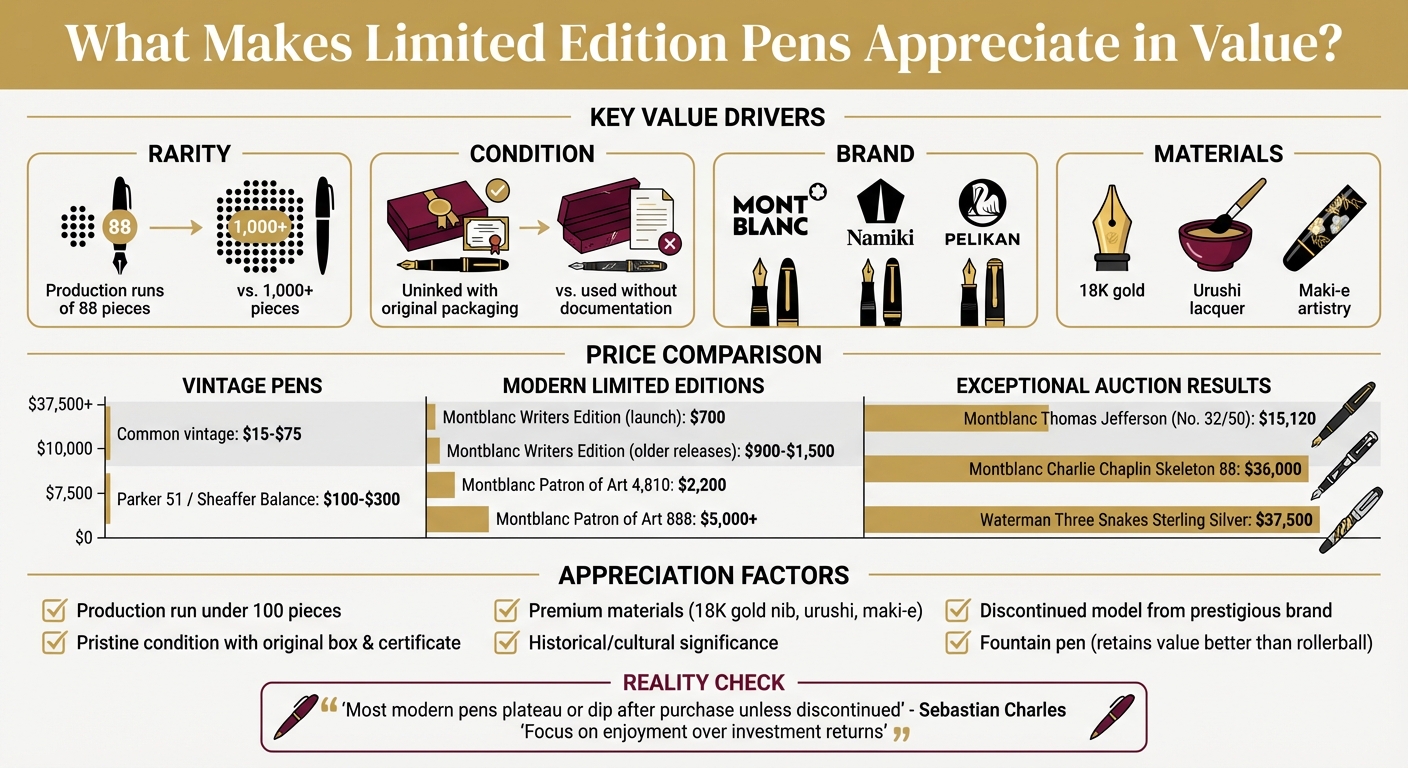
Factors That Determine Limited Edition Pen Value and Appreciation
Top 5 Luxury Pens To Buy Before Prices Explode (2025)
sbb-itb-1dd4fe9
What Determines the Value of Limited Edition Pens
Several factors contribute to the market value of limited edition pens. Understanding these elements sheds light on why some pens appreciate in value while others remain stagnant or even decline.
Exclusivity and Scarcity
The limited production of certain pens sets the stage for their potential to gain value over time. Pens crafted in small batches or from rare materials tend to hold more appeal for collectors. For instance, modern pens rarely see an increase in value unless they belong to a limited edition or feature rare components. The size of the production run plays a direct role in determining both demand and pricing.
Scarcity goes beyond production numbers. Take urushi lacquer, a material commonly found in high-end Japanese pens. Harvesting urushi is a painstaking process - each tree produces just 100–200 ml of sap per season, and only after reaching 10–15 years of maturity. This natural limitation adds to the material's cost, even before any artistic work begins.
The rarity of skilled labor further boosts value. Techniques like maki-e, which involve applying and curing multiple layers of lacquer, require months of work by highly trained artisans. Each pen becomes a one-of-a-kind masterpiece rather than a mass-produced item.
Collectors also place importance on original packaging. Missing elements like presentation boxes, certificates, or even the accompanying ink bottles can significantly diminish a pen's resale value.
While scarcity is crucial, exceptional craftsmanship is another key factor in determining a pen's worth.
Craftsmanship and Materials
The quality of materials and the methods of construction heavily influence a pen's value. High-end materials such as sterling silver, 18K gold, platinum, ebonite, urushi lacquer, and celluloid often justify higher price tags. For example, in December 2013, a Waterman "Three Snakes" Sterling Silver Fountain Pen from the late 19th century, featuring emerald accents, sold for $37,500 at a Bonhams auction in New York, surpassing its $35,000 estimate.
"At the scale of the human hand, a pen's value is all in its details." – Leigh Zagoory, Watches Specialist, Sotheby’s
Artisanal craftsmanship also adds a premium. In September 2021, a Pelikan "Originals of Their Time 1931 - Toledo" limited edition pen (numbered 0808 of 1,100) fetched HK$28,050 at Bonhams Hong Kong. This pen featured a black resin body, a gilded silver barrel with intricate chasing, and an 18K gold nib.
Collectors often prefer pens with classic filling systems - like piston-fill, lever-fill, or eyedropper-fill - over modern cartridge converters, as they provide a sense of historical authenticity.
Brand Reputation and History
While scarcity and craftsmanship build a pen's intrinsic value, a brand's reputation and legacy are what sustain its market appeal.
The prestige of certain brands plays a major role in maintaining long-term value. Pens from Montblanc, Parker, Pelikan, Waterman, Sheaffer, Omas, and Aurora consistently outperform unbranded counterparts. Montblanc, in particular, is often likened to luxury watchmakers like Patek Philippe or Rolex for its market dominance and prestige.
Some models achieve iconic status, ensuring consistent demand over decades. Examples include the Parker 51, Montblanc Meisterstück 149, and Pelikan 400, which are celebrated for their timeless designs.
Thematic collections also attract dedicated collectors. Montblanc's "Writers Edition" and "Patron of Art" series, introduced in 1992, honor cultural and historical figures while maintaining strong resale values. These series blend the allure of storytelling with the prestige of the brand, creating lasting appeal.
"Truly rare vintage examples were hotly contested, and modern limited Montblanc and Namiki pens continue to dominate the pen market." – Ivan Briggs, Director of the Fine Writing Instruments Department, Bonhams
Historical significance can elevate a pen's value far beyond its materials. Pens tied to major historical events, like signing treaties, or those owned by notable figures, carry immense appeal. Additionally, the involvement of master penmakers or renowned artists - such as Sarastro for Montblanc or Shogo for Namiki - adds further value to limited edition pieces.
Do Limited Edition Pens Increase in Value Over Time?
The value of limited edition pens can vary greatly depending on their specific characteristics and the timing of their release. While some pens see their value climb over time, others might hold steady or even decrease. Let’s explore how these trends play out in the world of modern and vintage pens.
Modern Pens vs. Vintage Pens
When it comes to long-term value, vintage and modern pens behave differently in the market.
Vintage pens, particularly those from the early 20th century, tend to hold their value better than modern limited editions. For example, models like the early Parker 51 and Sheaffer Balance often sell for $100–$300, even when they’ve been used.
"Resale prices for modern pens usually plateau or dip slightly after initial purchase unless discontinued." – Sebastian Charles
However, modern limited editions from high-end brands can defy this trend. Take Montblanc’s Writers Edition series, which debuted in 1992. These pens generally sell for about $700 at launch, but older releases now fetch anywhere from $900 to $1,500. Even more impressive is Montblanc’s Patron of Art series. The "4,810" edition, limited to 4,810 pieces, retails at around $2,200, while the ultra-exclusive "888" edition, limited to just 888 pieces, starts at $5,000.
Fountain pens tend to retain value better than rollerballs or ballpoints, largely because of their gold nibs, as opposed to metal-plated tips. This pattern holds true across both vintage and modern markets.
These trends provide a foundation for understanding how collector interest and auction results impact the value of limited edition pens today.
Market Trends and Collector Demand
Both vintage and modern examples highlight how broader market dynamics influence the resale value of limited edition pens.
The fountain pen market in 2025 is described as stable, with a noticeable rise in interest among younger collectors. Millennials, in particular, are fueling a renewed appreciation for handwriting and analog tools, which has boosted demand for both vintage and modern limited edition pens.
"Handwriting is back and surging thanks to millennials." – Sotheby's
Auction results also reveal the heights collector demand can reach. For instance, Montblanc’s Charlie Chaplin Skeleton 88 limited edition, released in 2007, saw Specimen No. 4/88 sell for £27,700 at a Dreweatts auction. Similarly, a 2009 Montblanc Thomas Jefferson edition (No. 32/50) brought in £15,120, while a 2004 Salvador Dali limited edition fountain pen in 18-carat gold (No. 038/100) sold for £10,080.
That said, these standout sales represent the upper echelon of the market. Pens in pristine condition, especially those that remain "uninked" and include their original boxes, certificates, and accessories, tend to command the highest prices. When evaluating a potential investment, following a fountain pen buying checklist can help ensure you don't overlook these critical value factors. Collectors place a premium on completeness and mint condition when bidding at auctions.
Factors That Affect Long-Term Value
When it comes to determining the long-term value of a fountain pen, several factors come into play. While broader market trends and collector interest certainly matter, the pen's specific attributes often hold the key. Two major aspects that stand out are production numbers and the pen's story or historical context.
Production Numbers and Rarity
The rarity of a pen is a major driver of its value. Quite simply, the fewer pens produced, the greater the potential for appreciation. Montblanc, for example, has mastered this concept. Their "Artisan" editions are released in extremely limited quantities, making them some of the most sought-after pens in the collector world. Auction results back this up - pens produced in editions of 30, 50, or 88 pieces consistently outperform larger runs of 1,000 or more.
Handcrafted pens take this rarity a step further. Consider Japanese maki-e pens, which are painstakingly created by a single artist over months. Each one becomes a one-of-a-kind masterpiece. Historical circumstances can also make a pen rare. For instance, the Montblanc Meisterstück no. 134 prototype, produced between 1942 and 1944 during World War II, is incredibly valuable today. Material shortages at the time limited production to just six prototypes, which sold for $8,400–$9,750 at a Bonhams auction in December 2015. Similarly, red lacquer Namiki pens are about 20 times rarer than their black counterparts, with only around 1,500 vintage Namiki pens known to exist - most of which are now in private collections.
But rarity alone isn’t the whole story. A pen's cultural or historical significance can elevate its appeal even further.
Cultural or Historical Significance
A pen’s story or connection to history can give it lasting value beyond its practical use. As Montegrappa Magazine puts it:
"Collecting fountain pens is not limited to writing enthusiasts; these are true pieces of history, tied to the era in which they were produced".
Pens tied to historic events often become iconic collectibles. Examples include pens used to sign World War II surrender documents, the Reagan-Gorbachev nuclear treaty, or major peace agreements. These objects are more than writing instruments - they're pieces of history.
Pens that honor cultural icons also spark immense interest. For example, Montegrappa’s Muhammad Ali edition, adorned with gold and diamonds, or their tributes to Frank Sinatra, have become collector favorites. Literary-themed pens follow a similar pattern. Montblanc’s Writers Edition series, which debuted in 1992 with an Ernest Hemingway model, has seen earlier releases like the Agatha Christie edition rise in value from an initial price of about $700 to over $1,500 on the secondary market.
Anniversary editions add another layer of desirability. Montblanc’s 75th Anniversary 149, introduced in 1999 with a production run of 1,924 pieces, remains highly sought after by collectors. These editions often feature standout materials, such as mother-of-pearl or diamonds, setting them apart from standard models.
Whether through rarity or historical significance, these factors combine to make certain pens timeless treasures for collectors. For those just starting their collection, exploring the best fountain pens for beginners can provide a solid foundation before investing in high-end limited editions.
Investment Potential vs. Personal Enjoyment
The Personal Value of Collecting
Limited edition fountain pens are more than just writing tools - they're a blend of utility and artistry that appeals to both collectors and everyday users. As Dreweatts aptly describes, "A fine pen is an intimate, personal accessory which also performs effortlessly as a writing implement". This combination of functionality and craftsmanship gives these pens a special place among collectibles, setting them apart from items that are purely decorative. With handwriting making a comeback among millennials, these pens offer a unique mix of practicality and nostalgia.
Take, for instance, a Japanese maki-e pen adorned with intricate hand-painted designs, or a Montblanc Writers Edition that pays tribute to a literary legend. These pens often become cherished keepsakes, carrying stories and personal memories. Some even pass down through generations as heirlooms. Unlike the unpredictable ups and downs of market trends, the true charm of these pens lies in their enduring sentimental and everyday value. While personal enjoyment is guaranteed, financial gains are far from certain.
Realistic Expectations for Financial Returns
While some limited edition pens have seen impressive price increases - like the Montblanc Charlie Chaplin Skeleton 88, which fetched around $36,000 at auction in 2007 - these are rare exceptions. As Sebastian Charles points out, "resale prices for modern pens usually plateau or dip slightly after initial purchase unless discontinued".
The pens that do appreciate in value share a few key traits: extremely limited production, flawless condition with all original packaging and documentation, and ties to significant historical or cultural events. However, maintaining their value requires strict care - keeping the pen uninked and ensuring the original box and certificate are intact. Even minor imperfections, such as cracks or ink stains, can significantly diminish a pen's worth, no matter how rare it is.
For most vintage pens, values are modest. Common examples often sell for $15 to $75, while well-maintained mid-century classics like the Parker 51 or Retro 51 fountain pens can range from $100 to $300. As Sebastian Charles wisely notes, "While not every pen will fund a retirement, many deserve more appreciation than they're typically given". For collectors, the real reward often lies in the pens' craftsmanship and personal significance rather than their potential for financial return.
Conclusion
Limited edition pens can gain value over time, though this depends on several factors like the brand's reputation, extreme rarity, use of exceptional materials (such as urushi lacquer or hand-painted maki-e designs), and ties to significant historical or cultural moments. Pens from brands like Montblanc, Namiki, Pelikan, and Montegrappa are often more likely to maintain or even increase in value, especially when they feature rare components and are part of extremely limited production runs. That said, most modern pens tend to stabilize or lose value post-purchase unless they are discontinued or belong to a highly specific limited edition. This dynamic reflects a mix of market trends and the passion of collectors.
The pens that do appreciate in value typically share a few key characteristics: pristine condition with all original packaging and documentation, desirable features like 14K or 18K gold nibs, and a level of rarity that cannot be reproduced. Exceptional examples, such as the Montblanc Charlie Chaplin Skeleton 88 and the Namiki Emperor Maki-e, stand out as rare gems in the world of pen collecting.
As noted by The Fountain Pen is Mightier:
"It is best to focus on how much you enjoy owning and using the pen, rather than seeing it purely as an investment".
At its core, the true value of limited edition pens often lies in their craftsmanship, historical importance, and the personal connection they inspire. Whether you’re captivated by the intricate artistry of Japanese designs or the legacy of a Writers Edition tribute, these pens provide something that financial returns can’t quantify: the pleasure of owning a functional piece of art.
While market trends can guide collectors, the real joy comes from the experience of ownership. If you’re collecting with an eye on value, meticulous care and thorough research are essential to preserving a pen’s worth over time. But above all, choose pens that resonate with you - because while not every pen will turn into a financial windfall, the satisfaction of writing with a beautifully crafted instrument is something money can’t buy.
FAQs
What makes limited edition pens increase in value over time?
Limited edition fountain pens can grow in value when factors like brand reputation, rarity, condition, and collector demand come into play. Pens from top-tier brands such as Montblanc or Parker often maintain their worth thanks to their prestige and craftsmanship. Iconic models like the Montblanc Meisterstück 149 or Parker 51 are particularly sought after.
Rarity is a major factor - pens produced in limited numbers, sometimes only a few hundred or thousand, tend to attract more interest. Collectors are also drawn to pens made with high-quality materials like precious metals, lacquered wood, or 14K/18K gold nibs, which enhance their overall allure.
Equally important are condition and provenance. Pens in mint condition, especially those with original packaging, certificates, or a noteworthy backstory, often fetch higher prices. When these elements align, limited edition pens can see a notable increase in value over time, making them an appealing investment for enthusiasts and collectors alike.
Do modern limited edition pens hold their value compared to vintage pens?
Modern limited edition pens typically hit the market with price tags around $700, but their value can climb over time, sometimes reaching $900 to $1,500 within just a few years. On the other hand, vintage pens, especially those rare or discontinued models from the early 20th century, often fetch much higher prices. Depending on factors like rarity and condition, these vintage treasures can easily sell for well over $1,500, making them prized possessions for collectors.
Why does brand reputation matter when valuing limited edition pens?
Brand reputation is a major factor in the value of limited edition pens. Collectors gravitate toward pens from iconic and respected brands because these names are synonymous with quality and expert craftsmanship. Brands like Montblanc, Parker, Pelikan, and Waterman are particularly prized. Their rich histories and established prestige often lead to higher resale values, making their pens highly desirable.
A well-regarded brand doesn't just drive demand - it also ensures these pens remain appealing over time. This lasting desirability makes them an attractive choice for both collectors and investors.