

When choosing between ink cartridges and converters for your fountain pen, the decision comes down to convenience versus flexibility. Cartridges are pre-filled, disposable, and easy to use, making them perfect for beginners and travel. Converters, on the other hand, allow you to refill from bottled ink, offering more color options and long-term savings. However, not all pens are compatible with every cartridge or converter. Here's what you need to know:
- Cartridges: Simple and portable; available in Standard International (fits many brands) or Proprietary (brand-specific) types.
- Converters: Refillable and cost-effective; also come in Standard International or Proprietary designs.
- Compatibility: Check your pen's specs, as size and fitting type matter. Some pens require specific cartridges or converters.
If you prioritize ease of use, go for cartridges. If you enjoy experimenting with inks or want to save money over time, converters are the way to go. Always ensure the refill system matches your pen to avoid leaks or poor performance.
Ink Cartridges: Convenience and Simplicity
How Ink Cartridges Work
Ink cartridges are pre-filled, sealed containers designed to fit snugly into your pen's feed. When you insert a cartridge, the pen's grip punctures the seal, allowing ink to flow through the feed and nib using capillary action. If the ink doesn’t start flowing right away, hold the nib over some scrap paper and gently squeeze the cartridge until a drop of ink emerges to kickstart the flow. Once the cartridge is empty, simply replace it with a new one.
Cartridge Compatibility
There are two primary types of ink cartridges: Standard International and Proprietary.
- Standard International cartridges are versatile and compatible with numerous brands, including Kaweco, Monteverde, Pelikan, and Visconti. These cartridges come in two sizes: short (about 38mm) and long (approximately 73mm), both sharing the same nipple size. For example, the compact Kaweco Sport only accommodates short cartridges due to its small design.
- Proprietary cartridges, on the other hand, are brand-specific. Companies like LAMY, Pilot, Platinum, Sailor, Parker, and Cross produce cartridges exclusively for their pens. For instance, a LAMY T10 cartridge (5-pack for $4.50) won’t fit a Pilot pen, and vice versa. To avoid compatibility issues, always check the manufacturer’s specifications or consult a compatibility chart before buying refills.
With the basics of compatibility covered, let’s look at when cartridges are the better choice over converters.
When to Use Cartridges
Cartridges shine in scenarios where convenience and quick setup are essential. They’re perfect for portable use, particularly with pocket pens or slim models that don’t support converters. Their sealed design minimizes the risk of leaks, making them ideal for on-the-go writing.
For beginners, cartridges offer a hassle-free experience. There’s no need to worry about messy ink refills or overfilling. Once a cartridge runs out, you simply remove it, rinse the nib section with water, and insert a new one. If you prioritize simplicity and ease of use over experimenting with a wide variety of inks, cartridges are an excellent choice.
Converters: Flexibility and Ink Variety
What Are Converters?
Cartridges might be the easiest way to use a fountain pen, but converters bring versatility to the table. A converter is a refillable device that fits into your fountain pen just like a cartridge. The difference? Instead of being disposable, it lets you draw ink directly from a bottle, making it reusable. Converters typically work with either a piston mechanism (where a twisting or push-pull action moves a plunger) or a squeeze system (which uses a flexible bladder to create a vacuum). This design opens the door to a huge selection of bottled ink colors and brands that cartridges simply can’t compete with.
Converter Compatibility
When it comes to compatibility, converters fall into two categories: Standard International and Proprietary. Standard International converters are designed to fit a wide range of brands, including Benu, Caran d'Ache, Pelikan, and Visconti. They come in a universal size, making them an easy choice for many fountain pens. Proprietary converters, on the other hand, are brand-specific. For example, Lamy pens use the Z27 or Z28 models (priced around $5.40 each), Pilot offers options like the CON-40 or CON-70, and Sailor has its own unique designs.
Some pens even require model-specific converters. Take Kaweco, for instance - most of their pens work with standard converters, but the compact Kaweco Sport needs a specially designed "Sport Piston Converter" to fit its smaller barrel. This variety in compatibility makes it important to double-check your pen’s specifications before buying a converter. A proper match ensures your pen performs as it should.
When to Use Converters
If you love experimenting with ink colors or want a more budget-conscious and eco-friendly option, converters are a fantastic choice. Bottled ink tends to cost less per milliliter compared to cartridges, making it a smart pick for frequent writers. Plus, by eliminating single-use plastic, converters offer a more sustainable way to enjoy fountain pens.
For those who like trying specialty inks from brands like Diamine, Jacques Herbin, or De Atramentis, converters are practically a must. The trade-off? Filling from a bottle can be a bit messy. To fill properly, you’ll need to submerge the nib past the breather hole to create a vacuum, which might leave you with inky fingers. As Goldspot Pens puts it:
You might get inky fingers sometimes when filling your pen using the converter. For pen enthusiasts that truly enjoy the hobby, a little ink on your fingers is a badge of honor.
Ultimately, converters are perfect for those who value ink variety and cost savings over the convenience of pre-filled cartridges.
Fountain Pen Ink Cartridge and Converter Sizes Explained!
sbb-itb-1dd4fe9
Cartridge vs. Converter: Key Comparisons
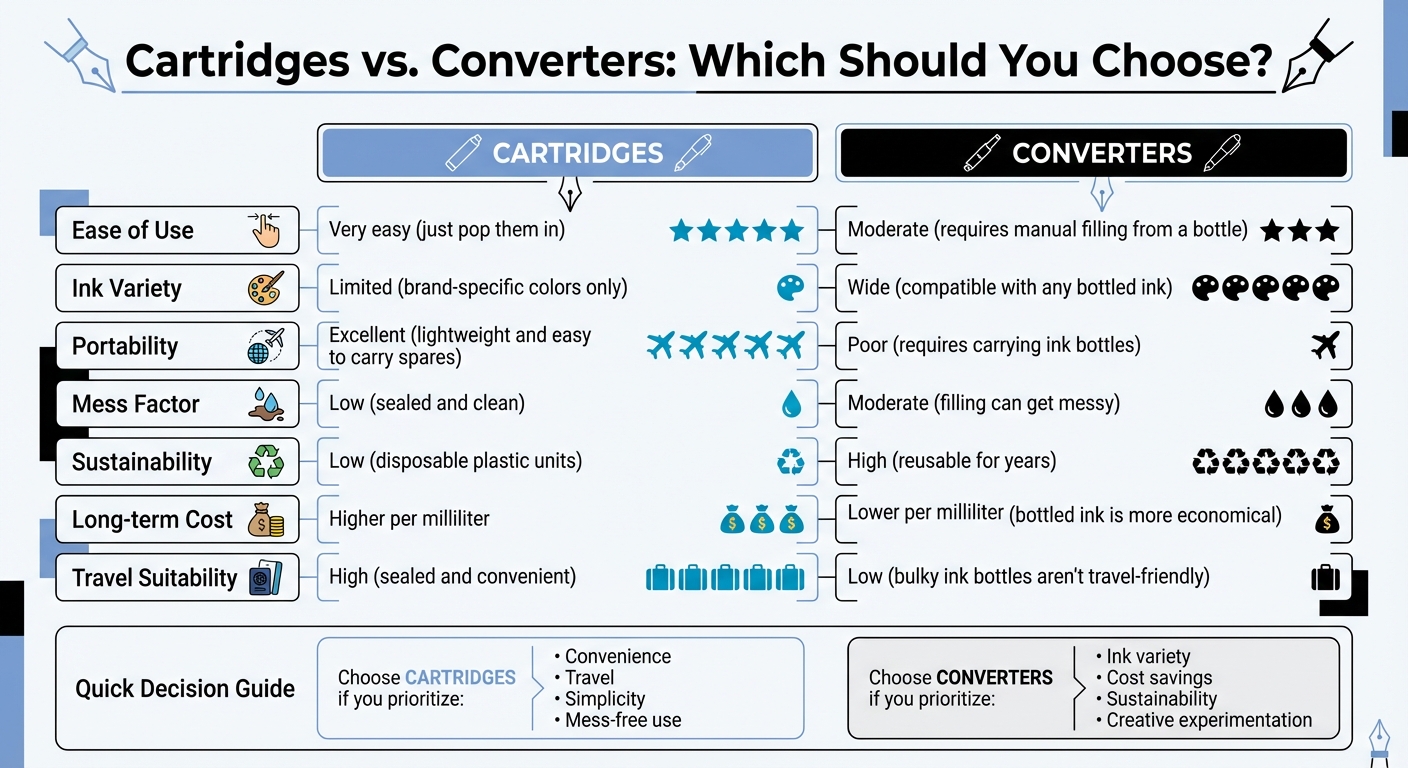
Ink Cartridges vs Converters Comparison Chart for Fountain Pens
Comparison Table: Cartridges vs. Converters
When deciding whether to use cartridges or converters, it’s helpful to compare them across practical factors that impact everyday writing. Here’s a straightforward breakdown:
| Factor | Ink Cartridges | Ink Converters |
|---|---|---|
| Ease of Use | Very easy (just pop them in) | Moderate (requires manual filling from a bottle) |
| Ink Variety | Limited (brand-specific colors only) | Wide (compatible with any bottled ink) |
| Portability | Excellent (lightweight and easy to carry spares) | Poor (requires carrying ink bottles) |
| Mess Factor | Low (sealed and clean) | Moderate (filling can get messy) |
| Sustainability | Low (disposable plastic units) | High (reusable for years) |
| Long-term Cost | Higher per milliliter | Lower per milliliter (bottled ink is more economical) |
| Travel Suitability | High (sealed and convenient) | Low (bulky ink bottles aren’t travel-friendly) |
The differences are clear: cartridges are all about convenience and portability, making them ideal for quick, mess-free use. Converters, on the other hand, open up a world of ink options and are more economical in the long run - perfect for those who love experimenting with different colors and ink properties.
How Compatibility Affects Your Choice
Compatibility plays a critical role when choosing between cartridges and converters. Each pen’s design dictates what refills it can accommodate, so understanding these details is essential. Brands like Pilot, Lamy, Sailor, and Platinum often require proprietary cartridges or converters, which limits your options.
Pen size and barrel design also matter. For example, compact models like the Kaweco Sport need specialized mini converters or shorter cartridges. Even pens that use the Standard International system can vary in cartridge length, so always double-check your pen’s specifications.
Some brands add another layer of complexity with hybrid compatibility. Take Faber-Castell and Waterman, for instance: while they accept Standard International cartridges, they require brand-specific converters for bottled ink. This means you can use universal cartridges for convenience, but switching to bottled ink will involve buying a proprietary converter.
Ultimately, cartridges are the go-to for simplicity and travel, while converters offer creative flexibility and cost savings. Just make sure your choice aligns with your pen’s design to avoid compatibility issues.
Troubleshooting Compatibility Issues
Let's tackle some common refill issues and how to troubleshoot them effectively.
Identifying Your Pen's Requirements
Before buying refills, it's essential to know what works with your pen. Start by checking the brand - some, like Kaweco, Visconti, and Monteverde, often use Standard International fittings, which are interchangeable across many pen manufacturers.
Next, inspect the connector at the back of your pen's grip. If you see threads, your pen likely needs a screw-in converter, not a push-fit one. For smaller pens, regular converters might be too long to fit, so you'll need "mini" or "squeeze" converters designed for compact models. Even within Standard International systems, cartridge lengths vary. For example, longer cartridges like Pelikan Edelstein or Monteverde Magnum may not fit all pen bodies.
Some brands complicate things with hybrid compatibility. For instance, Faber-Castell and Waterman accept Standard International cartridges but require proprietary converters. Others, like Lamy, have multiple converter models - Z27 for Studio/Aion and Z28 for Safari/AL-Star pens. Cross also offers both "Push In" and "Screw In" converters. Always consult your pen's manual, as specific models (like the Sailor Chalana) may need slimmer components than the brand's standard offerings. Knowing your pen's exact requirements is key to avoiding frustration.
Common Compatibility Problems and Solutions
One of the most common issues is attempting to use a Standard International cartridge in a proprietary pen - or vice versa. Forcing a cartridge or converter that doesn’t fit can damage the pen's feed. Instead, double-check compatibility using the brand list above or the manufacturer's documentation.
Another frequent problem is air bubbles disrupting ink flow. To fix this, fully submerge the nib when filling. After the first fill, hold the nib upright, twist the piston to force out air until a drop of ink appears, then submerge it again and refill. Dried ink in the receptacle is another culprit - it can prevent proper seating and cause leaks. If you're struggling to install a cartridge or converter, flush the pen with water to remove any residue.
To avoid these headaches in the future, stick to a consistent maintenance routine.
Maintaining Your Cartridges and Converters
Regular cleaning is essential to keeping your pen in good shape. Flush the pen whenever you change ink colors or if it hasn’t been used for a while. Fountain pen ink is water-based and can evaporate over time, leaving residue that clogs the feed or interferes with the cartridge seal.
To clean your pen, unscrew the grip section and remove the cartridge or converter. Flush the pen with water until it runs clear, using a bulb syringe if necessary. For converters, fill and flush them repeatedly with clean water until no ink remains. After cleaning, press a paper towel against the nib to absorb excess moisture before reinserting the cartridge or converter. If you’re planning to store your pen for a long time, clean it thoroughly instead of leaving it partially filled.
"We suggest you clean and flush your pen when not using them." - Pen Chalet
Conclusion: Choosing the Right Option for You
When deciding between cartridges and converters, think about your pen's design and how you like to write. Cartridges are all about convenience - they're great for travel and quick refills. On the other hand, converters give you the freedom to explore a wide variety of bottled ink colors and offer a more eco-friendly option.
Start by checking whether your pen uses a proprietary refill or a Standard International one. If you're just starting out with fountain pens, cartridges are an easy, hassle-free way to begin. But once you're ready to dive into the world of specialty inks - whether shimmering, vintage, or archival - a converter can unlock a whole new level of creativity.
"In short: cartridges are quick and easy, while converters are flexible and creative." - Ferris Wheel Press
While converters may require a bit more investment upfront, they pair with bottled inks, which are much cheaper per fill and help cut down on plastic waste. Brands like Fountain Pen Revolution offer pens and accessories that work with both systems, making it easier for beginners and seasoned writers to find what suits them best. Take a close look at your pen's specs and the tips shared here to pick the option that matches your needs.
FAQs
How can I tell if my pen uses Standard International or proprietary cartridges?
To figure out whether your pen uses Standard International cartridges or a proprietary system, start by identifying the brand and model. Standard International cartridges generally come in two sizes: short (about 1.5 inches) and long (around 2.8 inches). These cartridges usually feature a push-in or screw-in connector that works with a variety of pens. If your cartridge has an unusual shape or size, it’s probably a proprietary design made specifically for that brand.
You can also check the manufacturer's specifications or refer to a cartridge-converter compatibility guide. This ensures you pick the correct cartridge and avoid any mismatches.
What are the advantages of using a converter instead of cartridges?
Using a converter lets you use bottled ink with your fountain pen, giving you access to a broader selection of ink colors compared to pre-filled cartridges. Plus, converters usually hold more ink, meaning fewer refills and a more budget-friendly, environmentally conscious choice over time.
For those who love fountain pens, converters offer the freedom to try out various ink brands and formulations, making writing feel more personal and enjoyable.
Can I use a converter in any fountain pen that takes cartridges?
Not necessarily. While plenty of fountain pens that take cartridges can also accommodate a converter, some are made specifically for proprietary cartridges that won't work with standard converters. On top of that, some pens have barrels with limited space, making it impossible to fit a converter. It's always a good idea to review your pen's specifications to confirm compatibility before buying.