

Custom nib grinds can transform your fountain pen into a personalized tool for expressive handwriting and calligraphy. By reshaping the nib's tip, a professional nibmeister can create line variations tailored to your writing style, grip, and angle. Here's a quick overview of the main types:
- Stub Grinds: Smooth and forgiving, great for beginners. Produces bold downstrokes and thin cross-strokes.
- Cursive Italic Grinds: Sharper edges for more dramatic line variation. Ideal for precise scripts but less forgiving.
- Architect Grinds: Thin downstrokes and wide cross-strokes, perfect for block lettering or scripts like Arabic.
- Oblique Grinds: Angled nibs designed for writers with natural pen rotation, offering smooth, customized line variation.
- Flex/Spencerian Grinds: Pressure-sensitive nibs for ornate styles like Copperplate and Spencerian. Best for experienced calligraphers.
Prices typically range from $25 to $100 depending on the complexity. Starting with a Stub grind is recommended for beginners, while advanced options like Flex/Spencerian require practice and precision. Custom grinds not only enhance the aesthetics of your writing but also improve comfort and functionality based on your unique needs.
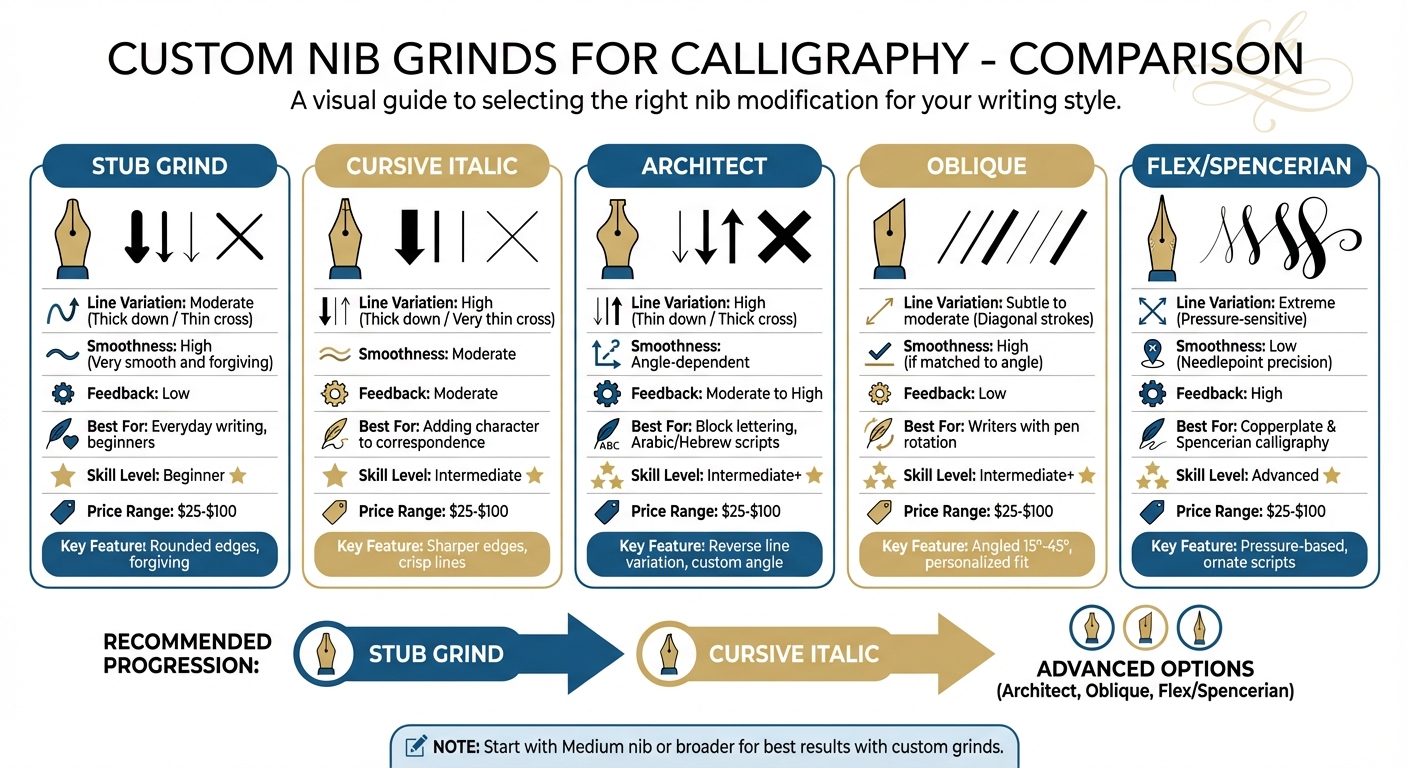
Custom Nib Grinds Comparison Chart for Calligraphy
10+ Custom Nib Grinds You Should Try · Monoline, Waverly, Journaler, Imperial, Sankakusen & More!
Main Types of Custom Nib Grinds for Calligraphy
Custom nib grinds reshape the nib's tip to create unique line variations, making them a key tool for tailoring your pen to specific calligraphy styles. Let’s explore the main types and their characteristics.
Stub Grinds
Stub grinds are a favorite starting point for many calligraphers. By reshaping the nib's round tip into a rectangular shape with rounded edges, this grind produces bold downstrokes and delicate cross-strokes. It's forgiving and smooth, making it a great choice for everyday writing with a touch of calligraphic elegance.
"The stub is the most user friendly of the custom grinds because it imparts some nice variability to the line width while preserving much of the smoothness of the round nib."
- Joshua, The Pelikan's Perch
Stub grinds are also beginner-friendly, allowing slight pen rotations without affecting the writing flow - a perfect way to experiment with line variation.
Cursive Italic Grinds
Cursive italic grinds build upon the stub grind by sharpening the edges. This adjustment creates more dramatic line variation, with thinner cross-strokes and sharper downstrokes, making it ideal for scripts that demand precision and definition. However, the sharper edges mean the nib is less forgiving and may catch on the paper if not held at the correct angle.
"Cursive italic is a good way to lend some character to your writing without sacrificing ease and comfort."
- Rachel, Rachel de la Fuente Blog
This grind is perfect for writers looking to add a refined, crisp finish to their calligraphy.
Architect Grinds
Architect grinds flip the stub grind's effect, creating thin downstrokes and wide cross-strokes. This makes them particularly suited for block lettering and scripts like Arabic or Hebrew. Since these grinds are highly sensitive to writing angle, they are custom-ground to match your grip and writing style.
For the best results, the nib is designed with a "sweet spot", ensuring smooth ink flow when the pen is held correctly. Straying from this spot can lead to scratchiness or inconsistent performance.
"Architect grinds are best ground to your specific writing angle. They are more sensitive to rotation and varying writing angles, so they may not be suited for everyone."
- Damien, All in the Nib
Architect grinds are ideal for those who enjoy bold lettering styles but require a personalized fit.
Oblique Grinds
Oblique grinds cater to writers with a natural pen rotation. The nib is ground at an angle - typically between 15° and 45° - to align with the writer’s grip. For example, a left-foot oblique works well for right-handers who rotate counterclockwise, while a right-foot oblique suits clockwise rotation.
When used correctly, with the angled tip flat on the paper, oblique grinds provide smooth, customized line variation. They combine the benefits of a stub grind with a tailored fit for your natural writing angle.
Flex and Spencerian Grinds
Flex and Spencerian grinds rely on pressure sensitivity to create dramatic line variation. Applying pressure on downstrokes spreads the nib tines apart, producing wider lines, while releasing pressure returns the nib to a fine point. This technique is essential for ornate scripts like copperplate and Spencerian.
Spencerian grinds, in particular, modify semi-soft 14k gold nibs to enhance flexibility and achieve an ultra-fine needlepoint finish. These grinds have gained popularity, with videos like Nibs.com’s Spencerian nib demonstration garnering millions of views. However, their delicate nature makes them more suitable for experienced calligraphers.
Most custom grinds require starting with a Medium nib or broader to ensure enough tipping material for visible line variation. The extra material allows nibmeisters to craft more pronounced effects.
Each of these grinds offers a distinct writing experience, helping you find the perfect match for your calligraphic needs.
Why Use Custom Nib Grinds for Calligraphy
Custom nib grinds can transform the way you approach calligraphy. While standard round nibs produce consistent, uniform lines, they often fall short when it comes to the dynamic contrast that makes calligraphy so striking. Custom grinds, on the other hand, bring bold downstrokes and delicate cross-strokes to life, allowing for a level of artistic expression that standard nibs simply can't achieve.
The difference is immediately noticeable. A stub or italic grind, for example, creates bold, dramatic downstrokes paired with fine, elegant cross-strokes. This interplay of thick and thin lines adds depth and character to your writing - something ballpoints and rollerballs just can't replicate.
Beyond aesthetics, custom grinds solve practical issues too. They can be tailored to your unique writing style, including your grip, pressure, and writing angle. A skilled nibmeister can adjust the nib so it maintains smooth contact with the paper, preventing problems like ink skipping during intricate calligraphic movements. For left-handed calligraphers, oblique grinds - angled between 15° and 45° - are a game-changer, helping to avoid smudging by aligning the nib with the natural rotation of the hand.
Different calligraphic styles also benefit from specific grinds. Traditional italic scripts thrive on the broad downstrokes and narrow cross-strokes that a stub or italic grind provides. Spencerian and Copperplate styles, on the other hand, often require a fine needlepoint grind combined with some flex to achieve the variation in line width that these scripts demand. Architect grinds flip the script entirely, delivering thin downstrokes and broad cross-strokes, which are ideal for scripts like Hebrew or Arabic. The cost for professional nib customization typically ranges from $30 to $45 per grind, turning your fountain pen into a precision tool designed just for you.
Custom nib grinds bring a level of personality and artistry that off-the-shelf nibs can't match, elevating every stroke into a work of calligraphic art.
sbb-itb-1dd4fe9
How to Choose the Right Nib Grind
Selecting the perfect custom nib grind depends on a few key factors: nib size, your writing style, and the kind of tactile feedback you prefer. Generally, broader nibs - like Medium, Broad, or Double-Broad - are better suited for custom grinds because they offer more material to work with. If you're starting with a Fine or Extra-Fine nib, the changes after grinding might be so subtle that they’re hard to notice.
Your writing mechanics also play a significant role. Writing angle and pen rotation are particularly important for grinds like Architect or Oblique. For example, Architect grinds have a specific "sweet spot" that must match your natural writing angle for a smooth experience. If you tend to rotate your pen or hold it at an unusual angle, be sure to mention this when consulting with a nibmeister. They’ll need details about your grip, handedness, writing speed, pressure, and handwriting size to tailor the nib to your needs.
The type of writing or calligraphy you plan to do should also influence your choice. Italic or Cursive Italic grinds are ideal for traditional italic scripts, as they create broad downstrokes and narrow cross-strokes. If you’re aiming for Spencerian or Copperplate, you’ll need a flex nib paired with a needlepoint grind. For scripts like Arabic or Hebrew, Architect grinds work best because they produce thick cross-strokes and thin downstrokes.
Finally, think about the balance between smoothness and feedback. Stub grinds, with their rounded edges, feel smooth and forgiving, while Cursive Italic grinds provide crisper lines and a more tactile, "toothy" sensation. Formal Italic grinds, on the other hand, are extremely sharp and precise, designed for experienced calligraphers who want maximum line variation. As Nibs.com explains:
"The sharper and narrower the point, the less smooth it will feel on paper. By contrast, a rounder stub will feel smoother, but not have as distinct a difference between the thin horizontal and broader vertical strokes".
Starting with Stub Grinds
If you’re new to custom nib grinds, starting with a stub is a great idea. Thanks to its rounded edges, a stub grind is forgiving and easy to use. It offers noticeable line variation without requiring perfect pen positioning. With a stub, you’ll see bold downstrokes and fine cross-strokes right away, which can add flair to your everyday writing or help you practice basic calligraphy.
Another big plus is its smoothness. Unlike sharper grinds that can feel scratchy or "toothy", stub grinds glide effortlessly across the paper. This makes them an excellent choice for beginners who want to build confidence and get a feel for how line variation works.
Moving to Advanced Grinds
Once you’ve mastered the basics with a stub, you might want to explore more advanced options. Cursive Italic grinds are a logical next step, offering sharper line definition while maintaining a balance between smoothness and crispness. These grinds create thinner cross-strokes and more pronounced downstrokes, giving your writing a distinctive character without being overly challenging to use.
If you’re drawn to scripts that rely on pressure-based line variation, like Spencerian or Copperplate, you’ll need to consider Flex or Spencerian grinds. These grinds require consistent pressure to achieve the desired line-width variation and are often paired with a needlepoint regrind. While they can be tricky to master, they’re essential for capturing the expressive nature of these scripts. Just keep in mind that flex grinds demand precision and a very light touch.
Custom Nib Grind Comparison Table
Custom nib grinds vary in how they affect line variation, smoothness, and feedback. Each type is tailored for specific writing styles and skill levels, offering unique features that cater to different preferences. Below is a detailed table comparing the key aspects of popular nib grinds, including their ideal uses and required skill levels.
Comparison Table
| Grind Type | Line Variation | Smoothness | Feedback | Best Application | Skill Level |
|---|---|---|---|---|---|
| Stub | Moderate (Thick down / Thin cross) | High (Very smooth and forgiving) | Low | Everyday writing, great for beginners | Beginner |
| Cursive Italic | High (Thick down / Very thin cross) | Moderate | Moderate | Adding character to correspondence | Intermediate |
| Architect | High (Thin down / Thick cross) | Angle-dependent | Moderate to High | Block lettering, Arabic or Hebrew scripts | Intermediate+ |
| Oblique | Subtle to moderate (Diagonal strokes) | High (If matched to writing angle) | Low | Correcting pen rotation, side-writers | Intermediate+ |
| Flex / Spencerian | Extreme (Pressure-sensitive variation) | Low (Needlepoint, requires precision) | High | Copperplate and Spencerian calligraphy | Advanced |
This table highlights the unique qualities of each grind, making it easier to choose one that aligns with your writing style and skill set. Whether you're a beginner exploring options or an advanced writer looking for precision, there's a grind suited for you.
Conclusion
Custom nib grinds transform fountain pens into tools that add a touch of artistry to every stroke. Whether you're starting with a forgiving Stub grind or exploring the intricate possibilities of a Flex nib for Spencerian scripts, the right grind can completely change how your words flow onto the page. As Joshua from The Pelikan's Perch insightfully puts it:
"I do sometimes miss the excitement that a good nib can lend to the writing experience and thereby elevate the text beyond mere words on the page".
These customizations don’t just enhance your writing style - they open doors to experimenting with various calligraphic techniques that can truly make your work stand out.
Custom grinds are tailored to your unique writing habits, taking into account your hand angle, grip, and pressure. With prices typically ranging from $25 to $45, this investment personalizes your pen, ensuring it feels like an extension of your hand.
If you're just starting out, experimenting is the best way to find what works for you. A Medium nib is a great starting point for exploring line variation, while a Stub nib offers a smoother introduction to mastering calligraphic strokes before transitioning to sharper Cursive Italic grinds.
For those on a budget, Fountain Pen Revolution offers affordable pens and nibs that are perfect for customization. Starter sets priced around $35 make it easy to dive into the world of calligraphy without stretching your wallet. Whether you're exploring this craft as a hobby or refining your skills, having access to quality yet affordable options makes the journey both enjoyable and accessible.
FAQs
Why is a stub grind a good choice for beginners in calligraphy?
A stub grind is a great option for beginners, offering a smooth and forgiving writing experience due to its rounded edges. It’s simple to handle and creates a gentle line variation, adding a touch of personality to your writing without being too tricky to master. This makes it an ideal choice for those just starting with calligraphy who want to experiment with expressive lettering while keeping things straightforward.
How do custom nib grinds enhance the writing experience for left-handed users?
Custom nib grinds can make a big difference for left-handed writers, offering smoother ink flow and unique line variations tailored to their needs. The effect, however, often hinges on the writer’s technique - whether they write as an overwriter, underwriter, or side-writer. For example, nib styles like stub or cursive italic may require adjustments in the way you hold the pen or apply pressure, which can feel quite different for left-handed users compared to right-handed ones.
If you’re a left-handed writer thinking about a custom nib grind, it’s a good idea to consult with experts or test out various nib options. This kind of customization can create a more personalized and enjoyable writing experience, whether you’re focused on calligraphy or just everyday note-taking.
What should I consider when selecting a custom nib grind for calligraphy?
Choosing the right nib grind comes down to the calligraphy style you want to create and how you naturally write. For formal italic or cursive italic styles, a sharp, angled nib tip delivers striking line variation. On the other hand, an architect grind is better suited for block or architectural lettering. If you're just starting out, stub grinds are a fantastic option - they provide a touch of line variation without being too tricky to handle.
Practical details like nib width, hand pressure, and smoothness also matter. Broader nibs work great for bold scripts like Gothic or Blackletter, while finer nibs are better for delicate styles like copperplate. If you tend to press harder while writing or frequently change your pen angle, a more forgiving grind like a stub or smooth italic might be the way to go. It's worth noting that custom grinds often require practice to master and can wear out faster than standard nibs, so they're ideal for those ready to hone their skills.
Fountain Pen Revolution offers a wide selection of custom nibs, including stub, italic, and architect grinds, making it simple to find one that fits your calligraphy goals and writing style.