

If I wanted a budget fountain pen in the U.S. today, I’d start with Japan. In the $5 to $30 range, brands like Pilot, Platinum, and Sailor keep beating many rivals for one simple reason: they handle the basics better. I’m talking about fine lines, clean writing on copy paper, and fewer startup problems.
Here’s the short version:
- Japanese Fine nibs run smaller: about 0.3 mm vs. 0.4–0.5 mm for many Western Fine nibs
- That finer line helps with small handwriting, planners, forms, and cheap paper
- Popular starter picks cover the main budget tiers:
- Platinum Preppy: about $5
- Pilot Kakuno: about $12–$18
- Pilot Metropolitan: about $20–$30
- Some models add simple user-first features, like:
- Slip & Seal caps to cut dry-out
- Triangular grips for easier hand placement
- Clear bodies so you can see ink levels
So if you want a pen that writes out of the box without a lot of trial and error, Japanese budget pens are often the safe bet. They fit how many people in the U.S. write every day: small notes, office paper, school paper, and narrow ruling.
Five of my Cheap Japanese Fountain Pens
sbb-itb-1dd4fe9
Quick Comparison
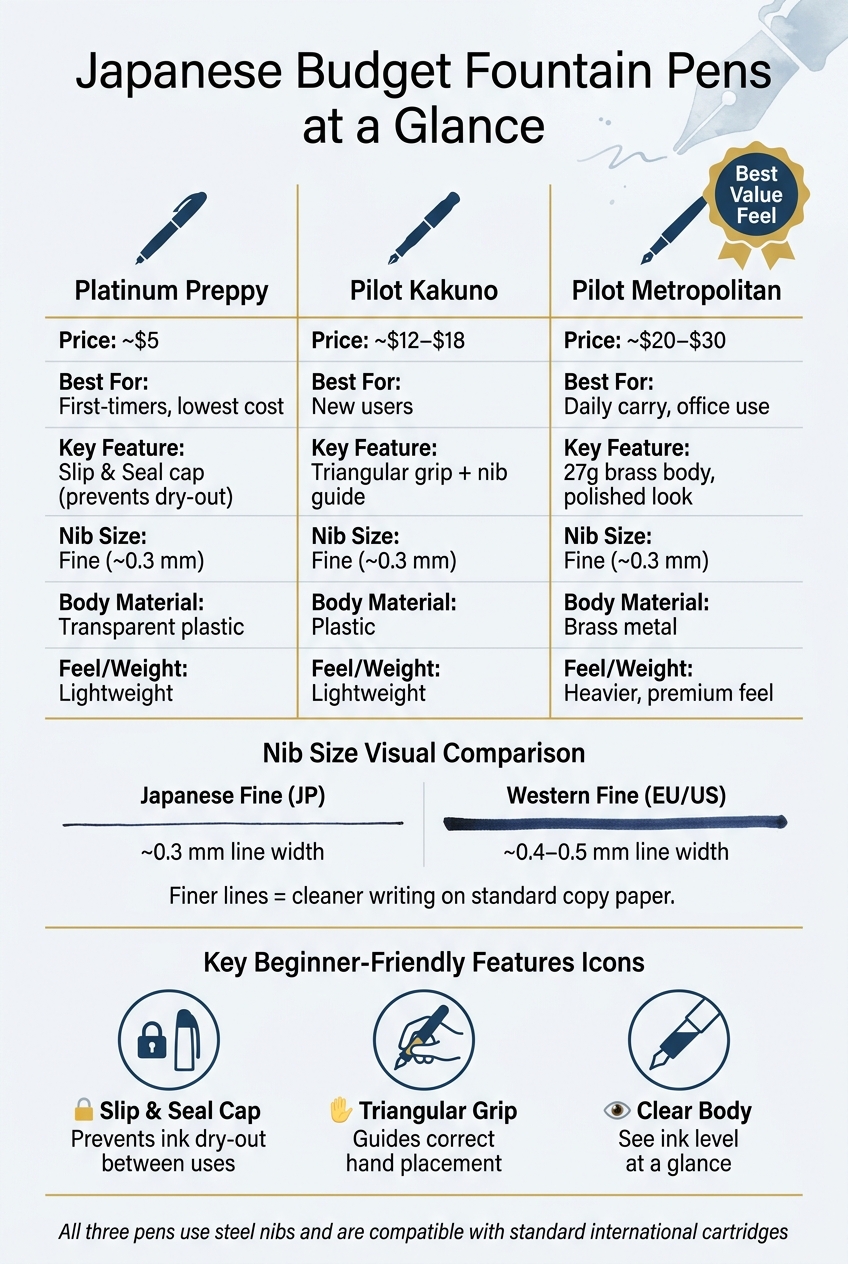
Japanese vs. Western Budget Fountain Pens: Price, Nib Size & Features Compared
| Pen | Price | Best for | Main point |
|---|---|---|---|
| Platinum Preppy | ~$5 | First try, lowest cost | Fine writer, cap helps stop dry-out |
| Pilot Kakuno | ~$12–$18 | New users | Easy grip, simple nib choices |
| Pilot Metropolitan | ~$20–$30 | Daily carry, office use | Metal body, more weight, polished look |
What stands out most to me is not hype. It’s consistency. These pens tend to start, write, and stay neat on normal paper, which is exactly what most budget buyers want. When choosing your first pen, it helps to follow a fountain pen buying checklist to ensure you get the right features for your needs.
Why Japanese Brands Lead the Budget Fountain Pen Market
Strong Price-to-Performance in the Under-$50 Range
Japanese budget pens often punch above their price. The Platinum Preppy starts at about $5, the Pilot Kakuno at $12, and the Pilot Metropolitan at $20, yet all three get strong feedback from fountain pen users. The Metropolitan is a good example. It has a brass body and weighs 27 grams, so it feels closer to a pen in the $50 to $80 range than one that costs $20. Below $50, that kind of value doesn't show up often.
A big reason comes down to how these companies make their pens. Pilot, Platinum, and Sailor all produce their own nibs, which lets them keep close control over quality and consistency across the lineup. You can feel that right away. Most Japanese budget pens write well from the first use instead of needing fiddling or extra setup. Pair that with beginner-friendly design and tighter nib control, and the value story gets even stronger.
A Long History of Entry-Level and Student-Friendly Pens
Sailor, Pilot, and Platinum have spent more than 100 years refining low-cost pens for students and first-time users. That history shows up in the small details. These pens tend to have fewer setup problems and more steady performance right out of the box. The Pilot Kakuno, for instance, uses a triangular grip and a smiley face on the nib to help guide new users into the right writing position.
That beginner-first mindset still shapes the pens many U.S. buyers pick up today. And honestly, it matters. A starter pen should feel easy on day one, not like a tiny project.
Fine Nibs That Work Well for Everyday U.S. Writing
That same thinking helps explain the nib sizes. A Japanese Fine nib measures about 0.3 mm, while a Western Fine usually falls around 0.4 to 0.5 mm. On regular copy paper in U.S. schools and offices, that gap matters more than it may sound.
With finer tips and tighter ink flow, Japanese nibs are less likely to feather or bleed through the page. The result is cleaner writing on standard copy paper. For everyday notes, forms, and classwork, that makes Japanese nibs a smart fit for daily U.S. writing.
How Japanese Pens Address Common Budget Buyer Problems
Better Fine Nibs for Small Handwriting and Clean Lines
These strengths matter most when someone wants a pen that handles small handwriting, starts without drama, and feels simple to use from day one.
One of the biggest problems with budget pens is the nib. It can feel scratchy, write too wide, or make small handwriting look messy. Japanese Fine nibs usually come in around 0.3 mm, compared with 0.4–0.5 mm for many Western Fine nibs, so they tend to work better in planners and narrow-ruled notebooks.
That difference sounds small on paper. In use, it can be the thing that keeps your notes neat instead of cramped.
Japanese nibs also tend to give more control. Sailor, in particular, is known for a firm, pencil-like feedback that helps guide the line without making the pen feel rough.
Reliable Starts, Smoother Flow, and Less Frustration
Another issue with low-cost pens is the hard start. You leave the pen alone for a while, pick it up again, and suddenly it skips, drags, or needs a few extra strokes before it settles down.
Platinum tackles that problem with its Slip & Seal cap. It helps the Preppy start cleanly even after long periods of non-use, which cuts out one of the most annoying beginner problems. Pilot also keeps startup trouble low through tight nib consistency, so the pen tends to write smoothly from the first use.
For a new user, that matters a lot. A pen that writes when you expect it to writes feels easier to trust.
Beginner-Friendly Design, Clear Nib Choices, and Upgrade Paths
Japanese budget pens also do a good job with the small design choices that make learning easier. The Kakuno’s triangular grip helps with hand placement. The Preppy’s transparent body makes it easy to see the ink level. And simple nib labels like EF, F, and M make starter pens easier to shop for without guesswork.
Low entry prices help too. Since the Preppy starts at around $5, it’s easy to try a different nib size or test a new ink without spending much. Fountain Pen Revolution fits that same low-risk mindset by offering affordable pens and nibs for buyers who want to try different setups without a big upfront cost.
Those strengths stand out most in the starter models below.
Key Japanese Budget Models and Where U.S. Buyers Can Start
If you're ready to pick from these new user pens, three models rise to the top fast.
Pilot Kakuno: A Solid Starting Point for First-Time Users
The Pilot Kakuno is built for beginners. Its triangular grip helps guide your fingers into the right position, and the nib marking makes it easier to learn how to hold the pen. It usually costs around $12 to $18, and it comes with a steel nib that’s similar to the nibs used on pricier Pilot pens (see our gold vs steel nibs guide for more details).
Platinum Preppy: The Lowest-Risk Way to Try a Fountain Pen
At under $10, the Platinum Preppy is one of the easiest ways to test the waters. If you're not sure fountain pens are for you, this is a low-cost place to start. Even at that price, it writes smoothly, and Platinum’s Slip & Seal feature helps keep the ink from drying out between uses.
If you want something with a bit more heft in the hand, the Metropolitan makes sense as the next move.
Pilot Metropolitan and Budget-Friendly Options Through Fountain Pen Revolution

The Pilot Metropolitan steps things up a notch. Its 27 g brass body gives it a feel that punches above its price, with handling that can remind people of pens in the $50 to $80 range. It usually sells for $20 to $30, which makes it a good fit for office use if you want something that looks a little more polished than a starter pen.
Fountain Pen Revolution is also worth a look if you want to build out a simple setup without spending much. The company sells low-cost pens, nibs, ink, stands, and cases, so it's a handy place to pick up the basics in one go.
These three pens keep coming up for a reason: they’re easy to find, simple to use, and easy to feel good about buying.
Conclusion: Why Japanese Fountain Pens Hold the Top Spot in the Budget Segment
Put it all together, and it's easy to see why the same Japanese models keep showing up on budget-buying lists. They sit at the top of the budget market because they fix the stuff that makes cheap fountain pens annoying to use: hard starts, messy lines, and uneven nib quality. Proper fountain pen maintenance can also help prevent these issues. Pilot and Platinum deal with those problems with tighter manufacturing tolerances, finer nib grinds, and practical features like Platinum's Slip & Seal cap.
The nib is where this edge shows up most. Small changes there make the biggest difference in day-to-day use. A Japanese Fine is much narrower than a typical Western Fine, which makes it a better fit for small handwriting and standard copy paper. Japanese nibs are tuned for precise, controlled strokes, so everyday writing on office paper tends to feel cleaner and more consistent.
Key Takeaways for U.S. Buyers
For most U.S. buyers, the safest place to start is a Japanese Fine nib on standard copy paper. Entry-level picks like the Platinum Preppy, Pilot Kakuno, and Pilot Metropolitan cover the main budget price points with very little financial risk. Pick based on your budget and how fine you want the line.
FAQs
Which nib size should I choose first?
It comes down to how you write and what paper you use.
For most beginners, a Fine (F) nib is the best starting point. It gives you a nice middle ground: enough precision for everyday notes, but still smooth on the page.
Go with Extra-Fine (EF) if your handwriting runs small or you usually write on standard printer paper. Pick a Medium (M) nib if you like a darker, bolder line and tend to use better paper.
Are Japanese fountain pens good for left-handed writers?
Yes. Japanese fountain pens are often a smart pick for left-handed writers because their fine, precise nibs usually put less ink on the page.
That can help cut down on smearing and bleed-through. Their steady ink flow and consistent performance also make writing feel smoother, with less need to press hard or go over the same stroke twice.
Do these pens use cartridges or converters?
Most budget-friendly Japanese fountain pens work with both cartridges and converters. The Pilot Metropolitan, for example, often comes with a cartridge and a squeeze converter. The Platinum Preppy uses standard cartridges.
A lot of people like converters because they let you use bottled ink. That can cost less over time, and you get more color options too.