

If your celluloid pen smells sharp, shows white crust, or starts cracking, stop using it and store it away from other pens. Celluloid breakdown does not reverse, and the warning signs often start small before turning into warping, brittleness, and damage to nearby items.
Here’s the short version:
- I’d watch for 9 main signs: discoloration, crazing, white residue, chemical odor, sticky or dull surface, warping, brittleness, metal corrosion, and fit problems
- Heat above about 80°F to 90°F can push damage along
- Old latex sacs and ebonite and acrylic parts can add sulfur-related damage
- Off-gassing can harm nearby pens, so separation and airflow matter
- Do not use heat, wax, or home repair tricks on a failing celluloid pen
What this means for you: if a pen looks blotchy, feels tacky, smells like vinegar or chemicals, or chips during normal handling, treat it as a material problem, not just wear.
| Warning sign | What I’d take it to mean | What to do first |
|---|---|---|
| Patchy color change | Early material change | Inspect and move it away from other pens |
| Hairline cracks or crazing | Active cracking | Stop use and avoid stress |
| White powder or crystals | Later-stage breakdown | Isolate at once |
| Sharp chemical odor | Off-gassing | Ventilate and separate |
| Sticky or cloudy surface | Surface failure | Don’t buff or wax it |
| Warping or soft spots | Heat or structural damage | Stop capping/posting |
| Brittle feel or chipping | Loss of strength | Handle as little as possible |
| Rust or tarnish nearby | Reactive vapors present | Check nearby pens too |
| Loose fit with other symptoms | Material movement | Get it checked before use |
I’d treat early action as the whole point here: cool storage, air flow, light handling, and fast isolation can limit more damage.
Everything about Celluloid Fountain Pens (INFO)
sbb-itb-1dd4fe9
What Causes Celluloid Pens to Break Down
Celluloid doesn't fail all at once. It tends to break down bit by bit under heat, light, moisture, and chemical reactions.
Heat, Sunlight, and Poor Ventilation
Heat and UV light damage the chemical bonds in celluloid. Over time, that can lead to yellowing, softening, or, at the other end of the spectrum, severe brittleness. For long-term storage, temperatures above about 80°F to 90°F can be risky for vintage celluloid. That means sunny windowsills, heating vents, and hot cars are all bad spots for a pen.
Poor airflow makes things worse. As celluloid gets older, it gives off nitrous gases and other byproducts. When those gases get trapped inside airtight storage or a tightly sealed pen barrel, they can speed up the breakdown process.
Moisture, Aging Ink Sacs, and Reactive Materials
Moisture also pushes these reactions along. As cellulose nitrate starts to degrade, it can pull in more moisture from the air, which adds to the damage.
Aging latex ink sacs are another problem. As they wear out, they release sulfur compounds that can permanently darken celluloid. The staining often shows up deep inside the barrel and can't be reversed. Button-filler pens face more risk here because their sealed barrels hold those compounds in place. Ebonite, also called hard rubber, can cause trouble too. Its sulfur content can range from 25% to 80%, and when it reacts with oxygen and water, it can form sulfuric acid that harms nearby celluloid.
These pressures usually show up in visible ways: color shifts, cracking, odor, and parts that no longer fit as they should.
9 Signs of Celluloid Pen Deterioration
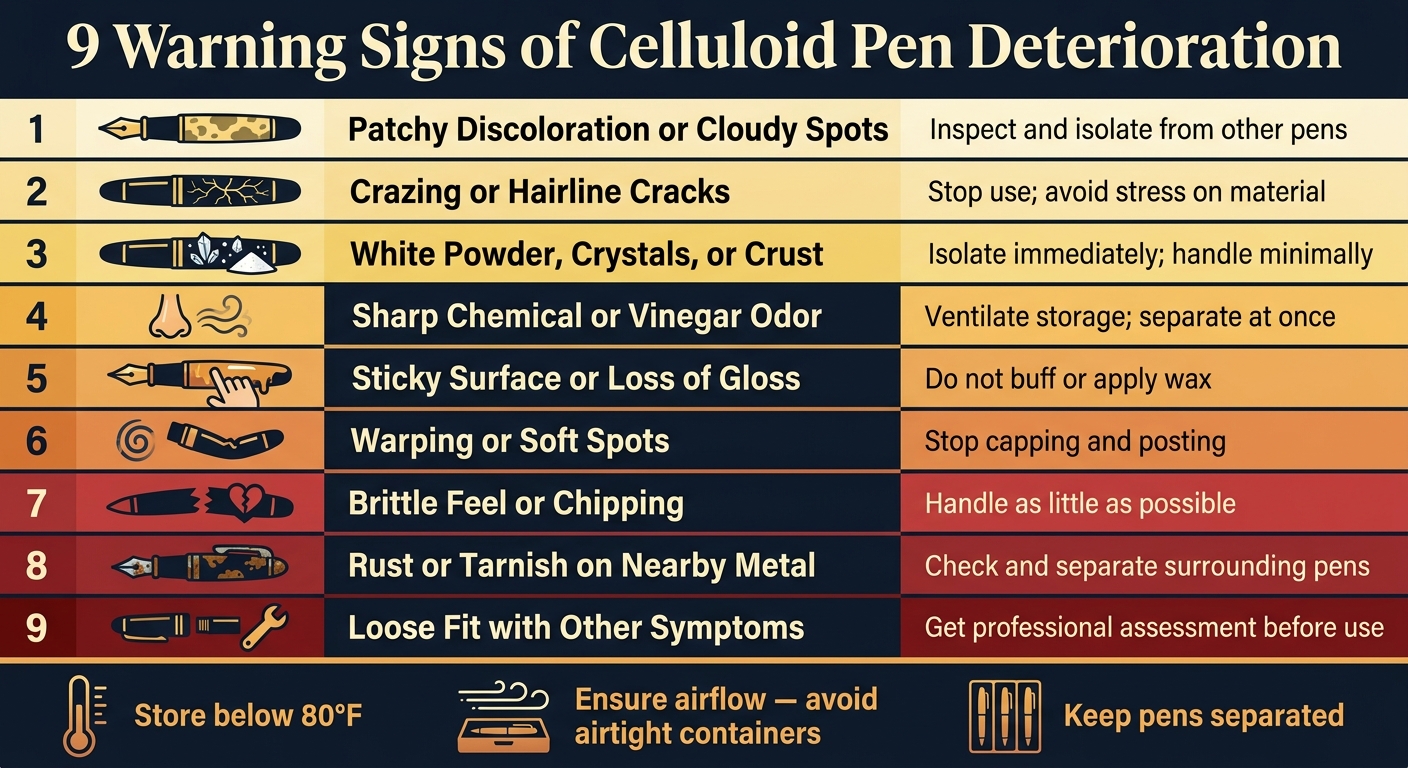
9 Warning Signs of Celluloid Pen Deterioration
Those stresses don’t stay hidden for long. They start to show in the material itself.
Here are nine signs to watch for, starting with small surface changes and moving into more serious structural damage.
1. Patchy Discoloration, Fading, or Cloudy Spots
Patchy yellowing, cloudy areas, or translucent spots are often the first red flags. You’ll often see them near thick ends, cap lips, or inner caps, where byproducts tend to build up.
Uniform aging is one thing. But if the color change looks uneven or blotchy, take it as an early warning and give the pen a closer look and review proper storage and maintenance to prevent further damage.
2. Crazing, Hairline Cracks, or Spiderweb Fractures
Fine surface cracks, dull patches, or a web of stress lines are serious warning signs. These usually show up first around cap lips, threads, and lever box areas, where the material is thinnest and under the most stress.
It helps to tell old damage from active damage. A small crack in a cap lip that hasn’t changed in years may just be old wear. Crazing is different. That spreading network of tiny fractures means the damage is moving forward, and it won’t reverse.
Do not try to “repair” crazing with heat.
3. White Powder, Crystals, or Crust on the Surface
A powdery or crystalline residue on the surface points to later-stage breakdown. This happens when camphor leaves the material and the celluloid starts to weaken.
This isn’t just about looks. It means the material is actively failing. If the surface also smells sharp or feels sticky, the damage is further along.
A pen with white deposits should be isolated at once and handled as little as possible.
4. Sour, Vinegar-Like, Camphor, or Strong Chemical Odor
Celluloid can have a faint camphor smell when wet, and that by itself is not a problem. What you want to watch for is a sharp, lasting chemical odor. That can point to active off-gassing and a risk to nearby celluloid pens.
If you notice that smell in storage, track down the source and separate that pen from the rest of the collection right away.
5. Sticky Surface, Loss of Gloss, or Persistent Cloudiness
If a pen used to feel smooth and polished but now feels tacky or looks hazy, the surface may be starting to break down.
Don’t try to buff it away. And don’t apply wax. Wax can seal the surface and keep gases from escaping.
6. Softening, Warping, or Out-of-Round Parts
If a cap no longer seats the way it should, a barrel looks slightly twisted, or you feel a soft spot while holding the pen, that points to heat damage or weakening in the structure. Warping, in particular, usually points to heat damage.
Take a close look at how the parts line up. Does the cap still thread on smoothly? Does the barrel still look even? Misshapen parts are more than a cosmetic issue. They can add stress to weak areas and lead to cracks during normal use.
7. Brittle Feel, Chipping, or Cracking During Routine Handling
If a pen chips or cracks during capping, posting, or gentle disassembly, it has lost a lot of its strength. The material is no longer flexible and has become fragile.
Thin sections tend to fail first, especially:
- Threads
- Cap lips
- Lever slots
If tiny flakes come off when you handle the pen, stop there. Set it down carefully and don’t force anything. At this stage, even normal handling or poor storage can push the damage further.
8. Rust, Pitting, or Tarnish on Nearby Metal Parts
New corrosion on a clip, trim ring, or hardware near the nib can mean reactive vapors are present in the storage area. Vapors from deteriorating sacs or hard rubber can corrode nearby metal over time.
If metal parts that used to look clean now show rust, pitting, or tarnish, inspect the celluloid body for other signs of breakdown. It’s also smart to check nearby pens or metal items. If they show similar tarnish, separate the affected pen from the rest of the collection right away.
9. Filling or Fit Problems That Appear Alongside Material Changes
A loose cap or a section that wobbles can come from plain mechanical wear. But when those issues show up along with visible cracks, warping, or a chemical smell, they deserve more attention.
Fit problems become much more serious when they appear with cracks, warping, or odor, because they can mean the material itself is changing.
What to Do If You Notice These Signs
If you spot these signs, stop using the pen and isolate it at once.
Isolate the Pen and Store It in a Cool, Ventilated Space
Move the pen away from the rest of your collection right away. As celluloid breaks down, it can give off gases that harm nearby celluloid pens. Store it in a cool, dry, well-ventilated place, and stay away from airtight containers, plastic bags, and closed drawers.
For longer storage, loosen the cap and keep the pen apart from other celluloid items. Containment comes first; repair comes later.
Avoid Heat and DIY Repairs
Do not use heat, open flames, or at-home fixes. Damaged celluloid can catch fire easily.
Limit Handling and Seek Professional Assessment
If a pen has an active odor, crystals, or crazing, focus on preservation, not use. Those signs point to advanced damage. Stop handling the pen more than needed, and do not keep using it.
For advanced damage, have a restorer with experience in vintage celluloid look at it before any repair.
Prevention and Safe Long-Term Storage
Once you know what to look for, prevention is pretty simple: cut down heat, trap less gas, and keep pens from touching each other.
Routine Checks, Better Storage Habits, and Pen Rotation
Check your pens a few times a year, and rotate the ones you use often. Keep celluloid pens away from heat and direct sunlight. Air flow matters. Airtight containers can hold in the acidic gases that celluloid gives off on its own, which speeds up damage.
For long-term storage, loosen blind caps and swap out old rubber sacs that release sulfur.
Using Cases and Stands to Keep Fragile Pens Separate
After storage conditions, the next layer of protection is separation. Gas from one pen that’s starting to break down can harm the pens beside it. Slotted trays, acid-free boxes, and open stands all help keep pens apart while letting air move around them.
That setup also makes inspections faster, which helps when you want to catch trouble early.
Conclusion: Spot the Signs Early and Act with Care
If a pen looks suspicious, isolate it. Skip DIY fixes. Store the rest in a cool, dry, ventilated space.
FAQs
Can a deteriorating celluloid pen be saved?
No. True celluloid rot can’t be reversed. Once the plastic starts to break down, there’s no way to bring it back to its original state.
You may be able to slow more damage with baking soda and water. And in some cases, you can handle small, local repairs on minor cracks. But the core damage is still there. If the rot is far along, isolate the pen so it doesn’t put the rest of your collection at risk.
How can I tell normal aging from active deterioration?
Normal aging can show up as minor, steady surface wear. Active deterioration in celluloid is different. It keeps moving, and it can't be reversed.
Watch for patches that turn transparent, especially near the ends or under the inner cap. Also look for new cracks, spreading cracks, chips, crumbling, or a frosted or crystallized surface.
If you spot any of those changes, isolate the pen right away. Celluloid in this state can release gases that may affect other celluloid items nearby.
What’s the safest way to store a failing celluloid pen?
Move the pen out of your main collection right away. That helps stop chemical gases from spreading to other pens.
Keep it in a dark, cool, well-ventilated space at 64–72°F with 40–60% humidity. Skip airtight containers. Instead, use acid-free boxes or trays, and wrap the pen in acid-free tissue paper or zeolite-impregnated paper such as MicroChamber paper.