

Using a fountain pen converter is simple and lets you switch from disposable ink cartridges to bottled ink. This small, reusable device fits into your pen’s cartridge slot, offering more ink options, lower costs, and reduced plastic waste. Here’s the quick process:
- Choose the Right Converter: Options include piston, squeeze, and push-button converters. Ensure compatibility with your pen (standard or proprietary).
- Install the Converter: Push or screw it into the pen’s grip section securely.
- Fill with Ink: Submerge the nib in bottled ink and use the converter mechanism to draw ink.
- Clean and Maintain: Flush with water every 4–6 weeks or when changing ink colors to ensure smooth ink flow.
Switching to a converter opens up a world of bottled ink choices while being cost-effective and eco-friendly. Keep your pen clean, and enjoy a smooth writing experience.
How to fill a cartridge-converter. A beginners guide to fountain pens
sbb-itb-1dd4fe9
Understanding Fountain Pen Converters
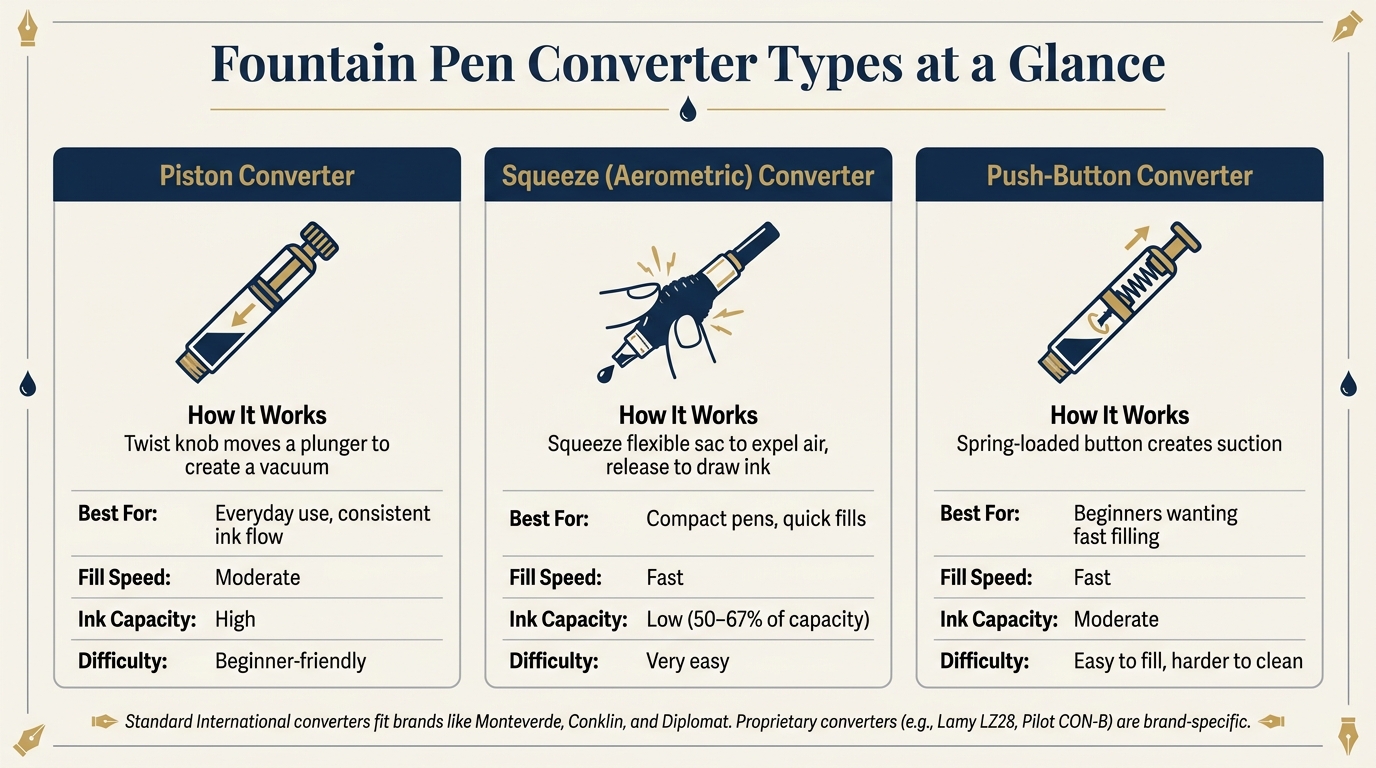
Fountain Pen Converter Types: Piston vs Squeeze vs Push-Button
What Is a Fountain Pen Converter?
A fountain pen converter is a handy, refillable reservoir that fits into the cartridge slot of your pen. It allows you to use bottled ink instead of disposable cartridges through a vacuum or pressure mechanism. Essentially, it’s a reusable alternative to cartridges, offering flexibility for those who enjoy the variety of bottled inks. Plus, you can always switch back to cartridges when convenience is key, like during travel.
"A fountain pen converter is a small device designed to allow fountain pens that typically use disposable ink cartridges to use bottled ink instead." - Goldspot Pens
Whether you are looking for the best fountain pens for beginners or upgrading your current setup, let’s dive into the different types of converters to help you find the one that matches your writing style.
Types of Fountain Pen Converters
The two most common types of converters are piston converters and squeeze (aerometric) converters.
"The most common type of converter is a piston converter. It works by twisting a knob... which moves the piston up and down to create a vacuum to draw ink into the pen." - Mackenzie, Writer, Must Have Stationery
Here’s how they work:
- Piston Converters: These use a twist mechanism to move a plunger inside the converter. As the plunger moves, it creates a vacuum that draws ink into the pen. They’re ideal for everyday use because of their consistent ink flow and ease of operation.
- Squeeze Converters: These have a flexible rubber or silicone sac inside a sturdy frame. You squeeze the sac to push air out, then release it while the nib is dipped in ink to draw the ink in. They’re quick to fill but typically hold less ink - only about 50–67% of their capacity.
A less common option is the push-button converter, which uses a spring-loaded button to create suction. It’s fast to fill but can be more challenging to clean thoroughly.
| Converter Type | How It Works | Best For |
|---|---|---|
| Piston | Twist knob moves a plunger to create a vacuum | Everyday use, consistent ink flow |
| Squeeze | Flexible sac expels air, then draws ink | Compact pens, quick fills |
| Push-Button | Spring-loaded button creates suction | Beginners wanting fast filling |
Converter Compatibility with Fountain Pens
Once you’re familiar with how converters work, the next step is to ensure compatibility with your fountain pen. A properly fitting converter not only enhances your writing experience but also ensures you can enjoy the wide range of bottled ink options while reducing waste.
Fountain pens generally fall into two categories: standard international or proprietary.
- Standard International Converters: These are versatile and fit a variety of pen brands like Monteverde, Conklin, and Diplomat.
- Proprietary Converters: These are designed specifically for certain brands. For example, Lamy pens require the Lamy converter (LZ28), while Pilot pens like the Metropolitan use the CON‑B, and the Vanishing Point takes the CON‑40.
To check compatibility, start by examining the cartridge currently in your pen. If it’s a standard international cartridge, a standard international converter will likely fit. When in doubt, consult the manufacturer’s compatibility guide. For instance, Fountain Pen Revolution pens are designed to work seamlessly with standard international converters, making it easy to transition to bottled ink without any guesswork.
Setting Up Your Fountain Pen Converter
How to Disassemble the Pen
Start by removing the cap and unscrewing the barrel from the grip section to reveal the cartridge or converter slot. If there's a disposable cartridge in place, gently pull it out while keeping the nib pointed upward to avoid any ink spills. For a converter, the removal method depends on its type: pull it straight out for a push-fit converter or unscrew it if it's threaded. Once removed, place the nib and grip section on a paper towel to protect the nib and prevent ink messes.
How to Install the Converter
The installation process varies depending on the type of converter:
- Push-fit converters: Simply press the converter straight onto the fitting inside the grip section. Apply firm pressure until it's fully seated - no twisting is required.
- Threaded converters: Screw the converter into the grip section to create a secure, tight connection.
"A screw-in converter creates a more secure seal between the converter and the feed, reducing the risk of leaks and improving long-term reliability - especially important for daily writers and travel use." - Hanna Struk, Scriveiner
Double-check for gaps between the converter and the grip section. Even a slight looseness can lead to ink leaks or uneven ink flow. As Csaba Kiss, a pen enthusiast from the Budapest Pen Show, explains: "If the converter is loose, it can easily slip out of the pen body and ink can leak."
Once the converter is firmly in place, you're ready to prepare your ink and workspace for a clean and efficient fill.
Preparing Your Ink and Workspace
Set up your workspace on a flat, stable surface. Lay out some paper towels and keep a cup of room-temperature water handy. Open your fountain pen ink carefully.
A critical reminder: always use ink specifically designed for fountain pens. Other types, like standard writing inks or India ink, can clog the feed and cause damage to the pen's internal parts. If your pen is already blocked, you may need to unclog the fountain pen to restore flow. With this setup, you'll be ready for a smooth and mess-free ink-filling process.
How to Fill Your Fountain Pen Converter
Once your converter is installed and your ink is set on a stable surface, you're ready to fill your fountain pen. The process varies slightly depending on whether you're using a piston or a squeeze converter, which are common fountain pen filling systems, but both methods are simple once you've tried them. These techniques ensure smooth ink flow, keeping your pen ready for uninterrupted writing and improving your handwriting.
Filling a Piston Converter
Begin by twisting the piston knob counter-clockwise. This moves the internal plunger toward the nib, pushing out any trapped air. Next, dip the nib into your ink bottle, making sure the breather hole is fully submerged. Turn the knob clockwise to draw ink into the converter. If you notice air bubbles, gently push the plunger to expel the air until you see a drop of ink at the nib, then repeat the drawing motion.
Now, let’s move on to the squeeze converter.
Filling a Squeeze Converter
Squeeze converters operate with a simple mechanism: compress the rubber bladder to expel air, submerge the nib, and release to draw ink. Follow these steps:
- Compress the rubber bladder firmly and hold it.
- Submerge the nib into the ink bottle, ensuring it's fully covered.
- Release the bladder to allow ink to be drawn in.
"To draw the ink into a squeeze converter, simply release the bladder. The vacuum effect will draw the ink inside." - PenChalet
If the converter doesn't fill completely, repeat the process until you’ve drawn enough ink.
Removing Excess Ink and Reassembling the Pen
After filling the converter, manage any excess ink and reassemble your pen. Carefully lift the pen from the ink bottle, then use a paper towel to wipe the nib and grip section clean. Reattach the barrel and secure the cap.
"Lift the pen from the bottle and wipe the nib and section with a soft cloth or a napkin." - Hanna Struk, Scriveiner
If your pen doesn’t write immediately, store it nib-down for a few moments to allow ink to flow through the feed.
Cleaning and Maintaining Your Fountain Pen Converter
Keeping your converter clean is key to smooth ink flow and extending the life of your fountain pen. As Al Qalam states, "Keeping your converter clean is essential for consistent ink flow and pen longevity." A good habit is to flush your converter every 4–6 weeks if you’re using the pen regularly, whenever you switch ink colors, or if the pen has been unused for more than 4–6 weeks.
Routine Cleaning Steps
Start by removing the converter from the pen and emptying any leftover ink. Flush it with room-temperature water 3–5 times until the water runs clear. For piston converters, use the twist mechanism to control the flow during each flush. Squeeze converters work similarly - compress, submerge, release, and repeat. A bulb syringe can make this process faster by pushing water through the converter more forcefully. Keep in mind that darker inks, like red or green, might need more than five cycles to fully clean.
If routine flushing doesn’t remove all the ink, it’s time to tackle stubborn residue.
Dealing with Dried or Stubborn Ink
When water alone doesn’t do the trick, soak the converter in room-temperature water for several hours to loosen dried ink. For tougher stains, use a pen flush solution designed to break down ink residue without harming seals or internal parts. Avoid using hot water or household cleaners, as these can damage the converter’s resin or rubber components. If a piston converter feels stiff after cleaning, a small amount of 100% silicone grease on the piston seal can restore its smooth operation.
Drying and Storing the Converter
After cleaning, drying and storing the converter properly is just as important. Remove any excess water and let the converter air dry on a soft cloth for several hours before refilling. A few bursts of air from a bulb syringe can help eliminate trapped moisture. If you’re not planning to use the pen for a while, store the converter empty - leaving ink inside can lead to residue buildup as it evaporates. When the pen is in use, keep it stored nib-up to prevent ink from pooling in the feed and causing clogs.
Troubleshooting Common Converter Problems
Regular cleaning is essential, but troubleshooting can help maintain a smooth writing experience when issues arise. Below are common converter problems and practical ways to resolve them.
Converter Won't Draw Ink
A common reason for this issue is that the nib isn't dipped deeply enough into the ink. If the breather hole - the small hole near the nib's tip - isn't fully submerged, the converter will suck in air instead of ink.
"Ensure the nib is fully submerged to prevent air bubbles." - Goldspot Pens
Also, check that the converter is securely attached to the grip section. A loose connection disrupts the vacuum seal, which is necessary for drawing ink. If you're using a new converter, rinsing it with room-temperature water can help eliminate any factory residue that might interfere with proper functioning.
If these steps don't solve the problem, the issue might be related to ink flow, which is addressed next.
Ink Flow Problems
Skipping or uneven ink flow after filling often points to a feed that needs priming. To fix this, hold the pen nib-down and lightly press the nib onto a paper towel. This helps pull ink into the feed channel. Alternatively, you can gently turn the converter knob to push a small drop of ink forward.
If you notice persistent air bubbles, try holding the pen nib-up and slowly operating the converter until a drop of ink emerges from the breather hole. This removes trapped air and stabilizes the flow. If the problem continues, a thorough flush of the pen system is usually the most effective solution.
If these steps don't resolve the issue, you may need to check for leaks or ink blobs.
Leaks and Ink Blobs
Leaks are usually caused by either a loose converter or an overfilled ink reservoir. Make sure the converter is tightly fitted into the grip section. Csaba Kiss, a pen enthusiast and marketing professional, explains:
"The most important aspect during selection is that the converter fits precisely and snugly into the pen neck. If the converter is loose, it can easily slip out of the pen body and ink can leak."
To prevent leaks, avoid overfilling the reservoir. Leave a small air gap to accommodate pressure changes, which is especially helpful when traveling or moving between altitudes. After filling, expel one or two drops of excess ink and pull the piston back slightly to create negative pressure. This simple precaution helps keep your pen clean and functional.
| Problem | Likely Cause | Fix |
|---|---|---|
| Converter draws only air | Nib not deep enough in ink | Ensure the nib is properly submerged |
| Ink skips or won't flow | Air bubbles or clogged feed | Prime the feed or flush the system |
| Ink leaks or blobs | Loose fit or overfilled reservoir | Reseat converter; leave a small air gap |
| Piston is hard to turn | Lack of lubrication | Apply a small amount of silicone grease to lubricate the piston |
Conclusion: Getting the Most from Your Fountain Pen Converter
To get the best out of your fountain pen converter, focus on a mix of proper use and regular care. Install the converter securely, fill it slowly while keeping the nib fully submerged, and prime the feed for smooth ink flow. Make it a habit to flush the converter with room-temperature water every 1–2 months - or sooner if the pen hasn’t been used for 4–6 weeks.
One of the biggest perks of using a converter is the ability to explore a vast range of bottled ink colors. From shimmering and sheening options to archival-quality formulas, converters unlock possibilities that disposable cartridges simply can’t match. This freedom lets you personalize your writing experience, adapting it to suit your style and mood.
"Many see a fountain pen converter as a technical component, but... we see it as an invitation to choice."
Converters also pair beautifully with the thoughtful designs of Fountain Pen Revolution’s pens. For example, the Himalaya pen, built with deep cleaning in mind, works seamlessly with its corresponding converters. Pricing for these converters varies by model: Himalaya V1 ($2.40), V2/Quickdraw Flex ($3.20), and Ashoka ($4.00).
Beyond the creative benefits, converters are a smart, eco-friendly choice. Over time, they save money and reduce plastic waste. With the right converter and consistent upkeep, you’ll enjoy smooth, reliable writing for years to come.
FAQs
How do I know which converter fits my pen?
To choose the right converter for your pen, start by identifying whether it requires a Standard International or a proprietary converter. Check the brand and model details, which are often engraved on the nib, cap band, or clip. Then, consult the manufacturer’s documentation for compatibility information.
Pay attention to the connector type - some pens use a push-in connector, while others require a screw-in design. Also, measure the barrel length of your pen, especially if it’s a compact model, as these often need shorter or specially designed converters.
Why is my converter pulling in air instead of ink?
When filling, make sure the nib and grip section are completely submerged in the ink. This is crucial for the vacuum mechanism to function properly. Double-check that the converter is firmly attached without any gaps. If you notice air bubbles, try expelling a small amount of ink back into the bottle while keeping the nib submerged. Then, refill to eliminate any trapped air.
How can I stop leaks after filling?
To avoid leaks, make sure the converter is firmly and securely attached to the pen's grip section without any visible gaps. If you still notice leaks, inspect the converter for signs of wear or damage, and replace it if necessary. Sometimes, switching to a different type of converter can provide a tighter seal. Fountain Pen Revolution provides a variety of pens and accessories designed to help you care for your writing instruments.