

Shimmer ink clogs pens for one simple reason: the sparkly particles can pile up in tight ink channels. In most cases, the ink itself is fine. The trouble starts in the feed and nib slit, where settled particles slow flow, cause skipping, and can stop writing altogether.
If I want fewer problems, I focus on four things right away:
- Use a wetter pen, usually with a medium, broad, stub, or italic nib
- Mix the shimmer gently before filling and again before writing
- Keep the ink moving by writing steadily and capping the pen during pauses
- Flush the pen soon after use, instead of letting shimmer dry inside
Here’s the short version: fine, dry nibs clog more often because their ink path is tighter. Pens left unused, stored nib-up for long stretches, or allowed to dry at the tip are also more likely to hard-start. A brief water dip of 1–2 seconds can help with a minor hard start, but repeated skipping usually means it’s time to flush.
A few practical numbers stand out:
- Rotate the pen about 30–60 degrees every few lines
- Soak stubborn residue for 30–60 minutes
- Let parts air-dry overnight before refilling
This comes down to flow, not pen damage. Shimmer ink can work well if I pair it with the right pen, use short, simple habits while writing, and clean it before the particles dry into the feed.
Clogged ink???😩 long term TEST of thick & shimmer inks
sbb-itb-1dd4fe9
How Shimmer Particles Move Through the Feed and Nib
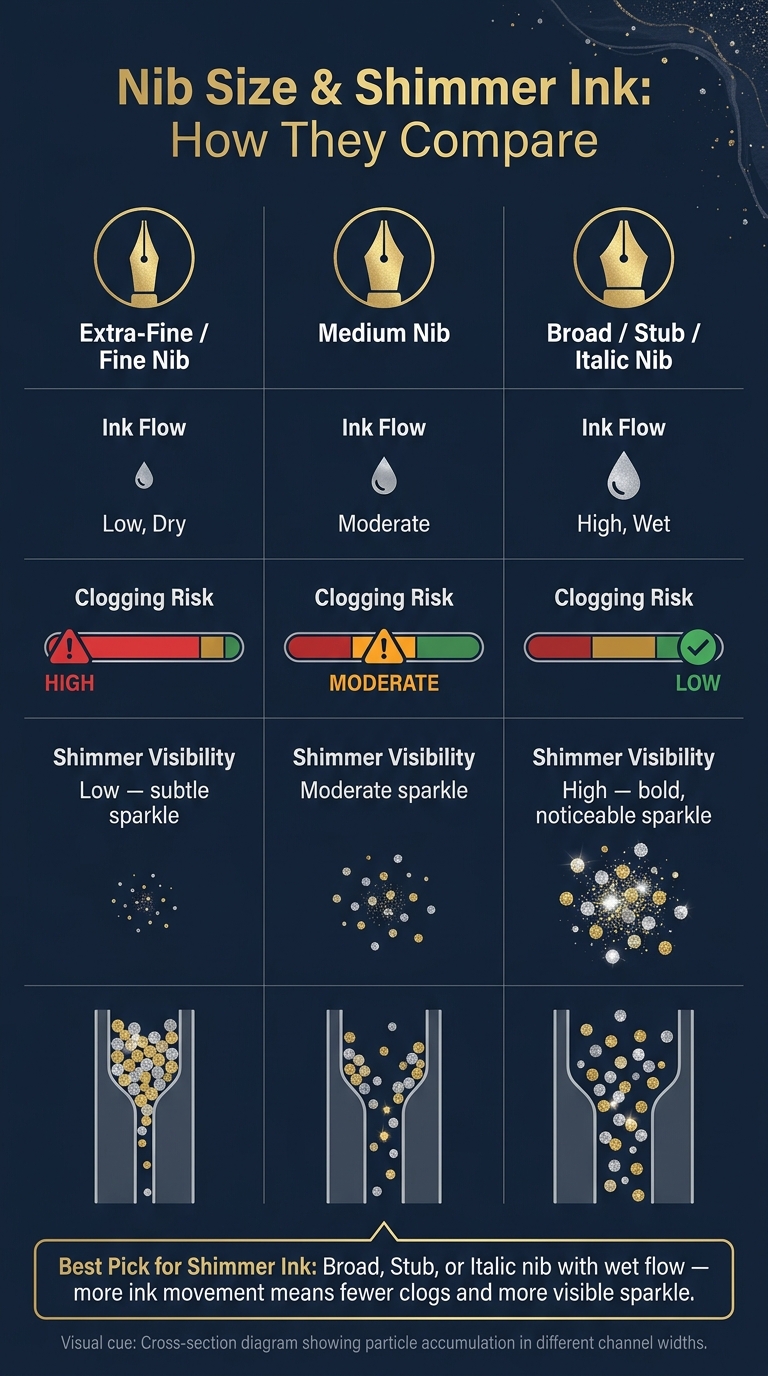
Fountain Pen Nib Size vs. Shimmer Ink Performance
Shimmer ink keeps tiny particles suspended in the liquid, but those particles can settle once the pen sits still. As you write, ink travels from the reservoir through the feed and along the nib slit, while air moves back the other way to take the ink’s place. That path gets tight at the feed and nib slit, so those spots are where particles tend to pile up first.
How Settled Particles Block Narrow Feed Channels
The feed fins and nib slit are the tightest parts of the ink path. Since shimmer particles are larger and heavier than the liquid around them, gravity pulls them toward the front of the pen when writing stops. They can gather near the breather hole and inside the tiny channels, which is where flow problems usually begin.
Once you start writing again, those little buildups can partly block the feed channels. That can lead to a hard start on the first stroke or skipping that comes and goes as ink flow drops and returns. And if ink has already started drying inside the feed, the blockage can be harder to clear. If the air path near the breather hole gets choked off too, air can’t move in to replace the ink, and flow may stop altogether.
Why Broad Wet Nibs Handle Shimmer Better Than Fine Dry Nibs
A broader nib puts down more ink with each stroke, which gives shimmer particles more liquid to travel with. Fine and extra-fine nibs usually write drier and have a smaller tine gap. That tighter space makes it easier for particles to bridge the gap and disrupt the ink film that capillary action relies on. Put simply, the same heavy flow that makes shimmer stand out on the page also helps it move through the pen.
| Nib Size | Ink Flow | Clogging Risk | Shimmer Visibility |
|---|---|---|---|
| Extra-fine/Fine | Lower, drier | Higher | Lower, often subtle |
| Medium | Moderate | Moderate | Moderate |
| Broad/Stub/Italic | Higher, wetter | Lower | Higher, more noticeable |
With the same shimmer ink, fine nibs tend to clog more often than broad nibs. Broad nibs also show the sparkle much more clearly on the page. A medium nib that writes wet and gets capped right away can also do a good job with shimmer. That’s why pen choice matters before the first stroke.
How to Choose and Prepare a Pen for Shimmer Ink
Nib size matters, but it’s only part of the story. A pen’s internal parts decide how easily shimmer moves through the pen and how much work cleanup will take later. Those narrow feed channels are the main reason pen design matters just as much as nib size.
Pen Features That Cut Clogging and Make Cleaning Easier
A shimmer-friendly pen usually has a medium or broad nib, wet flow, and a simple feed with wide channels. Pens that come apart with little fuss - where the nib and feed can be removed or unscrewed - make life much easier. You can reach the exact spots where shimmer particles like to build up, which means less shimmer gets stuck where the feed tapers down.
Cartridge/converter systems and simple piston fillers also tend to flush well. In plain English: pens with broad paths and easy access usually clog less and clean up faster than fine pens with tighter internal parts.
A lot of fountain pen fans also suggest keeping one pen just for shimmer ink. That’s a smart move. It keeps shimmer out of your daily-use pens and makes it easier to stick to one cleaning routine for one pen. A dedicated pen helps, but you still need to prep the ink well before each fill.
How to Shake, Fill, and Store Shimmer Ink Before Writing
Start by gently rolling the bottle between your palms. Then let the bubbles settle and fill the pen slowly from just above the bottom. If you’re using a cartridge/converter pen, draw the ink in, expel it once, and refill.
After filling, store the pen nib-up. Right before writing, gently roll the capped pen to mix the shimmer back into the ink. That small step can make a big difference. Even with the right pen, though, your writing speed and even brief pauses can still change how smoothly the ink flows.
Writing Habits That Keep Shimmer Ink Flowing
Writing Pace, Short Pauses, and Pen Rotation
Steady writing helps keep shimmer moving through the feed. By contrast, stop-and-start note-taking gives particles time to settle and dry at the nib slit.
During short pauses, keep the pen horizontal. If you'll step away for more than a minute, cap it. And never leave it nib-down on the page. That can make shimmer ink collect at the tip and start drying right there.
A simple habit helps a lot: write three to five lines, then gently roll the barrel between your fingers about 30–60 degrees. That changes which side of the feed faces down, so particles don't keep settling in the same narrow channel. This matters even more with fine nibs.
What to Do When Skipping or Hard Starts Begin
If flow starts to weaken, don't press harder. More pressure can throw the tines out of line and make things worse. Instead, pause and use a targeted fix for common nib issues.
These quick fixes help restore ink movement before settled particles turn into a tougher clog.
| Symptom | Likely Cause | Quick Fix | Can You Keep Writing? |
|---|---|---|---|
| Light skipping on downstrokes | Minor particle buildup at the nib tip | Wipe the nib and exposed feed with a lint-free tissue; rotate the pen and test on scrap paper | Yes, usually after a few strokes |
| Hard start after a short pause | Settled ink at the slit | Dip just the nib and a small part of the front of the feed in clean water for 1–2 seconds, wick off excess, test on scrap | Yes, though the first lines may be slightly lighter |
| Repeated hard starts every few words | Feed buildup or dry air | Prime the feed slightly with a small converter squeeze or piston turn; cap between pauses; avoid airflow | Yes, once flow is restored - monitor closely |
| Sudden dark blob followed by dry writing | A brief over-prime or released clump | Blot the nib on tissue, then write several test strokes to normalize flow | Yes, after excess ink is removed |
| Persistent skipping despite quick fixes | A deeper clog or a nib/ink mismatch | End the session and do a full flush before using shimmer ink again | No - clean first |
For a brief nib dip, use clean, room-temperature water. Submerge only the nib and the front edge of the feed for 1–2 seconds. Do not dip the section or reservoir. Wick off the extra water with a tissue, test on scrap paper, and write a few strokes to get the flow back.
If wiping and a brief water dip don't bring the flow back, stop and flush the pen before the clog hardens.
If flow still doesn't recover, stop using the pen and flush it before the clog sets.
How to Clean Shimmer Ink Before It Becomes a Stubborn Clog
Basic Flush, Deeper Cleaning, and Full Drying Steps
Once you're done writing, the job isn't quite over. The main goal is simple: don't let shimmer settle and dry inside the feed. If you flush shimmer ink right away, cleanup is usually pretty easy. If it dries, things get annoying fast.
Start by emptying the pen. Then flush it with lukewarm water using a converter or bulb syringe. Push water through the feed again and again until it runs clear. If your pen has a removable nib unit, take it out and flush straight through the feed. That's usually where clogs begin.
If the pen still skips or hard-starts after several water flushes, move to the next step. Soak the nib unit and section in lukewarm water for 30–60 minutes, and change the water at least once. If shimmer residue has dried inside, a commercial pen flush can help. Draw it into the converter, run it through the feed a few times, then rinse well. If that still doesn't do it, a drop of mild dish soap in a cup of lukewarm water can loosen stubborn buildup. After that, rinse VERY well so no soap stays behind. Skip hot water, alcohol, and strong household cleaners. They can warp plastic parts or harm the finish.
Use the gentlest method that gets the ink flowing again.
| Cleaning Method | When to Use It | Tools Needed | Time Required |
|---|---|---|---|
| Basic flush | After normal shimmer use; pen still writes well | Lukewarm water, converter or bulb syringe, paper towels | 10–20 minutes + short dry |
| Deeper cleaning | Skipping, hard starts, or visible residue after flushing | Soaking cups, pen flush or mild soap, soft brush, syringe | 30–60 minutes + longer dry |
| Full drying stage | After any cleaning, before refilling with shimmer | Dry surface, ambient air, optional pen stand | Overnight |
After cleaning, let every part air-dry overnight before you refill. If you put the pen back together too soon, moisture can get trapped in the capillary channels. That can thin out shimmer ink and set you up for another clog.
Flush the pen after every shimmer session and before any long break in use.
The Simplest Way to Enjoy Shimmer Ink With Fewer Clogs
In day-to-day use, four habits do most of the heavy lifting: pick a wetter pen with a broader nib, mix gently instead of shaking hard, write at a steady pace so particles keep moving, and flush the pen soon after use.
A dedicated shimmer pen makes this much easier. A low-cost cartridge/converter pen with a medium or broad nib is usually a good fit because it's simple to clean and tends to handle shimmer well. Keeping shimmer ink in one pen also removes a lot of guesswork. You already know the nib size works, and you already know how that feed behaves when it's time to clean it.
FAQs
Can shimmer ink damage a fountain pen?
Shimmer ink usually won’t cause permanent damage to a fountain pen.
That said, the suspended metallic or mica particles can clog the feed and nib, especially if the ink dries inside the pen or the pen sits unused for a long time.
Regular cleaning makes a big difference. If you stay on top of maintenance, your pen should remain in good shape. To help prevent buildup, flush the pen with water or a cleaning solution every 1 to 2 weeks.
Should I dedicate one pen to shimmer ink?
Yes - it’s smart to keep one pen just for shimmer inks.
Shimmer particles can stick around in the feed and nib, even after a deep clean. That leftover glitter can affect how the pen writes when you switch back to standard, non-shimmer inks.
A separate pen helps in two ways:
- It protects the flow and behavior of your regular inks later
- It can help shimmer inks write with more consistency
If you use shimmer inks often, having a dedicated pen can save you some hassle.
How often should I clean a pen with shimmer ink?
Clean a fountain pen filled with shimmer ink every 1–2 weeks. That routine helps stop metallic or mica particles from settling in the feed and nib, where they can lead to clogs.
If you won’t be using the pen for more than 1–2 weeks, empty it and flush it before putting it away. Then flush it again before you start writing with it. And if the ink starts acting up before then, clean the pen right away.