

Hard rubber pens start aging at the surface first, so daily storage matters more than most fixes. If I want to slow oxidation, I focus on 7 things: light, heat, humidity, water, skin oils, coatings, and handling.
Here’s the short version:
- Keep pens out of direct light
- Store them away from heat and temperature swings
- Use low-humidity storage with some airflow
- Keep water off the barrel and cap
- Wipe off oils, sweat, and ink after use
- Be careful with waxes, sealants, and polish
- Rotate pens and handle them with dry hands
This matters because hard rubber contains sulfur, and that surface can react with oxygen, moisture, and light over time. The result is a dull film and color change, often from black to brown, olive, or green. Black ebonite usually shows it first.
If I had to cut this article down to one line, it would be this: store hard rubber pens in a cool, dark, dry place, keep the surface clean, and avoid water.
Quick Comparison
| Risk factor | What it does | What I do instead |
|---|---|---|
| Light | Speeds color change and dulling | Store in a drawer, cabinet, or sleeve |
| Heat | Speeds surface breakdown | Keep away from cars, radiators, and attics |
| Humidity | Adds moisture and surface film | Use low-humidity storage with airflow |
| Water | Can discolor hard rubber fast | Keep barrel and cap dry |
| Skin oils / sweat | Leaves residue that speeds change | Wipe with a dry cloth after use |
| Heavy polish / harsh treatment | Removes material or traps residue | Use the mildest care routine |
| Frequent handling | Adds wear, light exposure, and residue | Rotate pens and handle with dry hands |
One useful target from the article: storage around 45% to 55% relative humidity is a good range for pen care.
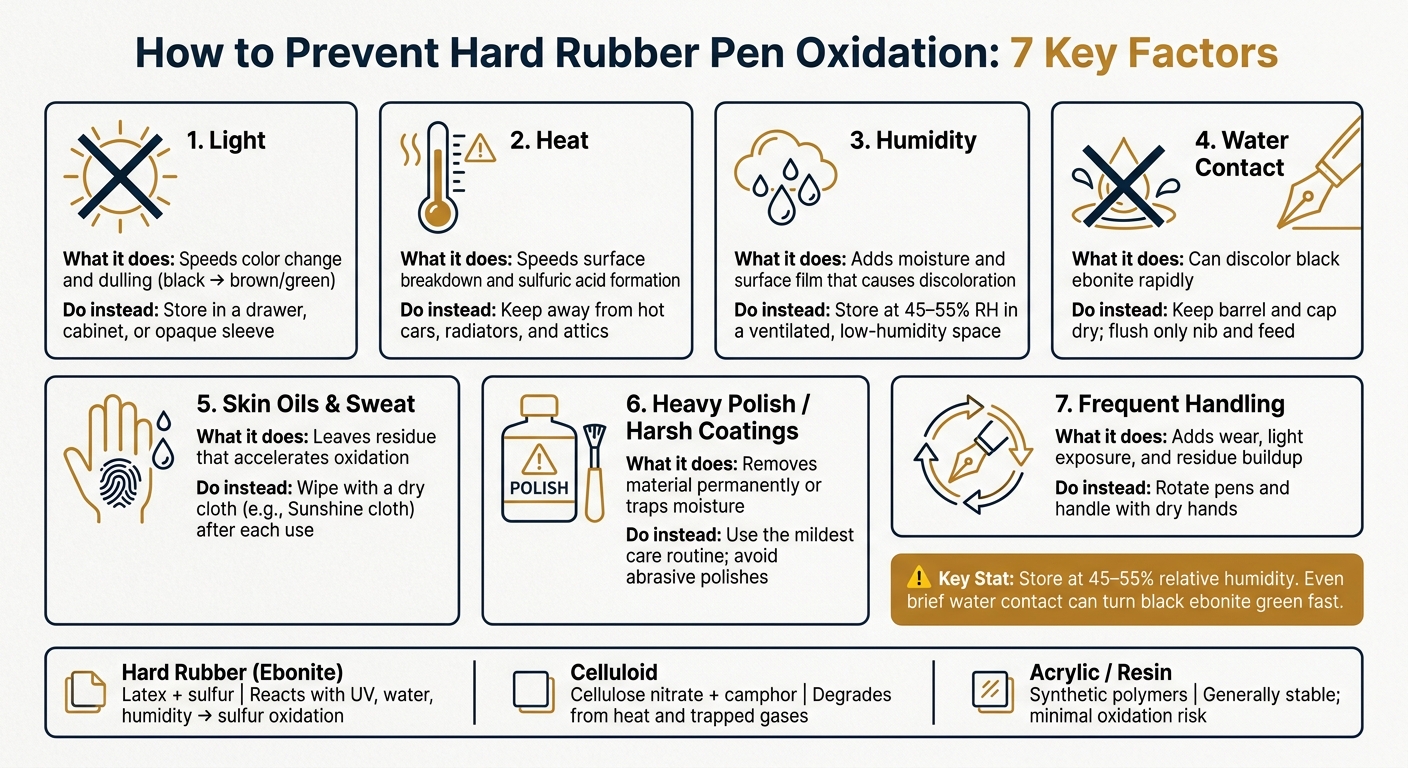
Hard Rubber Pen Oxidation: 7 Prevention Tips at a Glance
Deoxidizing Blackened Hard Rubber Fountain Pens - with La Belle Epoque Deoxidizer
sbb-itb-1dd4fe9
Why Hard Rubber Oxidizes Faster Than Other Pen Materials
Hard rubber oxidizes faster because its sulfur-rich surface reacts with oxygen and moisture. Over time, that reaction can leave behind a dull, acidic film. You may also see a sulfate film on the outside of the pen and even inside the cap. Put simply, these kinds of exposure speed up sulfur oxidation on the surface of hard rubber.
Solid black hard rubber usually shows this change first. Mottled and ripple patterns tend to hide oxidation better, so the damage can be less obvious at a glance.
Acrylic and modern resin are much more stable because they don't contain reactive sulfur. That's the big reason hard rubber needs stricter care.
| Material | Primary Composition | Degradation Mechanism | Environmental Triggers |
|---|---|---|---|
| Hard Rubber (Ebonite) | Latex rubber + sulfur | Sulfur oxidation / sulfuric acid formation | UV light, water, humidity |
| Celluloid | Cellulose nitrate + camphor | Camphor loss / degradation | Heat, trapped gases |
| Acrylic / Resin | Synthetic polymers | Generally stable; minimal oxidation | Extreme heat or impact |
Because light is the fastest trigger, the first step is simple: keep hard rubber out of direct exposure.
1. Control Light Exposure
Light is one of the main things that speeds up hard rubber oxidation. UV rays and even strong indoor lighting can push the material along, turning black pens brown or green over time.
The good news? You usually don't need any special product or fancy fix. Properly storing your fountain pen does most of the work. A windowsill, a pen cup sitting near a bright window, or a shelf under fluorescent lights can all keep a pen under steady exposure day after day.
A closed drawer or cabinet is a much safer place for long-term storage. Between uses, keep the pen shaded and out of direct sunlight.
It sounds like a small habit, and it is. But over months and years, that small habit can make a clear difference.
2. Avoid Excess Heat and Temperature Swings
Light can harm hard rubber, but heat makes the chemical change happen faster, even when the pen is stored in the shade. Because hard rubber is sulfur-cured, higher temperatures speed up surface oxidation. That process can lead to sulfuric acid forming on the hard rubber, and that can discolor nearby items. Big swings from hot to cool can also put stress on old hard rubber.
Where Hard Rubber Pens Should Never Go
Keep these pens out of hot cars, near radiators, in attics, and out of any storage space that holds heat. A cool, shaded spot is the safer choice. Keep the pen away from heat sources and store it where the temperature stays fairly steady.
3. Manage Humidity and Airflow in Storage
Heat isn't the only thing that can damage hard rubber. A damp storage spot can discolor it just as fast. Even if the pen stays in the dark, humidity still speeds hard rubber oxidation. Moisture can also help form a surface film that discolors ebonite.
Why Humidity Matters
Damp storage can leave a moisture-attracting film on the pen and inside the cap. That film can lead to permanent discoloration.
Airflow plays a part too. Sealed containers trap moisture, while a ventilated space helps reduce acid buildup.
The safer move is to store hard rubber pens in a low-humidity, well-ventilated space instead of an airtight container. It also helps to keep pens separated, so one damaged surface doesn't affect the others.
4. Limit Water Contact
Direct contact with water can speed up oxidation and discoloration in hard rubber pens. As ebonite gets older, oxygen and water can push surface oxidation and acid buildup, which can later produce sulfuric acid on the surface. Moisture can also cause sulfates to condense into a hydrophilic film that spreads discoloration.
Why Water Is Especially Risky for Black Ebonite
Black ebonite is more at risk than patterned ebonite. Even a short exposure to water can discolor black ebonite fast. Patterned ebonite tends to hide oxidation a bit better, but the risk is still there.
How to Clean Without Causing Damage
Keep water use as limited as possible. Flush only the nib and feed, and keep the barrel and cap dry. Never submerge hard rubber parts.
If you need hot water for feed work, remove the section first so the barrel stays out of the water. For exterior residue, use a dry polishing cloth instead of washing the surface. Then dry the pen all the way before capping or storing it.
After it's dry, handle it with clean hands so you don't leave a new layer of skin oil on the surface.
5. Clean Off Skin Oils, Sweat, and Ink Residue
After you limit water exposure, the next job is getting rid of what your hands leave on the pen. Every time you handle a hard rubber pen, a thin layer of skin oils, sweat, and ink residue stays behind. It may not look like much, but that surface moisture can speed oxidation, so it’s best to wipe it off before storage.
Safe Cleaning for Hard Rubber
Use a dry polishing cloth, such as a Sunshine cloth, to lift ink residue and fingerprints. Skip damp cloths and wet wipes on the exterior.
Dry After Each Use
A quick wipe after each writing session can help prevent long-term staining and chemical reactions. Before you put the pen away, check that the exterior is clean and dry. After cleaning, protect the pen with careful storage and handling.
6. Use Protective Coatings and Storage Accessories with Care
After cleaning, don’t rush to put a coating on the surface. A dry polishing cloth is usually enough to remove leftover residue, lift light stains, and bring back some gloss. Heavy waxes and sealants are best avoided on ebonite.
When it comes to care, storage does more than surface coatings. Keep hard rubber pens in a low-humidity, ventilated space to slow acid formation. And if you have ebonite eyedroppers, apply a small amount of silicone grease to the section and threads to help limit leaks.
7. Handle and Rotate Hard Rubber Pens with Care
Once storage is sorted out, day-to-day handling becomes your next layer of protection. Rotate your pens so one hard rubber barrel doesn’t absorb all the daily light, skin contact, and residue. Black ebonite oxidizes faster than lighter hard rubber, so it helps to limit both light and moisture. Oxidation builds over time, which means even short periods of exposure can stack up.
Rotate Pens to Reduce Wear
Switching between two or three pens in daily use spreads out exposure instead of putting it all on one barrel. That means less contact with light, less buildup from handling, and less residue sitting on the surface. In practice, rotation turns careful storage into a simple daily habit.
Safety for Hard Rubber
Handle the barrel with dry hands, and don’t grip it too tightly near the section. Even a brief touch of water can discolor black ebonite fast. Dry your hands before handling black ebonite.
Long-Term Storage Value
After using the pen, put it back in a well-ventilated, low-humidity spot. If the pen leaks, store it nib-up during long breaks.
Storage and Care Comparison Tables
Use these tables as a quick reference for storage and care choices that can slow hard rubber oxidation. They turn the earlier guidance into a fast checklist: first get storage right, then pick the gentlest care routine that does the job.
Light Exposure: Storage Options Compared
| Storage Option | Light Protection | Heat Risk | Best Use Case |
|---|---|---|---|
| Enclosed wood drawer | High – blocks direct and most ambient light | Low | Long-term preservation; infrequently used pens |
| Glass-front cabinet | Moderate – reduces direct beams, but UV and infrared can still pass through | Medium – heat can build up through glass | Display and moderate rotation; keep away from windows |
| Open tray | Low – full exposure to room light | Variable | Short-term staging only; daily rotation for non-hard-rubber pens |
Glass-front cabinets can work, but only if they stay out of direct sun. Keep illumination below 150 lux and UV below 75 microwatts per lumen.
Humidity and Airflow: Storage Options Compared
| Storage Option | Humidity Stability | Airflow | Main Risk |
|---|---|---|---|
| Sealed plastic box | Variable; can trap moisture | Very low – stagnant air | Use only with monitored desiccant packs; otherwise it can trap moisture. |
| Ventilated wooden case | Generally stable in climate-controlled homes | Moderate – gentle circulation | Best overall balance; limits moisture buildup without over-drying |
| Open shelf | Highly variable | High – full room exposure | Acceptable in climate-controlled spaces; avoid near kitchens, bathrooms, or humidifiers |
In climate-controlled homes, a ventilated wooden case usually gives the best balance. Recommended relative humidity for pen storage sits around 45–55% RH.
Once storage is steady, the next step is deciding whether any surface treatment is worth using at all.
Routine Care Products: Risk Comparison
| Product | Oxidation Prevention | Risk to Hard Rubber | Recommended Frequency |
|---|---|---|---|
| Wax (microcrystalline) | Creates a thin protective barrier | Low – reversible, minimal material removal | A couple of times per year |
| Mineral oil | Temporary surface barrier | Low to moderate – excess use attracts dust and may affect seals | Once or twice a year, sparingly |
| Specialized deoxidizer | Removes existing surface oxidation | Moderate – removes some material with each use | Only when oxidation visibly affects appearance |
| Abrasive polish | Temporarily restores gloss | High – permanently removes material, can erase imprints | Last resort only; not for routine care |
Abrasive polishes pose the highest long-term risk to hard rubber because they permanently remove material, soften sharp details, and can diminish collector value over time.
The safest rule is simple: use the mildest routine that fits the pen. The accessories below help keep that setup in place.
Useful Accessories for Daily Pen Storage
Once you’ve got the basic storage setup right, the next step is using the right accessories day to day. They help keep conditions steady and cut down on wear from normal handling.
Pen sleeves and pouches do a lot of the heavy lifting. They block light, reduce surface wear, and help protect the pen during storage or while you’re carrying it around. A soft-lined, opaque sleeve adds a simple physical barrier between the pen and rough desk surfaces. That matters because even small bits of friction can leave micro-scratches over time. Go with a smooth interior lining if you can. Rough seams may leave rub marks. Before the pen goes back into the sleeve, give it a quick wipe with a dry cloth.
Pen rolls work in much the same way. Each slot keeps pens apart, which cuts down on pen-to-pen contact and handling damage. If you store the roll inside a drawer, you also get more protection from light.
For everyday desk use, a closed or covered pen stand keeps the pen within reach without leaving it sitting under task lighting for hours. Place the stand away from windows and bright lamps. Covered is better than out in the open.
A polishing cloth helps finish the routine. After writing, a fast dry wipe before storage helps keep the pen ready for its sleeve or case. Write, wipe, cap, store.
The tables below compare which storage options protect hard rubber best.
Hard Rubber Oxidation Prevention Checklist
After you wipe the pen down and put it in the right spot, take a few seconds to check these basics before storage.
| # | What to Do | Key Detail |
|---|---|---|
| 1 | Keep pens out of direct light | Store them in a covered place when not in use |
| 2 | Avoid excess heat and temperature swings | Keep pens out of hot cars, radiators, attics, and rapid temperature swings |
| 3 | Store pens in a well-ventilated, low-humidity area | Avoid airtight seals and sealed cases |
| 4 | Limit water contact | Even brief contact can turn black ebonite green quickly |
| 5 | Wipe away surface residue and light stains | Use a dry cloth or Sunshine cloth instead of liquid cleaners |
| 6 | Avoid heavy waxes and sealants | Heavy coatings can trap moisture |
| 7 | Handle with dry hands and rotate pens in use | Minimize unnecessary wear during daily use |
A short checklist like this can save a lot of trouble later. Light, heat, moisture, and trapped air are often what push hard rubber toward discoloration.
A couple of points matter more than they seem. Water is a big one. Even a little contact can shift black ebonite toward green fast. And while it may feel smart to seal a pen away tightly, that can backfire. Sealed cases and airtight storage can hold in moisture, which is the last thing you want.
For day-to-day care, keep it simple. Wipe off surface residue with a dry cloth or a Sunshine cloth, skip liquid cleaners, and don’t pile on waxes or sealants that can trap moisture. Dry hands help too, especially if you use the pen often.
Conclusion
Hard rubber doesn’t hide neglect for long. It shows wear fast, which is why protection comes down to a few steady habits.
Light, heat, moisture, and skin oils all speed up oxidation. That’s the big reason storage matters so much.
Use the checklist and tables as a quick reset any time your routine shifts. Keep storage cool, stable, and dry.
If oxidation has already started, the goal is no longer prevention. It’s damage control. Once oxidation is visible, stay away from aggressive fixes. They remove material and rarely bring back the original color.
Daily storage gets much easier when the right container is already nearby. A simple pen case or pen stand can make day-to-day protection a lot easier.
FAQs
Can oxidized hard rubber be reversed?
Yes. In many cases, oxidized hard rubber can be brought back because the discoloration usually sits on the surface, while the darker material is still underneath.
Polishing can remove that dull brown or gray film and bring the original color back into view. If the oxidation is light, a soft wool cloth may do the job. If it’s heavier, you may need special polishing compounds or reblackening.
Go gently, though. It’s easy to wear down imprints or chasing if you get too aggressive.
What storage setup works best at home?
Store hard rubber pens in a cool, dark, well-ventilated spot to help slow oxidation, with a target range of 60°F to 75°F. Skip airtight containers, since they can trap reactive vapors over time.
Good storage choices include wooden pen chests, desk drawers, and leather or padded fabric cases. If you keep pens at your desk, store them horizontally to help maintain steady ink flow.
How often should I wipe down the pen?
Wipe the nib and grip section with a soft cloth after each writing session. It’s a small habit, but it helps keep ink residue, skin oils, and dirt from building up. You should also wipe the outside of the pen on a regular basis, since those oils and bits of grime can lead to surface oxidation over time.
For routine care, clean the internal parts every 4 to 8 weeks. During warmer months, do it every 2 weeks to help stop ink clogs caused by evaporation.