

Tired hands while writing? It’s likely your grip. Most people grip their pens harder than needed - up to 3x more force - causing fatigue, cramps, and even long-term strain. A lighter grip and better tools, like fountain pens for beginners can make writing easier and more comfortable.
Fountain pens reduce strain by requiring less pressure. Their design lets ink flow smoothly, so you don’t have to press hard. Pair this with ergonomic pen shapes, wider barrels, and materials like rubberized grips, and you’ll see a noticeable difference in comfort. Adjusting your writing technique - like holding the pen lightly and using your shoulder for movement - can also help.
Key takeaways:
- Over-gripping leads to hand fatigue and muscle strain.
- Fountain pens reduce effort with smooth ink flow.
- Ergonomic pens (wider barrels, flared grips) lower strain.
- Writing from your shoulder, not wrist, improves endurance.
Small changes in grip and pen choice can transform long writing sessions into a more comfortable experience.
Understanding Hand Fatigue and Its Causes
How Writing Affects Hand and Wrist Muscles
When you write, your fingers, wrist, and arm work together like a finely tuned system of levers. This movement relies on a combination of muscles, including the flexor pollicis brevis in your thumb, as well as muscles in your index and middle fingers, forearm, and even your shoulder.
An efficient grip allows your fingers to handle the majority of the work. These small, precise motions require less energy. However, when your grip becomes inefficient, your shoulder and elbow step in to compensate. This uses up far more energy, leaving you fatigued much faster - up to 80% less writing endurance in some cases. This imbalance in movement mechanics often leads to grip force problems, which we’ll dive into next.
How Grip Force Leads to Fatigue
One of the most common issues for writers is gripping the pen too tightly. Studies reveal that most people use three times more force than necessary to move a pen across paper. This excessive gripping causes hypertonic co-contractions, where opposing muscles work against each other. Over time, this can lead to conditions like Writer's Cramp.
Over-gripping also recruits more fast-twitch (Type II) muscle fibers than needed. These fibers are built for short bursts of power, not sustained effort. Using them excessively during prolonged writing quickly leads to exhaustion, undermining your ability to write for extended periods.
"Users are applying 3x the necessary force, creating a deadlock in their fine motor skills. This guide treats your hand as a mechanical linkage system that needs debugging." - Xin Wan, Founder & Lead Developer, PrintableHandwriting
Understanding these dynamics is essential, as recognizing early signs of strain can help you make adjustments before fatigue sets in.
Warning Signs of Grip-Related Strain
To avoid long-term discomfort, it’s important to watch for early signs of strain caused by excessive grip force. One of the first indicators is joint soreness in your thumb and fingers, especially since thumb force during writing (averaging 2.63 N) is significantly higher than the force exerted by your index finger (1.26 N). Other symptoms include tightness in your forearm, tension in your shoulder, and white knuckles, which signal reduced blood flow.
If you notice the paper denting under your pen or your knuckles turning pale, it’s a clear sign that your grip is too tight. Another red flag? Feeling the need to shake out your hand during a writing session. These signs suggest it’s time to reassess your grip and writing technique.
sbb-itb-1dd4fe9
Mastering the Art of Fountain Pen Grip: A Pain-Free Writing Experience
Ergonomic Principles for Reducing Hand Fatigue
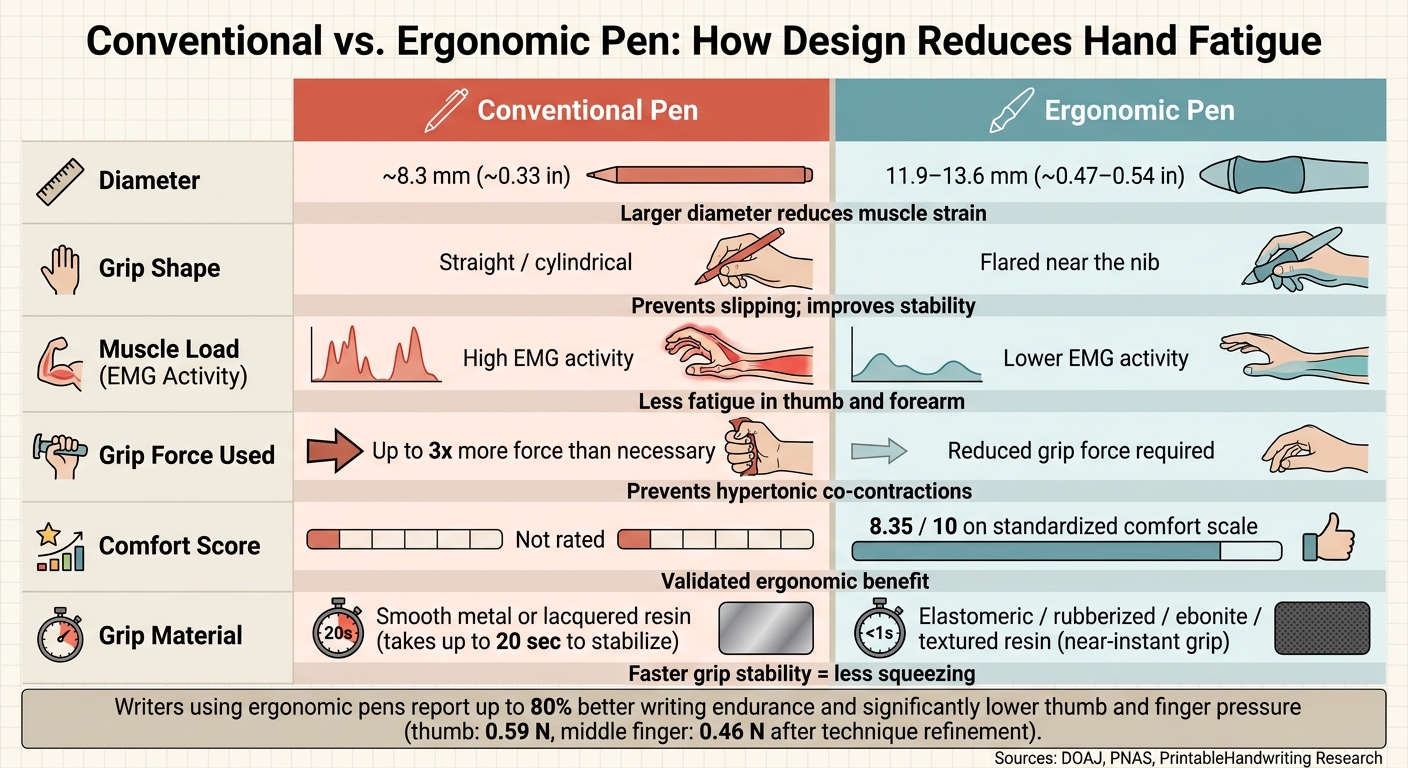
Conventional vs. Ergonomic Pen: Grip Comfort & Muscle Strain Compared
Grip Patterns That Reduce Fatigue
While many writing guides advocate for the dynamic tripod grip - where the pen rests on the middle finger and is pinched between the thumb and index finger - as the gold standard, research suggests the reality is more complex. A study involving 120 students revealed that after a 10-minute writing task, effort ratings were nearly identical across all common grip styles (p = 0.895). This means no single grip type is inherently less tiring than others. Interestingly, the lateral tripod and quadruped grips matched the dynamic tripod grip in both writing speed and legibility, even during longer tasks.
Efficient writing depends on maintaining a steady grip and making small, continuous adjustments. Skilled writers often apply consistent pressure to the pen barrel rather than the tip, which helps evenly distribute effort and reduces strain over time. Beyond grip techniques, the design of the pen itself plays a major role in overall comfort.
How Pen Size and Shape Affect Grip Comfort
The size and shape of a pen can significantly impact muscle effort. A comparison between a standard pen (about 0.33 inches / 8.3 mm in diameter) and a larger ergonomic pen (approximately 0.47–0.54 inches / 11.9–13.6 mm in diameter) showed that the wider, softer pen reduced pain in key areas like the thumb, fingers, forearm, and shoulder during hour-long writing sessions. A thicker pen barrel minimizes the need for tight finger curling, which naturally reduces the force required to hold it. Additionally, pens with a flared nib offer a built-in finger rest, preventing slipping and reducing the need for a tighter grip.
| Feature | Conventional Pen | Ergonomic Pen | Effect on Comfort |
|---|---|---|---|
| Diameter | ~8.3 mm (~0.33 in) | 11.9–13.6 mm (~0.47–0.54 in) | Larger diameter reduces muscle strain |
| Grip Shape | Straight/cylindrical | Flared near the nib | Prevents slipping; improves stability |
| Muscle Load | High EMG activity | Lower EMG activity | Less fatigue in thumb and forearm |
How Pen Balance and Materials Affect Grip
In addition to size and shape, the balance and material of a pen are critical for reducing hand fatigue. Pens with elastomeric or rubberized grip sections create a stable contact area almost instantly, requiring less pressure to maintain control. On the other hand, pens with harder, polished surfaces - like smooth metal or lacquered resin - depend on the skin’s natural moisture to generate friction, which can take up to 20 seconds.
"The formation of a steady-state contact area is almost instantaneous if the counter surface is soft relative to keratin in a dry state. It is for this reason that elastomers are commonly used to coat grip surfaces." - PNAS
This explains why fountain pens with ebonite, brushed metal, or textured resin grips are often preferred for extended writing sessions. These materials reduce the need to squeeze harder for stability. Additionally, pens with a balanced design - where the center of gravity is closer to the grip - help minimize the tension in your fingers and wrist that would otherwise arise from controlling a top-heavy pen barrel.
Practical Tips for Fountain Pen Users
How to Adjust Your Grip for Comfort
Ease up on the pressure. Fountain pens rely on capillary action to deliver ink, which means the nib only needs to gently touch the paper - there’s no need to press down hard.
"Fountain pens are designed to write with minimal pressure, so a light grip helps maintain a steady flow of ink and prevents fatigue." - Patrick Maness, A.T. Cross
For the best results, hold the pen about 1 inch above the nib and angle it between 40–55°. This keeps the nib flat against the paper, ensuring smooth ink flow. If you’re noticing ink blotting or feeling hand cramps shortly after starting, you’re likely gripping too tightly. Once your grip feels natural, choosing the right pen to match your writing style can take your comfort to the next level.
Matching Pen Design to Your Writing Style
Finding a pen that suits your writing style can make a big difference in comfort and performance. If you tend to write quickly or for long periods, a lightweight resin pen can help reduce hand strain. Pairing this with a medium or broad nib encourages smoother ink flow, which naturally reduces the temptation to press harder.
The type of paper you use also plays a role. Smooth, non-absorbent options like Rhodia or Tomoe River paper allow the nib to glide effortlessly, making writing easier and more enjoyable. If you’re new to fountain pens, consider starting with a beginner-friendly set, such as those from Fountain Pen Revolution, which offers packages starting at $35. These sets include a pen, ink, and accessories, giving you an affordable way to experiment with different nib sizes and barrel weights.
Building Healthy Writing Habits
Adjusting your pen and grip is only part of the equation - your posture and overall writing habits matter just as much. Over-gripping can strain your hand muscles, but adopting healthier habits can significantly reduce fatigue.
One key tip is to write using your shoulder and elbow rather than relying solely on your wrist. This approach not only minimizes strain but also improves your writing endurance.
"Try to write from your shoulder or elbow... Good posture reduces fatigue and helps you maintain the correct fountain pen grip without strain." - Hannah Smith, Creative Writer, The Pen Company
To further ease tension, rotate your paper 20–45° to align with your arm’s natural movement. Keep your wrist as straight as possible, and if you feel tension building, take short breaks to rest your hands. Lastly, ensure your pen’s nib is clean and flows well - forcing a pen to work harder than it should is a common but avoidable source of grip-related discomfort.
Better Grip, Better Writing Comfort
Hand fatigue while writing often stems from habits that can be adjusted. Studies highlight that excessive grip pressure is the main issue, and fountain pens, with their reliance on capillary action, naturally promote a lighter touch - breaking the cycle of strain.
Research indicates that refining grip techniques can significantly lower thumb pressure to 0.59 N and middle finger pressure to 0.46 N, which represents a substantial reduction compared to typical force levels. Additionally, ergonomic pens scored an impressive 8.35 out of 10 on a standardized comfort scale, showing how thoughtful design and proper technique create a more comfortable writing experience. These findings clearly show that design and technique must work together.
"Ergonomically designed hand tools can reduce user discomfort, biomechanical stresses, and risk factors for musculoskeletal symptoms and injuries in hands." - DOAJ
By applying ergonomic principles, the right pen paired with proper technique helps redistribute the physical strain. This balance shifts the load away from the smaller finger muscles and spreads it more evenly, making extended writing sessions manageable and far less taxing.
A few small adjustments - like improving your grip, tweaking the paper angle, or using a pen with the right weight - can make a noticeable difference. These changes not only reduce fatigue but also turn long writing sessions into comfortable and enjoyable routines.
If you're looking to enhance your writing comfort, explore pens designed with ergonomics in mind, such as those offered by Fountain Pen Revolution.
FAQs
How do I tell if I’m gripping my pen too hard?
If your hand feels sore, stiff, or tired while you're writing, you might be gripping your pen too tightly. This "death grip", as it's sometimes called, can even mess with the ink flow. To prevent this, try holding the pen with a light touch and keep your hand relaxed. Instead of relying solely on your fingers, use your forearm and shoulder to guide your movements. If you notice tension creeping in, take a break and shake out your hand to release the strain.
What fountain pen features help most with hand fatigue?
To ease hand fatigue, opt for fountain pens designed with ergonomic features that promote a comfortable grip. Pens with a wider barrel - ideally between 11.9 mm and 13.6 mm - reduce the strain caused by gripping too tightly. Grips made from soft, textured materials add to the comfort, making long writing sessions more manageable. Additionally, a well-balanced pen, particularly one with a front-weighted design, ensures smoother nib contact with less effort, enhancing the overall writing experience.
Can paper choice really make writing feel easier?
Yes, the type of paper you use can make a big difference in your writing experience. Even the smoothest nib can feel rough on cheap, porous paper. Opting for high-quality paper with a smooth finish and balanced absorbency minimizes friction, letting your pen glide more easily. Fountain Pen Revolution provides a variety of fountain pens and accessories, helping you match the perfect tools with premium paper for a seamless and comfortable writing experience.