

Flex nib calligraphy is about creating stunning line variations using flexible fountain pen nibs. To succeed, you need the right tools, proper technique, and regular practice. Here's a quick breakdown:
- Pens: Choose a flex nib pen with good "spring back" for smooth transitions. Steel nibs are durable for beginners, while gold nibs offer finer results.
- Ink: Use fountain pen ink with good flow. Avoid India ink or iron gall ink, which can damage your pen.
- Paper: Opt for smooth, high-quality paper to prevent bleeding or feathering.
- Technique: Maintain a relaxed grip, control pressure carefully, and practice slow, deliberate strokes.
- Maintenance: Clean your nibs after use to prevent corrosion and ensure consistent performance.
Consistency is key. Practice basic strokes daily, track your progress, and adjust tools as needed to improve. By combining the right tools with patience and care, you'll master this timeless art form.
HOW TO USE FLEX NIBS (and how not to break them)
sbb-itb-1dd4fe9
Tools You Need for Flex Nib Calligraphy
Using the right tools can make all the difference. Flex nib calligraphy demands more precision from your equipment than everyday writing. The nib, ink, and paper all work together as a system, and if one element falls short, the entire experience can be frustrating.
Choosing a Flex Fountain Pen
For flex nib calligraphy, look for pens with quick "spring back." This feature ensures the nib snaps back into place rapidly, allowing for smooth transitions between thick and thin strokes.
"Flex nibs used for the Spencerian or Copperplate writing styles should possess the property of 'spring back' or 'return', meaning that their tines should close back together extremely quickly when released." – Wikipedia
Another critical element is the feed. Flex nibs require a steady, generous ink flow to avoid railroading - a common issue where the ink film breaks between the nib's tines, leaving gaps in your strokes.
For beginners, steel nibs are a practical choice. They're more forgiving under pressure and less expensive than gold nibs. On the other hand, 14k gold nibs offer finer hairlines and better spring back but demand more careful handling. Companies like Fountain Pen Revolution provide beginner-friendly sets starting at $35, along with higher-end options beginning at $44, including pens with gold nibs for those ready to upgrade.
Inks That Work Well with Flex Nibs
Always use fountain pen ink. India ink, while tempting, can clog the feed and permanently damage the nib, making it unsuitable for flex pens. The key characteristic to prioritize is wetness. Flex nibs require inks that flow freely and provide ample lubrication to prevent railroading during wide, dramatic swells. Dark, saturated colors like black and deep blue create bold contrasts between thick and thin strokes, while lighter inks are better suited for practice.
If you're using a steel nib, avoid aggressive ink formulations like iron gall, which can corrode the nib over time. Even with mild inks, a steel flex nib may lose its fine hairline after approximately 750 feet of writing.
Paper and Writing Surface
Smooth, high-quality paper is a must for flex nib calligraphy. Rough or low-quality paper can cause bleeding, feathering, or uneven ink absorption. Additionally, sharp nib tips can catch on rough fibers, leading to ink splatter or damage.
"Having good paper matters. Think of this pen like a musical instrument - you have to work with the instrument for best results." – Desiderata Pen Company
Keep your paper surface clean, as oils from your skin can disrupt the ink flow and cause hard starts. Using a guide sheet beneath your writing paper can also help maintain consistent letter spacing and angles - especially helpful when you're still developing muscle memory for a specific script. With the right tools in hand, you can shift your focus to honing your technique and mastering the art of flex nib calligraphy.
Techniques for Flex Nib Calligraphy
Having the right tools is just the start. The way you handle your pen - your grip, pressure, and stroke pace - determines how polished your calligraphy will look.
Grip and Posture
A relaxed tripod grip - using your thumb, index, and middle fingers - is key. This grip should feel natural, giving you control without causing strain. The nib must stay aligned with your writing line; even a slight rotation can throw off the pressure balance, leading to scratchy or uneven strokes.
Pressure Control and Stroke Order
When applying pressure, focus on the pen’s barrel rather than pressing the nib directly against the paper. On upstrokes, avoid using any pressure at all. Pressing too hard can snag the paper or even damage the nib’s tines permanently.
For downstrokes, apply gentle outward pressure to flex the nib, creating bold, dramatic swells. On upstrokes, release all pressure to achieve fine, hairline strokes. Flex nibs, such as those from Fountain Pen Revolution, can produce lines ranging from 0.5 mm with no pressure to 2 mm when fully flexed. However, it’s best to stay well below the maximum flex until you’ve built confidence. Over-flexing too soon can "spring" the nib, causing the tines to bend outward and lose their ability to close properly.
Once you’ve mastered basic control, work on creating a steady rhythm and consistent strokes to refine your lettering.
Rhythm and Letter Spacing
Slow, deliberate writing is essential. A steady pace allows you to monitor the nib’s flex and ensures the feed delivers enough ink to fill wide strokes without railroading. If you encounter flow issues, there are several quick fixes for a fountain pen not writing to get the ink moving again. Before attempting full words, practice individual downstrokes and upstrokes. Repeating these motions builds the muscle memory you’ll need for smooth transitions and consistent spacing.
Use a guide sheet to help maintain even spacing. If you need to pause mid-word, lift the pen cleanly and allow the ink to settle before resuming. This prevents smudging and ensures your spacing remains intentional and neat.
Caring for Your Flex Nib and Tools
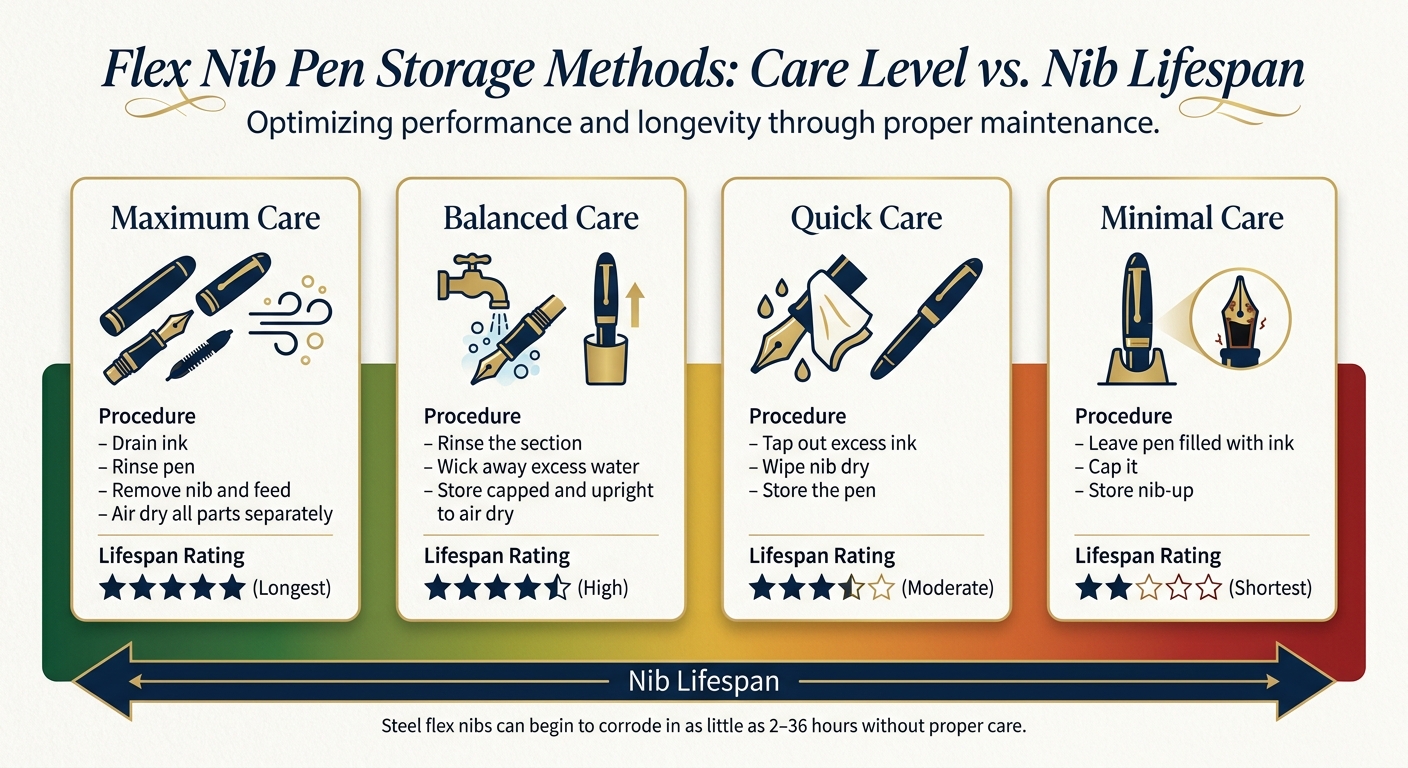
Flex Nib Pen Storage Methods: Care Level vs. Nib Lifespan
Taking care of your flex nib is just as important as mastering your writing technique. Without proper maintenance, nibs can begin to corrode in as little as 2 to 36 hours.
Setting Up Your Nib Before Use
Before you start writing, take a close look at your new flex nib under a bright light. Check that the tines at the tip are touching. As Desiderata Pen Company explains:
"If the tines don't touch, the pen won't write properly."
Most steel nibs come with factory oils that can block ink flow. To remove these, gently clean the nib's top and underside using non-gel abrasive toothpaste with a toothbrush or Q-tip. After cleaning, test the nib by dipping it into ink. If the ink beads up, there's still oil present. If it spreads evenly, you're good to go. Additionally, flush the pen's feed and section with soap and water to eliminate any leftover manufacturing residue. Ensure the nib is seated firmly against the feed to prevent leaks. A small dab of saliva on the nib tip can help activate capillary action before you start testing your strokes.
Once your nib is properly prepared, regular upkeep will keep it performing well for a long time.
Routine Cleaning and Storage
Steel flex nibs are particularly prone to corrosion, so cleaning them after each use is essential. For disposable steel nibs like the Zebra G, clean them thoroughly after every session. For fountain flex pens, a monthly flush works well. Use water, a drop of dish soap, and a bit of ammonia, followed by a thorough rinse with water. This is especially important when switching inks.
How you store your pen also affects how long your nib lasts. Here are some storage tips:
| Storage Method | Procedure | Nib Lifespan |
|---|---|---|
| Maximum Care | Drain ink, rinse, remove nib and feed, and air dry all parts separately | Longest |
| Balanced Care | Rinse the section, wick away excess water, and store capped and upright to air dry | High |
| Quick Care | Tap out excess ink, wipe the nib dry, and store the pen | Moderate |
| Minimal Care | Leave the pen filled with ink, capped, and stored nib-up | Shortest |
Always store your pen with the nib pointing up and capped. This helps prevent ink from pooling and reduces the risk of accidental damage.
Fixing Common Problems
Even with regular cleaning, occasional issues can arise. For example, railroading - when the nib produces two parallel lines instead of a smooth stroke - is often caused by a dirty nib or feed. As Desiderata Pen Company points out:
"An unclean nib, especially between the tines and on the underside is the number one cause of poor flow and railroading."
If you notice railroading during a writing session, it might also mean you're writing too quickly. Slowing down can give the feed time to keep up with the ink flow. If the tines become misaligned after cleaning, gently flick the tip with a fingernail or Q-tip to realign them. And if a nib continues to underperform despite your efforts, replacing it sooner rather than later is usually the best option. Nib issues often worsen gradually over time.
Building a Regular Calligraphy Practice
With the right tools and techniques in place, the next step toward mastering flex nib calligraphy is consistent practice. Regularity is what separates casual attempts from meaningful progress. Short, focused practice sessions are far more effective than sporadic, lengthy ones.
Daily Practice Sessions
Start each session with basic stroke drills. As Richard Wideman, Founder of Calligrascape, wisely advises:
"Before tackling letters and words, practice basic calligraphy strokes."
Think of these drills as your warm-up. They loosen your hand and sharpen your control over pressure transitions, preparing you to move on to full letters and words. These foundational exercises are essential for building muscle memory, ensuring smoother pressure shifts and more consistent rhythm. Focused daily practice, even for a brief period, will yield better results over time than occasional marathon sessions.
Tracking Progress and Setting Goals
Keep your practice sheets dated. This simple habit allows you to visually track your progress over time. Comparing older sheets with recent ones can highlight improvements in areas like stroke consistency or letter spacing. For finer details, like the quality of hairlines or the uniformity of ovals, taking photographs can be a helpful way to spot subtle changes.
For inspiration and benchmarks, explore the IAMPETH (International Association of Master Penmen, Engrossers, and Teachers of Handwriting) archives. Historical scripts provide clear targets - whether it’s mastering thin upstrokes or achieving consistent spacing. Focusing on one specific goal at a time is far more manageable than attempting to improve everything at once. And when you feel stuck, it might be time to reassess your tools or technique.
Knowing When to Adjust Your Tools or Technique
If you find yourself hitting a plateau despite regular practice, it’s worth examining your tools and approach. Issues like railroading, scratchiness, or inconsistent ink flow often point to a problem with your nib or ink. The Desiderata Pen Company notes that a steel flex nib typically lasts for about 750 feet of writing before its performance starts to decline. This means wear and tear is something to monitor closely.
Paper quality can also play a role. Oils from your hands can affect how ink flows, while using a heavier paper stock - such as 28 lb or 32 lb - can help prevent feathering, which might otherwise seem like a technique issue. If cleaning your pen, switching inks, or upgrading paper doesn’t resolve persistent problems, the Desiderata Pen Company offers straightforward advice:
"When in doubt, when you start having problems, change the nib. Don't wait."
Adjusting your tools and setup as needed ensures that your practice remains productive and frustration-free.
Conclusion: Steps to Flex Nib Calligraphy Success
Flex nib calligraphy thrives on four key elements: the right tools, solid technique, regular maintenance, and consistent practice. When these align, you're set up for success.
On the tools front, FPR flex nibs stand out, offering line variations ranging from 0.5mm at rest to 2mm under pressure. This allows for precise, expressive control. Make sure your setup checks all four boxes to get the best results.
High-quality tools pave the way for smooth execution - seamlessly transitioning between delicate hairlines and bold swells without ink flow issues or snagging on the paper. Regular maintenance is crucial to ensure your tools perform reliably. As Fountain Pen Revolution explains, "Everything you need for basic pen maintenance and nib tuning in one convenient kit." Keeping your nibs clean and well-tuned can save you from unnecessary frustration.
If you're looking to enhance your calligraphy setup, Fountain Pen Revolution offers a range of flex nibs, inks, tuning kits, and complete setups. Plus, they provide free shipping on U.S. orders over $65 and international orders over $149.
FAQs
How do I know if I’m over-flexing a nib?
Over-flexing happens when a nib is pushed beyond its natural limit, causing permanent bending or damage to the tines. To keep your nib in good shape, avoid forcing it to its extremes - especially if you're still getting the hang of it. Stick to gentle, controlled strokes and leave a 0.3 mm margin from the nib's maximum spread. Also, remember: never apply pressure on upstrokes, rotate the nib improperly, or write too quickly.
What’s the fastest way to fix railroading mid-stroke?
If railroading happens while you're writing, stop applying pressure right away. Railroading occurs when the pen's feed can't supply ink quickly enough to match the nib's spread. To avoid this, try using a wet, lubricated ink, slow down your writing speed, and make sure the nib is properly aligned with the writing line, applying even pressure to both tines.
When should I replace a steel flex nib?
If your steel flex nib becomes permanently bent, fails to return to its normal shape, or shows signs of "springing" due to over-flexing, it's time to replace it. Unlike gold, steel doesn't have the same elastic memory, so applying too much pressure can cause lasting damage. You should also consider replacing the nib if it develops rust that can't be removed, sustains physical damage, or no longer performs consistently even with proper maintenance and adjustments.