

Looking for the right pen nib for your writing or calligraphy? Here’s the key difference:
- Flex nibs create dynamic, thick-and-thin strokes by flexing under pressure. Ideal for expressive calligraphy like Copperplate or Spencerian.
- Rigid nibs deliver consistent line widths, perfect for everyday writing or structured scripts like Italic.
Key Points:
-
Flex Nibs:
- Tines spread apart with pressure, allowing bold and thin lines in a single stroke.
- Requires slow, deliberate writing (2–3 seconds per letter).
- Suited for artistic styles but needs careful handling to avoid damage.
-
Rigid Nibs:
- Maintain uniform line width regardless of pressure.
- Faster and easier to use for daily tasks.
- Durable and beginner-friendly, but lacks line variation for calligraphy.
Quick Comparison:
| Feature | Flex Nibs | Rigid Nibs |
|---|---|---|
| Line Variation | High (pressure-driven) | None (uniform width) |
| Writing Speed | Slow | Fast |
| Best For | Calligraphy (Copperplate, Spencerian) | Everyday writing, Italic scripts |
| Learning Curve | Steep | Easy |
Choosing the right nib depends on your goals: For expressive calligraphy, go with a flex nib. For consistent, no-fuss writing, rigid nibs are the way to go. If you're still deciding, check out our fountain pen buying checklist for more tips.
Introduction to Stub and Flex Nib Fountain Pens
sbb-itb-1dd4fe9
What Are Flex Nibs?
A flex nib is designed to create line variation by spreading its tines apart when pressure is applied. At rest, the tines sit together, but with pressure, they separate, allowing more ink to flow for broader strokes.
As nib expert Richard Binder puts it:
"A flex nib does not produce line variation as a result of its tip shape. Instead, it has an ordinary round tip. Its tines are longer and thinner than those of an ordinary nib, and this design makes them more flexible."
This design is what gives flex nibs their ability to produce dynamic, expressive strokes.
How Flex Nibs Work
The magic of a flex nib lies in its ability to deflect under pressure. This happens because its tines are longer and thinner, with an extended slit that allows them to bend more easily. For comparison, a rigid nib is about 0.45 mm thick, while a flex nib is closer to 0.25 mm.
The semicircular shape of the nib also plays a role, causing the tines to spread outward rather than just bending upward. As the gap widens, more ink is drawn onto the paper through capillary action. Once the pressure is released, a well-made flex nib snaps back to its original state, ensuring smooth transitions between thick and thin strokes.
These mechanical features are what make flex nibs so effective for creating expressive writing.
Advantages of Flex Nibs
The standout feature of flex nibs is their ability to produce striking line variation. A good flex nib can transition from a fine hairline to a bold, wide stroke within a single letter. High-quality flex nibs can even achieve up to 20× variation between their thinnest and thickest strokes. This dramatic contrast is a hallmark of calligraphic styles like Copperplate, where bold downstrokes and delicate upstrokes are essential.
This responsiveness makes flex nibs a favorite for scripts like Copperplate and Spencerian, where line contrast brings the lettering to life.
Things to Keep in Mind When Using Flex Nibs
Using a flex nib requires patience and precision. Skilled calligraphers often take 2–3 seconds to complete a single letter, giving the ink feed enough time to supply the widened tines. Rushing can lead to issues like railroading, where the ink splits into two thin lines.
It’s also important to respect the nib’s elastic limit - the maximum pressure it can handle. Exceeding this limit can permanently damage the nib, a condition known as being "sprung." When this happens, the tines bend upward near the breather hole and fail to close properly. On upstrokes, it’s crucial to ease off the pressure to prevent the tines from catching on the paper’s fibers.
Mastering a flex nib takes time, but the results are well worth the effort.
What Are Rigid Nibs?
A rigid nib - sometimes referred to as a "nail" or "manifold" nib - is engineered to resist bending under pressure. These nibs were originally developed in the 1930s for business purposes, specifically to handle the demands of creating multiple carbon paper copies. As nib expert Richard Binder puts it:
"A rigid, or manifold, nib won't bend very much even under hard pressure; it was designed to resist bending so that it could be pressed hard enough to make carbon copies."
The result? A nib that maintains its shape and produces a consistent line, no matter the pressure applied.
How Rigid Nibs Work
The secret behind a rigid nib’s consistency lies in its preload - the internal force that keeps the tines tightly together. When writing, most people apply between 30g and 80g of pressure. However, a rigid nib requires between 300g and 500g of force just to separate the tines by a small gap of 0.2mm to 0.4mm. This means that during normal writing, the tines remain firmly in place.
The design of rigid nibs also plays a key role. They feature shorter, thicker tines (around 0.45mm compared to the 0.25mm on flex nibs) with a stiffer cross-section. This eliminates any "hinge effect", ensuring the nib glides smoothly across the page while maintaining the same line width from start to finish. This structural firmness delivers practical benefits for everyday use.
Advantages of Rigid Nibs
Rigid nibs are ideal for straightforward, no-fuss writing. Since they don’t respond to pressure, there’s no special technique to master and no risk of damaging the nib by pressing too hard. They’re also faster to write with - where flex nibs require slow, deliberate strokes, rigid nibs handle regular handwriting speeds effortlessly, without skipping or railroading.
Another big plus is their durability. Rigid steel nibs can withstand heavy-handed writing that might permanently damage a more delicate flex nib. This makes them a great choice for everyday use, especially for those transitioning from ballpoint pens or carrying a pen for daily tasks.
Limitations of Rigid Nibs
While rigid nibs shine in many areas, they do have their drawbacks. The biggest downside? No line variation. A rigid nib produces the same line width on both upstrokes and downstrokes, making it unsuitable for calligraphic styles like Copperplate or Spencerian, which rely on contrasting line thickness. As engineer Amadeus W. explains, the preload ensures constant line width regardless of pressure changes. This consistency is great for daily writing but limits its use for expressive lettering.
It’s worth mentioning that italic nibs - while also rigid - can create some line variation based on the angle of the stroke rather than pressure. However, this effect is different from the dynamic variation achieved with a flex nib.
Line Variation: Flex Nibs vs. Rigid Nibs
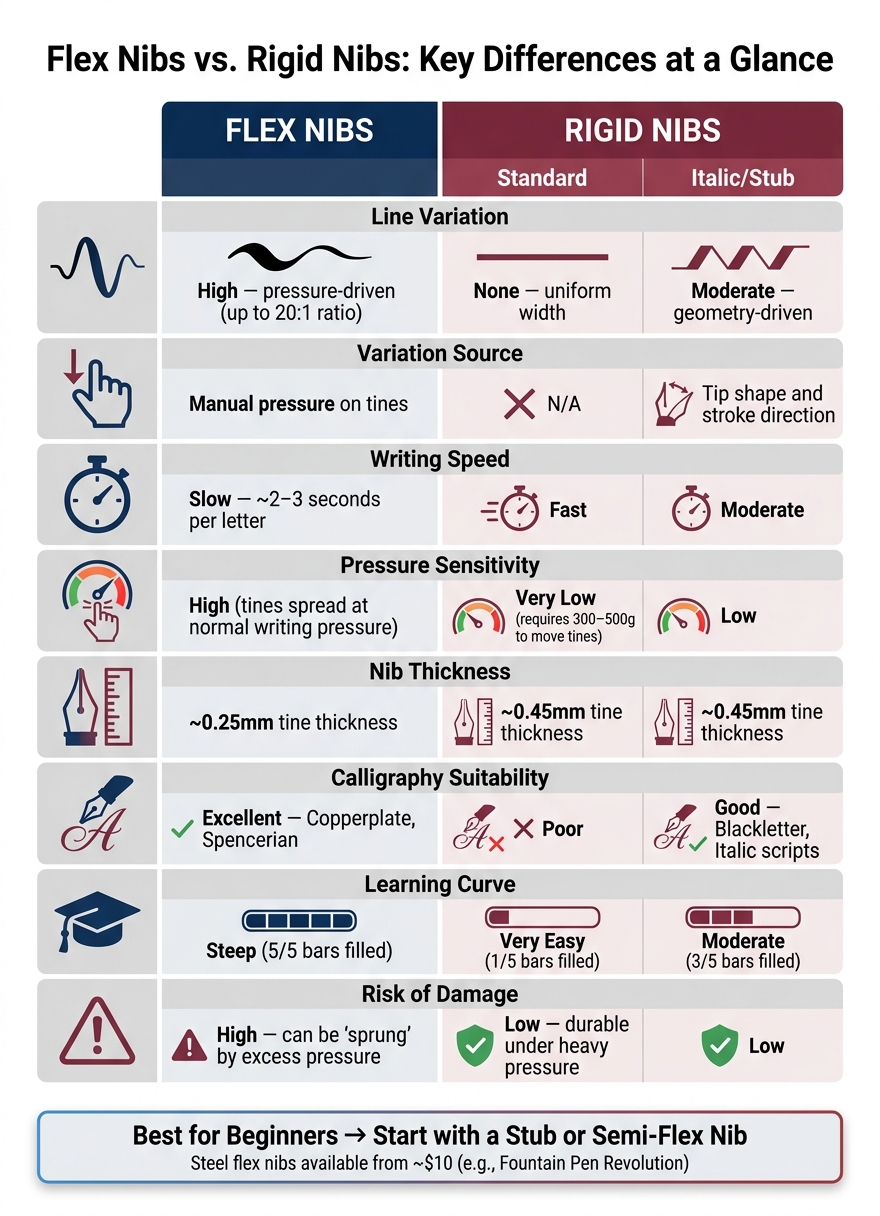
Flex Nibs vs. Rigid Nibs: Key Differences at a Glance
When it comes to nibs, line variation is where flex and rigid nibs truly set themselves apart. And the secret lies in one crucial factor: pressure.
Line Variation with Flex Nibs
Flex nibs thrive on pressure. As Richard Binder puts it:
"The tines of a flex nib curve upward and spread as pressure is applied during writing; the more pressure applied, the broader the nib slit becomes."
Top-tier flex nibs can achieve a 20:1 line width ratio, while more typical flex nibs hover around 6:1. This makes them ideal for calligraphy styles like Copperplate and Spencerian, where bold contrasts between thick and thin strokes are key. However, there's a catch: to avoid issues like "railroading" (when ink flow can't keep up with quick strokes), writing must be slow and deliberate - about 2–3 seconds per letter. High-quality options like a 14k gold flex nib can offer an even softer, more responsive writing experience. This pace is essential to maintain the smooth ink flow that these nibs demand.
Line Variation with Rigid Nibs
Rigid nibs, on the other hand, deliver consistent, uniform line widths no matter how much pressure you apply. With preload forces ranging from 300g to 500g just to move the tines a mere 0.2mm to 0.4mm, everyday writing pressure won't make a dent in their line width.
Instead, italic and stub nibs rely on their tip shape to create visual contrast. Vertical strokes appear broad, while horizontal strokes are much narrower. As Richard Binder explains, "the writer cannot control the degree of line variation to any significant extent. For all practical purposes, the strokes are as broad or narrow as the nib makes them." This predictable performance suits scripts like Blackletter or Italic, where a more structured and formal look is preferred. However, it lacks the expressive flair of a flex nib.
Comparison Table: Flex Nibs vs. Rigid Nibs
| Feature | Flex Nibs | Rigid Nibs (Standard) | Rigid Nibs (Italic/Stub) |
|---|---|---|---|
| Line Variation | High - dynamic, pressure-driven | None - uniform width | Moderate - geometry-driven |
| Variation Source | Manual pressure on tines | N/A | Tip shape and stroke direction |
| Writing Speed | Slow and deliberate | Fast | Moderate |
| Pressure Sensitivity | High | Very low | Low |
| Calligraphy Suitability | Excellent (Copperplate, Spencerian) | Poor | Good (Blackletter, Italic scripts) |
| Learning Curve | Steep | Very easy | Moderate |
This table highlights the distinct strengths and limitations of flex and rigid nibs, helping you decide which one aligns best with your calligraphy goals. Whether you're after the dramatic line contrasts of a flex nib or the precision of a rigid nib, understanding the differences between custom and standard nibs is key to choosing the right tool.
Choosing the Right Nib for Calligraphy
Factors to Consider
When picking a nib, think about how much line variation you want and how confident you are in controlling your strokes. Flex nibs allow you to create line variation by adjusting the pressure you apply, while rigid nibs (like stubs and italics) naturally produce variation due to their shape. Neither is inherently better - it all comes down to what suits your needs.
Flex nibs require slow, deliberate movements (around 2–3 seconds per letter) to ensure proper ink flow. On the other hand, rigid nibs allow for a faster, more fluid writing pace.
The material of the nib also matters. A 14K gold nib strikes a balance between flexibility and durability, making it ideal for flex nibs. Steel nibs, however, are tough and great for those with a heavier hand, though excessive pressure might "spring" the tines.
Understanding these elements can help you find a nib that complements your skill level and writing style.
Suggestions for Beginners and Advanced Users
If you're just starting, a stub or cursive italic nib is a great choice. These nibs provide consistent, predictable strokes, helping you develop muscle memory. As Franklin-Christoph explains:
"If this is your first foray into trying an italicized nib, we recommend you try a stub over a cursive italic. The stub or cursive calligraphy nibs are more forgiving and smooth feeling."
For those eager to experiment with flex techniques, begin with a semi-flex nib. Brands like Fountain Pen Revolution offer semi-flex nibs with ebonite feeds for around $10. These nibs are perfect for learning pressure control before moving on to full flex nibs for intricate styles like Copperplate or Spencerian.
Conclusion: Picking the Right Nib for Your Needs
Flex nibs and rigid nibs cater to different writing styles, and neither is inherently better - it all depends on your goals. Flex nibs shine when creating expressive calligraphy with bold thick-to-thin transitions, while rigid nibs deliver smooth and predictable lines, perfect for journaling or everyday writing.
As pen expert Richard Binder explains:
"The negative side of any flex nib is that it is more difficult to use than a nib that is not designed to flex."
For beginners, steel flex nibs are an excellent starting point. They’re more forgiving under pressure and less expensive than gold or vintage options. For instance, Fountain Pen Revolution offers steel flex nibs for under $10, many equipped with ebonite feeds. This makes them a practical choice for learning without the fear of damaging a pricier nib. Once you’ve mastered controlling pressure and timing, you can explore gold nibs or vintage-style flex nibs for finer details and quicker spring-back.
Ultimately, choose a nib that matches your experience level and the style of writing you want to achieve. Whether you prefer the dramatic flair of a flex nib or the steady reliability of a rigid nib, understanding how each affects your strokes is key to growing your skills and confidence in calligraphy.
FAQs
How do I know if my nib is flex or just soft?
A true flex nib is crafted to spread its tines when pressure is applied, resulting in noticeable line variation - specifically, thicker downstrokes. Once the pressure is released, the nib quickly snaps back to its original shape, maintaining its functionality.
On the other hand, a soft nib provides only slight line variation and has a springy, bouncy feel. However, it’s not designed for dramatic tine spreading. Applying excessive pressure can lead to permanent damage, such as splayed or sprung tines, rendering the nib unusable.
What causes railroading, and how can I stop it?
Railroading occurs when the tines of a flex nib spread under pressure, creating a broader stroke, but the feed fails to deliver ink fast enough. This leaves two thin parallel lines with an empty space in between. To avoid this issue, ease up on the pressure right away, ensure the nib is firmly seated and aligned correctly, and consider using a wetter feed to enhance ink flow.
How can I avoid springing a flex nib?
To avoid damaging a flex nib, apply pressure only on downstrokes and maintain light, gentle upstrokes to prevent overextending the tines. Focus on controlled, deliberate movements rather than pushing for the widest possible lines. Also, keep the nib clean and ensure smooth ink flow. Clogs can cause you to press harder than necessary, which increases the chance of damaging the nib.