

Custom nibs transform standard fountain pens into tools for expressive calligraphy. Unlike factory nibs, which create uniform lines, custom nibs are reshaped to introduce line variation, offering styles like stub, italic, oblique, and architect grinds. These modifications enhance stroke contrast, allowing for bold downstrokes and fine crossstrokes, perfect for artistic lettering. Here's what you need to know:
- Why Choose Custom Nibs? They provide dynamic line variation and, in some cases, flexibility for pressure-sensitive writing.
- **### Fountain Pen Nib Sizes and Grinds
- Types of Grinds:** Stub nibs offer smooth variation, cursive italic nibs create sharp contrasts, and architect nibs emphasize horizontal strokes.
- Nib Anatomy: Customization focuses on the nib's tip and tines, altering how it interacts with paper and ink flow.
- Professional Services: Skilled nib grinders can tailor nibs to your writing style, though turnaround times can range from weeks to months.
- Testing and Care: Use smooth paper for testing, practice light pressure, and clean nibs regularly to maintain performance.
For beginners, pre-ground nibs are a great starting point to explore custom options without committing to professional services. Whether you're after subtle character or dramatic effects, a custom nib can elevate your calligraphy game.
Nib Anatomy and Customization Options
Parts of a Fountain Pen Nib
To understand how customization works, it’s helpful to break down the anatomy of a fountain pen nib. Each part plays a specific role in how ink flows from the pen to the page.
The tipping material - usually a hard alloy like iridium - is welded to the nib’s tip to resist wear. This material influences line variation: a rounded tip gives consistent lines, while a flattened tip creates the dramatic thick-thin contrast of stub or italic styles. Just behind the tip, the nib splits into tines, which can flex under pressure in certain nibs, producing variable line widths. The narrow gap between the tines, called the slit, uses capillary action to pull ink to the paper. If this slit becomes misaligned, the ink flow can stop altogether.
Underneath the nib is the feed, which controls the amount of ink reaching the slit. Too little ink causes skipping, while too much leads to flooding. Finally, the nib’s body - its material and thickness, often gold or steel - affects how firm or springy the nib feels as you write.
Knowing these components helps explain how shaping and tuning can dramatically change how a nib performs.
Types of Nib Customizations
Nib customizations generally fall into two categories: shaping grinds and flow tuning.
Shaping grinds involve altering the tipping material to change how the nib interacts with paper. One common method is vertical narrowing, used to create stub, italic, and cursive italic grinds. A stub grind rounds the edges while narrowing the tip, making it smooth and forgiving. An italic grind narrows the tip even more, producing sharp, defined line variation. This style typically has a width 3 to 4 times greater than its thickness. The cursive italic sits between these two, offering italic-style narrowing with slightly rounded corners to prevent the nib from catching on the paper during faster writing.
Oblique grinds are another option, angling the nib tip to match a writer's natural pen rotation. Meanwhile, flow tuning adjusts the gap between the tines to control ink delivery. This is particularly useful when a custom grind changes how the nib interacts with the feed.
These adjustments allow writers to tailor their nibs to their specific needs, whether for calligraphy or everyday writing.
Factory Nibs vs. Custom Grinds
Factory nibs and custom grinds offer very different writing experiences due to their approach to shaping and tuning.
Factory nibs are designed for general use, with round tips that prioritize smoothness and ease of use. They’re forgiving of rotation and ideal for everyday writing, but their rounded tips limit line variation. Even factory-made "stub" or "italic" nibs tend to be ground conservatively, focusing on consistency rather than dramatic contrast.
Custom grinds, on the other hand, are tailored for specific performance goals. A professionally ground cursive italic nib, for instance, will have a sharper edge profile and a smaller, more precise sweet spot than any factory nib. This precision creates the crisp thick-thin contrast that calligraphy enthusiasts love, though it makes the nib less forgiving of rotation. As nib specialist Richard Binder explains:
"A stub nib can be made to produce extreme line variation; but the more extreme the variation, the less smooth the nib will be." - Richard Binder, Nib Specialist
Essentially, custom grinds trade some smoothness and ease of use for enhanced line variation and artistic control.
| Grind Type | Line Variation | Smoothness | Forgiveness of Rotation |
|---|---|---|---|
| Stub | Moderate | High | High |
| Cursive Italic | High | Medium | Medium |
| Crisp Italic | Very High | Low | Low |
| Flex | Variable (pressure-based) | High | High |
These options allow writers to choose a nib grind that aligns with their calligraphy goals and personal writing style.
sbb-itb-1dd4fe9
10+ Custom Nib Grinds You Should Try · Monoline, Waverly, Journaler, Imperial, Sankakusen & More!
Common Custom Nib Types and Their Calligraphy Effects
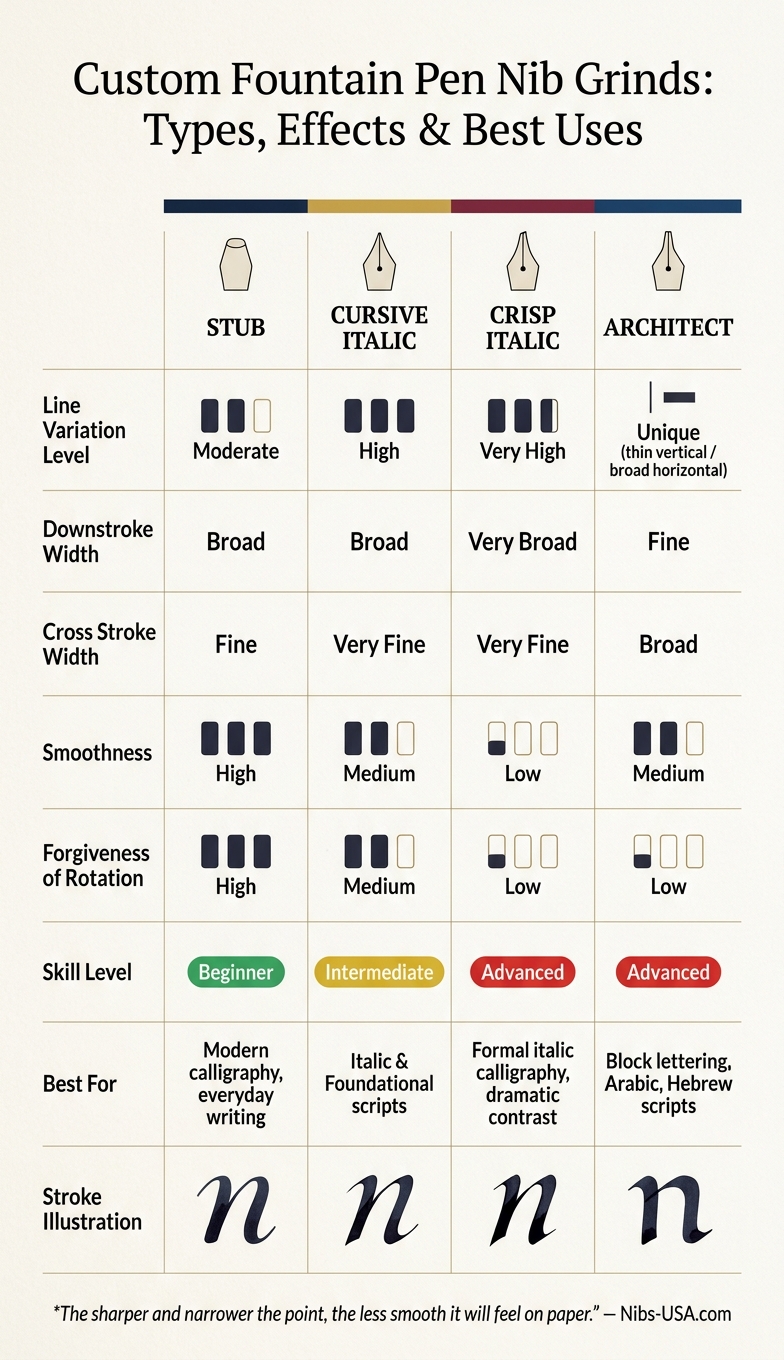
Custom Fountain Pen Nib Grinds: Types, Effects & Best Uses
Custom nibs bring distinct calligraphy effects to the table - stub, cursive italic, and architect nibs each cater to specific writing styles. By modifying the nib's shape and grind, these customizations create unique line variations that enhance particular calligraphy techniques.
Stub Nibs: Smooth Line Variation
Stub nibs are a great choice for beginners. With rounded corners and minimal vertical narrowing, they offer smooth and natural line variation, even if your pen alignment isn’t perfect. This makes them excellent for modern calligraphy and expressive everyday writing, where a touch of character can elevate your style without making the nib feel tricky to use. If your pen tends to rotate slightly while writing, a stub nib will glide along without skipping or catching. For the most noticeable effect, start with a Broad (B) nib or larger, such as a 1.5mm. When selecting a pen for customization, consult a fountain pen buying checklist to ensure the base model meets your needs. Narrower nibs provide a subtler line variation.
For sharper and more defined strokes, let’s look at cursive italic nibs.
Cursive Italic Nibs: Controlled Line Contrast
Cursive italic nibs are designed for precision. By removing extra tipping material, this grind creates crisp thick and thin strokes with sharper edges.
"Cursive italic is a good way to lend some character to your writing without sacrificing ease and comfort." - Rachel de la Fuente
This nib is ideal for Italic and Foundational scripts, where controlled contrast is key. However, it demands more precision from the writer. The nib works best when held at a 0° twist angle, with the top of the nib directly facing away from you. Unlike stub nibs, cursive italic nibs are less forgiving of slight pen rotation, which can cause them to catch on the paper.
For scripts that rely on horizontal strokes, the architect nib is the way to go.
Architect Nibs: Horizontal Line Emphasis
The architect nib flips the traditional calligraphy nib logic. Instead of thick downstrokes and thin cross strokes, it produces thin vertical lines and broad horizontal strokes. This unique grind emphasizes horizontal movement, making it a favorite for block lettering and scripts like Arabic or Hebrew, where horizontal strokes are a defining feature.
| Nib Type | Downstroke | Cross Stroke | Best For |
|---|---|---|---|
| Stub | Broad | Fine | Modern calligraphy, everyday writing |
| Cursive Italic | Broad | Very Fine | Italic, Foundational scripts |
| Architect | Fine | Broad | Block lettering, Arabic, Hebrew scripts |
Architect nibs are highly sensitive to pen angle and are often customized to match an individual writer’s hand position. This makes them the most specialized option among the three, better suited for experienced writers familiar with custom nib grinds.
How to Choose a Custom Nib for Your Calligraphy Style
Matching Nib Grinds to Your Calligraphy Goals
When choosing a custom nib, the key is to align it with your specific calligraphy goals. Think about your skill level and the kind of effect you want in your writing. Different nib grinds can dramatically change how your calligraphy looks and feels.
For smooth, everyday writing with just a hint of line variation, a stub nib is a solid choice. If you're looking for more contrast but still want a comfortable writing experience, a cursive italic nib is a great middle ground. On the other hand, for bold, dramatic thick-and-thin strokes - perfect for formal italic calligraphy - a crisp italic nib delivers that striking effect. Keep in mind, though, that this nib is less forgiving, as its sharp corners require consistent pen angles to avoid snagging on the paper.
"The sharper and narrower the point, the less smooth it will feel on paper." - Nibs-USA.com
If you tend to rotate your pen while writing, an oblique grind might be worth considering. Typically cut at a 15° angle, this grind widens the "sweet spot", making it more accommodating for those with a natural pen rotation.
These choices will guide you toward selecting the right nib size and material, which are crucial for achieving your desired calligraphy style.
Nib Size, Material, and Flex
The starting size of your nib greatly affects the customization options. A Broad (B) nib or one around 1.5 mm provides enough tipping material for detailed modifications. On the other hand, extra-fine nibs have limited material to work with and may feel scratchy after being ground.
For scripts like Spencerian that rely on flex, the nib material becomes even more important. 14k gold nibs are often preferred because they strike a balance between flexibility and resilience. Steel nibs, while usable, are less forgiving and can permanently splay if pushed too hard. Flex nibs also consume more ink, so pairing them with a high-capacity converter is a smart move.
Once you've chosen the right grind, size, and material, the next step is ensuring your pen can handle these customizations.
Checking Compatibility with Your Fountain Pen
Not all fountain pens are compatible with custom nibs, so it's essential to confirm this before making any modifications. Most professional nib grinders work with standard Jowo or Bock nib units, which are compatible with many fountain pen models. To check your pen's compatibility, refer to the manufacturer's specifications.
Fountain Pen Revolution pens are a good starting point for experimentation. Many of their models use standard nib sizes and fittings, making them ideal for testing custom grinds without risking a high-end pen. If you're unsure about committing to a specific grind, you can try a pre-ground Jowo nib from a professional nibmeister. This allows you to experience the unique feel and line quality of a custom grind on a compatible pen.
Lastly, don't overlook the feed compatibility. The feed controls ink flow, and some custom grinds - especially flex nibs - demand more ink than a standard feed can supply. If the feed can't keep up, you'll encounter "railroading", where your strokes form two thin lines instead of a solid one. Many nibmeisters will adjust the feed along with the nib grind, so it's worth discussing this during the customization process.
Working with Professional Nib Customization Services
When to Use a Professional Nib Service
Sometimes, the nibs that come standard with your fountain pen just don't cut it for the artistic flair you're looking to achieve. That’s where professional nib customization services come in. These experts can transform your nib into something that delivers the exact line dynamics and precision you need. Whether you’re after a sharp cursive italic grind, an architect grind for unique line emphasis, or simply need to fix common nib issues, professional nib grinders have the skills to make it happen. For calligraphy enthusiasts who require strong thick-to-thin contrasts or intricate horizontal strokes, these services can provide the consistency and quality that stock nibs often lack.
Keep in mind that patience is key - turnaround times for these services usually range between 12 and 15 weeks. If you're in a hurry, some providers offer expedited options that cut the wait to 2–3 weeks, but these typically come with significantly higher fees. Domestic priority shipping in the U.S. starts at around $10, and purchasing extra insurance is a smart move since standard coverage often maxes out at $50.
How to Communicate Your Needs to a Nib Grinder
Getting exactly what you want from a nib customization starts with clear communication. Be precise about the kind of line variation you’re after. Do you want a subtle difference between thick and thin strokes, or are you aiming for bold, dramatic contrasts? Share details about your writing habits, including how you hold the pen, the angle of the nib, and whether you tend to rotate the pen while writing. These insights help the nib grinder tailor the customization to your unique style.
"The broader the nib point you start from, the more line-width variation you'll see after customization." - Nibs-USA.com
It’s also important to specify your preference for how the nib feels on paper. Some people favor a smoother, more rounded edge, while others prefer crisp edges that might feel a bit scratchy but deliver sharper line contrasts. If you're left-handed or use an uncommon pen rotation, mention your preferred oblique type - standard left and reverse obliques are not interchangeable.
Since customized nibs are typically non-returnable, making your expectations crystal clear before the work begins is crucial. If you're unsure about your needs, starting with a pre-ground nib can help you refine your preferences.
Using Fountain Pen Revolution Nibs as a Starting Point
For those new to nib customization, starting with an affordable, pre-ground nib can simplify the process and minimize risk. Fountain Pen Revolution offers a variety of pre-ground nibs that are both budget-friendly and ideal for experimentation. For instance, their #6 Architect nib produces 0.5 mm vertical strokes and 1.0 mm horizontal strokes, earning a 5.0-star rating from 9 user reviews. They also sell loose nibs in #5.5 and #6 sizes, with options like architect or stub grinds priced at around $9.00 per nib. If you’re looking for value, bundles such as three #6 Architect nibs for $22 provide an economical way to test different styles before committing to a professional grind.
Practicing and Caring for Custom Calligraphy Nibs
How to Test a Newly Customized Nib
Start by testing your customized nib on high-quality fountain pen paper, like Rhodia. Smooth paper ensures the nib glides effortlessly, giving you a clear sense of how the grind performs. Using rough or inexpensive paper can create a false impression, making even a well-tuned nib seem scratchy.
When testing, write with your usual hand angle and pressure. As The Gentleman Stationer explains:
"People hold pens at different angles and apply different amounts of pressure, meaning that a nib can feel perfectly smooth for one person but scratchy or toothy for another."
It's also a good idea to examine the nib under strong light using a loupe to check the alignment of the tines. Misaligned tines are often the culprit behind writing problems - accounting for about 80% of issues. A quick visual inspection can save you from mistakenly blaming the grind itself.
Once you're satisfied with the nib's performance, you can move on to practicing techniques to fine-tune your writing.
Calligraphy Practice Tips for Custom Nibs
After confirming the nib works as expected, focus on developing a light touch through specific exercises. Custom nibs respond best to gentle pressure; pressing too hard can disrupt ink flow and even damage softer nibs.
Start your practice with simple vertical and horizontal strokes to understand how the nib behaves in different directions. This is especially helpful for nibs like stub, italic, or architect grinds, where line width changes based on stroke direction. Then, try drawing small figure-eights to identify the nib's "sweet spot" and smooth out transitions between strokes. Once you're comfortable, progress to writing full sentences to evaluate how the nib handles start-up and overall ink flow.
"Patience, a gentle touch, and respect for the material are absolutely key." - filip, Author, Follow My Pen
Cleaning and Storing Custom Nibs
Custom nibs are often designed to be unscrewed for thorough cleaning. To keep them in good shape, flush the nib under lukewarm water until the water runs clear. Make sure to let it air dry completely before reassembling.
It’s not unusual for new custom nibs to show some ink residue from testing - this is perfectly normal. When storing your nib, always keep it capped or place it in a dedicated nib case to protect its shape. If you’re planning to store the nib for an extended period without ink, give it a quick rinse to prevent dried ink from clogging the feed.
Conclusion: Getting Started with Custom Nibs
Custom nibs offer a world of possibilities for creating calligraphy effects that standard factory nibs just can't achieve. Whether you're captivated by the smooth line variation of a stub, the crisp edges of a cursive italic, or the bold horizontals of an architect grind, there's a custom nib out there that aligns with your writing style. These options, such as stubs, cursive italics, and architect grinds, build on the variety of choices we've explored.
A great way to start is by experimenting with a loose custom nib. For instance, Fountain Pen Revolution provides #5.5 and #6 Architect nibs, which are compatible with pens like the FPR Tanoshii, Madras, Triveni, or Ambassador. Opting for a medium or broader size will help you better appreciate the line variation these nibs can produce. Once you've selected your nib, focus on adjusting your grip, refining your holding angle, and developing a light touch - this will allow the nib to perform at its best.
From here, it's all about practice. Take your time to get used to the way the nib interacts with the paper. The unique, expressive lettering you'll achieve makes the effort worthwhile and inspires further refinement of your technique.
FAQs
Will a custom grind make my pen feel scratchy?
A custom grind often involves a smoothing process to create a polished finish and deliver a seamless writing experience. That said, precision grinds - like sharp italics - can feel scratchy if the nib isn't positioned or angled properly during use. These types of grinds are more sensitive to how you hold and press the pen, and they tend to offer more feedback compared to a standard rounded nib when not handled correctly.
Which grind works best for my handwriting angle?
An Oblique grind is a great choice for achieving the right handwriting angle. It's slanted at an angle (typically between 15° and 45°) to match your natural hand position, helping you create smooth and consistent lines.
- Left-foot obliques work best for right-handed writers who tend to rotate counterclockwise.
- Right-foot obliques, on the other hand, are ideal for clockwise rotation.
Not sure which to pick? Go with a Stub grind. It’s easier to handle and less dependent on precise angles compared to sharper grinds.
Do I need a different feed for a custom or flex nib?
Flex nibs don’t always require a different feed, but upgrading or tweaking the feed can make a noticeable difference. Flex nibs tend to work better with high-flow feeds - such as ebonite - because they can handle the increased ink demand and help avoid problems like railroading. Additionally, a nibmeister can fine-tune the ink flow during adjustments, meaning a separate feed isn’t always essential.