

Ebonite has been a key material in fountain pen design for over a century, offering durability, comfort, and a unique tactile experience. Made through vulcanization, it combines natural rubber and sulfur, resulting in a material that's easy to machine, resistant to ink, and perfect for intricate designs. Here's why ebonite remains a favorite for artisans and collectors:
- Material Benefits: Ebonite is lightweight, durable, and resistant to ink chemicals, making it ideal for long-term use.
- Tactile Comfort: Its warm, organic feel enhances grip and comfort during extended writing sessions.
- Customizability: Ebonite can be shaped and polished for precise threads, smooth finishes, and unique patterns like ripples and woodgrain.
- Ink Flow: Ebonite feeds allow better ink flow due to their semi-porous nature, ensuring consistent writing performance.
- Aesthetic Appeal: Available in various colors and patterns, it serves as a canvas for decorative techniques like Urushi lacquer.
Ebonite pens require proper care to maintain their quality - protect them from UV light, avoid prolonged water exposure, and gently polish to restore their finish. Despite modern materials, ebonite's durability, comfort, and craftsmanship ensure its place in fountain pen design.
The Properties of Ebonite
How Vulcanization Shapes Ebonite
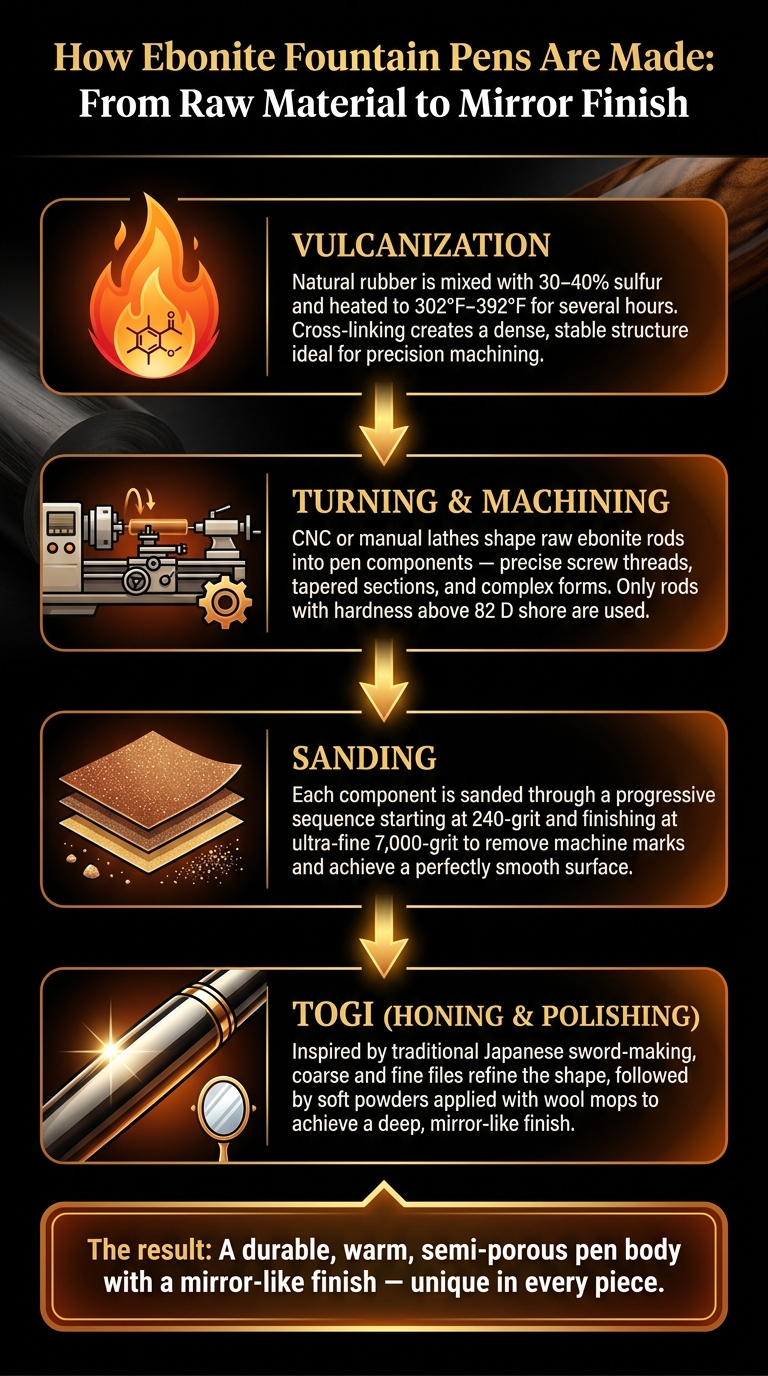
Vulcanization plays a key role in giving ebonite its unique properties. By heating natural rubber mixed with 30–40% sulfur to temperatures between 302°F and 392°F for several hours, the material undergoes a permanent transformation. This process cross-links the molecules, creating a dense and stable structure that’s perfect for machining intricate details like screw threads and fine engravings. This precision ensures components fit together perfectly and remain functional for decades. Plus, this structural integrity enhances the tactile experience, making items like handmade ebonite pens not just durable but also comfortable to hold.
Surface Feel and Tactile Comfort
Ebonite is widely appreciated for its warm, organic feel - something that sets it apart from colder materials like acrylic or metal.
"This is why many fountain pen users love pens crafted from ebonite, as it quite literally retains a bit of warmth long after a writing session." - Wancher Pen
This warmth makes a noticeable difference during extended writing sessions, as the material gradually adjusts to your hand’s grip and temperature. Polished ebonite adds to this experience, developing a rich, silky shine that matures into a subtle patina over time. While it may be softer than acrylic and prone to minor surface scratches, this trade-off is often worth it for its distinctive charm and comfort.
How Ebonite Reacts to Its Environment
Ebonite’s resilience extends beyond its tactile appeal, particularly in its interaction with fountain pen inks. It resists damage from both acidic and alkaline inks, ensuring long-term durability. As Nakaya Fountain Pen explains:
"Ebonite... is the best material for fountain pen barrels because of its elasticity, durability, and resistance to acidity from ink and dimensional deviations over a long period of time." - Nakaya Fountain Pen
However, ebonite does have its vulnerabilities. Prolonged exposure to UV light can oxidize its surface, and extended contact with water can dull its finish. To maintain its appearance, it’s best to store ebonite fountain pens away from direct sunlight and avoid soaking them in water for long periods.
sbb-itb-1dd4fe9
How Ebonite Improves Fountain Pen Performance
Ebonite Feeds and Ink Flow
Ebonite stands out for its impact on ink flow, especially at the feed level. Unlike plastic feeds, which are smooth and non-porous, ebonite is semi-porous, giving it a natural edge in capillary action. This means ink travels through an ebonite feed more smoothly, resulting in a wetter and more consistent flow.
"This semi-porous type of feed allows for better capillary action of the ink, leading to an improved flow." - EndlessPens
Another advantage of ebonite feeds is their ability to be heat-set. By carefully applying heat, artisans can mold the feed to fit snugly against the nib, eliminating gaps and ensuring optimal ink delivery. This level of customization extends further, as the feed can also be sanded or milled to fine-tune the flow for specific nib types. Plastic feeds, by contrast, are fixed in their shape once molded, making them far less adaptable. The result? A more precise and reliable writing experience that complements a pen’s overall design.
Writing Comfort with Ebonite
Ebonite fountain pens offer a lightweight alternative to metal pens, which can cause hand fatigue during extended use. The material’s slight softness and organic texture enhance grip comfort, making long writing sessions more enjoyable. Another bonus? Ebonite retains warmth from your hand, preventing that cold, metallic feel that can disrupt your focus.
Durability and Long-Term Wear
Ebonite doesn’t just improve performance - it’s built to last. This material resists the structural wear and tear that can affect other options, standing up to decades of regular use.
"Ebonite is vulcanized rubber, and it is one of the most popular, premium materials for fountain pens thanks, in large part, to its durable nature." - Wancher Pen
Ebonite also pairs beautifully with high-end finishes like Japanese Urushi lacquer. Its ability to bond securely with multi-layer lacquer coatings enhances both its aesthetic appeal and longevity. For this reason, many artisans choose ebonite as the foundation for intricate lacquer work. That said, ebonite feed fins can be brittle, so it’s important to handle them gently during maintenance. Avoid applying too much torque when removing nib units.
Ebonite vs Platic Feeds for fountain pens
Ebonite as a Design Material for Artisan Pens
How Ebonite Fountain Pens Are Made: From Raw Material to Mirror Finish
Ebonite isn't just about performance; it also opens up a world of creative possibilities for pen makers. This material plays a dual role in high-end fountain pens, acting as both a functional and aesthetic cornerstone.
Colors, Patterns, and Finishes in Ebonite
Ebonite offers an impressive array of visual options. Popular patterns like Blue Ripple, Rose Ripple, and Green/Black Ripple stand out, along with woodgrain finishes that echo its origins as a synthetic alternative to ebony wood. Since ebonite is a natural material, each piece is distinct - the marbling and ripple effects vary from rod to rod, making every pen one of a kind.
A great example is Conway Stewart's Marlborough Vintage Limited Edition series. These pens come in Black, Blue Ripple, Rose Ripple, or Woodgrain ebonite, with each one meticulously hand-turned and polished in Devon, England, ensuring the patterns align perfectly on both the barrel and cap.
Ebonite also serves as an excellent canvas for decorative finishes. Wancher Pen's Dream Pen collection highlights this by using premium Japanese ebonite, which bonds seamlessly with natural Urushi lacquer. Techniques like Yakumo-nuri and Echizen Urushi enhance the material's visual depth while maintaining its durability.
This variety in colors, patterns, and finishes sets the stage for the detailed craftsmanship that defines artisan ebonite pens.
Shaping and Hand-Finishing Ebonite
Ebonite is a dream to machine, allowing for precise screw threads and smooth tapered sections. Artisans use a combination of CNC technology and manual lathes to shape the raw rods into pen components. However, the material’s softness compared to metals means that cutting alone isn’t enough - hand-finishing is a critical step.
"Working this way takes more time and skill, but this is what we crave and is the difference between forgettable and timeless." - AJOTO
One standout feature of ebonite is its shape-memory property. When heated to 158°F–176°F (70–80°C), it can be carefully reshaped within limits, offering artisans a level of flexibility not found in acrylic or metal.
These shaping and finishing techniques, combined with meticulous polishing, result in the polished elegance that defines high-quality ebonite pens.
Turning, Sanding, and Polishing Techniques
Refining ebonite is a labor-intensive process. After machining, each component undergoes a detailed sanding sequence, starting with 240-grit paper and progressing to ultra-fine 7,000-grit, to erase machine marks and create a smooth surface.
Polishing is where ebonite’s beauty truly shines. For instance, Wancher’s True Ebonite Dream Pens are polished at ASO Inc. in Kanagawa using a traditional Japanese method called Togi. This technique, inspired by sword-making, involves a series of coarse and fine files, followed by soft powders applied with wool, to achieve a deep, mirror-like finish.
"When a skilled craftsman sharpens and polishes ebonite by hand, using their experience and intuition, the surface of the ebonite shines deep and smooth as if it were a mirror surface covered with water." - Wancher
Here’s a quick breakdown of the key techniques used in ebonite pen crafting:
| Technique | Tools Used | What It Achieves |
|---|---|---|
| Turning/Machining | CNC or manual lathes | Creates precise threads and complex shapes |
| Sanding | 240g to 7,000g abrasive papers | Smooths surfaces and removes imperfections |
| Togi (Honing) | Coarse and fine files | Refines shapes beyond basic machining |
| Polishing | Wool mops, powders, compounds | Adds a deep, mirror-like shine |
To ensure durability and precision, high-quality ebonite rods are tested for a hardness rating above 82 D shore before machining begins. This ensures the material can handle fine details without deforming under cutting tools.
How to Care for Ebonite Fountain Pens
Ebonite fountain pens are a blend of beauty and functionality, but their unique material demands extra care. Proper maintenance is crucial to preserving their charm and usability. Light, humidity, and heat are particularly important factors to manage when caring for these pens.
Storage and UV Protection
Light exposure, especially UV rays, is one of ebonite's greatest enemies. UV rays can break down the rubber's molecular structure, leading to sulfur oxidation. This process creates a dull film on the surface, and the damage can continue for up to two weeks after initial exposure. To protect your pen, store it in a closed case or a drawer, away from windows or direct sunlight. A cool, dry environment can also help slow down oxidation. As vintage pen expert David Nishimura explains:
"The damage done to hard rubber by exposure to light is done by the breaking of chemical bonds, the crosslinks that make the molecular structure of intact hard rubber so impervious to chemical action."
He also emphasizes that cooler temperatures can reduce the rate of deterioration. By keeping your pen in the right storage conditions, you can minimize UV-related damage and focus on maintaining its finish.
Cleaning and Restoring the Finish
If your pen begins to develop a faded patina, the restoration method you use matters. Water should be avoided on faded surfaces, as it can worsen the problem. For pens like the Click Century with smooth, unchased surfaces, gentle abrasive polishing can remove the oxidized layer and bring back the original shine. However, if your pen features intricate engravings or decorative chasing, polishing may damage these details. In such cases, surface dyeing is a better option. Dyes penetrate the material, making the process more forgiving and reversible compared to surface-level treatments.
Keeping Your Ebonite Pen in Good Shape
In addition to proper storage and cleaning, careful handling is key. Ebonite is mechanically brittle and prone to shattering if dropped on a hard surface. Since typical adhesives don’t bond well with cracked ebonite, it’s wise to use a padded pen case for extra protection. Interestingly, some collectors embrace the natural aging process of ebonite, viewing the patina as a testament to its history and authenticity. Whether you prefer to restore its finish or let it age gracefully, keeping your pen away from direct light and moisture will help you maintain its condition over time.
Why Ebonite Still Matters in Fountain Pen Design
What Ebonite Brings to Pen Design
Ebonite has earned its place in fountain pen design thanks to its unique and timeless qualities. Unlike modern materials, ebonite is chemically inert, meaning it doesn’t react with most inks, ensuring long-term reliability. It’s also lightweight yet durable, giving pens a premium feel without causing hand strain, unlike heavier metal alternatives. Plus, ebonite sets itself apart by warming to the touch during use, a feature that acrylic or resin simply can’t match. This warmth lingers, making writing sessions more comfortable and personal.
What truly makes ebonite special is its natural, evolving character. Artisan pen maker Dan from Good Made Better captures this sentiment perfectly:
"The fact that it changes over time is less a fault than a proper indication that it's a tool being put to use."
This natural patina tells a story of use and care, something no synthetic material can replicate. These qualities make ebonite ideal for pens that balance comfort, durability, and affordability.
Ebonite Pens at Fountain Pen Revolution
Fountain Pen Revolution embraces all that ebonite offers - its warmth, resilience, and artisanal charm - by incorporating it into their accessible pen range. For those who want high-quality craftsmanship without the hefty collector's price, Fountain Pen Revolution delivers. Their handmade and premium ebonite pens start at just $44, while starter sets begin at $35, providing a great option for beginners or seasoned enthusiasts. These sets pair beautifully with their black fountain pen ink and accessories, making it easy to experience the legacy of ebonite without breaking the bank. Whether it’s your first fountain pen or an addition to your collection, Fountain Pen Revolution ensures the artistry of ebonite remains within reach.
FAQs
How can I tell if a pen is real ebonite?
You can tell real ebonite apart by its warm, natural texture, which contrasts with the cold and smooth feel of metal or acrylic. If you rub the pen or rinse it under warm water, you might notice a faint scent resembling rubber or sulfur. With age, vintage ebonite often develops a dull brown patina due to oxidation - a characteristic that doesn’t occur with modern plastics.
Do ebonite feeds make every nib write wetter?
No, ebonite feeds don’t necessarily guarantee a wetter writing experience. While their semi-porous material and ability to be heat-set can improve ink flow - particularly with flex or broad nibs - their performance ultimately depends on factors like design, tolerances, and how well they fit the pen. In fact, a poorly tuned ebonite feed might fall short compared to a well-crafted plastic feed. That said, ebonite does allow for adjustments, such as heat setting or sanding, to fine-tune the flow when needed.
What’s the safest way to prevent ebonite from fading?
To keep ebonite pens from losing their color, it's best to store them somewhere dark, cool, and dry, away from direct sunlight. UV light can cause oxidation, which leads to fading. Consider using protective cases, wooden boxes, or leather sleeves to shield them from light and humidity. However, steer clear of airtight containers, as they can trap vapors. Also, keep your pens away from heat sources to ensure they stay in good condition over time.