

Most shimmer clogs come out with room-temperature water, light pressure, and time - not heat, tools, or force.
If I need to clean shimmer ink from a fountain pen feed, I keep the process simple: flush first, soak only if needed, and stop once the pen writes well again. Shimmer particles are solid, so even when the ink color is gone, glitter can still stay behind in the feed channels.
Here’s the short version:
- Start with water flushing
- Use a converter or bulb syringe with gentle pressure
- Soak for about 30 minutes only after flushing stops helping
- Check for glitter on a white paper towel under bright light
- Use pen flush only after repeated water flushes and soaks
- Do not use hot water, scraping, or forced disassembly
A feed does not need to look perfect. It needs to be clean enough to write without skipping or hard starts. In many cases, one to three flush-and-check rounds are enough for normal shimmer buildup. If glitter stays put after that, or the pen still writes poorly, I stop and contact the maker or a pen repair person.
That’s the whole idea of this guide: go in order, keep pressure low, and avoid damage while clearing the feed.
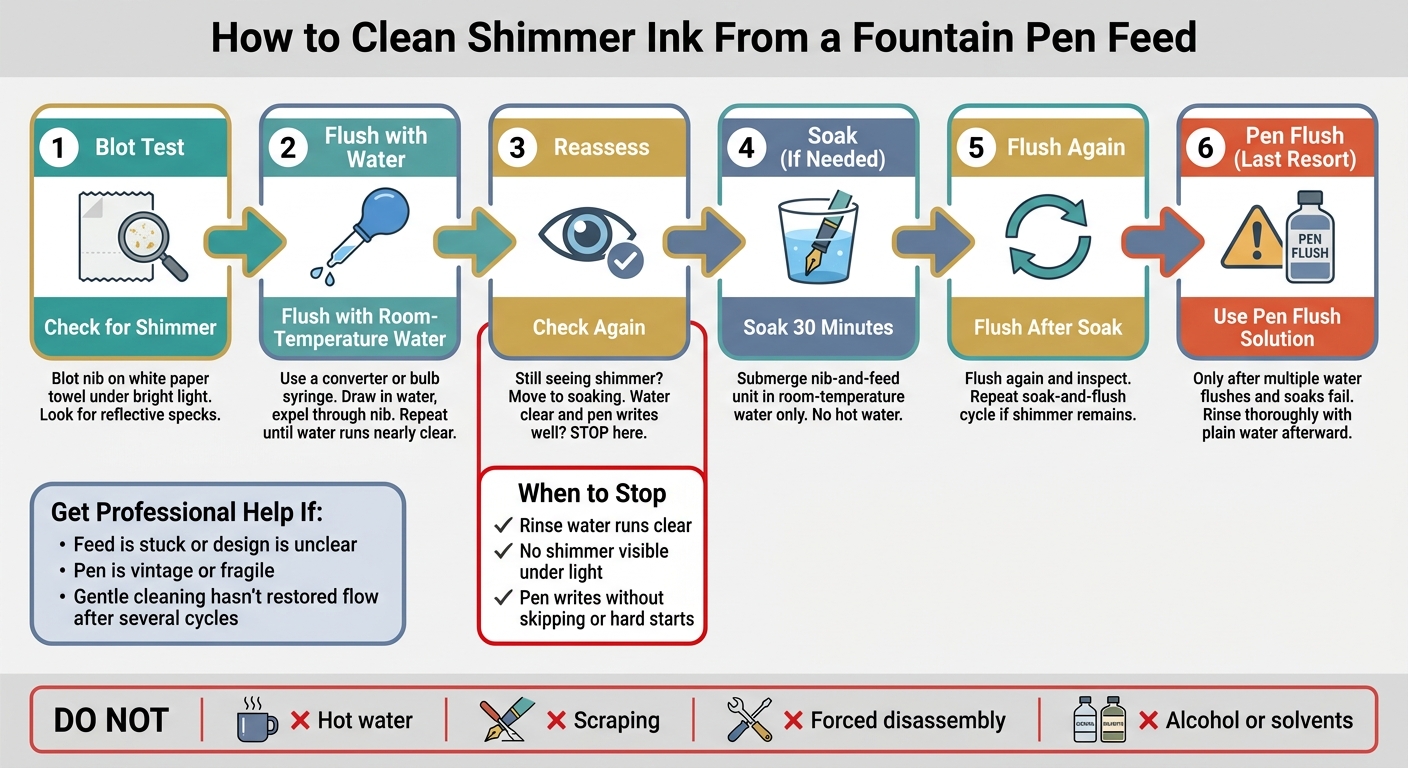
How to Clean Shimmer Ink From a Fountain Pen Feed
Inkquiring Minds Workbench Ep 23 - Cleaning the Shimmering Ink OUT!
sbb-itb-1dd4fe9
Why shimmer ink builds up in feed channels
Shimmer ink has solid reflective particles mixed into it. When the pen sits still, those particles drift down into the feed. Unlike the dye, they don’t dissolve in water. So you can rinse out the ink color and still have shimmer left behind. That’s why shimmer ink is tougher to clear than standard ink. The issue isn’t just leftover dye - it’s physical residue. So the next step is mechanical flushing.
How feed fins and channels trap shimmer particles
Those particles tend to get stuck in the feed’s narrow fins and channels. The feed sends ink to the nib and lets air move back into the reservoir. It does that through tight pathways, which are easy spots for solid particles to lodge - especially in corners and where the feed meets the nib.
If a shimmer-filled pen sits unused, some of the liquid ink can evaporate. Then the remaining particles are packed into less liquid, which makes them more likely to settle into those tight spaces instead of staying evenly mixed. Storing the pen nib-down can make this happen faster.
Signs the feed still has shimmer in it
After a few flushes, blot the nib on a white paper towel under bright light. If you spot tiny reflective specks, shimmer is still in the feed.
A few signs usually give it away:
- Visible glitter in rinse water that otherwise looks clear
- Reflective specks on a white paper towel after blotting the nib and feed
- Hard starts or skipping after rest
- Uneven flow or patchy saturation while writing
A pen can look clean on the outside and still hold shimmer inside. If the blot test still shows specks, move on to flushing.
Start by flushing the feed with water and gentle pressure
Once the blot test shows shimmer is still sitting in the feed, flush the pen with room-temperature water. Shimmer likes to settle in those narrow feed channels, so start with the normal ink path first. Flush before you soak, and only move to soaking if shimmer is still there after a few passes. Also, leave the nib and feed alone unless the manufacturer says users can remove them.
What you need before you start
You only need a few things: room-temperature water, a small cup or sink, and either a converter or a bulb syringe.
How to run flush cycles until the water runs clear
Remove the barrel and empty any ink left in the converter or cartridge based on how your pen fills. If there's a cartridge installed, take it out instead of trying to force water into a sealed cartridge.
Then flush through the converter or use a bulb syringe attached to the section end. Draw in water, then push it out through the nib. Count each fill-and-expel as one cycle. Keep going until the water coming out is nearly clear and you can't see shimmer anymore.
"Clear enough to move to the next step" is a better goal than chasing perfectly pure water. If shimmer is still hanging on after several gentle cycles, switch to a short soak instead of using more pressure.
Bulb syringe vs. converter flushing
Use a converter for normal flushing. Use a bulb syringe when buildup is heavier. In both cases, stick to gentle, steady pressure. If the water resists, stop there - don't force it.
If flushing cuts down the shimmer but doesn't clear it, the next step is a short soak.
Soak the feed only after flushing
If flushing still leaves shimmer stuck in the feed fins, move on to soaking. A soak helps loosen residue that plain flushing didn't wash out.
How long to soak and what to check afterward
Soak only the nib-and-feed unit, or another removable section if the manufacturer says it's safe, in a cup of room-temperature water. Use room-temperature water only. Start with a 30-minute soak, then take the section out and flush it again.
After that second flush, hold the feed up to good light and look at the rinse water. If the water still shows color, or if shimmer is still sitting in the fins, do another soak-and-flush cycle. Keep repeating that cycle until no shimmer remains.
When to use a pen flush solution
If water still leaves shimmer behind after several soak-and-flush cycles, use a commercial fountain pen flush as directed, then rinse the parts well with plain water. By default, do not use ammonia, alcohol, detergents, or solvents.
Know when to stop and when not to remove the feed
After flushing and soaking, stop as soon as the pen writes the way it should and the feed looks clear. More cleaning isn't always better. At some point, it adds risk instead of solving anything. The goal is a pen that's functionally clean, not perfectly spotless.
Signs the pen is clean enough to dry and re-ink
A good stopping point is pretty simple: the rinse water runs clear, or close to it, and no shimmer is left in the feed fins under good light. Then let the pen dry all the way, refill it with a small amount of fresh ink, and write a few lines. If the flow is steady and there are no hard starts, the feed is clean enough to move on.
If the final rinse still has a slight tint, but there are no particles left and the pen writes normally, that's fine. Stop there. Staining is not blockage. If shimmer is still clogging the pen, do one more gentle flush-and-soak cycle. Don't scrape the feed.
When to get professional help or contact the manufacturer
If gentle cleaning still leaves shimmer behind or the flow is still off, don't force disassembly. Leave the feed in place if the pen doesn't have a removable nib-unit design, if the feed is stuck, or if the pen is vintage or fragile. The removal direction and method can change from one model to another, so keep it installed unless the manufacturer says it is removable.
If several gentle flush-and-soak cycles still haven't brought back normal flow, or if the nib looks misaligned or the section leaks, contact the manufacturer for model-specific cleaning and disassembly guidance. When you're not sure, a qualified pen technician is the safer bet than trying to improvise with tools.
When you're deciding whether to stop, try again, or ask for help, use this rule of thumb:
- Stop when flow is normal and the feed looks clear.
- Repeat one more gentle flush-and-soak cycle if shimmer remains.
- Contact the manufacturer or a technician if the feed is stuck, the design is unclear, or gentle cleaning hasn't fixed the problem.
Summary: start gentle, escalate slowly, avoid damage
Shimmer often settles in feed fins and channels as ink dries. The good news is that plain water and patience clear most buildup.
Go easy here. Scraping, force, hot water, or taking the pen apart can damage the feed.
Cleaning order
After flushing and soaking, follow this order:
Flush → reassess → soak only if needed → flush again → use pen flush only after plain water and soaking fail → rinse thoroughly → dry and test.
Flush with steady, gentle pressure. A bulb syringe can make the job faster, but don't force water through the feed. Soak only if flushing still leaves shimmer behind. Use pen flush only as a last step.
Once the water runs clear and ink flow comes back, stop. If gentle flushing and soaking still leave poor flow, contact the manufacturer or a qualified technician.
FAQs
How often should I clean shimmer ink from my feed?
Clean your fountain pen every 1 to 2 weeks if you’re using shimmer ink. That simple habit helps stop metallic or mica particles from settling in the feed channels and causing clogs.
If the ink starts acting up or you notice signs of clogging, clean the pen right away. And if you plan to leave the pen unused for more than 1 to 2 weeks, empty it and flush it well first.
Can shimmer ink permanently clog a fountain pen feed?
No. Shimmer ink usually doesn’t cause permanent damage to a fountain pen feed.
What can happen is much less dramatic: the particles may gather in the feed channels and around the nib, especially if the ink dries out or the pen sits unused for a while. That can slow the flow or cause a clog, but it’s usually fixable.
A simple cleaning routine goes a long way. Regular cleaning every 1 to 2 weeks helps prevent buildup. If a clog does happen, flushing the pen with water, soaking it, or using a mild cleaning solution is generally enough to get the ink flowing again.
What should I do if my pen still skips after cleaning?
If your pen still skips after the first cleaning, soak the nib and feed in lukewarm water for a few hours. That can help loosen residue that’s stuck in there.
If soaking doesn’t do the trick, use a dedicated pen flush or a mild mix of 1 part clear ammonia to 10 parts water. After that, rinse the pen well with clean water.
It also helps to inspect the nib tines under 10x magnification to see if they’re out of line. And if the pen needs a little nudge, try priming the feed by using the converter to push a small amount of ink into the nib.