

A premium pen fits well when four things line up: grip width, usable length, writing weight, and balance. In this article, I’d boil the whole topic down to one point: hand size helps, but it does not decide comfort on its own.
Here’s the short version:
- I’d check the grip section first, because that’s where finger strain starts.
- I’d compare uncapped length and posted length, since the same pen can feel fine one way and awkward the other.
- I’d weigh the pen in the way I actually write with it, not just by total listed weight.
- I’d test balance after several lines, because fatigue often shows up fast when the cap shifts weight to the rear.
The article also gives a few starting numbers: about 9.5 mm for smaller hands, about 10.16 mm for many average hands, 128.0 mm as a middle-range uncapped length, and about 149.5 mm posted for people who want more reach. It also points out that a pen listed at 12 g total may write more like an 8 g pen when used unposted.
If I were choosing fast, I’d use this order: measure the grip, check the writing length, test posted vs. unposted balance, then judge comfort after a full page - not one sentence. That is the simplest way to avoid buying a pen that looks good but feels wrong.
This makes the rest of the article easy to follow: the specs matter, but the fit in your hand matters more.
PEN REVIEW: This Fountain Pen Adjusts to Fit Your Grip? TU-ZU Sailor
sbb-itb-1dd4fe9
How to Measure a Premium Pen Correctly
Use a caliper, ruler, and scale to measure the dimensions that affect fit. Hand size matters, sure. But these measurements show why two people with similarly sized hands can like very different pens. They take fit out of the realm of guesswork and put it into numbers.
Measure grip-section diameter where your fingers rest
The grip section - the section just above the nib - is where your fingers rest. Measure it at the spot where your fingers naturally make contact, not at the barrel’s widest point. That detail matters. A narrow section can feel cramped during long writing sessions.
Record capped, uncapped, and posted length separately
Record capped, uncapped, and posted length separately. Each one affects reach and control in a different way. If the uncapped length is too short for your hand, the end of the barrel may press into the web of your hand during longer sessions. Posting the cap can help, but only if it doesn’t make the pen feel back-heavy.
Check writing weight, not just total weight
Measure the pen in the setup you actually use for writing - body only, or body plus posted cap. A pen that weighs 12 g total may weigh only 8 g during unposted use. That 4 g difference can change control and fatigue. So weigh the pen exactly as you write with it.
| Measurement | How to Take It | What It Affects |
|---|---|---|
| Grip diameter | Caliper at natural finger contact point | Finger strain and grip security |
| Uncapped length | Ruler from nib tip to barrel end | Reach and hand posture |
| Posted length | Ruler from nib tip to end of posted cap | Balance and center of gravity |
| Writing weight | Scale with body only, or body plus posted cap | Muscle fatigue and stroke control |
Use these numbers to compare pens against your grip style and hand size.
Match Pen Size to Hand Size and Grip Style
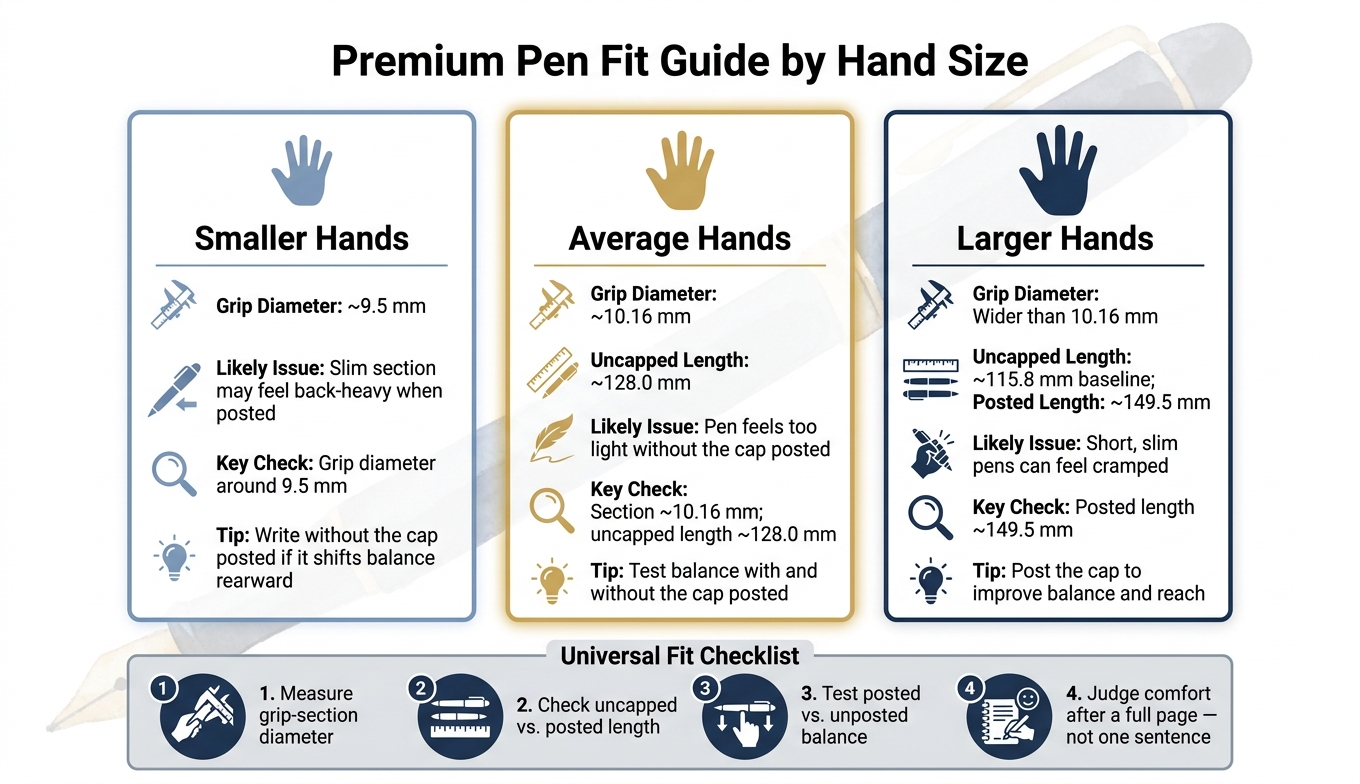
Premium Pen Fit Guide: Hand Size vs. Key Measurements
Once you have the pen measurements, compare them with your own hand size and the way you hold a pen. Measure from your wrist crease to the tip of your middle finger, then use that number as a rough check against the pen’s uncapped and posted length.
Smaller hands and shorter fingers
If you have smaller hands, a grip section around 9.5 mm is often a good place to start. A slimmer section asks less of your fingers, so you don’t have to stretch as much while writing. If posting the cap makes the pen feel back-heavy, try using it unposted first.
Average hands and flexible fit options
For many people with average-sized hands, a section around 10.16 mm and an uncapped length around 128.0 mm can land in a comfortable middle range. From there, test the balance both posted and unposted to see what fits your grip length best. If the pen feels too light when unposted, posting the cap may give you better balance and a steadier feel.
Larger hands and longer fingers
Larger hands usually need more reach and a bit more weight toward the rear than short, slim pens can give. Posting the cap can extend the pen to about 149.5 mm, which may help with both reach and balance.
Use these hand-size patterns as a quick filter before you start comparing pens one by one.
| Hand Fit Pattern | Likely Comfort Issue | Check | Try |
|---|---|---|---|
| Smaller hands | Slim section may feel back-heavy when posted | Grip diameter around 9.5 mm | Write without the cap posted if it shifts balance rearward |
| Average hands | Pen feels too light without the cap posted | Section around 10.16 mm; uncapped length around 128.0 mm | Test balance with and without the cap posted |
| Larger hands | Short, slim pens can feel cramped | Uncapped length around 115.8 mm; posted length around 149.5 mm | Post the cap to improve balance and reach |
A pen can look like a match on paper and still wear you out during a long writing session if the weight or balance feels wrong. Size gets you close. Long-session comfort is what tells you whether the pen will stay in regular use.
How Weight, Balance, and Fatigue Affect Longer Writing Sessions
Total weight matters less than balance. A pen can feel steady when you use it unposted, then start to wear on your hand once you post the cap and shift the center of gravity behind your grip. Hand size plays a part here too, because grip position changes where pressure builds. During long writing sessions, that small shift can snowball into hand fatigue.
| Weight Distribution | Sensation | Benefit | Drawback |
|---|---|---|---|
| Very light or nose-heavy unposted | Very light | Less finger strain | Can be hard to control |
| Neutral unposted | Solid and stable | Good control and consistency | Posting may make the pen back-heavy |
| Back-heavy posted | Cap end pulls rearward | Adds length for some grips | Causes fatigue and uneven letterforms |
Test posted and unposted balance
Hold the pen where you normally grip it and write several lines both posted and unposted. Notice what happens at the nib end. Does it feel planted on the page, or does the back of the pen seem to pull upward and away?
If a pen feels back-heavy when posted, that usually shows up fast in longer sessions. The better setup is the one that still feels comfortable after several lines, not the one that feels nice for a single sentence.
Watch for pressure, slipping, and hand tension
Bad balance often shows up in your hand before you fully notice it. You might feel cramping, slipping, or pressure points where your fingers sit on sharp ridges or cap threads at your normal grip point. Those little annoyances don't stay little for long. Even a lightweight pen can become painful over time.
Use a repeatable writing test before deciding
Before you make a call, test the pen the same way each time. Write several lines posted, then unposted. After that, do the same test at your normal pace and then a bit faster.
Look at two things:
- How even your letterforms stay
- How your hand feels after several lines
If your lines get shaky or your letterforms start to drift, the balance is probably working against you. If the pen stays relaxed and under control after a few rounds, there's a better chance it fits your hand well. Those fatigue cues make it much easier to compare published specs and buying factors side by side.
Compare Published Specs and Choose a Better Fit
Use your writing test to check whether the published specs line up with what you felt on the page. Then put those results next to the listed measurements.
Build a side-by-side pen spec checklist
Before you buy, gather the key measurements in one place. A side-by-side view makes it much easier to spot differences in grip width and usable length than flipping back and forth between product pages.
| Specification | What to Record | Why It Matters |
|---|---|---|
| Grip-Section Diameter | Measured at the point where your fingers actually rest | Directly affects comfort |
| Barrel Diameter | Measured at the widest point | Affects how the pen fills the palm |
| Capped Length | Length with the cap on | Useful for portability |
| Uncapped Length | Length with the cap off | Baseline writing feel |
| Posted Length | Length with the cap posted | Changes balance and reach |
| Writing Weight | Weight of the pen body without the cap | The weight your hand actually manages while writing |
| Total Weight | Weight with the cap on | Useful for portability |
| Balance Notes | Posted vs. unposted feel | Note whether posting improves or hurts comfort |
The FPR Guru is a good example of why this checklist helps. Its slim grip, short uncapped length, and light body weight feel quite different once the cap is posted. That changes both reach and balance in a way the raw numbers alone don’t fully show.
When the specs match how the pen felt in use, you’re looking at a better fit.
Conclusion: The best premium pen is the one that fits your hand
Fit matters more than materials. Start with grip-section diameter. Then compare uncapped and posted lengths based on how you actually write. Test the balance both ways, and judge the pen by how relaxed your hand feels after several lines, not just one sentence. When the numbers and the feel point in the same direction, the pen fits.
FAQs
How do I know if a grip is too wide or too narrow for me?
Watch for strain or fatigue while writing. If you have to squeeze hard, your thumb or fingers may start to ache, and your fingertips might turn white or red. That usually means the grip is too narrow.
On the other hand, if the pen feels bulky or tough to guide, it may be too wide or too heavy. A good grip should feel easy in your hand and let you hold the pen lightly without it slipping.
Should I write with a pen posted or unposted?
It depends on what feels better in your hand and how the pen is balanced. Posting the cap on the back can make the pen longer, which often helps with smaller or shorter pens.
That said, it also shifts the center of gravity toward the rear. If the cap is heavy, the pen can feel back-weighted or a bit top-heavy, which may make it harder to control. Try it both ways and stick with the one that feels more natural.
What matters more: hand size, weight, or balance?
Balance often makes the biggest difference in comfort and control because it changes how a pen’s weight sits in your hand, especially during long writing sessions.
That said, this part is personal. Your hand size, grip style, and the way you write all shape what feels best. If you have larger hands, a wider grip diameter may do more for comfort than extra weight.