

When picking a fountain pen nib, the choice between fine and broad nibs depends on your handwriting style, writing habits, and paper type. Here's the quick guide:
- Fine nibs (0.45–0.55mm): Ideal for small handwriting, detailed notes, and quick writing. They use less ink, dry faster, and work well on everyday paper.
- Broad nibs (0.75–0.85mm): Great for bold, expressive writing, signatures, and journaling. They require high-quality paper to avoid smudging and showcase ink shading and sheen.
Quick Comparison
| Feature | Fine Nib | Broad Nib |
|---|---|---|
| Line Width | Thin (0.45–0.55mm) | Thick (0.75–0.85mm) |
| Ink Usage | Lower, dries faster | Higher, slower drying |
| Best For | Small handwriting, notes | Signatures, bold writing |
| Paper Compatibility | Everyday paper | Smooth, premium paper |
Choose fine nibs for precision and speed or broad nibs for bold, expressive strokes. The right nib elevates your writing experience! Use our nib size calculator to find your perfect match.
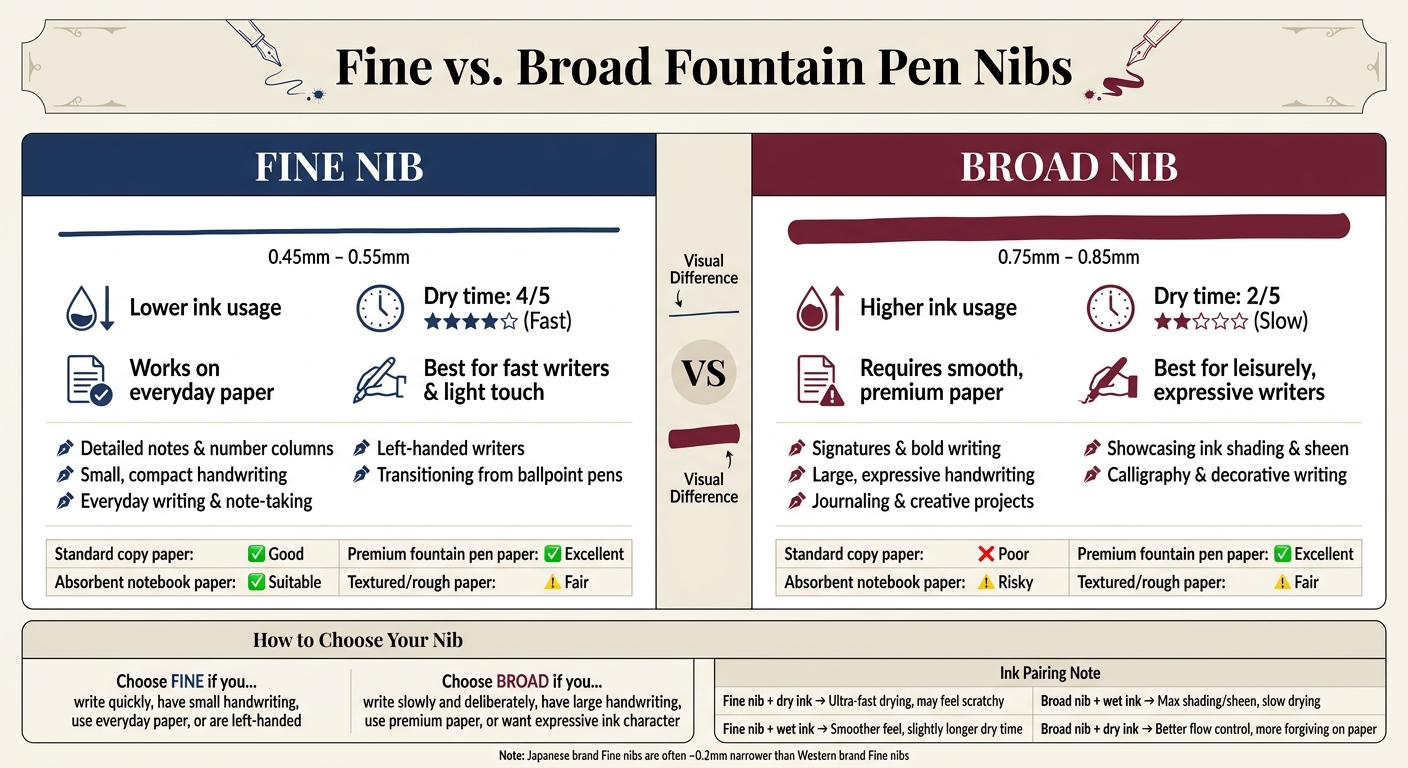
Fine vs. Broad Fountain Pen Nibs: Complete Comparison Guide
Fine and Broad Nibs Explained
Fine Nibs: Precision and Control
Fine nibs are built for precision. With a line width of 0.45mm–0.55mm, they deliver thin, crisp strokes, making them perfect for small handwriting, detailed notes, or writing involving numbers and tight spaces. Since they use less ink, the drying time is quicker - great for fast-paced writing on everyday paper.
"A fine nib... is generally regarded as the preferred option if you have a relatively light touch, write quickly or deal with lots of numbers." - David Cooper, Conway Stewart
Broad Nibs: Bold Lines and Rich Ink
Broad nibs take a different route, offering a line width of 0.75mm–0.85mm. They create thicker, more saturated strokes that stand out visually. This makes them ideal for signatures, journaling, or any writing that calls for bold, expressive lines. However, their heavier ink flow requires smooth, high-quality paper to avoid issues like feathering or bleed-through, and the ink takes longer to dry.
"A broad nib... is perfect for those who are more leisurely in their writing or like to create an impact with bold, broad writing strokes." - David Cooper, Conway Stewart
These differences make it easier to compare fine and broad nibs side by side.
Fine vs. Broad Nibs: A Side-by-Side Comparison
| Feature | Fine Nib | Broad Nib |
|---|---|---|
| Line Width | 0.45mm – 0.55mm | 0.75mm – 0.85mm |
| Ink Usage | Lower; dries faster | Higher; more saturated |
| Writing Pace | Fast, quick strokes | Leisurely, deliberate |
| Best Use Case | Detailed notes, numbers, small text | Signatures, journaling, bold writing |
| Paper Demands | Works on everyday paper | Best on smooth, quality paper |
Learning how to improve everyday handwriting often starts with the right tool. Your handwriting style can also play a big role in deciding which nib suits you best. Let’s dive into that next.
sbb-itb-1dd4fe9
How to Choose the Right Fountain Pen Nib - Fine Pens for Beginners Ep. 2
Matching Nib Width to Your Handwriting Style
Choosing the right nib width starts with understanding your natural handwriting size. When the nib complements how you naturally write, your lines look cleaner, your letters are more consistent, and the entire writing experience feels effortless. Let’s dive into how your handwriting size can guide your nib selection.
"Your personality will show through not only in the words you use, but also in the visual picture you create by putting ink on paper." - David Cooper, Conway Stewart
Small Handwriting: Why Fine Nibs Are Ideal
If your handwriting tends to be small and compact, a fine nib (0.45mm–0.55mm) is your best bet. It keeps your writing sharp and legible, especially in dense passages. Wider nibs can overwhelm small letters, depositing too much ink and making the text look smudged or blurry. For extremely small writing, like detailed notes or precise number columns, an extra fine nib (0.35mm–0.45mm) offers even more control. Plus, if you write quickly, a fine nib ensures that your strokes stay crisp without excess ink pooling.
Large Handwriting: Why Broad Nibs Shine
If your handwriting leans larger and more expansive, a broad nib (0.75mm–0.85mm) delivers the bold strokes you need. It adds weight and presence to larger characters, creating lines that feel substantial and confident. Using a fine nib for large handwriting often results in thin, unimpressive lines that fail to match the scale of your writing. Broad nibs, on the other hand, are perfect for a slower, more intentional writing pace, allowing each stroke to fully develop. If you enjoy sweeping, expressive letters in your journaling or signature, a broad nib adds depth and flair to your style.
How Paper Type Affects Nib Performance
The type of paper you use can make or break your writing experience. A pen that glides effortlessly on one sheet might feel scratchy or messy on another. Let’s dive into how different papers interact with fine and broad nibs.
"The thickness of your handwriting also depends on the pressure you exert on the pen, and what type of paper you are using." - David Cooper, Conway Stewart
Fine Nibs: Ideal for Everyday Paper
Fine nibs are a solid choice for common, lower-quality paper. Since they release less ink, they dry quickly and stay clean within the edges of each stroke. This is especially important on standard copy or notebook paper, where excessive ink can lead to feathering (ink spreading into paper fibers, creating a blurry effect) or bleed-through (ink soaking through to the back of the page). If you’re jotting down notes on printer paper or writing in a basic spiral notebook, a fine nib is a reliable, no-fuss option.
Broad Nibs: Shine on Smooth, High-Quality Paper
Broad nibs, on the other hand, are all about expression and richness - but only when paired with the right paper. Smooth, high-quality paper allows broad nibs to showcase ink shading, sheen, and color saturation in ways fine nibs can’t. However, on absorbent or fibrous paper, the generous ink flow of a broad nib can become a drawback. As Cult Pens explains:
"That increased flow means with unsuitable paper you will get feathering, where the letters go fuzzy, or bleeding, where the ink shows through the page - these will happen with finer nibs, but more so with broad nibs."
Broad nibs also offer a distinct writing feel when used on smooth paper. The extra ink they lay down acts as a lubricant, creating a buttery-smooth sensation as the nib glides across the page. By contrast, fine nibs, with their smaller ink output and sharper tip, provide more feedback - a slight resistance that appeals to those who prefer a controlled writing experience.
Paper Compatibility
Here’s a quick breakdown of how different paper types perform with fine and broad nibs:
| Paper Type | Fine Nib Performance | Broad Nib Performance |
|---|---|---|
| Standard Copy/Printer Paper | Good: Minimal ink flow reduces feathering and bleed-through. | Poor: Excessive ink flow causes feathering and bleeding. |
| Absorbent Notebook Paper | Suitable: Dries quickly, making it practical for casual notes. | Risky: Ink tends to soak through and blur writing. |
| Textured/Rough Paper | Fair: Can feel scratchy as the small tip catches on the texture. | Fair: Extra ink helps with lubrication, but texture still adds resistance. |
| Premium Fountain Pen Paper | Excellent: Delivers crisp, clean lines with a smooth feel. | Excellent: Perfect for showing off ink shading, sheen, and vibrant saturation. |
If your fine nib feels scratchy or your broad nib seems messy, the paper you’re using might be the culprit. Switching to a smoother, higher-quality stock can often solve these issues without requiring adjustments to your nib.
Ink Flow and Drying Time by Nib Width
When it comes to crafting the perfect writing experience, ink flow and drying time are just as important as paper compatibility. The width of your nib plays a key role in determining how much ink reaches the page and how quickly it dries. Understanding this relationship can help you avoid smudges, choose the right ink, and write comfortably at your own pace.
Fine Nibs: Less Ink, Faster Drying
Fine nibs are designed to use less ink. Their narrow tips limit the flow of ink, resulting in quicker drying times. According to Goldspot Pens, fine nibs score a 4 out of 5 for dry time, second only to extra-fine nibs, which achieve a perfect 5 out of 5. This makes fine nibs ideal for fast writers, those who frequently turn pages, or anyone who rests their hand on freshly written words. They’re especially helpful for left-handed writers, who are more prone to smudging due to the natural angle of their hand.
Broad Nibs: More Ink, Better Shading
Broad nibs, on the other hand, deliver a wetter ink flow, creating a smooth and luxurious writing experience. However, this comes at the cost of slower drying times and increased ink consumption. Goldspot Pens rates broad nibs at just 2 out of 5 for dry time, so patience - or a blotter - may be necessary to avoid smudges. The trade-off? Broad nibs bring out the full visual character of premium inks, showcasing features like shading (light-to-dark variations within a stroke), sheen (a metallic glint), and shimmer (sparkle from fine particles).
"The increased ink flow will mean you will go through that favourite ink of yours quicker than with a finer nib." - Cult Pens
These characteristics highlight the importance of matching your nib width to the right ink for your specific needs.
Picking the Right Ink for Your Nib Width
Choosing the right ink can make all the difference. Just as paper affects ink behavior, the ink's own properties interact with nib width to influence drying time, shading, and overall feel. Here’s how you can pair inks with nibs for the best results:
- Fine nib + dry ink: Minimal ink use and ultra-fast drying, though it may feel scratchy.
- Fine nib + wet ink: Smoother writing with slightly longer drying times, but still manageable.
- Broad nib + wet ink: Maximum shading and sheen, but slow drying and risky on standard paper.
- Broad nib + dry ink: Better control over ink flow, reduced smudging, and more forgiving on everyday paper.
If a fine nib feels scratchy or drags on the page, try switching to a wetter ink before considering common nib issues and quick fixes. Similarly, if a broad nib is leaving excessive ink or smearing, a drier ink can help control the flow while maintaining the line width you love. By balancing your nib, ink, and paper, you can create a seamless and enjoyable writing setup tailored to your style.
Choosing the Right Nib for Your Writing Purpose
Once you understand how nibs interact with paper and ink, the next step is selecting a nib that aligns with your writing goals.
Everyday Writing and Note-Taking
If you're jotting down notes or writing daily, a fine nib is your best bet. Its sharp tip produces precise, clean lines that are ideal for compact spaces like lined notebooks or pocket journals. As David Cooper from Conway Stewart explains:
"A fine nib... is generally regarded as the preferred option if you have a relatively light touch, write quickly or deal with lots of numbers."
Fine nibs also feel familiar to those transitioning from ballpoint pens, as their line widths are quite similar.
Expressive Writing and Creative Projects
Broad nibs take center stage when writing becomes more about expression than function. Their thicker strokes bring a sense of drama and personality to signatures, journal entries, or headings. These bold lines command attention in ways that finer nibs simply can't.
"A broad nib... is perfect for those who are more leisurely in their writing or like to create an impact with bold, broad writing strokes." - David Cooper, Conway Stewart
For those venturing into calligraphy or decorative writing, custom nibs vs. standard nibs can be customized. A nib mechanic can grind them into specialized shapes like italic or stub nibs, often for a small additional fee.
Making the Final Call
If you're unsure which nib to choose, think about your typical writing habits. The way nibs perform with different types of paper and ink can also guide your decision. Here's a quick reference table to help:
| Priority | Better Choice |
|---|---|
| Speed and legibility | Fine nib |
| Small handwriting or tight lines | Fine nib |
| Bold, expressive strokes | Broad nib |
| Showcasing ink character | Broad nib |
| Working with standard paper | Fine nib |
| Signatures and creative projects | Broad nib |
One more thing to keep in mind: over time, a nib will naturally adapt to your writing pressure and angle, becoming uniquely yours. Because of this, it's best not to share your fountain pen once you've broken it in. By pairing your writing style with the right nib, you'll create a seamless and enjoyable writing experience. For more tips on technique, see our guide to handwriting with fountain pens.
Conclusion: Finding the Right Nib for You
When choosing a nib, think about your writing habits, the type of paper you use, and how you prefer your ink to flow. Fine nibs (0.45–0.55mm) work well for those with smaller handwriting, quick note-taking, or using everyday paper. On the other hand, broad nibs are perfect for writers who enjoy a slower, more deliberate pace and want to highlight shading and sheen in their ink.
Keep in mind that nib sizes can differ depending on where the pen is made. For instance, a "Fine" nib from a Japanese brand is often narrower than a "Fine" nib from a Western manufacturer - sometimes by as much as 0.2mm. If you're looking for the best fountain pens for beginners, this distinction might catch you off guard. It’s a reminder that every element of your pen should match your personal writing preferences.
And here’s the best part: there’s no wrong choice. As Daisy Goodwin wrote in the Sunday Times:
"Now that handwriting is a choice, not a chore, and there is a premium on the unique rather than the infinitely reproducible, people are beginning to discover, or rediscover, the thrill of pen and ink."
FAQs
How do I choose a nib if my handwriting size varies?
If your handwriting shifts in size, a medium nib is a great place to start since it accommodates most writing styles. For smaller, detailed handwriting, finer nibs like EF (extra fine) or F (fine) are a better fit. On the other hand, broader nibs such as M (medium) or B (broad) are perfect for larger, more expressive strokes. Don’t hesitate to try out different nibs to find the best match as your handwriting style evolves.
What’s the easiest way to stop smudging with a broad nib?
To avoid smudging when using a broad nib, allow the ink to dry completely before touching the page. Quick-drying ink can make a big difference since broad nibs deposit more ink. You might also want to adjust your writing angle or lighten your pressure to control the ink flow better. If smudging persists, consider using high-quality, absorbent paper. It dries ink faster and often provides a smoother surface for writing.
How do I account for Japanese vs. Western nib sizing?
Japanese and Western fountain pen nibs vary noticeably in line thickness. Japanese nibs, such as EF (Extra Fine) or F (Fine), tend to create much thinner lines compared to Western nibs of the same designation. For instance, a Japanese EF nib will produce a finer line than a Western F nib. To find the best fit for your writing style, it's helpful to consult nib size charts or use a nib size calculator to see how the two systems compare in actual line widths.