

The short answer: the right cleaning kit depends on how your pen stores ink. If the reservoir comes out, cleaning is simpler. If ink stays inside the barrel, you need more flushing and more care around seals.
I’d break it down like this:
- Cartridge-converter pens are the easiest to clean because the converter or cartridge comes out.
- Piston-fill pens need repeated flushes through the built-in barrel reservoir.
- Eyedropper pens need barrel cleaning plus thread and O-ring care.
- Vacuum-fill pens usually take the most rinse cycles because ink can stay deep in the plunger system.
In most cases, a basic kit covers the job:
- Bulb syringe
- Blunt-tip syringe
- Microfiber cloth
- Soft swabs or brush
- Pen flush for shimmer, pigmented, or dark inks
- Silicone grease for pens with seals that need it
One detail stood out to me: some vacuum-fill pens may need about 10 cleaning cycles, and heavy residue may take 15 or more. That alone shows why not all kits should look the same.
Fountain Pen Cleaning Ranked Hardest To Easiest
sbb-itb-1dd4fe9
Quick Comparison
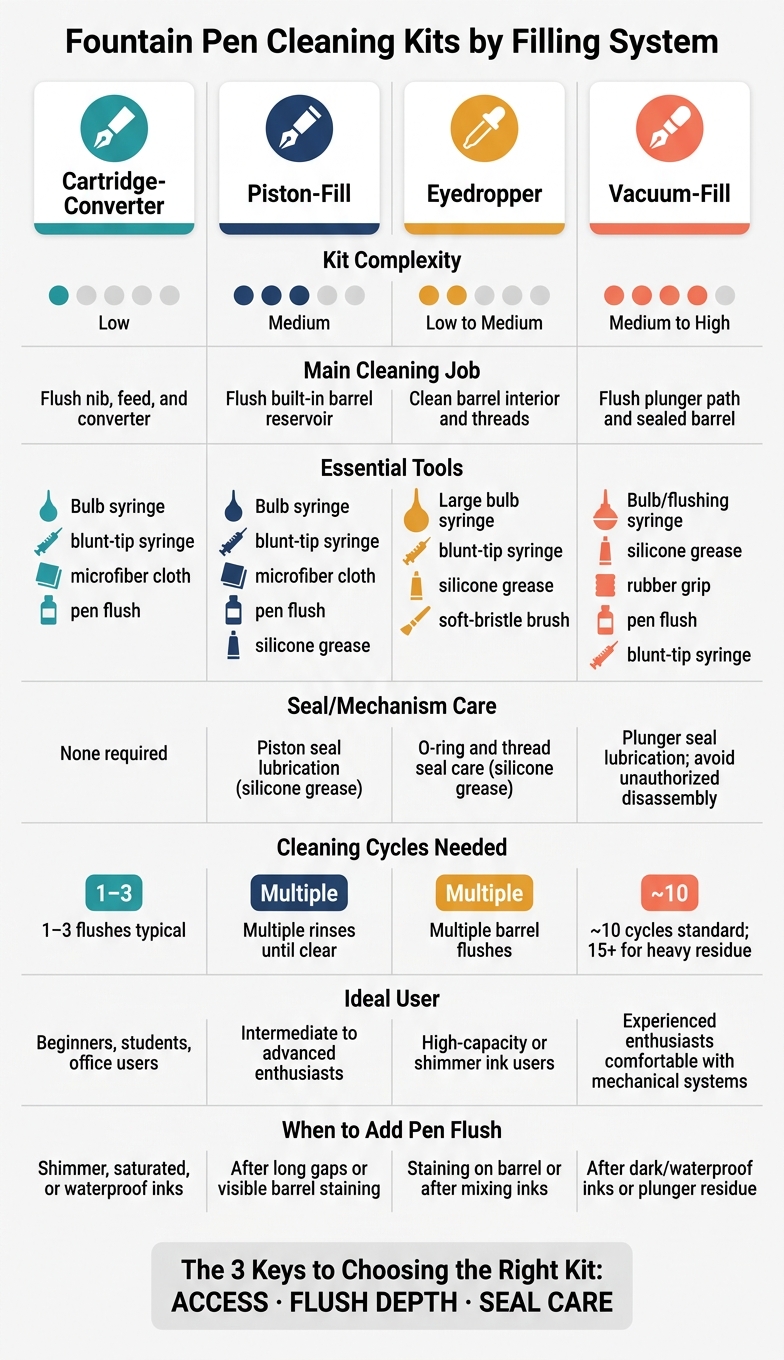
Fountain Pen Cleaning Kits by Filling System: A Complete Comparison
| Pen type | Main cleaning job | Extra tool needs | Usual kit size |
|---|---|---|---|
| Cartridge-converter | Flush nib, feed, and converter | Pen flush for stubborn ink | Low |
| Piston-fill | Flush built-in reservoir | Silicone grease for piston seal | Medium |
| Eyedropper | Clean barrel interior and threads | Silicone grease, barrel brush or swabs | Low to medium |
| Vacuum-fill | Flush plunger path and sealed barrel | Silicone grease, rubber grip, more rinse cycles | Medium to high |
My takeaway: if you match the kit to the filling system, cleaning gets simpler, safer, and less messy. Following a routine to clean and maintain your fountain pen ensures it stays in top condition. The main things I’d look at are access, flush depth, and seal care.
1. Cartridge-Converter Pen Cleaning Kits
Cartridge-converter pens are the easy ones to clean. You can remove the reservoir, which leaves the nib and feed out in the open. That means fewer hidden ink paths than with other filling systems, so it's much easier to reach leftover ink and flush it out.
Best Tools
A 2 oz bulb syringe does a better job of flushing the grip section and feed than simply refilling the converter over and over. A blunt-tip syringe helps you clean the narrow inside of an empty converter or cartridge. And when plain water isn't enough, pen flush helps break down ink residue.
The Fountain Pen Revolution Tuning/Cleaning Kit bundles those tools with brass flossing sheets, a feed brush, silicone grease, and a rubber grip for loosening tight section parts.
That simplicity ends once the ink reservoir stays inside the pen.
Cleaning Focus
Flush the section with cool water until it runs clear. Then clean the converter on its own by filling and expelling water until there's no color left. If you used shimmer or pigmented ink, a short soak in pen flush before the final rinse can help lift leftover particles.
Kit Complexity
Cartridge-converter kits stay simple and practical. For most people, a bulb syringe, pen flush, and a microfiber cloth are enough for routine cleaning. If you switch inks often or deal with stubborn residue, add brass flossing sheets and a rubber grip.
Piston-fill kits call for more specialized tools because the reservoir doesn't come out.
2. Piston-Fill Pen Cleaning Kits
Unlike cartridge-converter kits, piston-fill kits have to clean the pen’s built-in reservoir. That reservoir sits inside the barrel and doesn’t come out, so the job is pretty simple in practice: cycle water through the pen’s own piston until it runs clear.
Best Tools
A bulb syringe helps push flush into the fixed barrel, while a blunt-tip syringe gives you more control when you need to aim cleaning solution with care. Microfiber cloths are handy for drying the grip section and threads after rinsing, and pen flush helps cut through stubborn residue that plain water can leave behind. At that point, the kit stops being just a rinse setup and becomes a barrel-cleaning setup.
Cleaning Focus
Keep your attention on the barrel, nib, and feed. Fill, expel, and repeat until the water comes out clear. After the last rinse, blot the nib dry and let the pen air-dry before you refill it.
Mechanism-Specific Needs
The piston seal needs occasional lubrication. Use a small amount of silicone grease to keep the piston moving smoothly. It also helps to follow the maker’s cleaning guidance, since some piston pens should be cleaned with plain water only.
Kit Complexity
For most piston-fill users, a moderately simple kit is enough: a bulb syringe, microfiber cloths, and pen flush for stubborn inks. The main difference from a cartridge-converter kit is that this setup is built around flushing a reservoir you can’t remove, with piston-seal care added.
3. Eyedropper Pen Cleaning Kits
Eyedropper pens are mechanically simple - no piston, no vacuum rod - but they use the barrel as a large ink reservoir. That setup leaves more interior surface area in contact with ink, so cleaning kits need to handle two things well: flushing a lot of volume and keeping seals in good shape.
Best Tools
The single most important item here is silicone grease. Eyedropper pens depend on threaded barrel joints and O-rings to keep ink where it belongs, and those threads need a thin, even coat every few fills to help prevent leaks.
A large-capacity bulb syringe does most of the flushing work. A blunt-tip syringe gives you more control when you need to direct water or a pen-safe cleaning solution into the section or barrel opening. And a soft-bristle brush helps remove dried ink from feed channels, which matters even more after shimmer or pigmented inks.
Fountain Pen Revolution's Fountain Pen Tuning/Cleaning Kit ($31.00) includes a 2 oz. bulb syringe, blunt-tip syringe, silicone grease, brush, and a 5 mL vial - covering the core eyedropper maintenance tasks in one package.
Cleaning Focus
The barrel interior, feed, and threads all need attention. Flush the barrel with clean, cool-to-lukewarm water until it runs clear, then rinse the nib section on its own.
For daily writers, a regular barrel flush is a good baseline. If you use shimmer or pigmented inks, clean more often. When you refill, check the threads and add a light layer of silicone grease every few fills.
Mechanism-Specific Needs
Because there are no internal moving parts, you don't need piston seal lubricants or mechanism tools. The job here is all about volume management and seal integrity.
Use silicone grease sparingly. If you apply too much, it can work its way into the feed and affect ink flow. For stubborn residue from waterproof, pigment-based, or iron gall inks, a pen-safe cleaning solution usually works better than water alone.
Kit Complexity
For most users, a simple kit is enough:
- Bulb syringe
- Blunt-tip syringe
- Silicone grease
- Pen-safe cleaning solution for tougher inks
If you rotate through multiple eyedropper pens and use different ink types, it makes sense to add a dedicated feed brush and extra O-rings. The big difference from piston kits is simple: the added effort comes from volume and seal care, not from servicing internal mechanisms.
4. Vacuum-Fill Pen Cleaning Kits
Vacuum-fill pens are tougher to clean than many other fountain pens. The reason is pretty simple: their sealed reservoirs hold onto ink inside the plunger system and barrel. Ink can linger around the plunger rod, the shut-off system, and deep inside the barrel where it's hard to see.
Asvine's manuals for the V126 and V200 recommend about 10 cleaning cycles of filling the pen with water and expelling it until the water runs clear. If you're dealing with heavier residue or very saturated inks, a service guide recommends at least 15 fill-and-flush cycles for heavy residue. Like piston-fill pens, vacuum-fill models have the same sealed-reservoir problem. But the plunger setup adds even more places for ink to hide.
Best Tools
A few tools do most of the heavy lifting here:
- A bulb or flushing syringe helps push water through the plunger system and deep barrel
- Silicone grease helps keep the plunger seal airtight and moving smoothly
- A rubber grip makes it safer to remove the nib and feed when you need better access
- Pen-safe flush helps loosen residue that plain water may leave behind in hidden areas
- A blunt-tip syringe gives you more control on compatible models by letting you direct solution into the section
Cleaning Focus
With vacuum-fill pens, repeated gentle flushing works better than scrubbing or forcing parts apart. Run clean water through the pen again and again until it looks mostly clear, then check the barrel and feed.
If you often use waterproof or heavily saturated inks, pen-safe flush can help loosen residue that water alone may not remove. After cleaning, let the pen dry for several hours or overnight before you ink it again. Moisture tends to stick around longer in vacuum-fill reservoirs.
Mechanism-Specific Needs
This is one area where manufacturer guidance matters a lot more than it does with simpler filling systems. Before you use a wrench or a stronger flush, check the maker's instructions. Some vacuum-fill pens are made for user service, while others are sealed.
Kit Complexity
A vacuum-fill kit doesn't need to be big. It needs to be precise.
The core setup is a bulb or flushing syringe, silicone grease, a rubber grip, pen-safe flush, and a blunt-tip syringe for compatible models. The Fountain Pen Revolution Tuning/Cleaning Kit includes many of these basics in one package.
Vacuum-fill kits are about control, not size. The tools need to clean around a moving plunger and airtight seals, which means patience and precision matter more than brute force.
Pros and Cons of Each Cleaning Kit Type
Each filling system comes with its own cleaning routine, so the best kit depends on how your pen is built. Some pens are easy to rinse and move on. Others may require more intensive care, such as following steps to unclog a fountain pen if flow has stopped completely. Others ask for more time, more flushing, or a bit of seal care. The table below lays out the main differences.
| Pen Type | Main Kit Advantages | Main Kit Limitations | Ideal User | When to Add Pen Flush |
|---|---|---|---|---|
| Cartridge-Converter | Compact, low-cost, quick nib/feed flushing | Less effective for stubborn or waterproof inks; limited to section-level cleaning | Students, office users, beginners | When using shimmer, heavily saturated, or waterproof inks |
| Piston-Fill | Uses the pen's own mechanism to rinse the full barrel; silicone grease helps maintain the seal | Needs repeated rinses; staining may need pen flush; repeated strokes can stress older seals | Intermediate to advanced enthusiasts | After long gaps between cleanings or when the barrel shows visible staining |
| Eyedropper | Brushes and swabs reach the barrel interior; silicone grease helps protect threads | More cleaning steps; risk of scratching the barrel with harsh tools; messier if the seal fails | Writers who use high-capacity pens or shimmer inks | When staining appears on transparent barrels or after mixing inks |
| Vacuum-Fill | Vacuum action flushes the barrel efficiently | Requires repeated flushing cycles; valve design adds complexity | Experienced enthusiasts comfortable with mechanical systems | After dark or waterproof inks, or when residue lingers near the plunger rod or seals |
The main choice comes down to three things: access, flushing, and seal care.
- Cartridge-converter kits are the easiest to deal with and usually work well for day-to-day cleaning.
- Piston-fill and vacuum-fill pens need more flushing, plain and simple.
- Eyedropper pens need more attention around seals and inside the barrel.
That makes the next move pretty simple: match the kit to your pen type and the kind of ink you use most often.
How to Pick the Right Cleaning Kit
Start with the fill system. That’s the simplest way to cut through the options and choose a kit that fits your pen.
Here’s the buying rule: pick tools based on access, seal care, and how deep you need to flush.
The fill system should guide the kit you buy. Pens with removable reservoirs need tools that help you reach those parts with control. Sealed reservoirs are a bit different. They call for repeated flushing and more attention to seals. If you’re new to fountain pens, a basic kit is usually enough. If you use heavily saturated inks often, it helps to have brushes, swabs, and silicone grease on hand. For piston and vacuum pens, a bundled kit with silicone grease and more than one syringe type usually covers what you need.
| Pen Type | Best tools | Cleaning focus | System-specific needs | Kit complexity |
|---|---|---|---|---|
| Cartridge-Converter | Bulb syringe, blunt-tip syringe, microfiber cloth | Nib, feed, and converter | Avoid damaging feed fins or converter fittings | Low |
| Piston-Fill | Blunt-tip syringe or flush adapter, soft feed brush, cotton swabs, silicone grease | Nib, feed, and piston chamber | Protect piston seals; avoid harsh chemicals or abrasive brushes inside the barrel | Medium |
| Eyedropper | Large syringe or eyedropper, barrel swabs and brushes, silicone grease | Nib, feed, and barrel interior | O-ring and thread seal care; keep petroleum products away from rubber seals | Low–Moderate |
| Vacuum-Fill | Bulb or flushing syringe, soft feed brushes, silicone grease | Nib, feed, and plunger path | Complex plunger and seal system; avoid disassembly unless the maker allows it | Medium–High |
Stick to non-abrasive tools only. That means microfiber cloths, cotton swabs, foam swabs, and soft-bristle brushes. If a tool feels rough, it probably doesn’t belong anywhere near a fountain pen.
For routine cleaning, plain room-temperature water does the job. Save pen flush for dried ink, shimmer residue, or heavily saturated inks, and rinse well after using it. This matters even more with piston, eyedropper, and vacuum pens, where residue can sit out of sight past the feed.
Once you’ve got those basics down, it gets much easier to match the kit to your fill system and the inks you use most.
Conclusion
The fill system is what shapes the whole cleaning setup. Cartridge-converter pens are usually the easiest and fastest to flush. Piston, eyedropper, and vacuum-fill pens take a bit more work because you have to think about the reservoir and the seals too.
So the choice is pretty simple: look at access, how deeply you need to flush, and whether the seals need care. Then pick the smallest kit that fits your pen and ink. For most people, that means a bulb syringe, a blunt-tip syringe, a mild flush, and a soft brush. If your pen has seals that need care, add silicone grease.
That makes the buying decision easier. Match the tools to the mechanism and the ink. Fountain Pen Revolution's Fountain Pen Tuning/Cleaning Kit ($31.00) puts those core tools in one package and serves as a practical starting point for most filling systems.
The rule doesn’t change: match the tools to the mechanism, keep them non-abrasive, and clean consistently. A small kit you’ll actually use on a regular basis does more than a bigger kit that sits in a drawer.
FAQs
How often should I clean each pen type?
For any fountain pen, do a plain water flush every 2 to 4 weeks and any time you switch ink colors.
If you’re not using a pen, store it clean and empty. Another option is to flush it every 1 to 2 months so residue doesn’t build up. Save deep cleaning for when you spot problems like skipping, pale lines, or dried ink in the pen.
Can one kit work for all fountain pens?
No. Cleaning needs change based on the filling system, so one kit can’t work for all fountain pens.
Basic tools like distilled water and a bulb syringe are safe for many pens. But the details matter. Piston and vacuum fillers should not be taken apart, while cartridge-converter pens often do better when you remove parts and flush them directly.
Cleaning solutions also aren’t one-size-fits-all. Some can damage vintage models, aluminum parts, or certain resins.
When do I need pen flush instead of water?
Use pen flush when water isn’t enough to fix ink flow issues, stubborn residue, or dried ink. Distilled water works best for routine cleaning and normal ink changes, but pen flush helps loosen deposits that regular flushing can leave behind.
If soaking the nib and feed and flushing with a bulb syringe still leaves heavy color or clogging, switch to pen flush. Rinse the pen thoroughly with plain water afterward.