

When selecting inks for calligraphy branding, the right choice can elevate your designs and ensure lasting impressions. Here's what you need to know:
- Fountain Pen Revolution Inks: Affordable, vibrant, and smooth-flowing. Great for bold designs and custom colors. Prices start at $7.00 for a 30 mL bottle.
- Sumi Ink: Delivers deep, opaque black with archival quality. Perfect for professional, long-lasting work. Costs around $11.00 for 180 mL.
- Walnut Ink: Offers a rich brown tone for a classic, elegant look. Priced at $17.00 for 3 oz.
- Metallic Inks: Adds shimmer and luxury to branding. Requires preparation but creates striking effects. Available for $12.50 per 30 mL.
Key takeaway: Match the ink to your project’s needs - whether it’s vibrancy, longevity, or a premium look. Test on your materials before committing to ensure flawless results.
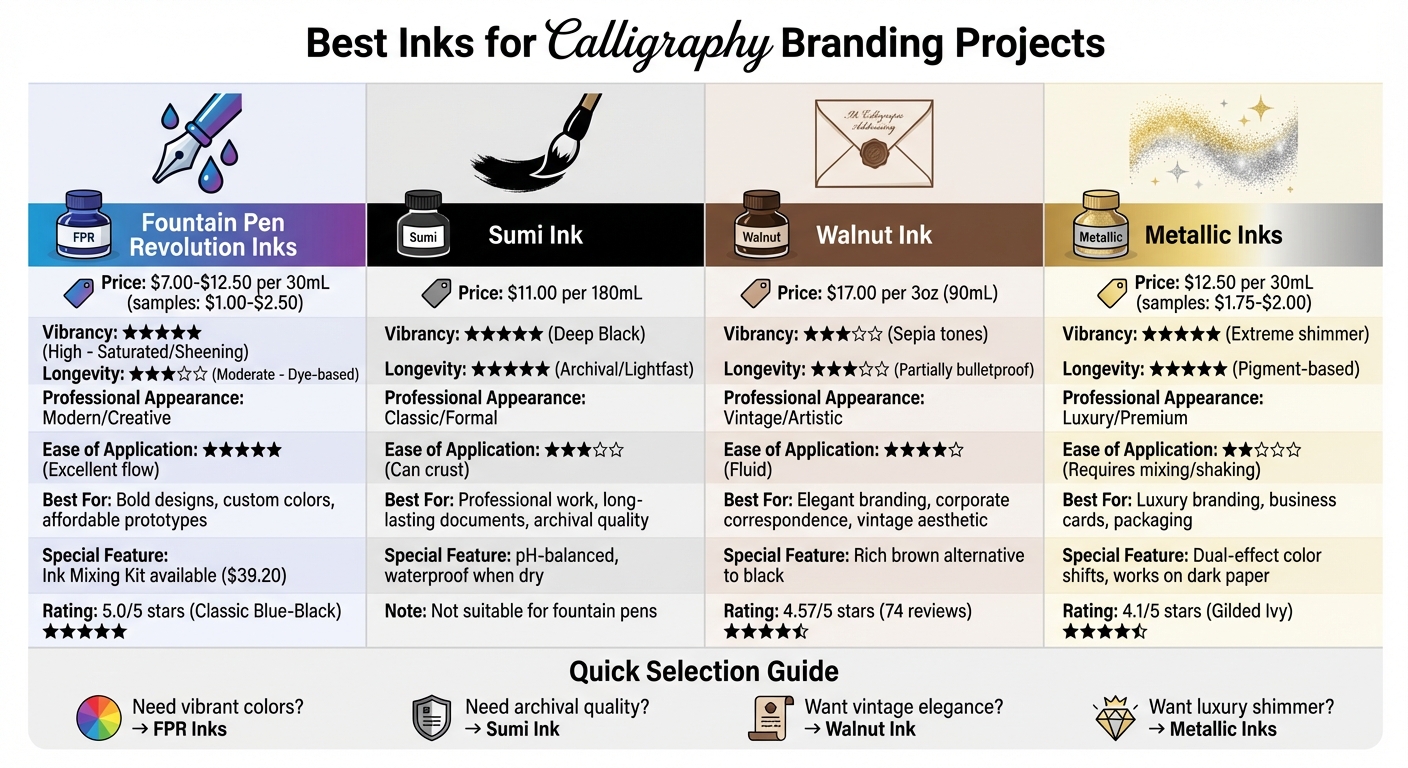
Calligraphy Ink Comparison: Features, Pricing, and Best Uses
My Top 3 Gold Ink Comparison for Calligraphy - Ink Stirrer Tutorial
sbb-itb-1dd4fe9
1. Fountain Pen Revolution Inks
Fountain Pen Revolution inks combine reliable performance with affordability, making them a solid choice for branding projects. A 30 ml bottle typically costs between $7.00 and $12.50, and if you're unsure about committing, ink samples are available for just $1.00 to $2.50.
Vibrancy
The standout feature of these inks is their rich saturation. William H., in his review of the Classic Blue-Black, captures this perfectly:
Ink tracks are as fully saturated as ink swabs piled on top of one another.
For a bold and striking look, colors like Royal Flush Blue are a great choice. Alfonso, a Verified Customer, shared his experience:
Royal Flush Blue – This guy surprised me the most! It popped off the page with a sharp, rich blue.
Additionally, specialty finishes such as Mardi Gras Purple and Galaxy Blue offer unique, multi-layered effects that elevate luxury branding. For those seeking custom hues, the Ink Mixing Kit ($39.20) provides tools to blend base colors - Red, Blue, Yellow, and Pink - into precise shades using syringes and pipettes. This level of vibrancy ensures that your branding leaves a lasting impression.
Professional Appearance
The Classic Blue-Black ink, which boasts a perfect 5.0/5 rating from 8 reviews, is particularly noted for its suitability in professional settings. James K. highlighted its versatility:
This is a color for professional documents and other boring things. The color is well balanced between blue and black... The water resistance is better than the FPR blue I have.
Its balance of sophistication and visual appeal makes it ideal for official branding and corporate materials.
Ease of Application
These inks perform reliably across a variety of paper types. Lee praised their behavior:
It's an extremely well-behaved ink that stays put and doesn't feather. I like inks that can handle a variety of papers, and this fits that description.
Peter A. also noted its practicality:
even on cheap copy paper
with no bleeding issues. The quick drying time and smooth flow make it a favorite for intricate calligraphy, while shimmering inks add a touch of sparkle - just remember to shake them well before use. Up next, we’ll explore other ink options to help refine your branding efforts.
2. Sumi Ink
Professional Appearance
Sumi ink delivers a rich, opaque black that’s perfect for professional branding. High-quality options, like Moon Palace Sumi, maintain their intensity even in the thinnest strokes. Calligrapher Molly Suber Thorpe shares her preference for this ink:
I recommend most black sumi inks for both calligraphy practice and finished work, but among all the brands, Moon Palace Sumi is my top choice... It has the perfect consistency straight out of the bottle, and dries completely opaque, even on thin upstrokes.
Its matte finish reduces glare during scanning, making it ideal for digitizing artwork. Some Japanese Sumi inks also contain less glue, creating a richer, more fluid black that enhances the overall professional quality. Beyond its striking appearance, Sumi ink offers durability and precision that artists can rely on.
Longevity
Sumi ink is known for its archival quality, being pH-balanced and lightfast, which ensures that your work retains its vibrancy over time. Thorpe emphasizes the importance of these features:
If you want your finished calligraphy piece to last a lifetime, then it's crucial that your ink is up to the task. Make sure to pick an ink that is advertised as archival. These inks are pH-balanced (meaning low acid or acid-free), and lightfast (meaning they won't fade over time).
Many Sumi inks are waterproof once dry, offering additional protection. Pairing this ink with archival-quality paper further ensures the longevity of your creations.
Ease of Application
Sumi ink is specially designed for use with dip pens or brushes but isn’t suitable for fountain pens due to its thickness, which could clog the feed . Designer Karla Lim from Written Word Calligraphy highlights one aspect to keep in mind:
The downside to this deep black ink is that it does form a crust if left exposed too long, so we do add water here and there to improve flow.
To prepare new nibs for use, clean them with soapy water or briefly treat them with a flame to remove any manufacturing oils. Japanese Sumi‐e Ink is also budget-friendly, priced at around $11.00 for a 180 mL bottle. Its affordability, combined with its performance, makes it a strong choice for professional branding projects. These features set a solid foundation for exploring other ink options in the next sections.
3. Walnut Ink
Professional Appearance
Walnut ink offers a deep, rich brown hue that stands out as a refined alternative to traditional black inks. Its classic tone adds an elegant touch to branding, making it ideal for professional uses like corporate correspondence. The smooth, matte finish further enhances its polished look. Carol C., a fan of Noodler's Walnut, shares her experience:
This has quickly become one of my favorite inks. It has a deep, rich color and it is now my go to for writing out envelopes.
At $17.00 for a 3 oz (90 mL) bottle, it strikes a balance between quality and cost, making it an accessible choice for both personal and corporate needs.
Longevity
Noodler's Walnut ink is labeled as "partially bulletproof", meaning it provides moderate water resistance once dried. While it holds up to light exposure to water, repeated wetting can cause some fading or washout. This is worth noting if you're planning to layer watercolors or other wet media over your calligraphy, as the ink may not remain fully intact.
The drying time depends on the type of paper you’re using. On standard copy paper, it dries relatively quickly, but on non-absorbent surfaces, drying can take longer.
Ease of Application
This ink is compatible with fountain pens, converters, and eyedropper-filled pens, offering a smooth writing experience. However, because it’s handcrafted, slight variations in color may occur between batches. If consistency is critical - such as for large-scale branding - it's a good idea to use ink from the same production batch.
Left-handed writers, especially those using medium or large nibs, should be cautious about potential smudging. Despite this, Noodler's Walnut has earned high praise, holding an impressive 4.57 out of 5 stars from 74 reviews. Users frequently highlight its rich color and reliable water resistance.
Walnut ink’s unique qualities make it a versatile choice for specialty projects, adding depth and sophistication to branding efforts.
4. Metallic and Specialty Inks
Metallic and specialty inks take traditional ink options to the next level, offering a luxurious touch that aligns with the expectations of high-end branding projects.
Vibrancy
These inks are all about making a statement. With microscopic gold or silver particles, they create a shimmering effect that shifts under different lighting. For instance, Fountain Pen Revolution's shimmer inks highlight this beautifully. Royal Flush features a blue-turquoise base with a red sheen and silver sparkle, while Cosmic Pink transitions from dark fuchsia to a gold-tinted finish with silver accents. These dual-effect inks are perfect for adding an upscale, eye-catching element to items like business cards, packaging, or other branding materials.
Professional Appearance
Metallic and specialty inks give designs a refined, foil-like finish without requiring additional processing. This polished look is ideal for luxury branding. Take Fountain Pen Revolution’s Gilded Ivy Shimmer as an example. With its deep green base and gold shimmer, it creates a rich and sophisticated aesthetic. Reviewers have rated it 4.1 out of 5 stars, praising its elegant finish. At around $12.50 for a 30 mL bottle, or $1.75 to $2.00 for 1.7 mL samples, these inks offer an affordable way to add a premium touch to branding projects without breaking the bank.
Ease of Application
While specialty inks perform reliably, they do require a bit of preparation. Metallic particles tend to settle, so shaking the bottle before use is essential for even distribution. One reviewer, Simon, shared:
Gilded Ivy requires far less agitation to stir up the settled shimmer... This ink really knocked it out of the park as far as performance goes.
Another user, Grace, added:
GREAT with a dip pen!
Dip pens are often recommended for these inks, especially for calligraphy projects, as they handle the metallic particles better and reduce the risk of clogging in finer fountain pen nibs. Proper fountain pen maintenance is also crucial when using these shimmering formulas. By following these tips, you can ensure consistent, high-quality results that elevate your branding efforts.
Pros and Cons
Different ink types come with their own set of benefits and challenges, each suited for specific branding needs. Ink performance can vary widely depending on the application, so it’s essential to weigh the options carefully. Here's a breakdown of the strengths and limitations of popular ink types:
Fountain Pen Revolution (FPR) inks are known for their high saturation and unique sheening effects, like the striking red sheen of Neptune Blue. They deliver consistent performance but can bleed on standard paper. Calligrapher Louise points out that these water-based dye inks may slide off the nib without quality paper. To get the best results, pair them with premium paper like Rhodia to prevent feathering.
Sumi ink stands out for its opacity and archival quality, making it a favorite for professional black work. It produces a deep, matte finish that holds up even on intricate hairlines. Sumi ink is ready to use straight from the bottle, but its tendency to crust when exposed to air means it occasionally needs thinning with water.
Walnut ink offers a sepia tone that’s perfect for creating a vintage aesthetic. It flows smoothly and provides moderate longevity, though it’s less opaque compared to Sumi or metallic inks. Its watercolor-like quality is ideal for projects where subtle tonal effects are more important than bold contrast.
Metallic inks deliver unmatched shimmer and opacity, especially on dark paper. These pigment-based inks are highly durable but require frequent agitation to keep the pigment evenly distributed. While they pass the opacity test with flying colors, they do demand extra preparation and care.
To simplify the comparison, here’s a table summarizing the key features of each ink type:
| Ink Type | Vibrancy | Longevity | Professional Appearance | Ease of Application |
|---|---|---|---|---|
| FPR Inks | High (Saturated/Sheening) | Moderate (Dye-based) | Modern/Creative | High (Excellent flow) |
| Sumi Ink | High (Deep Black) | High (Archival/Lightfast) | Classic/Formal | Moderate (Can crust) |
| Walnut Ink | Moderate (Sepia tones) | Moderate | Vintage/Artistic | High (Fluid) |
| Metallic Inks | Extreme (Shimmer) | High (Pigment-based) | Luxury/Premium | Low (Requires mixing) |
Conclusion
Choosing the right ink is all about matching it to your branding needs. Each type of ink brings its own advantages. Metallic and shimmering inks, for example, are perfect for bold designs that need to pop, especially on dark surfaces. If you're after a dynamic, multi-tonal effect, FPR Mardi Gras delivers a stunning color shift under different lighting. For projects requiring longevity, such as premium packaging or important documents, archival Sumi ink stands out with its lightfast and acid-free properties.
Your ink choice should also align with the specific demands of your project. Fountain Pen Revolution (FPR) inks offer vibrant colors and affordability, making them a great option for professional branding. Prices start at just $1.00 for classic colors, with shimmering varieties available for $1.75. For those looking to create custom hues, the Ink Mixing Kit ($39.20) allows for precise adjustments, ensuring your branding remains consistent across all materials.
Before committing to a large-scale project, test your selected inks on the actual materials you’ll use. Paper stocks can vary greatly in how they absorb and display ink. What looks incredible on high-end Rhodia paper might bleed or fade on standard cardstock. Start with cost-effective FPR inks for prototypes and client samples, and only move to premium archival inks when durability and longevity are essential. By carefully matching your ink to your project's needs, you can create calligraphy that not only grabs attention but also stands the test of time.
FAQs
Which ink is best for logo work that must last for years?
For logo designs that stand the test of time, opt for a pigment-based, archival-quality ink such as Platinum Carbon Black. These inks are known for their durability and resistance to fading, delivering professional results that last.
Will these inks bleed or feather on my packaging cardstock?
These inks can bleed or feather when used on packaging cardstock, especially if the paper is not high-quality. Using premium, coated, or fountain pen-friendly paper can significantly reduce these problems, as lower-quality cardstock tends to exacerbate them.
Can I use shimmer or metallic inks in a fountain pen without clogging?
Shimmer or metallic inks can sometimes clog fountain pens because of the small particles they contain. To reduce the risk, make sure to clean your pen often and opt for pens with broader nibs, as they handle these inks more effectively. Regular maintenance is essential for preventing flow issues and keeping your pen writing smoothly.