

Vacuum filling pens stand out for their high ink capacity and fast filling process, making them a favorite for heavy writers and frequent travelers. However, they demand more maintenance than other systems. Here’s a quick breakdown:
- Ink Capacity: Utilizes up to 80% of the barrel, holding more ink than cartridges or converters.
- Filling Speed: Single plunger action fills the pen quickly but requires care to avoid air bubbles.
- Maintenance: Cleaning and repairs are more complex due to the intricate design.
- Cost: Typically higher-priced compared to cartridge or piston pens.
Quick Comparison
| System | Ink Capacity | Ease of Cleaning | Filling Speed | Maintenance |
|---|---|---|---|---|
| Cartridge | Low (0.7–1.0 ml) | Very Easy | Fast | Very Low |
| Converter | Low (0.4–1.2 ml) | Easy | Moderate | Low |
| Piston | High (1.5–2.5 ml) | Moderate | Moderate | Moderate |
| Vacuum | High (80% of barrel) | Difficult | Very Fast | High |
Vacuum fillers are perfect for those who value large ink reservoirs and leak-proof designs, but they require extra care and are best suited for experienced users.
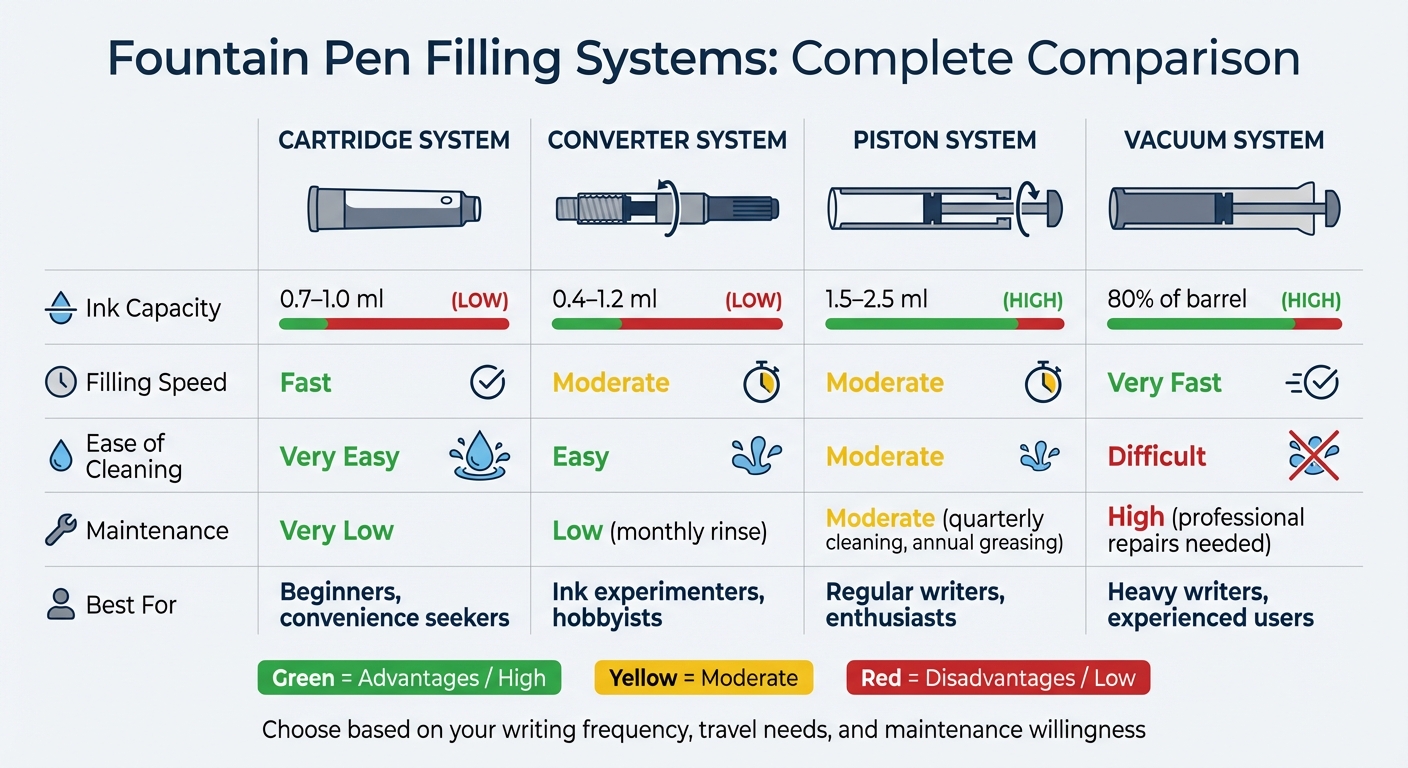
Fountain Pen Filling Systems Comparison: Capacity, Speed, and Maintenance
1. Vacuum Filling Systems
Ink Capacity
Vacuum fillers are known for their impressive ink capacity. By utilizing the entire barrel as a reservoir, these pens can hold significantly more ink compared to other fountain pen filling systems. In fact, they can fill over 80% of the barrel, making them ideal for users who want fewer interruptions during extended writing sessions.
Filling Speed
One of the standout features of vacuum fillers is their efficient filling process. With just a single downward stroke of the plunger, the pen can almost completely fill with ink. To ensure a proper fill, fully immerse the feed in the ink before activating the plunger. It's best to use both hands - one to press the plunger and the other to stabilize the ink bottle. While the process is quick, it does require some attention to avoid pulling in air instead of ink.
Ease of Cleaning
Cleaning vacuum fillers is thorough but requires a gentle approach. Pen expert Jim Mamoulides highlights this in his advice:
Vacuum Fillers flush very thoroughly, but care is needed to avoid damaging the pen and its seals.
For effective cleaning, use light pressure and move the plunger slowly in a rocking motion through the liquid. Avoid fast or forceful movements, as these can create excessive pressure and lead to leaks near the barrel.
Maintenance Requirements
Maintaining a vacuum filler can be more complex compared to other systems. The airtight seals and plunger rod are critical components and need careful upkeep. Mamoulides points out:
Restoration is a professional level job and is substantially more than most other repairs.
If repairs are needed, they often require specialized skills and can be more expensive than standard pen maintenance.
sbb-itb-1dd4fe9
2. Cartridge/Converter Systems
Ink Capacity
When it comes to ink capacity, standard ink cartridges typically hold between 0.7 and 1.0 ml of ink. Converters, on the other hand, vary depending on the type. Basic piston converters usually hold around 0.4 ml, while premium models can store up to 1.2 ml. Squeeze converters fall somewhere in the middle, with a capacity of about 0.5 ml, and piston-style converters, like the CON-40, hold approximately 0.4 ml of ink.
Filling Speed
Cartridges are the fastest option for refilling. All you need to do is pop in a new ink cartridge, and you're good to go. Converters, however, take a bit more time and effort since you’ll need to manually draw ink into the converter by twisting or pulling it while the nib is submerged in ink.
Ease of Cleaning
Cleaning cartridge and converter systems is straightforward compared to vacuum systems. As EndlessPens explains:
"Although the ink capacity of a converter is small, it is also easier to clean."
For cartridges, there’s virtually no cleaning involved - just replace the empty cartridge with a new one. Converters, however, are removable, making it easy to flush out both the converter and the nib unit separately when needed.
Maintenance Requirements
These systems are low-maintenance. Cartridges require almost no upkeep since they’re disposable - you simply discard the old one when it’s empty. Converters, while reusable, only need a monthly rinse with water to keep them in good condition. Compared to vacuum systems, which demand more complex care, cartridges and converters are much simpler to maintain. Up next, we'll dive into piston filling systems to round out the comparison.
How Do Vacuum Fillers Work? Fountain Pen Explainer
3. Piston Filling Systems
After discussing cartridges and converters, let's dive into piston fillers - a system known for its larger ink capacity and specific maintenance needs.
Ink Capacity
Piston fillers are champions when it comes to ink storage. Popular models like the Pelikan M200 and Montblanc 146 can hold between 1.5–2.5 ml of ink. Even budget-friendly options, such as the TWSBI ECO, offer impressive capacities of around 1.8–2.0 ml. Compared to standard cartridges or converters, these numbers are considerably higher, making piston fillers ideal for heavy writers or those who dislike frequent refilling.
Filling Speed
The filling process for a piston system involves a simple yet manual operation. By twisting the end cap, an internal plunger moves to create suction, drawing ink into the reservoir when the nib is submerged. While not as quick as snapping in a cartridge, the process is straightforward and efficient for those who enjoy the ritual of using a fountain pen.
Ease of Cleaning
Cleaning a piston filler takes a bit more effort than cartridge or converter systems. Ideally, you should clean the pen quarterly or whenever switching inks. This involves flushing water through the mechanism by repeatedly filling and emptying the pen. Since the piston is built into the pen’s body, the cleaning process can be more time-intensive but is essential for keeping the system running smoothly.
Maintenance Requirements
Piston fillers demand moderate upkeep. In addition to regular cleaning, applying silicone grease to the piston threads once a year helps maintain the seal and prevents it from drying out. While this routine is more involved than the simple monthly rinses converters require, it’s still less demanding compared to vacuum filling systems.
These characteristics highlight the balance of benefits and challenges that come with piston systems, offering a deeper perspective on their functionality and care.
Advantages and Disadvantages
Vacuum filling systems stand out for their impressive ink capacity and quick filling process, but they come with the trade-off of requiring more maintenance.
Ink capacity is a major advantage of these pens. They offer some of the largest ink reservoirs available today, often matching or surpassing the 1.5–2.5 ml capacity seen in piston fillers. This far exceeds the capacity of cartridges and converters, which typically hold between 0.4–1.2 ml of ink.
Another highlight is their filling speed. Thanks to the plunger mechanism, vacuum fillers can refill much faster than the twisting action needed for piston or converter systems. Plus, their sealed design effectively prevents leaks, adding to their practicality for regular use.
However, maintenance complexity is a key downside. The intricate engineering behind vacuum systems means they require more attention and care compared to other filling mechanisms. Cleaning them is more time-consuming and challenging than cleaning converters or piston fillers. Cost is another consideration - pens like the Pilot Custom 823 with vacuum systems are generally priced higher than those with cartridges or pistons.
Additionally, the reliance on bottled ink can be inconvenient for users on the go. While bottled ink is much cheaper - offering savings of 60–75% compared to pre-filled cartridges over time - it’s less portable and requires planning when refilling away from home.
| System | Ink Capacity | Ease of Cleaning | Filling Speed | Maintenance Requirements |
|---|---|---|---|---|
| Cartridge | Low (0.7–1.0 ml) | Very Easy | Fast | Very Low |
| Converter | Low (0.4–1.2 ml) | Easy | Moderate | Low |
| Piston | High (1.5–2.5 ml) | Moderate | Moderate | Moderate |
| Vacuum | High | Difficult | Very Fast | High |
These pros and cons show why vacuum systems continue to attract users despite their higher upkeep demands. They’re ideal for those who value performance and efficiency, even if it means investing more time in maintenance.
Conclusion
Choosing the right filling system depends on how often you write, how much you travel, and how willing you are to handle maintenance. Vacuum fillers are perfect for dedicated writers who need maximum ink capacity and reliable, leak-proof travel options, though they require more upkeep. Cartridge systems are ideal for beginners, offering simplicity and low maintenance. Piston fillers provide a balanced option, with decent ink capacity (1.5–2.5 ml) and manageable maintenance, making them a favorite for hobbyists moving beyond cartridges.
Each system offers specific benefits tailored to different writing needs. Writers who churn out pages daily will appreciate the larger capacity of vacuum or piston systems, which reduce the need for frequent refills. Travelers, on the other hand, may prefer cartridges for their convenience or vacuum fillers for their secure, leak-resistant design - especially useful during flights where cabin pressure can cause issues. Ink enthusiasts who love experimenting with colors can enjoy the flexibility of bottled ink through converters or piston systems, which make color changes easier and more economical.
While bottled ink systems may seem pricier upfront, they often save money in the long run for those who write regularly. Fountain Pen Revolution makes it easy to explore all these options, offering affordable starter kits that include pens, ink, and accessories. These sets allow beginners to experiment with different filling systems without overspending, while seasoned writers can indulge in premium collections like their Gold vs Steel Nib collections for enhanced performance.
Whether you're just starting out or looking to upgrade, Fountain Pen Revolution caters to a variety of budgets and writing preferences. Their range ensures that as your writing needs evolve, you’ll find the perfect pen to match - culminating in vacuum fillers for those who value high capacity and engineering excellence over simplicity.
FAQs
Are vacuum fillers good for beginners?
Vacuum fillers can be a good option for beginners, but they come with a bit of a learning curve. These pens are known for their larger ink capacity and offer a classic writing experience that many enthusiasts appreciate. However, their maintenance and filling process can feel tricky if you're just starting out. For those new to fountain pens, simpler systems like cartridges or converters might be more approachable. That said, if you're up for learning how to care for and handle them properly, vacuum fillers can become a satisfying choice for long-term use.
How do I avoid air bubbles when filling a vacuum pen?
To keep air bubbles at bay, make sure the nib stays completely submerged in the ink during the filling process. If you notice bubbles forming, simply repeat the process while keeping the nib under the surface. Press the plunger all the way down to draw ink effectively and create a secure seal. For any trapped air, a gentle tap or shake of the pen can help release it before sealing. Using the right technique ensures a hassle-free and smooth filling every time.
When should a vacuum filler be serviced by a professional?
If your vacuum filler starts showing signs of trouble - like leaks, difficulty creating a vacuum, or the need for more thorough cleaning and maintenance than regular upkeep can handle - it’s time to get it professionally serviced. Tackling these problems early can help avoid bigger issues down the line and keep your equipment running smoothly.