

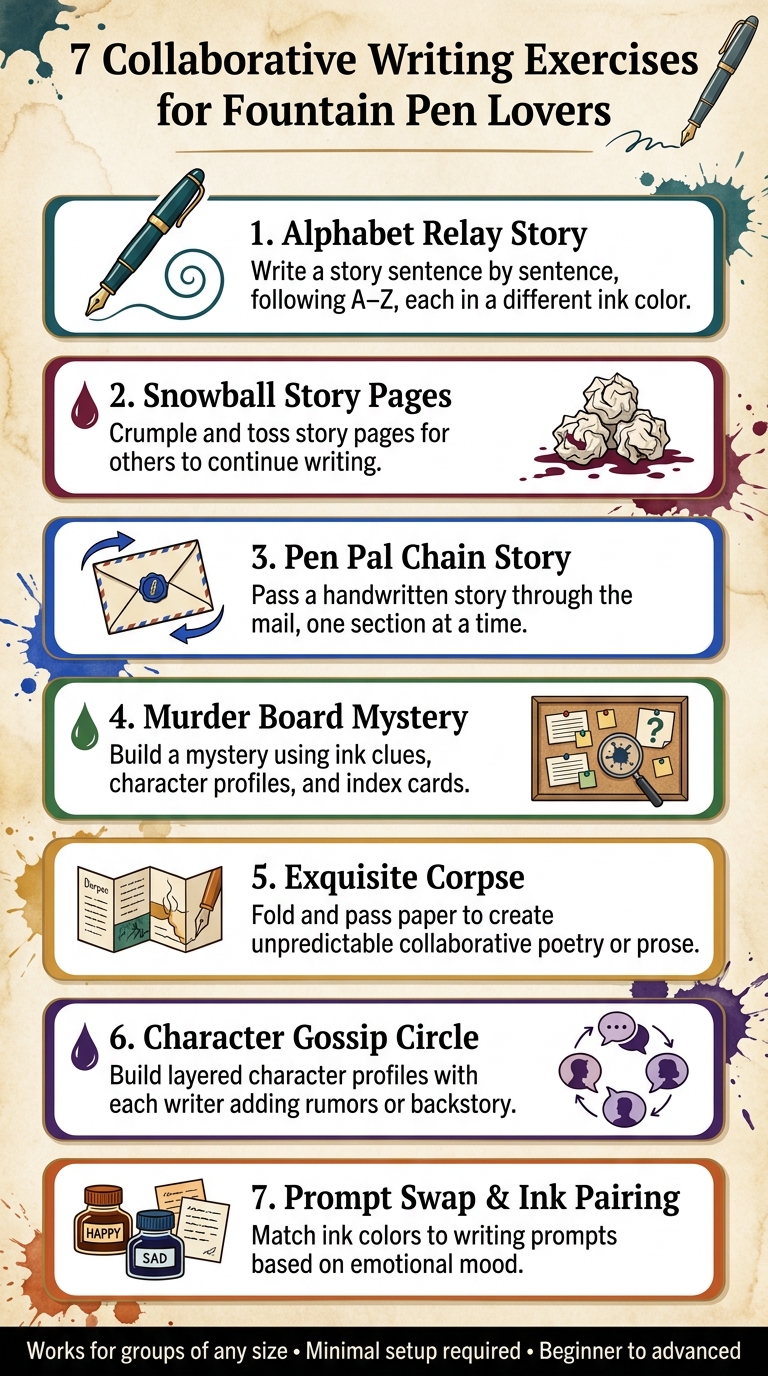
Collaborative writing is a fun way to combine storytelling with teamwork. For fountain pen enthusiasts, it adds a personal touch to the process through handwriting styles, ink colors, and nib choices. Whether you're in a group or exchanging letters, these activities spark creativity and bring people together. Here’s a quick breakdown of seven engaging exercises:
- Alphabet Relay Story: Write a story one sentence at a time, following the alphabet.
- Snowball Story Pages: Toss crumpled story pages for others to continue writing.
- Pen Pal Chain Story: Pass a story through the mail, one handwritten section at a time.
- Murder Board Mystery: Build a mystery using ink clues and character profiles.
- Exquisite Corpse: Add hidden lines to create unpredictable poetry or stories.
- Character Gossip Circle: Develop layered character profiles with group input.
- Prompt Swap and Ink Pairing: Match ink colors to prompts for expressive writing.
These exercises are simple, require minimal setup, and work for groups of any size. Whether you’re a beginner or a seasoned writer, they offer a tactile and social way to enjoy the art of handwriting.
7 Collaborative Writing Exercises for Fountain Pen Enthusiasts
1. Alphabet Relay Story for Ink Lovers
In this activity, participants sit in a circle, creating a story one sentence at a time. The catch? Each sentence must start with the next letter of the alphabet, from "A" to "Z." This structure keeps the storytelling light and prevents anyone from getting stuck overthinking their contribution.
To make it even more engaging, have each person use a different pen and ink color. By the time the story reaches "Z", the page becomes a vibrant display of handwriting styles and colors - think shimmering blues mixed with earthy browns, all in various strokes. As writer and educator Misa Sugiura observed:
"The letter challenge gave him an excuse to be less than perfect, and move on. That is, he didn't get bogged down trying to convey his very abstract thinking or create a complex narrative." - Misa Sugiura, Writer and Educator
To keep the momentum, set a timer for 2–3 minutes per turn. Choose bold, easily readable inks instead of pastels, and kick things off with a fun prompt, like: "What happened to the missing bottle of Blue Suede ink?".
This activity works for all group sizes. Smaller groups can complete multiple 26-letter rounds, while pen pals could adapt it to letters sent by mail. Wrap up by noting each participant's pen, nib size, and ink choice - details that add another layer of charm to the experience.
sbb-itb-1dd4fe9
2. Snowball Story Pages with Fountain Pens
This activity is a playful way to combine storytelling and creativity with fountain pens. Each participant begins by writing the start of a story on a blank sheet of paper. After a set amount of time, they crumple their page into a ball and toss it into the center of the room. Another participant picks up a random "snowball", uncrumples it, reads the story so far, and adds their own section. This process repeats for at least three rounds before the paper returns to its original author. It’s a fantastic exercise that highlights both collaboration and individuality, two values often celebrated in the fountain pen community.
What makes this unique is that participants actively read and build on the previous writer’s work, ensuring continuity and creativity. As one verified teacher put it:
"Holds the students accountable for reading the previous section(s) and expanding." - Verified Teacher Review, Presto Plans
To make the activity even more engaging, assign each writer a specific ink color and nib type. For instance, an extra-fine nib could be used for intricate details, while a broad nib works well for bold headers. This not only creates a visually dynamic, color-coded story but also adds a tactile element to the experience. However, this creative approach requires durable paper that can withstand repeated crumpling and handling. Thin paper might tear or cause ink to feather along the creases, so opt for a sturdier stock.
For added depth, assign each round a sensory focus. For example:
- Writer 1 describes what the character sees.
- Writer 2 explores smells and textures.
- Writer 3 focuses on sounds and tastes.
This structured approach ensures the story remains vivid and engaging, avoiding any dull moments as it passes through multiple hands.
"Students always have so much fun with this activity, often surprised and delighted that crumpling up their work is part of the process!" - Presto Plans
To wrap things up, read the completed stories aloud. The mix of unexpected plot twists and the variety of fountain pen ink colors often leads to plenty of laughs and memorable moments.
3. Pen Pal Chain Story for Mail Enthusiasts
This activity brings collaborative storytelling into the world of handwritten letters. A group of 5–10 writers takes turns adding to a story, passing it along through the mail. Each person reads the previous sections, contributes their part, and sends it to the next person on the list. The unpredictable nature of this process often leads to surprising twists and turns in the narrative. Beyond crafting a shared story, this exercise strengthens connections through the tangible experience of exchanging letters.
What sets this apart is the physicality of the process. Holding a handwritten letter allows you to feel the writer’s effort and creativity in a way digital text can’t match. As Adeline Kurkinen explains:
"Writing a letter forces you to slow down. You don't send quick replies like a text message. You think and write more intentionally."
The choice of pen and ink adds a personal touch to each contribution. Using a unique ink color or nib size can make your section stand out while keeping the text readable. If you’re new to fountain pens and want to explore without spending too much, Fountain Pen Revolution offers starter kits for $35, including a pen and ink - perfect for experimenting before diving into the project.
Organization is key to keeping this activity enjoyable and productive. Assign someone to manage the mailing list, set deadlines, and keep everyone on track. A 1–2 week window per participant works well to maintain momentum. For inspiration, Paper Trail Diary’s Chain Letter Short Story Project #4 (February 2026) involved participants worldwide, each adding one handwritten page to the story. The organizer then compiled the pages into a zine for all contributors to enjoy.
One practical note: as the manuscript grows, so does its weight - and postage costs increase accordingly. Later participants should be prepared for slightly higher shipping fees. Using tracked mail is highly recommended to safeguard the manuscript, which represents months of collaborative effort.
4. Murder Board Mystery with Ink Clues
Transform collaborative storytelling into an engaging detective game. Here’s how it works: participants create character profiles, plot threads, and clues on index cards, using various fountain pens for beginners and inks. These cards are then pinned or arranged on a shared board. To kick things off, the group randomly selects one setting, one object, and two characters from separate piles. From there, the team works together to craft a mystery around these elements. The unique characteristics of fountain pens and inks can make each clue stand out, adding another layer of intrigue.
To bring suspects to life, assign each one a specific ink color and nib type. For example, a stub nib with shading ink could represent an eccentric artist, while a needlepoint nib with black ink might suit a meticulous accountant. These choices make clues instantly identifiable and reinforce each character’s personality. Use bold nibs for major pieces of evidence and extra-fine nibs for subtle details or hidden symbols that connect clues to specific scenes.
A strong mystery thrives on misdirection. Writers should mix true clues with red herrings - convincing but misleading hints designed to throw the detectives off track. Alice Flynn, writer and facilitator at ArtfulScribe, explains:
"Before redirecting the reader to dead-ends and false conclusions... clarify details of the murder, who the murderer was and what their motivation was."
To keep the game solvable and the collaboration organized, designate one person to maintain a master clue sheet. This sheet, written in a neutral ink, outlines the three true clues and two red herrings. It ensures the group doesn’t accidentally create a mystery that’s impossible to solve.
Once the clues are laid out, the physical nature of the cards allows for easy reordering of the narrative. The group can dynamically rearrange the beginning, middle, and end of the story as new clues are introduced. As Dave Hickey, author and educator at the University of Prince Edward Island, notes: "Details like these are great because they add intrigue, but they also help shape the direction of your story." After organizing the clues, invite someone outside the group to solve the case. This is a fun way to test whether the mystery holds up and the clues make sense.
5. Exquisite Corpse with Nibs and Shading
Exquisite Corpse is a collaborative writing game with roots in the Parisian Surrealist Movement of the 1920s. The idea is straightforward: one person writes a line, folds the paper to hide it, and passes it along. The next person adds their line, unaware of what came before. Once everyone has contributed, the paper is unfolded and read aloud, often producing quirky and unexpected results.
As the Academy of American Poets explains:
"The only hard and fast rule of Exquisite Corpse is that each participant is unaware of what the others have written, thus producing a surprising - sometimes absurd - yet often beautiful poem."
This exercise takes on a new dimension when paired with fountain pens. Each writer's choice of nib and ink adds a distinct visual style to their contribution, much like how improving your handwriting with fountain pens emphasizes personal flair. A broad nib with shading ink might create bold, dynamic strokes, while a fine nib with steady flow offers a more delicate touch. Professor Lisa Russ Spaar captures this idea perfectly:
"Each line's handwriting conjures the particular student."
These unique visual elements highlight the personal flair of each writer, a feature that resonates deeply with fountain pen enthusiasts.
To add structure while preserving the game's spontaneity, try using the "last word" technique: leave the final word(s) of each line visible as a prompt for the next writer. Agreeing on a loose sentence framework - like "Adjective, Noun, Verb, Adjective, Noun" - can also help create a natural rhythm, even with the unpredictable flow of contributions.
Group size and organization are key to making this activity work smoothly. For smaller groups of 2–3 people, cycling the paper through multiple rounds can fill a page with layered creativity. Medium-sized groups of 4–6, common in classrooms or social gatherings, might limit each person to one or two contributions before the big reveal. In larger groups, arranging participants in a circle or line prevents accidental peeks at earlier lines.
After the reveal, a quick edit can help refine transitions between sections without losing the individuality of each part. Small adjustments - like tweaking verb tenses or smoothing articles - can make the piece flow better while retaining its charm. Annie Lindgren, DUI Program Coordinator at Turning Point, sums it up well:
"This method results in a piece that can be whimsical, bizarre, and often surprisingly coherent, reflecting the collective unconscious of the group."
6. Character Gossip Circle for Handwritten Profiles
The Character Gossip Circle is an engaging and imaginative group activity. Each person starts with a blank sheet of paper, jotting down a short character profile - think of a name, a few key personality traits, and one quirky detail. Once written, the pages are passed around the circle, with each participant adding something new: a rumor, a hidden backstory, or an unexpected twist. By the time the profile makes its way back to the original writer, it has evolved into a layered narrative that no single person could have created alone. This collaborative process reflects the dynamic and personalized nature of fountain pen writing that enthusiasts love.
To add a unique touch, participants can use different ink colors to reflect their individual styles. As John Bosley, a photographer and pen collector, puts it:
"The ink or inks that you choose... probably have the biggest overall impact on the final look and feel that they have."
Assigning a distinct ink to each contributor not only highlights the collaborative effort but also visually captures the character's transformation. For instance, the original profile might be written in a rich, shading teal, while the first round of rumors could be added in a bold, sheening burgundy. Each stage of the story can take on its own personality through ink choice.
Small details can make a big difference. Use a broader nib for the initial profile to give it prominence, while finer nibs work well for the whispered secrets or marginal notes added later. Stick with saturated inks for the main text to ensure readability, as lighter pastels or multi-shading inks might fade into the background. For added context, jot down the ink and paper details at the bottom of the page.
To keep the story flowing, include a "currently" section - what the character is reading, fearing, or eating. This concrete detail gives the next writer a springboard for their contribution. As Vihan, editor at Thoughts Too Loud, advises:
"Everyone is free to add new characters, kill existing ones, add new settings, whatever you like. But also try to put yourself in the preceding writer's shoes and figure out what he/she was actually thinking ahead."
This mix of creative freedom and respect for prior contributions helps maintain a coherent story, even as multiple voices shape it. It's a beautiful way to celebrate shared creativity and the joy of storytelling.
7. Prompt Swap and Ink Pairing Challenge
This activity invites participants to write a short prompt - just a single sentence or question - and then pass it to someone else. The recipient responds using an ink color that matches the mood of the prompt. For instance, a somber prompt might call for a soft blue, while an adventurous one might inspire a vibrant orange. This simple exercise turns writing into a sensory experience by connecting emotions to colors.
One of the best parts? The prompt gives immediate direction, which helps avoid the dreaded blank page. As InkJournal explains:
"The point is to enjoy using your fountain pens and exploring the various inks in your collection."
This approach shifts the focus to the act of writing itself, rather than struggling to come up with ideas. To keep everyone engaged, set a minimum response length of one full page. This ensures there's plenty of material for a lively group discussion afterward.
Once the writing is done, participants share their ink choices, asking questions like, "Why did you choose this color?" or "How did the nib width affect your writing flow?" These discussions naturally lead to a deeper exploration of ink qualities - like shading, sheen, and flow - and how nib width influences the rhythm and feel of handwriting.
Worried about wasting ink when switching colors? You can use just a few drops or opt for a dip pen instead. Keeping a notebook to record your pen and ink combinations after each round is another great way to track your creative journey. This adds a practical layer to the exercise and ties it to the tactile joys of fountain pen use.
"The act of actually putting pen to paper has been shown to create stronger links to the brain, aid in memory, and is far more intimate for writing like this because it makes you think before you respond (you can't delete ink!)." - Swap-bot
For those looking to build a regular writing habit, challenges like #30inks30days have inspired over 30,000 Instagram posts. If you're feeling limited by your current ink collection, samples are an affordable way to expand your palette. Brands like Fountain Pen Revolution also offer a variety of inks and nibs, perfect for experimenting without breaking the bank.
Conclusion
From relay-style storytelling to crafting mystery clues, each activity taps into the charm of handwritten creativity. These exercises turn the enjoyment of fountain pens into a collaborative art form, encouraging participants to build on each other’s ideas and create something far beyond what any one person could achieve alone. Studies show that working together on writing projects often leads to clearer, more engaging narratives while easing the stress of facing a blank page.
Writing with a fountain pen encourages deliberate, thoughtful letter formation, improves pen control, and boosts confidence over time. These group activities not only rejuvenate your writing process but also simplify logistics, especially when participants share resources for high-quality supplies.
Try starting with a relaxed exercise like Snowball Story Pages or Character Gossip Circle. Rotate leadership roles and wrap up each session with a quick debrief to uncover creative takeaways. These discussions can help unify the group’s voice and spark fresh ideas for future projects.
At the heart of every activity is the joy of collaboration and the tactile satisfaction of fountain pen writing. Sharing a communal pen-and-ink kit makes it easier for newcomers to join in and strengthens the sense of community. For those just starting out, Fountain Pen Revolution offers affordable starter kits that make diving into these shared writing adventures simple. Every page created together becomes a lasting record of collective imagination - a reminder of what a group of pen enthusiasts can achieve when they write as one.
FAQs
What paper works best for these exercises with fountain pen ink?
For the best experience, choose fountain pen–friendly paper that resists feathering and bleed-through while highlighting ink shading and sheen. Some popular choices include Rhodia and Clairefontaine for their smooth surface, and Tomoe River paper, which excels at showcasing vibrant ink qualities, though it takes longer to dry. Paper weights between 80 gsm and 100 gsm generally work well. Check out Fountain Pen Revolution for pens and accessories to elevate your writing sessions.
How do we keep a collaborative story coherent with multiple writers?
To keep a collaborative story on track, it’s crucial to begin with a solid plan. Start by crafting an outline that includes key plot points and well-thought-out character profiles. A style guide can be a lifesaver, helping the team stay consistent with grammar, tone, and the overall narrative voice. Assigning a central editor is another smart move - they can ensure the writing feels cohesive and polished. Finally, regular review meetings are essential to keep everyone aligned and quickly resolve any inconsistencies.
What’s the easiest exercise for beginners with limited pens and inks?
For those just starting out with a modest collection of pens and inks, National Letter Writing Month offers an ideal opportunity to dive in. With only two or three tasks per week, it’s a laid-back way to explore your tools without feeling overwhelmed. This gentle approach helps you gain confidence using your fountain pen and ink while enjoying the art of correspondence.