

Celluloid transformed fountain pens from purely functional tools into objects of beauty and design. Before its introduction, pens were limited to dark, simple colors due to the constraints of hard rubber. Celluloid - a moldable material made from nitrocellulose and camphor - brought vibrant colors, intricate patterns, and durability to the pen industry. From the 1920s to the 1940s, it dominated pen manufacturing, becoming a hallmark of craftsmanship and style.
Key points about celluloid in fountain pens:
- Origins: Invented in the 1860s, celluloid was initially used in products like billiard balls, combs, and photography film.
- Advantages: Offered bright colors, transparency, and durability, unlike the brittle and limited hard rubber.
- Peak Era: Popularized by brands like Sheaffer and Parker, celluloid pens became iconic for their colorful designs and technical precision.
- Challenges: Highly flammable and prone to aging issues like discoloration and brittleness.
- Decline: By the 1940s, safer and cheaper plastics, such as cellulose acetate and acrylic, replaced celluloid in mass production.
Today, celluloid still holds a nostalgic appeal among collectors and luxury pen makers, who value its rich colors, warm feel, and historical significance.
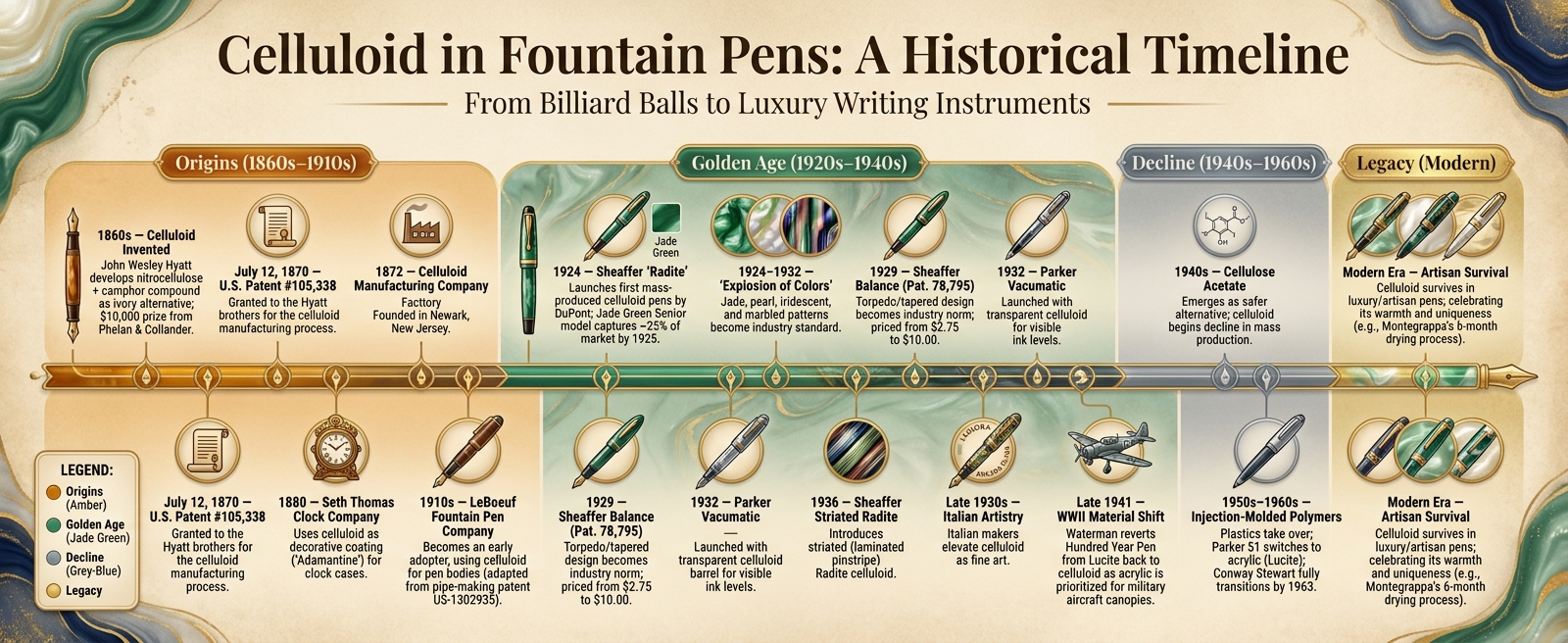
Celluloid in Fountain Pens: A Historical Timeline (1860s–Present)
Origins of Celluloid and Early Uses
The Invention of Celluloid
Celluloid's story began in the 1860s, during a time when ivory was in high demand, particularly for billiard balls. To address this shortage, Phelan & Collander offered a $10,000 prize to anyone who could create a viable alternative. This challenge caught the attention of John Wesley Hyatt, an American printer, who, along with his brother Isaiah, discovered a groundbreaking solution. They found that combining nitrocellulose with camphor under heat and pressure produced a durable, moldable material. Their discovery led to the patenting of this process on July 12, 1870 (U.S. Patent #105,338). By 1872, the Hyatt brothers had founded the Celluloid Manufacturing Company in Newark, New Jersey, laying the groundwork for the material's industrial success.
Hyatt's work built upon earlier experiments with nitrocellulose, but his critical innovation - using heat and pressure to minimize the need for volatile solvents - made celluloid practical for widespread use. This breakthrough opened the door for its adoption in various industries, including the emerging market for decorative fountain pens.
Early Uses of Celluloid
Before celluloid became a go-to material for fountain pens, it had already made its mark in other industries. It was used to create dental plates, combs, piano keys, and knife handles. Notably, the Seth Thomas Clock Company secured the rights to use celluloid as a decorative coating for wooden clock cases in 1880. They marketed it under the name "Adamantine", which was designed to mimic the appearance of black marble.
Perhaps one of its most transformative uses was in photography. Celluloid enabled the development of flexible roll-film, a key innovation that played a pivotal role in the rise of the motion picture industry.
Manufacturers were drawn to celluloid for several reasons. It was three times cheaper than ivory, easy to shape, and could convincingly replicate the look of more expensive natural materials. These qualities made it an appealing choice across a wide range of applications, eventually catching the interest of fountain pen makers.
Key Properties That Made Celluloid Suitable for Fountain Pens
When pen manufacturers began exploring celluloid, they found it to be an ideal replacement for hard rubber. Its unique properties not only solved existing material limitations but also allowed for more creative and functional pen designs. Here’s a closer look at why celluloid worked so well for fountain pens:
| Property | Benefit for Fountain Pens |
|---|---|
| Thermoplasticity | Softens at ~140°F (60°C), making it easy to mold into precise shapes. |
| Machinability | Can be sawed, drilled, carved, and polished like wood, allowing for detailed craftsmanship. |
| Color Retention | Maintains vibrant colors and intricate marbling, enhancing aesthetic appeal. |
| Durability | Provides excellent shock resistance and waterproofing, outperforming earlier materials. |
| Tactile Warmth | Offers a comfortable, earthy feel similar to ebonite, which many writers appreciated. |
One of the most significant advantages of celluloid was its machinability. Hyatt even developed specialized tools, including an early version of the injection molding machine, to work with the material as if it were wood. This innovation allowed manufacturers to craft pen barrels, caps, and other components with precision, blending technical functionality with striking visual designs.
sbb-itb-1dd4fe9
The Shift from Hard Rubber to Celluloid
Drawbacks of Hard Rubber
For decades, hard rubber - often called ebonite - was the go-to material for fountain pen manufacturing. But it came with some serious limitations, especially when compared to what celluloid would eventually bring to the table. The vulcanization process restricted hard rubber to dark shades, meaning pens were usually black or a red-black mottled mix. Bright or transparent colors? Not an option. On top of that, the sulfur in hard rubber made it prone to oxidation, which caused pens to lose their luster and turn dull brown or green when exposed to light and moisture. Durability was another issue - hard rubber was brittle, making pens vulnerable to cracks and chips from everyday use.
Early Use of Celluloid in Fountain Pens
These drawbacks created an opening for celluloid to step in with its superior qualities. Celluloid offered more vibrant colors and better durability, prompting manufacturers to make the switch. One of the early innovators was the LeBoeuf Fountain Pen Company, which began using celluloid for pen bodies as early as the 1910s. Interestingly, LeBoeuf adapted a patent (US-1302935) originally intended for making pipes to suit pen production needs.
The real game-changer came in 1924 when the Sheaffer Pen Company introduced the first mass-produced celluloid pens under the trade name "Radite", a cellulose nitrate material developed by DuPont. Their Jade Green Senior model became a massive success, and with aggressive marketing, Sheaffer quickly captured about 25% of the market by 1925. Not to be outdone, Parker followed suit in 1926, revamping their iconic Duofold line with a celluloid material they branded as "Permanite". Sheaffer's bold leap into color and Parker's quick response marked a turning point, as celluloid began to redefine the pen industry's identity.
Between 1924 and 1932, the industry saw what collectors now call an "explosion of colors." Gone were the days of limited palettes - celluloid pens brought vibrant hues like jade, pearl, and swirling iridescent patterns to life.
How Celluloid Pens Were Made
As celluloid pens gained popularity, manufacturers fine-tuned their production methods to meet growing demand. The process of making a celluloid pen was complex and labor-intensive, quite different from modern manufacturing techniques.
It started with mixing pigments into a translucent celluloid "dough", made from cellulose nitrate and camphor. To achieve the stunning marbled or layered patterns, manufacturers layered and re-layered the dough before pressing it into solid blocks or rods. Alan Gill of The Pen Company described the process like this:
"The dough can be rolled, layered and re-rolled producing a wide range of multi-colour effects."
After shaping the material, it had to cure - a process that took about 18 months. Skipping or rushing this step could result in warping, shrinking, or brittle pens. Once cured, the solid rods were machined on a lathe, where they were sawed, drilled, and turned into pen barrels and caps. The final step involved polishing them to a high-gloss finish. This meticulous process highlighted how new materials directly influenced the craftsmanship of pen making.
However, celluloid wasn't completely free of issues. A phenomenon called "ambering" could occur when sulfur from residual rubber parts caused discoloration. Bright colors like jade green could transform into a less appealing "burnt spinach" shade. Ironically, the very rubber parts that celluloid was meant to replace could still undermine its appearance.
The Peak Years of Celluloid Fountain Pens
Decorative Designs in Celluloid Pens
Once manufacturers figured out how to work with celluloid, they unlocked its potential to transform fountain pen design. Its biggest appeal wasn’t just its strength - it was the explosion of color and patterns it allowed. Suddenly, pens could feature marbled swirls, pearl-like inlays, transparent barrels, and shimmering finishes that had been impossible with hard rubber.
Some brands took this creativity to the next level by blending celluloid with other materials. For example, Carter's "Pearltex" combined celluloid with nacre (mother-of-pearl), and Sheaffer experimented with "Abalone" finishes to create a striking iridescent effect. In 1936, Sheaffer introduced striated Radite, a laminated pinstripe design that not only looked great but was tougher than earlier marbled versions. Conklin, on the other hand, went with a bold "brickwork" style in its "Penline" series, using sheet celluloid to create alternating stripes of plain and marbled patterns.
Clear celluloid opened up even more design possibilities. The Parker Vacumatic, launched in 1932, featured a transparent barrel so users could see their ink levels - a feature marketed as a major technical leap. Conklin pushed this idea even further with its Nozac model, which had markings on its transparent section to show ink capacity. It even boasted it could write 7,000 words on a single fill.
These innovations ushered in a new era of creativity and craftsmanship in American pen manufacturing.
Key Developments in the United States
The 1920s and 1930s marked a high point for American fountain pen makers. Companies like Sheaffer and Parker led the way, but the entire industry quickly embraced the vibrant color options of the time, such as jade green, lapis blue, and rose glow.
In 1929, Sheaffer made a major leap with the introduction of the Balance, a pen designed under patent 78,795. This new model ditched the flat-top shape for a sleek, tapered "torpedo" design that shifted the center of gravity forward, making it more comfortable to write with. The design caught on, and soon, the torpedo shape became the norm across the industry. Sheaffer also ensured the Balance was accessible to a range of buyers, pricing junior models at $2.75 and oversize versions at $10.00. Meanwhile, the Waterman Patrician, another standout model of the time, also sold for $10.00.
"The beautifully colored pens of the 1930s and early '40s were constructed of brass, gold, and celluloid - an early plastic made of plant-based material treated with various chemicals." - Richard Heinberg, Author and Collector
World War II brought an unexpected twist to materials. With Lucite (acrylic) prioritized for military use, particularly for aircraft canopies, Waterman had to revert its Hundred Year Pen from Lucite back to celluloid in late 1941. This shift highlighted how central celluloid still was to pen production, even as newer materials began entering the market.
While American brands focused on mass production and innovation, Italian pen makers carved out their own niche with a focus on artistry.
Italian Contributions to Celluloid Pen Design
Italian manufacturers brought a different level of craftsmanship to celluloid pens, treating the material as a canvas for artistic expression. Aurora developed its own celluloid variant called Aurolite, and Italian makers became known for creating intricate, original patterns that stood out.
A standout example is the Ancora Da-Ma from the late 1930s. This pen featured a faceted barrel with either 12 or 14 sides, designed to catch light beautifully while also improving grip. It used laminated transparent celluloid and included a plunger vacuum filling system. For Italian makers, celluloid wasn’t just a practical material - it was a way to elevate their pens into works of art, a philosophy that would influence their designs long after celluloid’s peak years had passed.
The Decline of Celluloid in Fountain Pens
Problems with Celluloid Production
Celluloid, for all its vibrant beauty, came with significant challenges that made large-scale production risky and complex. The material's extreme flammability was one of its biggest drawbacks, stemming from its composition of nitrocellulose and camphor. Pen historian Dirck de Lint summed it up perfectly:
"Celluloid was also not an entirely perfect material for pens... it was in point of fact an adulterated explosive."
The production process itself was equally demanding. Raw celluloid bars needed an extended drying period to safely release flammable gases - a process that could take anywhere from six months to several years. Additionally, celluloid couldn't be injection molded, meaning each pen part had to be individually crafted on a lathe. This manual approach significantly increased both production time and costs.
Over time, celluloid also degraded. As it aged, it lost camphor, which made it brittle and prone to cracking. Worse, it emitted acidic fumes that could accelerate the deterioration of nearby materials. These issues eventually pushed manufacturers to explore safer and more efficient alternatives when choosing a pen.
The Rise of Modern Plastics
By the 1940s, the industry began moving toward safer and faster production methods. Cellulose acetate became the first practical alternative, offering a similar appearance to celluloid without the same level of flammability. Then, during the 1950s and 1960s, injection-molded polymer plastics took over, revolutionizing mass production with their speed and cost-effectiveness.
One company that embraced this change was Conway Stewart. By 1963, they had completely replaced their patterned celluloid pens with models made from injection-molded plastics, such as the 106 and 106M series that featured the "Pressac" filling system. Parker, on the other hand, transitioned even earlier, swapping celluloid for acrylic resin (Lucite) in its iconic Parker 51 model. Modern enthusiasts seeking similar high-quality finishes often look to acrylic fountain pens as a durable alternative. This marked a departure from the celluloid used in earlier designs like the Vacumatic.
| Material | Era of Use | Advantages | Drawbacks |
|---|---|---|---|
| Celluloid (Nitrate) | 1920s–1940s | Vibrant colors, warm feel | Highly flammable, slow curing |
| Cellulose Acetate | 1940s–Present | Safer handling, similar look | Still flammable, transport restrictions |
| Injection Plastics | 1950s–1960s | Fast, low-cost mass production | Less decorative, perceived as cheap |
| Cast Acrylic (PMMA) | Modern Era | UV-resistant, stable colors | Lacks celluloid's unique feel and scent |
While modern plastics dominate the market, celluloid still holds a special place in the world of luxury pens.
Celluloid's Limited Role in Modern Pens
Even though mainstream production has moved on, celluloid remains cherished by a few luxury and artisan pen makers. Its unique qualities - like the depth of its colors, a warm tactile feel, and even its distinct camphor scent - continue to captivate enthusiasts. Brands like Montegrappa still rely on a meticulous six-month drying process to prepare celluloid for their high-end pens, treating the labor-intensive production as part of the pen's exclusive charm. Similarly, Visconti and Japanese maker Onishi Seisakusho maintain celluloid lines, celebrating the material's warmth and unmatched aesthetic.
For these makers, the challenges of working with celluloid are not obstacles - they're part of what makes each pen special. This enduring connection to celluloid highlights its lasting influence on the art of fountain pen craftsmanship.
The Legacy of Celluloid in Fountain Pens
How Celluloid Shaped Pen Design
Celluloid brought a whole new world of possibilities to fountain pen design. It introduced vibrant colors, pearlescent finishes, and translucent patterns that were impossible to achieve with hard rubber. One of the most iconic designs, the Sheaffer Balance from 1928, showcased a sleek, tapered silhouette that set a design standard still admired today. As Alan Gill from The Pen Company explained:
"Celluloid does have a look and feel which other more modern plastic resins don't... it has a solidity and weight about it a bit like polished stone."
Even now, modern "precious resins" are often compared to vintage celluloid, particularly for their depth and translucency. This lasting influence keeps celluloid at the forefront of collectors' minds and continues to shape pen design.
Vintage Celluloid Pens in Today's Collector Market
In the U.S., vintage celluloid pens from the 1920s to the 1940s hold a special place in the hearts of collectors. They’re celebrated not only for their historical significance but also for their unique appearance - each pen is one of a kind due to the layered manufacturing process.
Proper care and maintenance are essential to preserve these treasures:
- Avoid wax: Wax can trap acidic by-products, speeding up decomposition.
- Provide ventilation: Celluloid needs airflow to prevent discoloration and deterioration.
- Isolate decaying pens: If a pen shows signs of celluloid rot, keep it away from others to prevent further damage.
- Protect light-colored pens: Keep them away from rubber ink sacs, as the sulfurous gases they emit can cause permanent stains.
To verify a pen's authenticity, try rubbing it briskly - real celluloid emits a distinct camphor scent. This tactile link to the past is a reminder of the craftsmanship that modern pen makers still strive to honor.
Connecting Historical Craft to Modern Fountain Pens
The production of celluloid pens - machining each piece from solid rod stock - was a labor-intensive process that added a level of artistry and individuality unmatched by mass-produced plastics. This dedication to craftsmanship is why brands like Visconti have made celluloid a cornerstone of their identity. As Alan Gill remarked:
"Visconti... have made it their business to revive the pen makers' art of working with the oldest plastic material – celluloid."
For those who appreciate the history and artistry of their tools, a celluloid pen is far more than just a writing instrument. It’s a tangible connection to over a century of innovation and meticulous craftsmanship that continues to inspire both collectors and modern artisans.
[Documentary] How The Japanese Makes Celluloid Fountain Pen
For a modern take on this craftsmanship, explore the FPR Tanoshii Junior Fountain Pen, developed in collaboration with a Japanese manufacturer.
FAQs
How can I tell if a pen is real celluloid?
To determine if a pen is made of real celluloid, start by considering its age and visual characteristics. Pens produced between the late 1920s and 1940s are commonly celluloid. These pens often feature vivid colors, pearlescent finishes, or translucent patterns. Another clue is the material's scent - when slightly dampened, celluloid may release a camphor-like odor.
If you're still unsure, you can perform a more definitive test. Carefully take a tiny shaving from a hidden spot on the pen and try dissolving it in acetone. However, this should only be done as a last resort to avoid damaging the pen.
What are the warning signs of celluloid rot?
Celluloid rot happens when camphor, an essential plasticizer in the material, deteriorates over time, causing instability. Signs to watch for include:
- A whitish, powdery bloom on the surface
- Darkening, crazing, or visible cracks
- Chipping or crumbling of the material
This type of damage cannot be reversed and may even affect nearby items. If you notice these symptoms, it's critical to isolate the affected pieces right away.
How should I store a vintage celluloid pen safely?
To preserve vintage celluloid pens, store them in a cool, dark, and dry location with proper ventilation. Avoid using airtight containers since celluloid releases gases that need to escape. A stable environment is key - exposure to light, heat, or humidity can speed up deterioration. Skip waxes or silicone grease, as these can harm the material. Instead, you might use zeolite-based paper to absorb potentially damaging by-products. Additionally, make it a habit to replace rubber ink sacs regularly to prevent discoloration caused by chemical breakdown.