

Fountain pens combine age-old craftsmanship with modern advancements, creating writing instruments that are both functional and artistic. Techniques like hand-turning barrels, shaping nibs, and applying decorative finishes have roots in centuries-old practices but remain relevant today. Modern materials such as resins, metals, and even crushed gemstones are paired with meticulous processes to produce pens that stand out for their quality and design.
Key Highlights:
- Handcrafting Processes: Pen barrels are shaped on lathes, sanded, and polished for precision and aesthetic appeal.
- Nib Crafting: Nibs are carefully shaped, tipped with durable materials, and polished to ensure smooth writing.
- Material Choices: From classic ebonite and celluloid to modern acrylics and metals, materials influence a pen's look, feel, and durability.
- Decorative Art: Techniques like Urushi lacquer art, engraving, and inlays elevate pens into works of art.
- Blend of Old and New: While traditional methods remain integral, modern tools like 3D printing and advanced machining enhance production efficiency.
Fountain pens are more than tools - they're a connection to the craftsmanship of the past, offering a tactile and meaningful writing experience.
The Process of Crafting Handmade Fountain Pens Tailored to Writing Habits - A World First!
sbb-itb-1dd4fe9
How Traditional Methods Shaped Modern Pen Making

Evolution of Fountain Pen Technology: Key Innovations from 1850s to 1939
Development of Pen Crafting Techniques Over Time
The evolution of fountain pens began with a focus on solving a critical issue: inconsistent ink flow. Early inventors tackled this by adding small holes between the ink reservoir and the nib, a feature that remains a cornerstone of fountain pen design today.
Initially, users relied on messy methods like eyedroppers to fill their pens. Over time, more sophisticated systems emerged. Sheaffer's lever-filler (1912), Parker's button-filler, and Pelikan's screw-piston filler (1929) revolutionized ink-filling mechanisms. The screw-piston design, in particular, became a favorite among high-end pens due to its larger ink capacity and reliable mechanics.
Material advancements went hand-in-hand with these mechanical improvements. Ebonite, a vulcanized hard rubber, provided durability and was easy to machine, while celluloid, introduced in 1864, offered vibrant colors and resilience. Around the same time, manufacturers began tipping gold vs steel nibs with platinum-group metals (commonly referred to as "iridium") to enhance durability - setting the standard for premium nibs.
By the 1850s, mass production transformed the pen industry. Birmingham, England, produced over 50% of the world's steel-nib pens using early machinery that significantly lowered costs, making pens more accessible. While this industrial shift favored efficiency, it also laid the groundwork for modern manufacturing, blending factory production with elements of traditional craftsmanship for high-quality pens.
These historical innovations continue to influence the meticulous, handcrafted techniques that define modern artisan pen making.
Traditional Processes in Modern Production
Modern artisan pen makers still rely on time-honored methods to ensure their products stand out. One of the most enduring techniques is hand-turning on a lathe, a process used to shape pen barrels. Craftsmen carefully rotate materials like wood, resin, ebonite, or celluloid while using chisels and gouges to create precise tapers, curves, and intricate decorative details. This hands-on approach ensures complete control over the pen's balance and geometry - qualities automated methods struggle to achieve.
To achieve a stunning finish, artisans sand the pen barrels through multiple grits, typically ranging from 120 to 600, before applying wax or polish while the piece spins on the lathe. This meticulous process results in the depth and shine that set handmade pens apart from their mass-produced counterparts.
High standards of quality control, rooted in the practices of early manufacturers, remain essential. For example, the Parker 75 model underwent 792 individual inspections during production. Today’s luxury pen makers, such as Visconti, continue this tradition by employing multi-stage processes like gold bar drawing, lamination, and hand-polishing to craft nibs of exceptional precision and performance.
Traditional decorative techniques have also endured. Burin engraving, a centuries-old method using a steel tool to carve intricate designs into metal, is still practiced because it produces unmatched detail. As Montegrappa explains:
"The burin technique is performed entirely by hand because it allows for results impossible to achieve with more modern engraving technologies, such as laser or diamond engraving".
This dedication to handcrafting highlights a broader truth: some traditional methods remain irreplaceable, even in an era of advanced technology.
Materials Used in Modern Fountain Pen Production
The materials used in fountain pens play a huge role in shaping their weight, balance, durability, and overall look. Today’s manufacturers use a mix of traditional and modern materials, from classics like celluloid and ebonite to newer resins and metals. Each material brings its own set of challenges and benefits, requiring specific preparation techniques to achieve the desired result. Whether sticking to timeless methods or embracing modern innovations, these materials are at the heart of the craftsmanship behind fountain pens.
From Celluloid to Modern Resins
Celluloid is a standout for its striking visual appeal. It's created by mixing nitrocellulose, pigments, camphor, and alcohol, resulting in vibrant colors and a rich, layered depth. However, crafting with celluloid isn't easy - it requires a long drying process to remove moisture. If rushed, the material can crystallize, and it needs to be worked at around 140°F (60°C) to avoid damage.
Because of its flammability and time-consuming production, manufacturers started favoring alternatives like acrylic resin (also known as Lucite or PMMA). A notable example is the Parker 51, introduced in 1939, which helped set the standard for modern resins. Acrylic resins are favored for their chemical resistance and adaptability to injection molding, making production more efficient. Before molding, the resin pellets are dried to ensure consistency, and UV stabilizers are added during the melting process to protect against sunlight damage. Interestingly, luxury pen makers have recently returned to celluloid because its intricate production process gives it a sense of exclusivity that injection-molded plastics lack.
Artisans today are also exploring new materials like TruStone - a mix of crushed semi-precious stones and resin - and DiamondCast, a resin infused with real diamond dust. These materials can be shaped on a lathe, resulting in unique, eye-catching designs. By combining traditional techniques with modern materials, artisans continue to push the boundaries of creativity.
Wood and Metal in Pen Crafting
Natural materials like wood and durable metals remain essential in pen crafting. Wood adds warmth and individuality, as each piece showcases its own distinct grain pattern. To prevent warping, the wood must be completely dried before use. Craftsmen shape the wood into blanks, drill them to fit a brass inner tube for stability, and secure the pieces with polyurethane glue. The blanks are then carefully turned and sanded to achieve the desired finish, resulting in pens with a natural, tactile charm.
Metals like stainless steel, brass, and aluminum are also widely used, offering strength and a pleasant weight. These materials are shaped through processes like casting, machining, or forging, and are often treated with finishes such as anodizing or plating to enhance their durability and appearance. High-end pens may feature precious metals like gold, silver, or platinum for both functional and decorative purposes. Meanwhile, modern materials like titanium and carbon fiber are gaining popularity for their resilience and sleek, contemporary look.
Some artisans take innovation even further, using unconventional materials like Sicilian basaltic lava combined with proprietary resins. These pens are designed to be both highly durable and uniquely tactile, blending natural elements with cutting-edge techniques.
Nib Crafting: Precision and Technique
The nib is the core of any fountain pen, and its creation demands incredible accuracy. Each step in the process, from shaping to smoothing, directly impacts how the pen performs. While traditional methods have been honed over decades, modern tools now complement these techniques to ensure consistency.
Shaping and Smoothing Techniques
The process begins with rolling metal strips to create variations in thickness. For steel nibs, the "heel" is thinned to about half its original thickness, while for gold nibs, it's reduced to one-third. Meanwhile, the tines are kept thicker to provide flexibility and maintain the slit’s alignment under pressure.
To handle the friction of writing, the tip is reinforced with a bead of osmiridium or iridium, applied using electric resistance welding. Osmiridium’s melting point of roughly 2,500°C (4,532°F) is far higher than gold (1,100°C or 2,012°F) or stainless steel (1,430°C or 2,606°F), requiring highly specialized equipment.
Once the tip is capped, a slit is cut from the breather hole to the tip using thin cutting discs. Modern systems rely on numerical controls and lubricants to minimize burrs and prevent the discs from breaking.
A particularly intricate step is the "second setting" technique. This involves manually rotating each tine inward with pliers to form a precise "V" shape when viewed head-on. This opening, typically between 0.15 mm and 0.25 mm, ensures the slit remains filled with ink. According to Amadeus W., an engineer specializing in nib mechanics:
"Through this shaping, the lower section of the slit was always kept apart and remained filled with ink. Through a gentle touch only, the fibres of the paper would enter into that gap and readily absorb the ink".
This technique enables "pressureless writing", where ink flows effortlessly as soon as paper fibers make contact with the gap.
The final smoothing phase uses diamond polishing stones or ultra-fine abrasives like 12,000-grit micro-mesh to eliminate burrs and create a smooth glide. However, nib expert Richard Binder warns:
"Smoothing a nib seems simple, but unless you have years of training and experience under your belt, you... run the risk of destroying your nib".
Precision is key - too much pressure can ruin the nib, so material removal must be slow and deliberate.
Luxury brands, like Visconti, still employ multi-stage production processes, including hand-polishing. Meanwhile, Stipula uses over 200 molds from the 1930s Globus company to replicate vintage nib designs. This meticulous craftsmanship ensures the nib integrates seamlessly with the feed system for optimal ink flow.
Feed Design and Ink Flow Systems
The feed is just as crucial as the nib, acting as the bridge that regulates ink flow through a controlled air-liquid exchange. As Amadeus W. explains:
"The flow rate of ink is not controlled directly. It is the inflow of air into the ink reservoir, which allows ink to escape from it, or not. It is a yes/no regulation, air bubble in or not".
Traditional ebonite feeds are naturally hydrophilic, meaning they allow ink to spread evenly rather than bead up. These feeds can be "heat-set" by dipping them in boiling water (212°F or 100°C), making the material pliable so it conforms perfectly to the nib for better capillary action. Modern plastic feeds, such as those made from ABS, are mass-produced using injection molding. While these feeds feature intricate comb-like designs with fine capillaries, they require chemical etching with chromic acid to create tiny cavities that improve ink adhesion.
The "Spoon Feed" design, introduced by Waterman in 1899, incorporated overflow pockets to catch excess ink caused by temperature or pressure changes. This concept remains a cornerstone of modern feed designs. During assembly, feeds are pre-filled with ink through agitation, ensuring they’re ready to perform immediately.
Craftsmen can fine-tune feed channels by deepening or widening them with abrasives, tailoring the ink flow to match specific nib widths or user preferences. For proper capillary action, the feed must sit flush against the nib, with the slit perfectly aligned over the feed’s ink channel.
This attention to detail ensures the pen delivers a smooth and consistent writing experience.
Finishing Steps: Polishing, Assembly, and Details
Polishing and Buffing Methods
The final surface treatment is what transforms a pen from a simple writing tool into a true piece of artistry. Today’s pen makers use a mix of traditional hand techniques and modern tools to create stunning finishes.
For resin and acrylic pens, the process begins with wet-sanding, followed by two stages of liquid polishing. After that, a soft wheel is used with a dry compound, and the finishing touch is a hand-polishing step. Paul Bennett from Karas Pen Co. describes their approach:
"We currently use a multi-step method that starts with wet-sanding each piece, then use a two-step liquid polishing compound, followed by a two-step soft wheel process with a dry compound on the first wheel, and we finish it off with a hand polishing step".
The hand-polishing step is especially important because it removes tiny scratches that machines might miss. Different resins require specific polishing compounds since each material reacts differently.
Wooden pens follow a slightly different process. Craftsmen sand the wood with progressively finer grits, then apply wax or plastic polish using a soft cloth while the barrel spins on a mandrel. This creates a smooth, glossy finish.
For metal pens, the technique depends on the material. Brass and copper are polished in two steps to achieve a shine while allowing a natural patina to develop over time. Aluminum, on the other hand, often gets a clear anodized coating to prevent residue and uneven wear. Another option is mechanical tumbling with ceramic media, which creates a matte-like surface that hides scratches. At Karas Pen Co., most black Delrin pens are sold with this tumbled finish.
Once the desired finish is achieved, the pen moves on to assembly and testing to ensure it not only looks beautiful but also functions flawlessly. For those looking to acquire such a piece, following a fountain pen buying checklist can help identify these quality markers.
Assembly and Quality Testing
Assembling a pen is a precise process, where every component must fit together perfectly. For example, the nib and feed are inserted into the grip section using threading or friction fitting, with exact alignment being critical for smooth ink flow. To maintain accuracy, craftsmen often use drill presses equipped with special jigs. Clips are attached to caps through riveting, soldering, or mechanical fasteners, while internal mechanisms - like levers, buttons, or pistons - are carefully installed before the pen halves are joined.
Quality control is rigorous, with testing performed at multiple stages. Common checks include evaluating ink flow, ensuring nib smoothness on paper, and inspecting the operation of filling mechanisms. Technicians use magnifying glasses to carefully examine tine alignment, as even a slight misalignment can cause a scratchy writing experience. If a pen fails ink flow tests, the nib is tuned manually by adjusting the tine spacing with thin metal shims. After assembly, nibs are flushed with clean water to remove any residual oils that might interfere with ink flow.
Decorative Elements: Lacquer and Metal Accents
Decorative details are the final touch that elevates pens into works of art. These techniques, rooted in centuries-old traditions, highlight the craftsmanship behind each piece.
One example is Maki-e lacquer art, a traditional Japanese technique that uses Urushi sap mixed with metallic powders like gold or silver. These powders are sprinkled onto wet lacquer to create intricate designs . Some Maki-e pens take up to 10 months to complete, with artisans repeating lacquering, drawing, sprinkling, and polishing steps as many as 130 times .
Other techniques, such as Raden (using iridescent shell inlays) and Chinkin (engraving lacquer and filling it with gold leaf), add even more detail. In 2016, AP Limited Editions created "The Great American Bald Eagle" using Shishiai Togidashi Maki-e. This design featured a sky made of 0.8 mm thick pieces of abalone shell, 50 platinum stars, and eagle eyes inlaid with Turban Shell.
Metal accents are crafted using methods borrowed from jewelry making. Filigree involves weaving fine threads of precious metal into intricate patterns, while skeletonization creates a lattice-like structure of gold or silver around the barrel. Burin engraving, a hand-carving technique, produces details that modern tools like lasers can’t replicate. Other methods, like lost wax casting, add three-dimensional elements, while scrimshaw involves engraving resin and filling the lines with ink for decorative designs.
Modern Fountain Pen Options: Fountain Pen Revolution
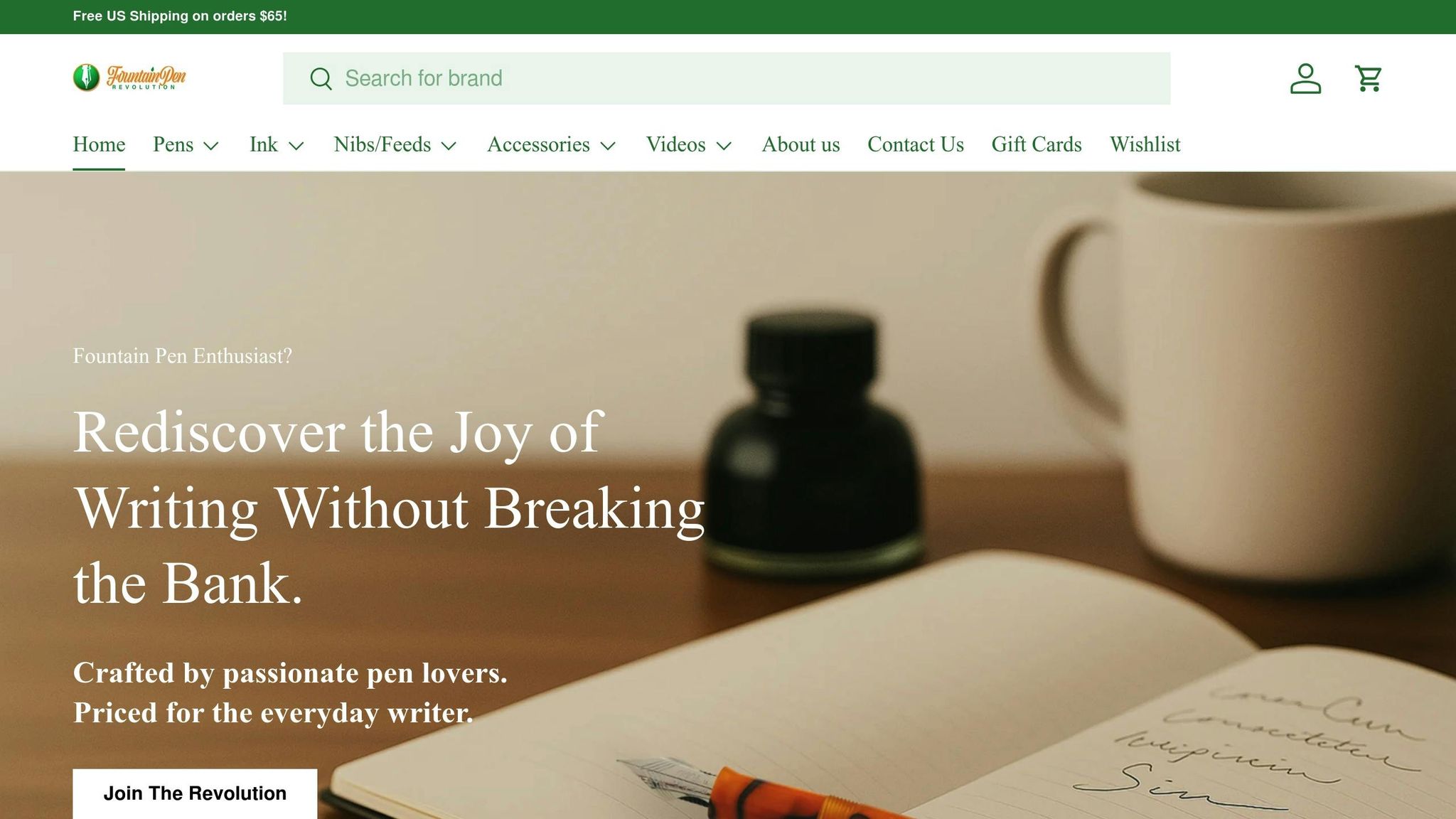
Blending old-world craftsmanship with modern practicality, Fountain Pen Revolution offers a range of pens that honor tradition while staying budget-friendly. Their collection spans from beginner-friendly models to high-end designs, making it easy for anyone to find the perfect fit.
The handmade series pays tribute to traditional techniques, combining timeless artistry with contemporary accessibility:
- FPR Triveni Ebonite ($65.00): This pen features ebonite, a classic material known for its durability and the intricate curing process required to stabilize it.
- FPR Tanoshii Urushi Art ($149.00): Crafted using authentic Japanese Urushi lacquer techniques, this pen boasts a stunning, unique finish.
- FPR Duet ($119.00): A standout design with dual nibs, meticulously handcrafted for precision and versatility.
For those who appreciate the vintage flair of early 20th-century pens, Fountain Pen Revolution offers flex nib options. These replicate the elegant line variations of the 1920s and 1930s. Popular choices include the FPR Quickdraw Flex ($35.00) and Himalaya V2 ($44.00), both delivering a smooth, expressive writing experience.
The platform also caters to different skill levels. Beginners might enjoy models like the Darjeeling ($18.00) or Indus ($20.00), while experienced writers can explore more specialized options.
"Crafted by passionate pen lovers." – Fountain Pen Revolution
In collaboration with traditional Indian manufacturers, Fountain Pen Revolution offers artisan pieces like the FPR-Ranga Madras ($89.00). This handmade ebonite pen reflects the enduring beauty of classic craftsmanship. Plus, with free U.S. shipping on orders over $65.00 and a daily "Pen-Of-The-Day Deal", enjoying the timeless pleasure of writing has never been more accessible.
Conclusion
The fusion of traditional craftsmanship and modern technology has allowed fountain pens to honor their rich heritage while adapting to contemporary needs. Techniques like hand engraving, the use of ebonite for its warmth, and meticulous nib tuning highlight that true perfection still requires the human touch. For example, Montblanc technicians dedicate 6 to 8 months mastering the art of hand-testing nibs, while artisans continue to employ burin engraving, turning these writing instruments into genuine works of art.
While modern CNC machines bring consistency to production, the handcrafted processes of turning and polishing give each pen its own unique character. This blend of old and new not only preserves the artistry behind these pens but also offers a more sustainable alternative to disposable writing tools.
"Using a handcrafted fountain pen is like stepping back in time and connecting with the craftsmanship of the past." – Artisan Penmaker
Whether it’s a $20 starter pen or a $150 lacquered masterpiece, the principles remain constant: balanced ink flow through capillary action, precisely shaped nibs, and an unwavering attention to detail. In today’s digital age, these pens serve as a reminder of the value of creating something with care and intention.
The enduring appeal of handcrafted pens lies in their ability to provide a tactile, meaningful writing experience. They glide smoothly across paper, offering a connection to the skilled hands that shaped them. By supporting and maintaining these pens, we help preserve techniques that have been passed down for centuries, keeping the art of fine writing alive.
FAQs
What makes traditional techniques valuable in modern fountain pen crafting?
Traditional techniques infuse modern fountain pen crafting with a level of artistry and skill that's hard to replicate. Methods like delicate hand engraving or meticulous lacquer work transform each pen into more than just a writing instrument - it becomes a genuine work of art. The manual precision and care poured into these creations give them a unique charm and visual appeal.
These techniques often incorporate high-quality materials such as ebonite, celluloid, or even precious metals. This not only boosts the pen's durability but also enhances its feel and overall writing experience. In a world dominated by mass production, these handcrafted pens stand out as meaningful, collectible treasures, cherished by enthusiasts and collectors for their individuality and timeless craftsmanship.
How do materials like TruStone and DiamondCast enhance modern fountain pen designs?
Materials like TruStone and DiamondCast are transforming the world of fountain pen design with their striking combination of style and modern craftsmanship.
TruStone is crafted from a blend of natural stone powders and resin, giving it the appearance and texture of genuine stone. This material not only exudes luxury and sophistication but also offers excellent durability, making it a top choice for creating high-end, standout writing instruments.
On the other hand, DiamondCast takes a bolder approach. This resin material is infused with metallic or shimmering elements, resulting in vibrant, dynamic patterns. From iridescent swirls to glittering finishes, every pen made with DiamondCast is a one-of-a-kind masterpiece. These materials enable artisans to merge traditional pen-making techniques with contemporary design, creating fountain pens that are both practical tools and stunning pieces of art.
Why is the quality of nib craftsmanship so important for fountain pens?
The nib is the centerpiece of a fountain pen, playing a crucial role in how it writes. Its design and craftsmanship directly affect how smooth and enjoyable your writing experience will be. A well-made nib ensures steady ink flow, reduces problems like skipping or blotting, and strikes the perfect balance between flexibility and control.
Top-tier nibs are built to move effortlessly across the page, making writing feel almost second nature. Whether you're scribbling quick notes or crafting detailed calligraphy, the nib's quality is what truly brings your fountain pen to life.