

Ebonite, a vulcanized rubber material, has been a favorite in fountain pen manufacturing since the 19th century. While modern materials like acrylic and plastic dominate the market, ebonite remains popular among collectors and premium brands for its unique characteristics. Here's what you need to know:
Key Benefits:
- Ink Flow: Ebonite feeds promote smooth, consistent ink flow due to their textured surface.
- Chemical Resistance: Extremely resistant to acidic inks, making it ideal for long-term use.
- Thermal Insulation: Helps maintain stable ink performance by insulating against heat.
- Feel: Offers a "warm" and organic tactile experience unmatched by metal or plastic.
Main Drawbacks:
- Durability: Brittle and prone to cracking if dropped.
- Oxidation: Exposure to sunlight and moisture can discolor the surface over time.
- Cost: Labor-intensive production makes it more expensive than acrylic or plastic pens.
- Maintenance: Requires regular cleaning to prevent ink buildup in feeds.
Comparison with Other Materials:
- Acrylic: More impact-resistant, offers a wider range of colors and patterns, but lacks the texture and warmth of ebonite.
- Plastic (ABS): Affordable, durable, and low-maintenance, but less effective for ink flow and customization.
Quick Comparison Table:
| Feature | Ebonite | Acrylic | Plastic (ABS) |
|---|---|---|---|
| Durability | Brittle; prone to cracking | High impact resistance | High impact resistance |
| Appearance | Limited colors; oxidizes | Wide color variety | Solid, functional colors |
| Ink Flow | Excellent | Moderate | Moderate |
| Thermal Insulation | Excellent | Moderate | Moderate |
| Chemical Resistance | Very high | Moderate | Moderate |
| Price | High | Moderate to high | Low |
Ebonite pens are ideal for enthusiasts who value performance, history, and a distinct feel. However, they require careful handling and come at a higher price point. For everyday reliability and vibrant aesthetics, acrylic and plastic pens are better options.
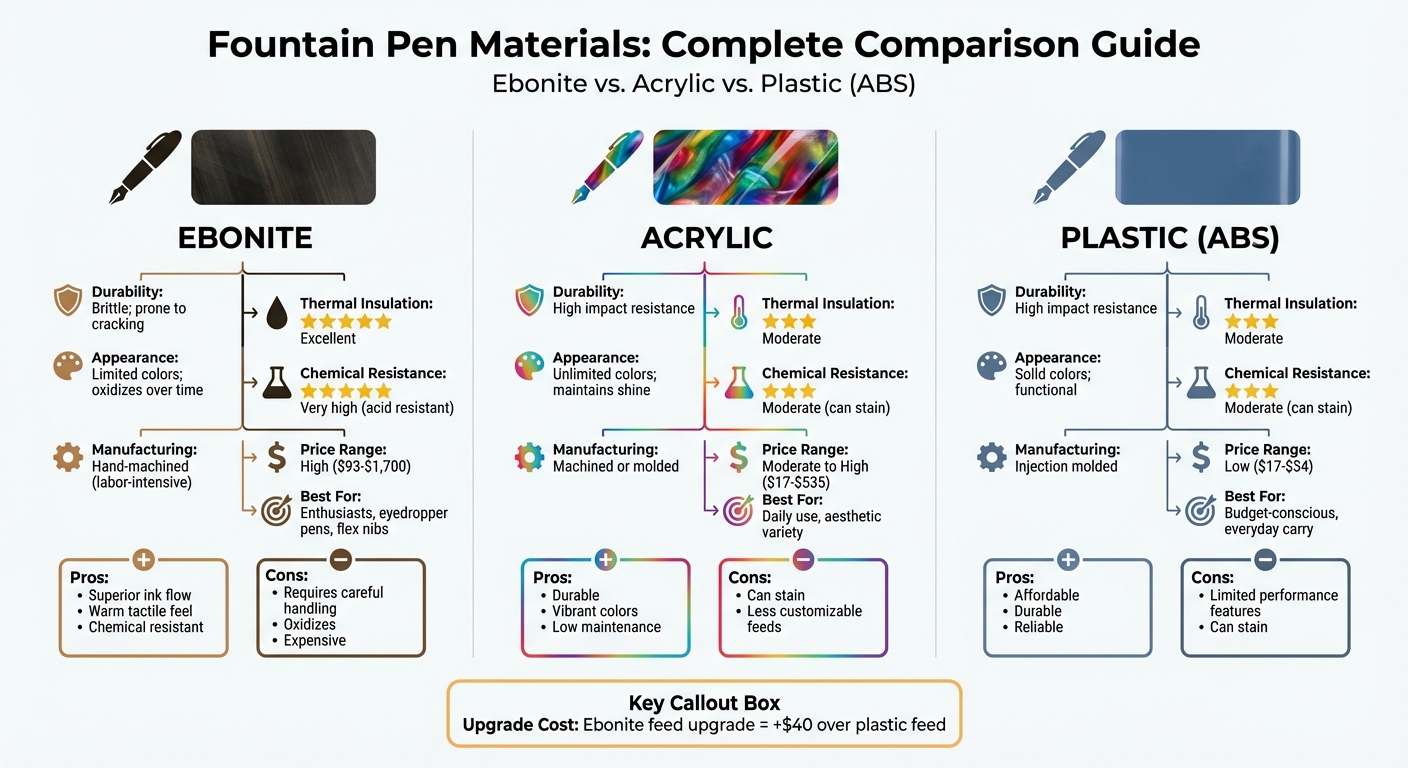
Fountain Pen Materials Comparison: Ebonite vs Acrylic vs Plastic
1. Ebonite
Durability
Ebonite stands out for its impressive resistance to chemicals, particularly acidic inks that can degrade other materials over time. It's not uncommon to find vintage ebonite pens from the early 1900s still in working condition, a true testament to its longevity. That said, ebonite does have its weaknesses. It’s prone to brittleness, meaning a hard impact could result in cracks or even shattering - unlike modern plastics, which tend to flex under pressure.
Environmental factors can also affect ebonite. Exposure to sunlight, moisture, and heat can lead to surface oxidation, causing the material to develop a brown or greenish tint over time. To keep your pen looking its best, store it away from direct sunlight and avoid exposing it to warm water for extended periods.
While its physical durability is impressive, ebonite's distinct appearance is another reason it's so highly regarded.
Aesthetic Appeal
Ebonite offers a warmth and tactile quality that neither metal nor plastic can replicate. It’s often featured in beautiful patterns like mottled, rippled, or woodgrain designs, giving it a natural and inviting feel that’s perfect for prolonged writing sessions.
Although ebonite starts as a naturally black material, it can be transformed into striking colors. Deep reds are achieved with hematite, while cinnabar creates vibrant oranges. High-end brands like Pilot, Sailor, and Namiki frequently use ebonite as the base for pens finished with traditional Urushi lacquer. Over time, ebonite develops a patina, which many collectors see as adding character and a sense of history to the pen.
Ink Flow and Performance
One of ebonite's standout features is its hydrophilic nature, which makes it ideal for ink flow. Danny Watts, author of Fountain Pen Chronicles, explains:
Ebonite is favored because it is easily wetted with ink and it won't bead up on an ebonite surface because it is textured.
The surface texture, enhanced by tiny machined scratches, promotes capillary action for smooth and consistent ink delivery.
Ebonite’s thermoplastic properties also make it highly adaptable for fountain pen feeds. These feeds can be heat-set - softened with hot water and shaped to fit perfectly against the nib. This ensures there are no gaps that might cause air leaks or disrupt ink flow. As YSTUDIO highlights:
Since ebonite can be heated to fit perfectly with other parts of the fountain pen such as the nib and nib collar, it creates better capillary action and ink saturation capabilities.
However, ebonite feeds require more cleaning than plastic ones. Ink tends to accumulate in the textured channels, so regular maintenance is key. Despite this, the superior ink flow and customization options make ebonite feeds a favorite among enthusiasts.
Cost
Ebonite pens are generally more expensive than their plastic counterparts, largely due to the production process. Unlike plastic, ebonite can’t be injection molded. Every component must be lathe-machined, which drives up manufacturing costs. For instance, Wancher offers an ebonite feed upgrade for about $40.00. Entry-level ebonite pens, like the Opus 88 Koloro, start around $93.00, while luxury models such as the Pilot Custom Urushi can cost as much as $1,700.00. These prices reflect both the craftsmanship and the material's unique qualities.
sbb-itb-1dd4fe9
2. Acrylic
Durability
Acrylic pens are known for their ability to handle the bumps and drops of everyday use. Unlike ebonite, which can chip or crack under pressure, acrylic is more flexible and less brittle. This quality makes acrylic pens a practical choice for those who need a reliable, durable option. Plus, its resilience adds to its appeal, especially for people who carry their pens daily.
That said, acrylic isn't without its weaknesses. Some inks can stain or even damage the material over time, making it less ideal for eyedropper pens where ink sits directly in the barrel. In such cases, ebonite remains the safer option for long-term ink exposure.
Aesthetic Appeal
When it comes to looks, acrylic truly shines. While ebonite develops a warm patina over time, acrylic offers a bold, modern aesthetic with an almost endless variety of colors and patterns. As Jon Szanto from the FPGeeks Forum puts it:
Acrylic pens will likely come in more flamboyant colors, and frequently more color choices.
From transparent demonstrators that reveal the pen's internal mechanics to swirling, multi-colored designs, acrylic pens deliver a brilliance and depth that traditional materials simply can't match.
This variety spans across different price ranges. For instance, the Lamy Safari, made from ABS plastic, costs $29.60 and is celebrated for its vast array of color options. Moving up the price ladder, the Benu Euphoria Collection in acrylic is priced at $174.00, while luxury models like the Aurora Optima Auroloide can reach $535.50. Best of all, acrylic maintains its sleek, polished look with minimal upkeep.
Ink Flow and Performance
Acrylic isn't just about aesthetics; it also impacts ink flow and performance. Unlike ebonite, which has a textured surface that naturally promotes capillary action, acrylic's smooth surface resists ink adhesion. To address this, manufacturers often use chemical treatments or etching to improve the "wettability" of acrylic feeds, allowing ink to cling better. As an engineer at Lamy explained:
It took a lot of different chemical treatments to make the plastic feeds as rough as the sawn ebonite ones.
While injection-molded acrylic feeds are known for their precision and consistent performance - even under fluctuating air pressures - they lack the customizability of ebonite feeds, which can be manually adjusted for optimal ink flow.
Cost
One of acrylic's standout advantages is its affordability. Thanks to the efficiency of injection molding, acrylic pens are far less expensive to produce than ebonite pens, which require labor-intensive lathe work. For example, entry-level acrylic pens like the Platinum Plaisir start at just $17.60, while the Pilot Metropolitan is priced at $34.00. Even within the same brand, acrylic versions tend to be significantly cheaper. Santini Italia's acrylic resin pens cost about 259 euros, compared to 359 euros for their ebonite counterparts - a difference of 100 euros. Similarly, Narwhal's standard acrylic pens are priced between $45 and $55, while their anniversary ebonite models climb to $80.
Acrylic pens strike a balance between affordability and visual appeal, but their limitations in ink flow and performance should be weighed when considering their overall functionality.
Ebonite vs Platic Feeds for fountain pens
3. Plastic
Plastic pens combine modern manufacturing techniques with practical design, offering a reliable alternative to ebonite and acrylic.
Durability
Plastic fountain pens, particularly those made from ABS (acrylonitrile butadiene styrene), are designed to handle the rigors of daily use. Fun fact: ABS is the same material used to make Lego blocks. While ebonite is known for its warm feel but can be prone to cracking, plastic provides a more durable option. It’s less likely to break from drops or impacts, making it a dependable choice for everyday carry. In fact, modern plastics were initially developed to offer better impact resistance compared to ebonite.
Another plus? Plastic keeps its color and shine even when exposed to light or heat over time. However, it’s worth noting that some plastics might stain if exposed to certain inks.
Ink Flow and Performance
Plastic feeds are produced through precise injection molding, ensuring consistent ink flow without the need for manual tweaks like "heat fitting". To enhance ink flow, the smooth surfaces of plastic feeds are chemically treated to improve their wettability. This process allows the feed to manage air pressure effectively, reducing the chances of leaks and ensuring smooth performance.
These advancements, paired with precision manufacturing, make plastic feeds both reliable and economical.
Cost
One of plastic’s biggest advantages is its cost-effectiveness. Thanks to injection molding, plastic pens are much cheaper to produce than ebonite pens, which require time-consuming machining. Ebonite, being abrasive, also wears down metal tools quickly, driving up production costs. For example, Wancher charges an extra $40.00 to upgrade from a plastic feed to an ebonite one. This substantial price difference makes plastic an ideal choice for affordable fountain pens that still deliver on durability and performance.
Advantages and Disadvantages
Every material brings its own set of strengths and weaknesses to the table. Ebonite, for instance, shines when it comes to ink flow and chemical resistance, making it a top choice for feeds and eyedropper pens. Its naturally textured surface supports smooth capillary action, ensuring consistent ink delivery. On top of that, ebonite provides excellent thermal insulation, which keeps the ink reservoir stable against the heat from your hand. Many users also appreciate its warm, organic feel, which offers a tactile experience that's hard to replicate.
That said, ebonite has its downsides. It's mechanically brittle, meaning it can crack if dropped. Over time, exposure to light and humidity can cause oxidation, leading to a brownish or greenish patina that dulls its original finish. Its color options are also quite limited, usually restricted to black or subtle variations like mottled reds and oranges achieved through mineral additives. On top of that, its chemical inertness makes it difficult to repair. These limitations highlight the differences when comparing ebonite to more versatile materials like acrylic or plastic.
Acrylic, on the other hand, offers impressive impact resistance and retains its brilliance over time. Its nearly limitless range of colors and transparency options far outpaces ebonite. Meanwhile, ABS plastic, commonly found in everyday fountain pen components, stands out for being cost-effective and durable, thanks to efficient injection molding processes.
The price gap between these materials is also worth noting. For example, Wancher charges an additional $40.00 to upgrade from a plastic feed to an ebonite feed. This price reflects the labor-intensive nature of ebonite production, which involves lathe-turning rather than molding. Ebonite's abrasive properties also wear down cutting tools - some as fine as 0.015 mm (about 0.0006 inches) - more quickly, adding to production costs.
Here’s a quick breakdown of how these materials compare:
| Feature | Ebonite | Acrylic | Plastic (ABS) |
|---|---|---|---|
| Durability | Brittle; prone to cracking | High impact resistance | High impact resistance |
| Appearance | Limited colors; oxidizes | Unlimited colors; maintains shine | Solid colors; functional |
| Ink Flow | Excellent | Moderate | Moderate |
| Thermal Insulation | Excellent (prevents leaks) | Moderate | Moderate |
| Chemical Resistance | Very high (acid resistant) | Moderate (can stain) | Moderate (can stain) |
| Manufacturing | Hand-machined (labor-intensive) | Machined or molded | Injection molded |
| Price | High | Moderate to High | Low |
Conclusion
Choosing the right material for your pen depends on what matters most to you. Ebonite stands out for its excellent ink flow, thermal insulation, and that warm, organic feel that pen enthusiasts often rave about. As Danny Watts points out, ebonite's textured surface keeps ink from beading, ensuring a steady flow of ink. This makes it a fantastic choice for eyedropper pens, flex nibs, and writers who prioritize top-notch performance.
That said, ebonite does need some extra care. It should be kept away from sunlight and moisture to avoid oxidation. Plus, its brittleness and limited range of colors might not appeal to everyone. For those who need durability and vibrant aesthetics, acrylic and ABS plastic are better options, offering stronger impact resistance and a wider array of colors.
For writers who cherish the tactile experience and the charm of traditional materials, ebonite’s natural grip and warmth make it worth the extra effort. It’s particularly suited for eyedropper pens or flex nibs that require high ink capacity, thanks to its chemical resistance and superior capillary action.
On the other hand, if you’re looking for a tough, low-maintenance pen for everyday use or prefer colorful, transparent designs, modern plastics are a more practical choice. By balancing performance and tradition against versatility and ease of use, you can pick the material that best matches your writing habits and preferences.
FAQs
How do I prevent ebonite from oxidizing?
To keep ebonite from oxidizing, limit its exposure to direct sunlight or UV light, as these can lead to discoloration. Regularly applying a specialized ebonite or pipe polish can help clean the surface, remove sulfur buildup, and bring back its original look.
Can I fix a cracked ebonite pen or feed?
Yes, it's possible to fix a cracked ebonite pen or feed using adhesives specifically made for hard rubber, like certain types of rubber cement. To restore its look, you can try techniques like polishing or reblackening. If you're facing ink flow issues, heat-setting might help improve performance. Just make sure to handle the repairs gently to prevent causing more harm.
Which inks are safest for ebonite pens?
Fountain pens made from ebonite are best paired with water-based, non-toxic inks to avoid damage to the material. Trusted brands like Waterman, Sheaffer, and Diamine (including their safe ink line) offer excellent options. These inks not only protect your pen but also deliver a smooth and enjoyable writing experience.