

Ebonite is still around because it does three things well: it feels better in the hand, it can help feed ink more steadily, and pen makers can shape it with tight control.
If I were deciding whether to buy an ebonite pen, I’d focus on four points right away:
- Feel: ebonite tends to feel warmer and less slippery than metal or glossy plastic
- Writing performance: ebonite feeds are often chosen for wet flow and flex nib use
- Build: it must be cut and turned from rods, not molded like standard plastic
- Care: it can oxidize, lose shine, and sometimes has a light rubber smell at first
Here’s the short version: ebonite is hard vulcanized rubber, a pen material used since the late 1800s. It still shows up in feeds, grip sections, and full pen bodies because it offers a mix of comfort, tuning control, and an old-school look that many writers still want.
If you want the lowest-maintenance option, plastic may be the easier pick. If you want better grip, feed tuning, and a softer hard-rubber feel, ebonite still makes sense.
| Part of the pen | What ebonite adds | What to watch for |
|---|---|---|
| Feed | Steadier ink contact, often wetter flow, heat-setting | More care, higher cost |
| Grip section | Warmer touch, less slip during long writing | Can dull over time |
| Full body | Hard-rubber feel and old pen look | Sunlight and heat can discolor it |
So before I buy, I’d check one thing first: which part is actually ebonite? That tells me more than the photos do.
Making of My Own Ebonite – THE PENMAKER'S ATELIER | Full Production Film 🇺🇸
sbb-itb-1dd4fe9
Why Writers Like the Feel of Ebonite
A lot of writers notice the difference with ebonite almost right away. Within the first few minutes, it tends to feel warmer and less slick than metal or many plastics. So it settles into the hand fast and stays comfortable. That comfort is a big reason pen makers still use it.
Warmth, Grip, and Comfort During Long Writing Sessions
Ebonite has a fine, matte-like surface with a slight texture that helps keep your fingers in place. You can hold it with a light touch and still stay in control, which may help cut down on hand fatigue during long journaling or note-taking sessions.
Polished acrylic and smooth injection-molded plastics can feel slippery, especially once your hand warms up. Ebonite usually doesn’t have that issue. Many users also say it feels warm and grippy even in humid conditions, which can help keep the nib angle more stable. For people who write with italic, stub, or flex nibs and ebonite feeds - where nib angle matters - that extra grip can make a noticeable difference. That steadier hold helps explain why ebonite is still common in writing sections.
How Ebonite's Low Heat Transfer Supports Steadier Handling
Ebonite moves heat more slowly than brass, steel, or aluminum. In plain terms, it doesn’t feel cold when you pick it up from a desk in an air-conditioned office or a cool classroom. It gets close to hand temperature fast and tends to stay there, so the feel remains neutral and consistent through a long writing session. That steady handling also works well alongside ebonite feeds and other functional parts.
Why Ebonite Works Well for Feeds and Pen Parts
Ebonite vs Plastic Feeds: Key Differences for Fountain Pen Writers
Ebonite isn't just useful on the outside of a pen. It also performs well under the nib. It helps move ink in a smooth, steady way, and it can be machined for a very exact fit. That's a big reason many makers still use it for feeds and other turned parts.
Ink Flow, Ink Adhesion, and Heat-Setting Benefits
One reason ebonite stands out is how it handles water-based ink. Instead of letting ink bead up, it helps the ink spread across the surface. That supports steadier movement through the feed channels. In practice, this is why ebonite feeds are often known for a wetter, more generous flow.
The other big plus is heat-setting. Ebonite can be softened with heat and adjusted for a closer fit against the nib, which may improve ink transfer and lower the odds of uneven flow. That same trait also makes it useful for other turned pen parts where fit matters.
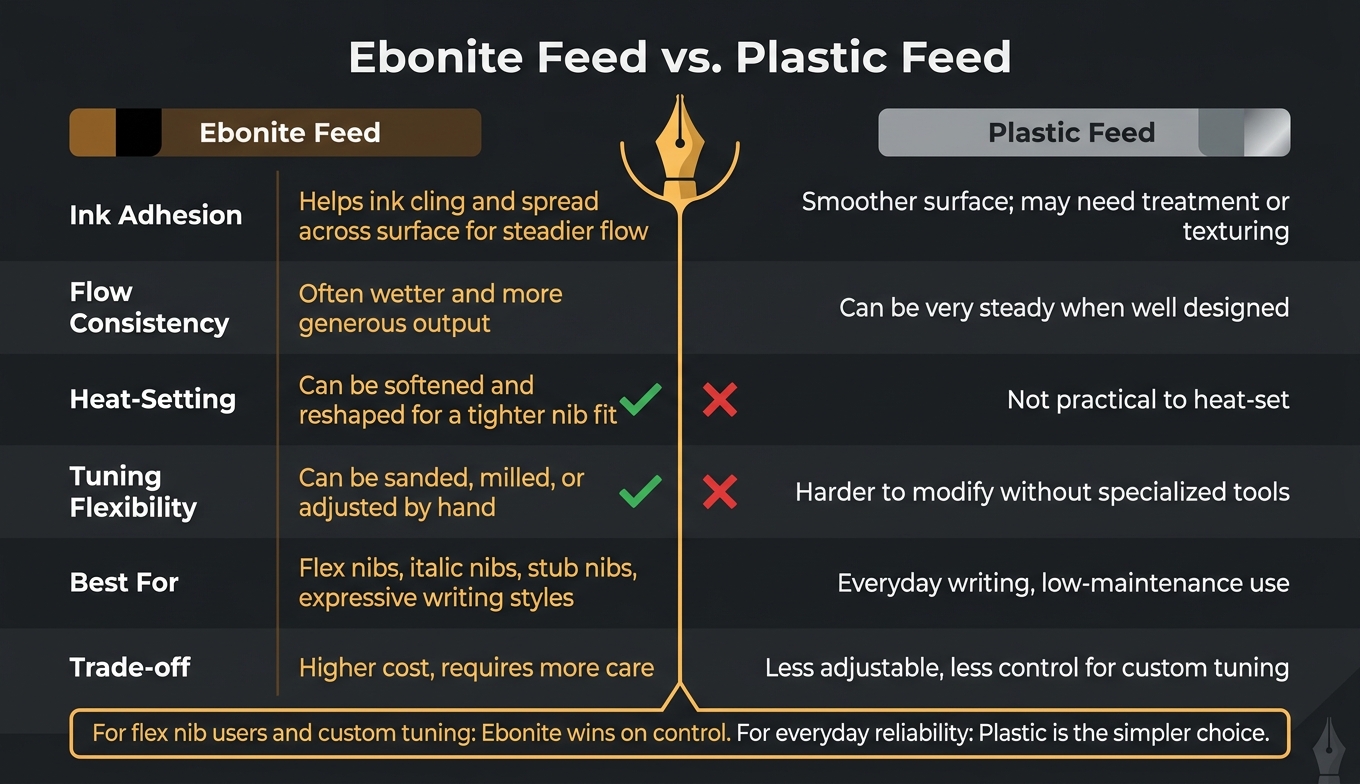
Ebonite Feeds vs. Plastic Feeds: A Side-by-Side Comparison
Both materials can work well. The better choice often comes down to what the pen is meant to do and how much tuning is needed.
| Feature | Ebonite Feed | Plastic Feed |
|---|---|---|
| Ink adhesion | Helps ink cling and move in a steady way | Usually smoother; may need treatment or texturing |
| Flow consistency | Often wetter and more generous | Can be very steady when well designed |
| Heat-setting | Can be softened and reshaped for a tighter fit | Not practical to heat-set |
| Tuning flexibility | Can be sanded, milled, or adjusted by hand | Harder to modify without specialized tools |
A well-made plastic feed can do the job just fine for daily writing. But if a pen is being built or tuned for a certain nib and writing style, ebonite gives makers and hobbyists more control.
Why flexible nib users Often Seek Out Ebonite Feeds
Flexible nibs need a wetter, steadier ink supply. If the feed can't keep up, the nib can starve and the line starts to fail. That's why many writers who use flex nibs look for ebonite feeds. They can often be tuned for stronger flow and adjusted with more precision, which makes them a good match for expressive writing styles.
That job under the nib is a big part of why ebonite still holds such a firm place in fountain pen history and design.
Why Ebonite Still Matters to Pen History and Design
From Early Fountain Pens to Current Production
Ebonite still matters in modern pens for the same simple reason it mattered at the start: it works well. It was one of the first practical materials used for fountain pens, with use going back to the late 1800s. Pen makers used it for barrels, caps, sections, and feeds, and it stayed the standard for decades because it machined cleanly and held up well in daily use.
Later, celluloid and then plastic took over much of body and feed production. Even so, ebonite didn't disappear. It kept its place in the areas where fit, ink flow, and adjustment made the biggest difference.
Why Some Buyers Want the Vintage Hard Rubber Look
Performance is only part of the story. Ebonite also has a look and feel that other materials struggle to copy. Classic black hard rubber develops a soft satin luster from regular handling. It doesn't shout for attention, and that's part of the charm. For many collectors and daily writers, that quiet finish is exactly the point.
Mottled and marbled ebonite, which mixes black with browns, reds, or olive tones, also carries a strong link to pen history. Those patterns echo the color experiments early 20th-century makers used to set their pens apart. The Esterbrook Model J reissue leans into that link by using ebonite to recall a vintage look, not just a vintage function.
So the draw comes from both sides: how the material performs and how it ages over time. Ebonite earns its place on the page and in the hand. But like many materials with character, it asks for a bit more care.
What to Know Before Buying an Ebonite Pen
Oxidation, Smell, and Day-to-Day Care
Ebonite feels great in the hand, but it does ask for a little care.
The main issue is oxidation. Over time, black ebonite can shift toward brown or olive and lose some of its gloss. To help slow that down, keep ebonite away from direct sunlight and heat. When it needs cleaning, properly maintain your fountain pen using cool water and a soft microfiber cloth. Skip alcohol, acetone, and household cleaners, since they can harm the surface. If you notice light oxidation, use only a mild polish that’s safe for the material, and be extra careful with chased or mottled pens.
New ebonite pens can also have a light rubber or sulfur smell. That usually fades with normal use and a bit of ventilation.
How to Choose the Right Type of Ebonite Pen
After upkeep, the next thing to check is simple: which part of the pen is ebonite?
That detail changes the writing experience more than many buyers expect. An ebonite feed can help with ink flow. If you experience issues with your pen not writing, the feed is often the first place to look. An ebonite section can make the grip feel warmer and more comfortable. A full ebonite body gives you that classic hard-rubber look and feel people often want in the first place.
Before you buy, read the product description closely. Make sure it says which parts are actually made from ebonite, so the pen fits what you want rather than what the photos seem to suggest.
Conclusion: The Main Reasons Pen Makers Still Use Ebonite
So who gets the most out of ebonite?
Usually, it’s the writer who cares about feel, nib tuning, and the link to fountain pen history. Pen makers still use ebonite because it does a few jobs well: it feels warm in the hand, helps support steady ink flow, machines cleanly, and gives modern pens a direct tie to older hard-rubber designs. If you want the easiest possible ownership experience, a simpler material may make more sense. If you want character and function in the same pen, ebonite still makes a strong case.
FAQs
Is ebonite worth the extra care?
That depends on how much you care about a more hands-on writing experience.
Ebonite has a warm feel in the hand, better insulation than many other pen materials, and a lightly textured surface that can help with steady ink flow. That’s part of why people often like it for flex nibs and eyedropper pens.
The downside is upkeep. You need to keep it away from direct sunlight, heat, and moisture, and clean it gently by hand with cool water. If you want something easy to care for, it may not be the best choice.
Which ebonite part matters most?
The ebonite feed is the part that matters most. Its naturally textured surface helps capillary action, which keeps ink flow steady and smooth. Its insulating properties also help limit pressure shifts that can cause leaks.
Another plus: it can be heat-set to fit the nib more closely. That’s especially helpful for flex nibs or if you prefer a wetter writing style.
How long does ebonite last?
Ebonite is built to last and can remain in use for 100+ years with proper care. That’s not just theory, either. Many vintage ebonite pens from the early 1900s still work today.
It also holds up well chemically and resists acidic inks. But it has a weak spot: impact. Drop it, and it can crack. Over time, light, heat, and humidity can also oxidize the surface, which may leave it looking dull brown or slightly green.