

Use silicone grease in only 2 places: sealing threads and moving seals. If it gets into the ink path, even a thin film can cause hard starts, skipping, or no flow at all.
Here’s the short answer:
- Yes: eyedropper barrel threads, section-to-barrel threads, threaded converter joints, piston seals, and removable converter plungers
- No: nib, feed, feed fins, ink channels, breather hole, section opening, and inside the ink reservoir
- Amount: use a barely visible film on threads or a pinhead-sized dab on piston seals
- Before applying: clean the pen and let it dry all the way
- After applying: hand-tighten only, wipe off extra grease, and test eyedroppers with water for 15–30 minutes
In other words: I treat silicone grease as a sealant and a friction reducer - not as an all-purpose fix. If a pen still leaks after a light application, the cause is often a crack, bad O-ring, or loose nib unit, not a lack of grease.
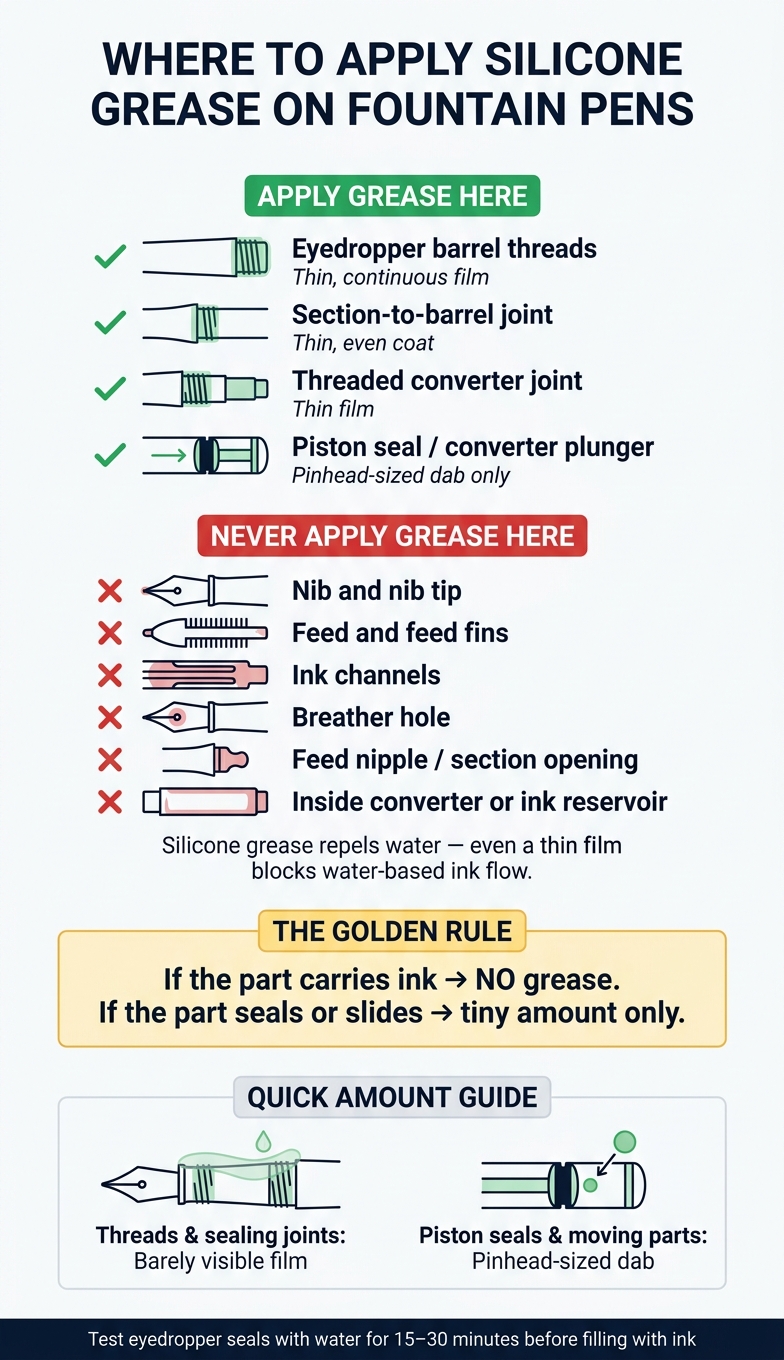
Where to Apply Silicone Grease on Fountain Pens: Quick Reference Guide
Fountain Pen Maintenance: Silicone Grease for Ink Leaks & Flossing for Shimmer Clogs
sbb-itb-1dd4fe9
Quick comparison
| Pen part | Apply grease? | Why | How much |
|---|---|---|---|
| Eyedropper barrel threads | Yes | Stop ink and air leaks | Thin film |
| Section-to-barrel joint | Yes | Help seal threaded connection | Thin film |
| Threaded converter joint | Yes | Keep joint air-tight | Thin film |
| Piston seal / converter plunger | Yes | Help seal move with less drag | Pinhead-sized amount |
| Nib and feed | No | Can block ink flow | None |
| Ink channels / reservoir interior | No | Can contaminate ink | None |
A good rule: if the part carries ink, I keep grease off it; if the part seals or slides, I use only a tiny amount.
How to apply silicone grease to threads and sealing joints
Start with the joints that need to stay ink-tight or air-tight. Here, silicone grease works as a seal on static joints, helping block both ink and air.
Apply grease only to clean and maintained threads.
Eyedropper barrel threads and section-to-barrel joints
Eyedropper pens store ink right in the barrel, so the point where the section screws into the barrel needs a solid seal. Apply a thin, continuous coat of grease around the full circumference of the barrel threads. Think even film, not a blob. Once you reassemble the pen, wipe away any extra grease.
The same idea applies to other threaded joints that seal the pen body.
Threaded converter joints and airtight section joints
Use grease sparingly on airtight section and converter threads. A thin film on the threads is enough. Keep grease away from ink-contact surfaces and feed openings.
Sealing joints vs. lubricating moving parts: a quick comparison
| Pen Part | Use | Amount to Apply | Too Much Grease Can… |
|---|---|---|---|
| Eyedropper barrel threads | Seal against ink leaking through threads | Thin, continuous film | Migrate inward and affect ink flow |
| Section-to-barrel joint | Prevent ink wicking at the connection point | Thin, even coat | Reach the feed if over-applied |
| Threaded converter joint | Maintain an airtight seal for filling | Thin film | Cause flow issues or skipping |
| Piston seal / converter plunger | Reduce friction on moving parts | Minimal, targeted | Spread into the ink chamber |
Moving seals need a different touch, which comes next.
How to lubricate piston seals and serviceable filling parts
Moving parts need grease so they move more smoothly. Grease is not there to make the seal itself work.
A piston seal usually needs attention when the knob feels stiff, drags, or grabs instead of gliding. Another common sign is ink seeping past the piston head and along the barrel wall. The same idea applies to piston seals and removable converter plungers.
Only grease parts the manufacturer marks as user-serviceable.
Piston seals and converter piston seals
Use a pinhead-sized amount of 100% pure silicone grease on the seal’s outer edge. That’s all you need. Keep the grease out of the ink chamber.
Also, don’t spread that grease onto the piston rod, threads, or inner filler parts unless the maker says it’s okay.
Piston threads, rods, and vacuum-filler warnings
Beyond the seal itself, only work on parts the manufacturer lists as accessible. Vacuum fillers are not user-serviceable unless the manufacturer says otherwise. That means you should not disturb their inner parts, including breather tubes, unless you have model-specific instructions.
Where silicone grease should never go
Silicone grease helps seals move smoothly and keeps threaded parts from binding. But it should never get into the ink path.
Here’s why: silicone grease repels water. Fountain pen ink is water-based, so even a very thin film can interfere with flow and stop ink from moving the way it should.
Parts that must stay grease-free
Keep grease away from the feed fins, ink channels, nib tip, breather hole, feed nipple, section openings, and the inside of the converter or reservoir.
When grease gets on the nib or feed, the pen can start hard, skip, or write with restricted flow. Another clear warning sign is oil droplets in the ink.
What to do if grease reaches the feed or ink chamber
If you notice any of these signs after maintenance, clean the affected parts right away.
Flush the contaminated parts with lukewarm water and a few drops of dish soap. If residue sticks around, use a pen flush made from 1 part household ammonia to 10 parts water with a drop of dish soap. Then rinse everything well with clean water.
If the pen still leaks after cleaning, the problem may not be the grease at all. Check for:
- a cracked barrel
- a damaged O-ring
- a loose nib unit
Grease can help seal parts that are still in good shape. It won’t fix broken ones.
Reassemble, check for leaks, and know when to reapply
How to check the seal after reassembly
Once the grease is in place, put the pen back together with care and make sure the seal is holding. At this stage, you want to confirm that the grease stayed only on the sealing surfaces. Tighten by hand only, and stop as soon as you feel firm resistance. If any grease squeezes out of the joint, wipe it off right away with a lint-free cloth before it picks up dust or drifts where it doesn’t belong.
For piston-fillers, move the piston up and down several times before adding ink. That helps spread the grease along the seal. If the piston still feels stiff, add only a tiny bit more.
For eyedropper pens, test the seal with plain water first. Fill the barrel, leave about 10–15% air space at the top, and let the pen rest on a paper towel for 15–30 minutes. If you don’t see any wet spots, the joint is sealing properly. This test checks the section joint and barrel threads, not the nib or feed. That air gap also helps cut down on burping, where warm air pushes ink out of the barrel.
If the threads feel gritty, stop there. Clean them, then apply a thin coat again before tightening.
Key points to remember before regular use
Grease eyedropper-style threads and section joints only when you notice a slow leak or ink sitting in the thread tracks. Use grease on piston seals sparingly, and keep it away from the nib, feed fins, and internal ink channel.
Reapply based on performance, not a calendar. If the piston feels stiff, a joint seems loose, or you notice a leak after normal hand-tightening, it’s time for a fresh dab. Dish soap, an ammonia flush, and ultrasonic cleaning can strip away grease, so you’ll need to apply it again after those cleaning sessions. If the pen still leaks after that, the issue is a damaged part, not too little grease.
FAQs
What kind of silicone grease is safe for fountain pens?
Use 100% pure silicone grease made for fountain pens. It won’t react with common pen parts, and it’s safe for materials like plastic and rubber. Well-known options include Krytox GPL 205 (Grade 0 or 2) and Pelikan 4001.
Stay away from petroleum-based lubricants, including petroleum jelly. Those products can harm seals and plastic parts over time. When you apply grease, use only a very thin film. Too much can work its way into the ink feed or reservoir and cause a mess.
How can I tell if my pen needs grease or a new O-ring?
Check the seals and threads closely. If you spot leaks, steady air intake, or a gritty feel even after cleaning and adding a thin layer of 100% pure silicone grease, the O-ring may be worn out or damaged.
Inspect the O-ring and threads for wear, cracks, or leftover residue. If they still don’t seal well or move smoothly after cleaning and lubrication, it’s probably time to replace the O-ring.
How often should I reapply silicone grease?
It depends on the part of the pen and how often you use it.
For piston seals, a good schedule looks like this:
- Frequent use: every 4 to 6 months
- Moderate use: every 9 to 12 months
- Light use: every 18 to 24 months
As a general rule, check the mechanism every 6 to 12 months.
For threaded connections, reapply grease only when there’s a reason to do it. That usually means the threads feel stiff, you notice air leaks, or cleaning washed away or contaminated the old grease.