

My starting point for a $200–$300 fountain pen: choose comfort and writing feel over nib material. I’d check essential factors for choosing a pen like nib width, grip, weight, balance, and ink capacity before buying. Gold alone won’t tell you how well a pen writes.
Here’s my quick comparison of all 7 pens: 5 have gold nibs, and 6 use cartridge/converter filling.
Quick Comparison
| Pen | Nib and writing feel | Build or handling | Filling |
|---|---|---|---|
| Lamy 2000 - Black Makrolon | 14k gold; smooth, controlled | Balanced body for long notes | Built-in piston |
| Pilot Custom 74 | 14k gold; choose width to suit your handwriting | Resin body; check grip comfort | Cartridge/converter |
| Pilot Vanishing Point - Standard Lacquer | 18k gold; click-to-write access | Grip-end clip may affect your hold | Cartridge/converter |
| Pilot E95S | 14k gold; smooth with slight bounce | Pocket-sized; 4.7 inches closed | Cartridge/converter |
| Platinum #3776 Century - Laurel Green | Firm 14k gold; pencil-like feedback | Light resin body; cap helps limit drying | Cartridge/converter |
| Diplomat Excellence A2 - Steel Nib | Steel; smooth, firm feel | Check grip and balance in hand | Cartridge/converter |
| Faber-Castell E-Motion - Pure Black | Steel; writing feel not described by the sources | Thick, weighty metal body | Standard international cartridge/converter |
For quick office notes, I’d start by testing the Vanishing Point’s clip placement. For pocket carry, I’d try the E95S with and without its cap posted.
<u>I’d verify the current U.S. price before ordering.</u> The sources don’t confirm that every model falls within $200–$300, so check the exact finish, nib size, converter inclusion, and total delivered cost.
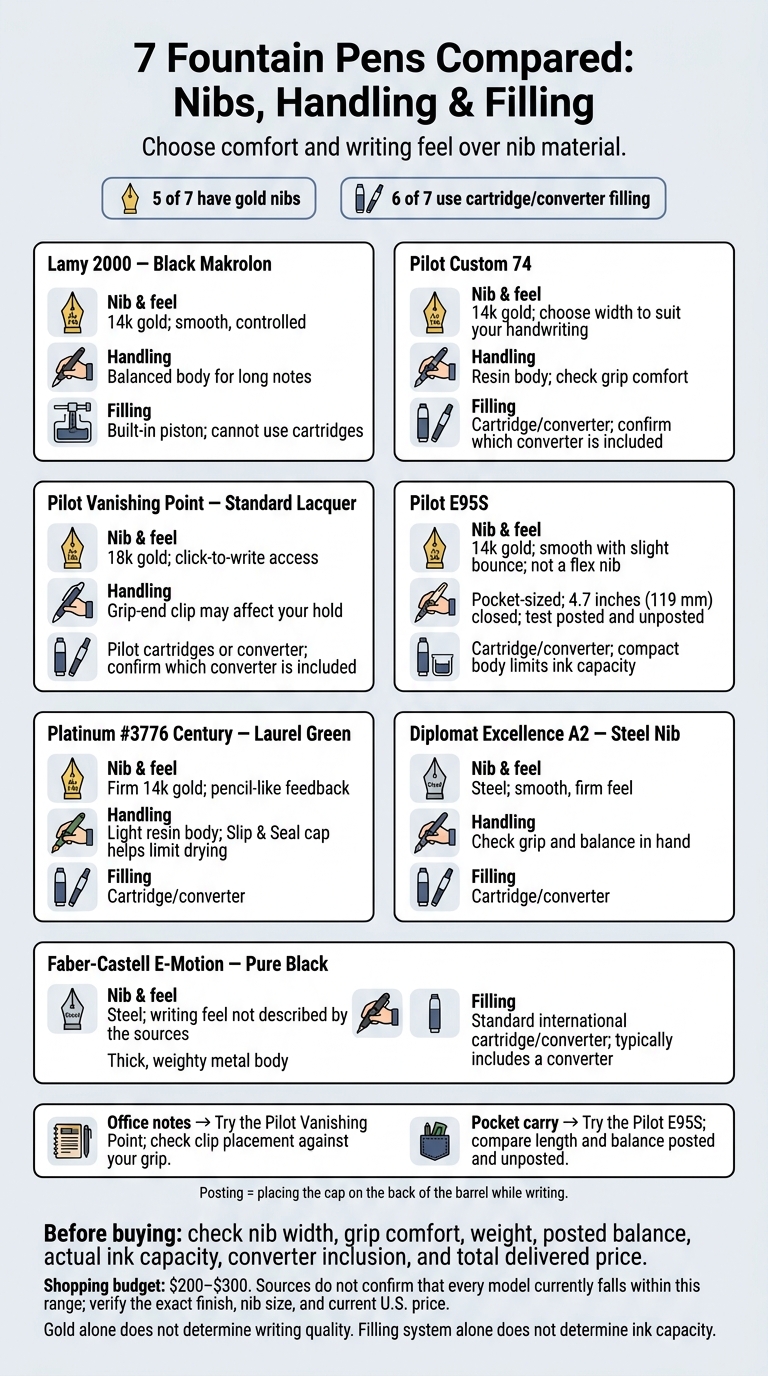
7 Fountain Pens Compared: Nibs, Handling & Filling
What to Check Before Spending $200–$300
Nib Width, Feedback, and Softness
Match nib width to your handwriting and paper. EF nibs produce thin lines. Broader and stub nibs add character, while flex nibs vary line width with pressure. Wetter ink can help a dry nib, but it takes longer to dry and smudges more easily for left-handed writers.
Feedback is a controlled feel against the paper. Scratchiness catches on paper fibers. Hard starts or ink flow that stops after a few letters are flow problems - not the feedback you want. A soft nib yields slightly under pressure, but softness is not flex.
Grip, Weight, and Cap Posting
Check the grip’s diameter and shape where your fingers rest. A narrow grip may lead to an uncomfortable pinch. A matte surface can give your fingers a more secure hold than a glossy finish.
Posting means placing the cap on the back of the barrel while writing. This adds length and moves weight toward the rear. That may suit larger hands, but it can also make the pen feel back-heavy. Compare the pen’s weight with and without the cap posted; total weight alone won’t tell you how it feels in your hand. Only post pens designed for secure posting.
Piston vs. Cartridge/Converter Filling
Compare ink capacity, not just the filling system. A piston’s rod and seal take up barrel space, so a small piston filler may hold no more ink than a large cartridge or converter.
- Filling: Twist the end knob on a built-in piston to draw bottled ink into the barrel. These pens cannot use cartridges. Cartridge/converter pens accept cartridges or a removable converter that fills from a bottle. Check whether the model takes proprietary or standard international cartridges.
- Capacity: A piston’s capacity depends on usable barrel space and piston design. For cartridge/converter pens, capacity depends on the cartridge or converter you use.
- Maintenance: Properly flush either system with water until it runs clear. Only dismantle a piston if permitted, and never force its knob past the stopping point. Internal piston faults may need repair, while a faulty converter can usually be replaced.
The seven reviews below use these same checks to compare feel, balance, filling, and daily use.
sbb-itb-1dd4fe9
1. Lamy 2000 - Black Makrolon
Nib Feel and Line Control
The hooded 14-karat gold nib feels smooth on the page while keeping each line controlled.
Build, Weight, and Grip
The Black Makrolon body uses fiberglass-reinforced polycarbonate, paired with a snap cap and small metal grip tabs. Its balanced weight keeps it comfortable during long writing sessions.
Filling and Maintenance
The integrated piston filler holds more ink, so you won’t need to refill as often. After changing inks, flush the pen with water until the water runs clear.
Daily Writing and Best-Fit User
This pen suits writers who want a durable, understated daily carry with high ink capacity. Its secure grip and piston filler work well for long notes and daily journaling. It’s a strong first pick if you care more about reliability than ornament.
2. Pilot Custom 74
Nib Feel and Line Control
The Custom 74’s 14-karat gold nib appeals to buyers looking for a gold-nib Pilot. But choose a nib width that fits your handwriting: line control matters more than the gold itself. The focus is on how the pen writes, not just its nib material.
Build, Weight, and Grip
Pilot’s clean resin build and polished trim give the pen a refined finish. If grip comfort matters to you, try holding it before buying. Also check the filling system and whether the included setup fits your ink routine.
Filling and Maintenance
Before ordering, confirm which converter is included and which cartridges the pen accepts. These details matter most if you plan to write with it regularly rather than keep it on display.
Daily Writing and Best-Fit User
The Custom 74 suits writers who want a classic Pilot gold-nib pen with a refined resin build. Choose it if you can assess its comfort in hand and find that its grip and balance fit your daily writing routine.
3. Pilot Vanishing Point - Standard Lacquer Finish
Nib Feel and Line Control
The Pilot Vanishing Point’s retractable 18k gold nib extends with a click, ready for everyday notes. Pick your usual nib size, then check whether the clip feels comfortable with your grip.
Build, Weight, and Grip
The clip sits at the grip end, so it may get in the way if you hold pens high on the section. The design puts fast access ahead of conventional handling. For daily carry, make sure that trade-off works for you.
Filling and Maintenance
The pen takes Pilot cartridges or a converter, keeping daily refills simple. Before buying, confirm which converter is included. Flush the nib unit with water when switching inks.
Daily Writing and Best-Fit User
One-handed use suits quick, stop-and-start writing. It’s a good fit if you want fast nib access and feel comfortable with the grip-end clip.
4. Pilot E95S
Nib Feel and Line Control
The E95S has a 14-karat gold inset nib that writes smoothly with a slight bounce. It isn’t a flex nib, so use light pressure.
The writing feel suits the pen’s design: smooth, controlled, and easy to carry.
Build, Weight, and Grip
At 4.7 inches (119 mm) closed, the E95S is the most pocket-friendly Pilot in this group. If you prefer a pen with more length in your hand, check its posted length - the length with the cap on the back.
Filling and Maintenance
The cartridge/converter setup is simple to use, though the compact body limits ink capacity.
Daily Writing and Best-Fit User
In the $200–$300 range, the E95S stands out for its portability and controlled writing feel. It’s best for writers who want a pocketable pen for quick notes, letters, and short writing sessions.
5. Platinum #3776 Century - Laurel Green
Nib Feel and Line Control
The firm 14-karat gold nib delivers noticeable pencil-like feedback, giving each stroke a controlled, precise feel.
Build, Weight, and Grip
The resin body and grip section feel light and simple in hand. The pen is easy to hold for routine writing.
Filling and Maintenance
This model uses cartridge/converter filling. Its Slip & Seal cap helps prevent dry starts when the pen sits between uses.
Daily Writing and Best-Fit User
The pen suits writers who prefer control over glide, whether they're jotting short notes or writing regularly at a desk. It's a good fit for those who want firm feedback, clean starts, and a pen that handles pauses well.
My favourite pens in the $200-$300 range #fountainpen #fountainpencollection
6. Diplomat Excellence A2 - Steel Nib
The Excellence A2 is a steel-nib option in this lineup, putting control ahead of softness or flex.
Nib Feel and Line Control
Its high-quality steel nib is tuned in-house for a smooth, firm feel and consistent lines.
Build, Weight, and Grip
Before buying, check the body shape, how comfortable the grip feels, and how the pen balances in your hand. Proper handwriting technique can also help you get the most out of this firm nib.
Filling and Maintenance
Confirm the filling system and what the cleaning routine and tuning involves before making a purchase.
Daily Writing and Best-Fit User
The Excellence A2 suits everyday writers who want line control rather than line variation.
7. Faber-Castell E-Motion - Pure Black
Nib Feel and Line Control
The sources list a 14k gold nibs or steel nibs but don’t describe how smooth it feels or how much feedback it provides.
Build, Weight, and Grip
The thick metal body gives this pen a weighty feel in hand.
Filling and Maintenance
It uses a standard international cartridge/converter system and typically includes a converter for bottled ink.
Daily Writing and Best-Fit User
It’s a good fit for writers who want a straightforward cartridge/converter pen for routine notes and easy cleaning.
In the comparison table below, the E-Motion stands out for its simple refilling and cleanup.
Compare Prices and Specifications
The table below lists the filling systems confirmed by the sources used for the seven reviews.
| Pen | Filling system |
|---|---|
| Lamy 2000 | Integrated piston; no converter needed |
| Pilot Custom 74 | Cartridge/converter |
| Pilot Vanishing Point | Cartridge/converter |
| Pilot E95S | Cartridge/converter |
| Platinum #3776 Century | Cartridge/converter |
| Diplomat Excellence A2 | Cartridge/converter |
| Faber-Castell E-Motion | Cartridge/converter |
Before buying, check the exact model, nib width, current U.S. price, and whether a converter is included. Choose the pen that fits your writing routine.
Match a Pen to Your Writing Routine
After comparing price and specs, match each pen to how you write. These pairings bring the earlier grip, posting, and balance checks into everyday use - but treat them as starting points, not firm recommendations. The sources support only a limited fit for each pen, with direct support for office notes and pocket carry only.
| Writing routine | Try this pen | Check before buying |
|---|---|---|
| Office notes | Pilot Vanishing Point | Check whether the clip gets in the way of your fingers during quick notes. |
| Pocket carry | Pilot E95S | Compare usable length and balance with the cap posted and unposted. |
When testing these pens, repeat the grip and posting checks from the reviews. For the Vanishing Point, watch for clip contact or pressure if you grip high or rotate the pen. For the E95S, try it posted and unposted to find which setup gives you easier control without tightening your grip.
Conclusion
After comparing the seven pens, pick the one that suits your handwriting, grip, preferred weight, and filling needs. Balance comfort and ink capacity with ease of cleaning.
The sources don’t verify current U.S. prices for these pens. Check the exact model and total delivered price before ordering.
FAQs
How can I test a pen’s comfort before buying online?
When shopping online, check a pen’s length, diameter, and weight to get a sense of how comfortable it might feel. Read reviews that discuss comfort both posted (with the cap on the back) and unposted. Pay attention to how posting changes the pen’s balance and weight.
Look for a matte texture or slim profile in the grip section. Watch for sharp ridges or noticeable threads, which could make the pen less comfortable to hold during longer writing sessions.
Which nib size works best on everyday office paper?
An extra-fine (EF) nib is usually the best choice for everyday office paper. Fountain Pen Revolution pens tend to put down plenty of ink. An EF nib keeps lines thinner and reduces the risk of feathering or bleed-through on standard, lower-quality paper.
Flex nibs produce beautiful line variation, but they also put more ink on the page. That makes them better suited to calligraphy or journaling than daily office use.
What should I check in a pen’s warranty?
Check whether the manufacturer offers direct customer support for ink flow problems, leaks, or faulty components, along with exchanges for defective pens.
The pen should also be easy to take apart for cleaning. This lets you care for the nib and feed, keep them working well over time, and avoid maintenance problems.