

Vintage fountain pens have left an enduring mark on history, not just as tools for writing but as symbols of craftsmanship and progress. From Lewis Waterman’s 1884 invention that solved ink flow issues to iconic models like the Parker Duofold and Sheaffer Balance, these pens revolutionized how people wrote and communicated. They replaced quills and dip pens, making writing smoother and more efficient, while their designs reflected the era’s focus on quality and style.
Key takeaways:
- Fountain pens improved literacy by making writing more accessible in the 19th century.
- Major innovations like Waterman’s three-fissure feed and Parker’s Vacumatic system set new standards for reliability.
- Historical significance: Pens like the Parker 51 were used in pivotal events, including the signing of the Treaty of Versailles and WWII surrender documents.
- Modern appeal: Collectors and enthusiasts value vintage pens for their durability, ergonomic designs, and historical connections. To preserve these treasures, owners must properly clean and maintain their instruments.
Today, vintage pens are celebrated for their blend of functionality and elegance, inspiring modern designs while offering a tactile, personal alternative to digital tools.
The Evolution of the Fountain Pen
sbb-itb-1dd4fe9
From Quills to Fountain Pens: How Writing Tools Changed
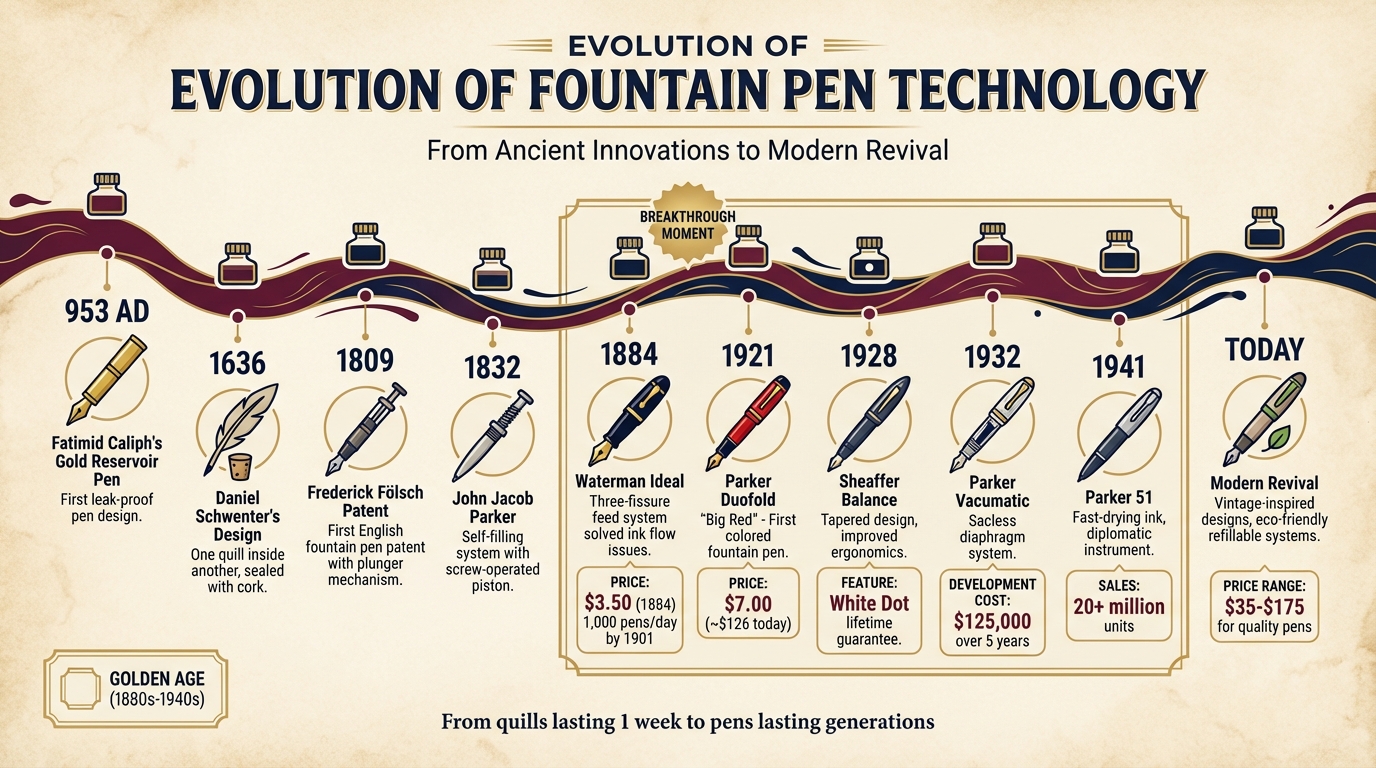
Evolution of Fountain Pens: From 953 AD to Modern Day
Quills and Dip Pens: Early Writing Methods
For over a millennium - from the 6th to the 19th century - quill pens were the go-to tool for writing. Made from bird feathers (usually goose, swan, or crow), each quill was carefully shaped into a point and split to create a nib. The hollow shaft of the feather acted as a tiny reservoir, drawing up ink through capillary action when dipped. However, this method came with plenty of challenges.
Quills were short-lived, typically lasting about a week, and needed constant maintenance. Writers had to re-trim them after just a few pages and stop frequently to re-dip them in ink, breaking their concentration. Thomas Ratcliffe reminisced, "The art of cutting a quill by adept 'quill-drivers' was dying out when I first began schooling". Dip pens, which featured metal nibs made of bronze, silver, or steel attached to handles, improved durability but didn’t solve the issue of constant re-dipping or the risk of ink spills.
The need for a better solution was obvious. Writers longed for a tool that could provide continuous ink flow, mimicking the uninterrupted nature of "flowing speech". Early inventors, however, struggled with the science behind ink flow. Without understanding how air pressure controlled ink movement, their designs either leaked profusely or didn’t work at all. These frustrations pushed inventors to develop self-contained writing tools.
First Fountain Pen Designs
The quest for a more efficient writing instrument began centuries ago. In 953 AD, the Fatimid caliph Al-Mu'izz requested a pen that wouldn’t stain his hands or clothes, leading to the creation of a gold reservoir pen that could even be used upside down without leaking. By 1636, Daniel Schwenter introduced a design involving one quill inside another, sealed with cork. Later, in 1663, Samuel Pepys noted using "a silver pen to carry ink in".
The 19th century marked a turning point with significant advancements. Frederick Fölsch secured the first English patent for a fountain pen in 1809, featuring a plunger mechanism. In 1832, John Jacob Parker introduced a self-filling system with a screw-operated piston, eliminating the hassle of using eyedroppers for refills. A major leap came in 1884 when Waterman developed a self-regulating ink feed mechanism, solving many earlier issues.
Material improvements also played a huge role. Durable steel nibs and hard rubber bodies made fountain pens more reliable and practical. These innovations paved the way for the explosion of fountain pen designs during what became known as their Golden Age.
The Golden Age of Fountain Pens
Major Manufacturers and Their Designs
The late 19th to mid-20th century is often referred to as the Golden Age of fountain pens, a period when manufacturers fiercely competed to create the most reliable and stylish writing instruments. By 1901, the L.E. Waterman Company was selling around 1,000 pens daily, thanks to its capillary feed system, which prevented blotting and ensured smooth ink flow.
George Parker made a significant mark in 1889, introducing the "Lucky Curve" feed in 1894. This curved channel cleverly drew ink back into the reservoir when the pen was upright, reducing leaks. Around the same time, the Conklin Pen Manufacturing Company launched its Crescent Filler in 1897. This self-filling pen featured a crescent-shaped metal piece that compressed an internal ink sac, making refilling easier. Mark Twain himself endorsed this design, appreciating how the crescent kept the pen from rolling off his desk.
In 1908, the W.A. Sheaffer Pen Company changed the game by patenting the lever-filling system. This mechanism used an external lever to compress a pressure bar inside, simplifying the refilling process. Between 1913 and 1915, Sheaffer produced 200,000 double-bar lever-filling pens, far surpassing the earlier single-bar versions, which only reached 35,000 units. Back then, a Sheaffer pen retailed for $2.50, with production costs hovering around 70 cents per unit. By the 1920s, Wahl-Eversharp emerged as a major player, eventually replacing Conklin to join the "Big Four" of American fountain pen manufacturers.
While these brands defined elegance and market dominance, their technical advancements also elevated the performance of fountain pens.
Technical Improvements in Fountain Pen Design
The Golden Age wasn't just about aesthetics - it was a time of engineering breakthroughs that turned fountain pens into dependable tools. Waterman's three-fissure feed set a new standard for ink regulation, influencing future designs.
Material innovation also played a crucial role. In the 1920s, manufacturers transitioned from brittle hard rubber to vibrant, durable celluloid. This shift allowed for the creation of striped and pearlescent patterns, transforming pens into eye-catching accessories and expanding design possibilities. Additionally, the use of iridium for nib tips introduced durable metal points that could withstand the wear and tear of daily writing.
Even during the economic challenges of the Great Depression, innovation thrived. Parker Pen Company invested $125,000 over five years to develop the Vacumatic. Released in July 1932 as the "Golden Arrow", this pen eliminated the traditional rubber sac with a sacless diaphragm system, using the entire barrel as an ink reservoir to significantly boost capacity. Paired with striped celluloid material supplied by DuPont, this design represented a peak in fountain pen engineering before the rise of ballpoint pens in the 1940s.
These advancements not only enhanced functionality but also cemented the fountain pen's place in history, blending technical ingenuity with timeless design.
Fountain Pens in History and Culture
As the design of fountain pens evolved, their significance extended beyond mere writing tools, embedding themselves in historical milestones and social hierarchies.
Fountain Pens in Major Historical Events
Fountain pens didn’t just record history - they became part of it. For instance, British Prime Minister David Lloyd George used a gold Waterman fountain pen to sign the Treaty of Versailles in June 1919, solidifying these pens as instruments of diplomacy.
World War II’s conclusion also highlighted the symbolic weight of fountain pens. In May 1945, General Dwight D. Eisenhower’s aide provided two Parker 51 pens - one solid gold and one gold-plated - for signing the German Instrument of Surrender in Reims, France. The solid gold pen passed through the hands of U.S. General Walter Bedell Smith and Allied representatives from Russia, France, and Great Britain. Eventually, it was given to President Harry S. Truman and now resides in the Truman Presidential Library. Meanwhile, General Douglas MacArthur used a 1928 Parker Duofold "Big Red" for the Japanese surrender aboard the USS Missouri on September 2, 1945.
The Parker 51, known for its reliability and fast-drying ink, became a symbol of diplomatic precision. It was even used to sign the United Nations Charter. Later, President Lyndon B. Johnson chose Esterbrook desk fountain pens to sign the Civil Rights Act in July 1964, showcasing the enduring ceremonial role of these pens, even as ballpoints gained popularity.
From treaties to civil rights legislation, fountain pens not only marked key moments in history but also carried a sense of formality and prestige.
Fountain Pens as Status Symbols
By the 1920s, fountain pens had become more than practical tools - they were symbols of social standing. A Parker Duofold, priced at about $7.00 (over $100 in today’s money), was a serious investment. These pens often became heirlooms, passed down through generations as symbols of professional identity and permanence in a pre-disposable era.
The Parker 51, launched in 1941, was so iconic that some people who couldn’t afford the full pen carried just the cap in their shirt pocket to signal wealth and sophistication. During World War II, pen quality often aligned with military rank. Officers typically carried premium brands like Sheaffer and Waterman, while lower-tier options like Wearever or Esterbrook were common among enlisted soldiers. In the China Burma India Theater, scarcity drove pen prices as high as $15.00 - a significant cost, especially when wartime material restrictions meant 88% of U.S.-manufactured pens in early 1942 featured steel nibs instead of gold nibs.
"Language most shows a man, speak that I may see thee." - Ben Jonson
This quote reflects how pen choice could reveal character and social standing. Beyond status, the physical act of writing remains a personal art; mastering handwriting with fountain pens allows modern users to reconnect with this historical sense of character. General Eisenhower’s sleek Parker 51 symbolized his efficient, modern leadership style, while MacArthur’s oversized, boldly colored Duofold mirrored his dramatic and commanding persona.
Classic Vintage Pen Models and Their Features
Three vintage fountain pens introduced innovative designs and features that influenced the industry for decades.
Waterman Ideal (1884)

Lewis Waterman, an insurance broker, created his pen after losing a client due to a leaky model. His solution was the three-fissure feed system, which used thin grooves and capillary action to regulate ink flow. This design reduced leaks and allowed air to enter the ink reservoir as needed.
The original Waterman Ideal was priced at $3.50 with a nib or $2.25 for just the holder in 1884. By the second year, Waterman was hand-assembling 500 pens annually. By 1901, the company was producing roughly 1,000 pens per day. At the 1900 Paris World Exposition, the pen earned a Medal of Excellence, and Waterman confidently offered a five-year full refund guarantee. His advertising claimed:
"It never soils the fingers" and "It is always ready, without any pounding or shaking".
The capillary feed principle introduced by Waterman remains a cornerstone of modern fountain pen engineering. Parker later built on this foundation with its own groundbreaking designs.
Parker Duofold (1920s)
Parker transformed both the aesthetics and functionality of fountain pens with the Duofold. Launched in 1921 at $7.00 (around $126 today), the Duofold broke away from the traditional black pen designs. Its "Big Red" model, measuring 5.5 inches when capped, featured a striking Chinese Red body with contrasting black ends. As Richard Binder remarked:
"The feature that would forever distinguish the Duofold from its predecessors was the color... instead of the ordinary black, it would be red, seriously red".
The Duofold also introduced practical innovations. Its button-filling system, hidden under a blind cap, was a cleaner and sleeker alternative to exposed lever mechanisms used by competitors. In 1926, Parker began using "Permanite" celluloid, a material marketed as unbreakable. The pen’s large, rigid manifold nib was designed for durability and for creating carbon copies, moving away from the flexible nibs popular at the time. Parker backed its craftsmanship with a 25-year warranty, and notable users included Sir Arthur Conan Doyle and Graham Greene.
Sheaffer Balance (1920s)
Sheaffer continued to advance pen design with its Balance model, introduced in late 1928. Protected by U.S. Design Patent 78,795, the Balance brought a streamlined shape to fountain pens. By tapering both ends and redistributing weight toward the front, Sheaffer improved the pen’s balance and made it more comfortable for extended writing sessions. As Ron Gilmour described:
"With the gracefully tapered Balance, Sheaffer brought a new sleekness to the world of fountain pens".
The Balance also featured "Radite" celluloid, which Sheaffer had introduced in 1924. This material allowed for vibrant, durable colors like Jade Green and Pearl Marbles, replacing the more fragile hard rubber used previously. Another standout feature was the "White Dot", symbolizing Sheaffer’s lifetime guarantee, which initially covered nibs in 1921 and was extended to the entire pen in 1926. Most Balance models were equipped with smooth 14K gold nibs. Its sleek design influenced competitors like Parker to modernize their flat-top pens. Today, common Balance models are available for under $50, while collector-grade examples range between $100 and $175.
Vintage Pens Today
The market for vintage fountain pens is seeing notable growth between 2023 and 2030, as people rediscover their charm - not just as collector's items but also as practical tools for everyday writing. British pen-maker Conway Stewart, for instance, has reported consistent double-digit growth every year over the past decade as of 2025. Social media influencers, often called "penfluencers", are playing a significant role in introducing younger audiences to the art of analog writing. This renewed interest seamlessly blends historical craftsmanship with modern-day utility.
Collecting Vintage Fountain Pens
Vintage fountain pens hold a special appeal for collectors due to their high-quality gold nibs, smooth writing performance, and ergonomic designs that minimize hand fatigue during extended writing sessions. These pens were built with balance in mind, making them comfortable for long-term use. Over time, a nib adapts to its owner's unique handwriting style, turning each pen into a deeply personal writing instrument. Entry-level vintage pens typically range from $50 to $150, making them an accessible hobby. For beginners, the Esterbrook J series, priced between $30 and $60, is a popular choice. It was the first pen to feature a removable nib unit, simplifying cleaning and maintenance.
Beyond their practical features, vintage pens are often seen as windows into history. They offer a tangible connection to design movements like Art Deco or mid-century modernism. When purchasing a vintage pen, it’s important to check for authenticity by examining manufacturer markings, serial numbers, or date codes engraved on the body or nib. The nib itself is the heart of any fountain pen - be sure to inspect its material (preferably 14k or 18k gold for durability and corrosion resistance), flexibility, and condition, ensuring there are no cracks or issues like sprung tines (where the metal tips are misaligned). A thriving community of restorers and specialized shops is dedicated to preserving and reviving these classic tools.
While vintage pens are prized for their timeless appeal, their influence continues to inspire modern fountain pen designs.
Modern Pens Inspired by Vintage Designs
The legacy of vintage design lives on in today’s fountain pens. Classics like the streamlined Sheaffer Balance and the minimalist Parker 51 continue to set the standard for modern ergonomics and aesthetics. Many contemporary brands have also revived vintage filling systems, such as piston and vacuum fillers, which not only hold more ink but also provide a satisfying tactile experience. Modern materials, like advanced resins and acrylics, now mimic the vibrant, marbled appearance of original celluloid - without the fire hazards associated with it.
Fountain Pen Revolution (https://fprevolutionusa.com) is one brand embracing this blend of old and new. They offer pens that combine the classic balance and style of vintage models with the reliability of modern engineering. Starting at $35, their vintage-inspired pens are both affordable and sustainable, thanks to their refillable designs. Starter kits include everything needed to begin writing, while their premium handmade options cater to enthusiasts seeking a more refined experience. Unlike disposable pens, these refillable models are built to last, helping to reduce plastic waste - a feature that resonates with today’s growing interest in eco-friendly alternatives.
Vintage-inspired pens prove that the charm of analog writing is anything but outdated. They offer a perfect mix of nostalgia, functionality, and sustainability for writers in the digital age.
Conclusion
Vintage fountain pens changed the way we write, laying the groundwork for the tools we use today. Key milestones like Waterman's 1884 three-fissure feed and the Parker "51" from 1941 - selling over 20 million units - remain benchmarks for modern pen design. Even ballpoint pens borrowed the enclosed reservoir concept first seen in vintage fountain pens.
But their impact goes beyond mechanics. By the 1850s, Birmingham, England, was producing over half of the world's steel-nib pens, making writing more accessible than ever before. The evolution from flexible nibs to stiffer designs in the mid-20th century was a direct response to the practical needs of carbon paper. This shift not only modernized writing but also paved the way for today's environmentally conscious alternatives.
"It will always be possible to make a better pen." - George Parker
That vision lives on. The refillable nature of vintage pens has inspired a movement toward sustainability, offering an eco-friendly solution to the 1.6 billion plastic pens discarded annually in U.S. landfills. At the same time, smart pens like the Montblanc Augmented Paper and Livescribe 3 combine the artistry of traditional nibs with cutting-edge digital features, proving that analog craftsmanship and modern technology can go hand in hand. The growing popularity of boutique inks - featuring effects like "sheen" and "shimmer", a trend sparked by Noodler's Ink in 2004 - further highlights how vintage-inspired tools continue to fuel creativity.
Vintage fountain pens are more than just writing instruments; they are a testament to innovation and artistry that transcends time. Whether you're drawn to a lovingly restored 1920s Sheaffer or a sleek, modern pen with vintage-inspired charm, these tools remain a bridge between past and present, inspiring both nostalgia and progress. At Fountain Pen Revolution, we celebrate this history while embracing the future of writing.
FAQs
What made fountain pens stop leaking?
Fountain pens saw a leap in reliability during the 1920s and 1930s with the introduction of shutoff valves. These clever additions tackled common problems like ink burping, making the pens far more dependable and improving their overall performance.
Which vintage pen is best for beginners?
The Esterbrook J is an excellent option for those new to fountain pens. It’s budget-friendly, durable, and straightforward to restore, making it an attractive choice for beginners. Plus, its reputation among both novice and seasoned pen enthusiasts speaks volumes, offering a dependable gateway into the world of vintage pens.
How can I tell if a vintage pen is authentic?
To determine if a vintage pen is genuine, start by inspecting its maker marks, which should match the branding and details expected for that model. Examine the materials and construction - authentic pens often use specific materials and craftsmanship consistent with their era. Pay attention to the filling system, as this can be a key indicator of authenticity. Cross-reference these details with trusted sources, such as official records or expert appraisers. Additionally, understanding the pen's historical background and unique features tied to its model can provide further clues about its legitimacy.