

If your writing looks messy due to blurry ink edges or marks on the back of the page, you're likely facing feathering or bleed-through. Here's the difference:
- Feathering: Ink spreads sideways along the paper fibers, creating fuzzy, uneven edges. It happens on absorbent or untreated paper.
- Bleed-Through: Ink soaks through the paper, leaving visible marks on the reverse side, making it hard to use both sides of the page.
Both issues stem from the interaction between paper, ink, and pen. Here's how you can address them:
- For Bleed-Through: Use thicker paper (80 GSM or more), finer nibs, and drier inks.
- For Feathering: Opt for coated paper, finer nibs, and less saturated inks.
Quick Comparison
| Feature | Feathering | Bleed-Through |
|---|---|---|
| Appearance | Fuzzy, spidery edges | Ink visible on the reverse |
| Cause | Ink spreading on paper fibers | Ink soaking through paper |
| Paper Type | Absorbent, unsized | Thin, porous |
| Prevention | Coated paper, drier inks | Thicker paper, finer nibs |
Understanding these differences helps you choose the right materials for clean, sharp writing. Read on for detailed tips to fix both problems.
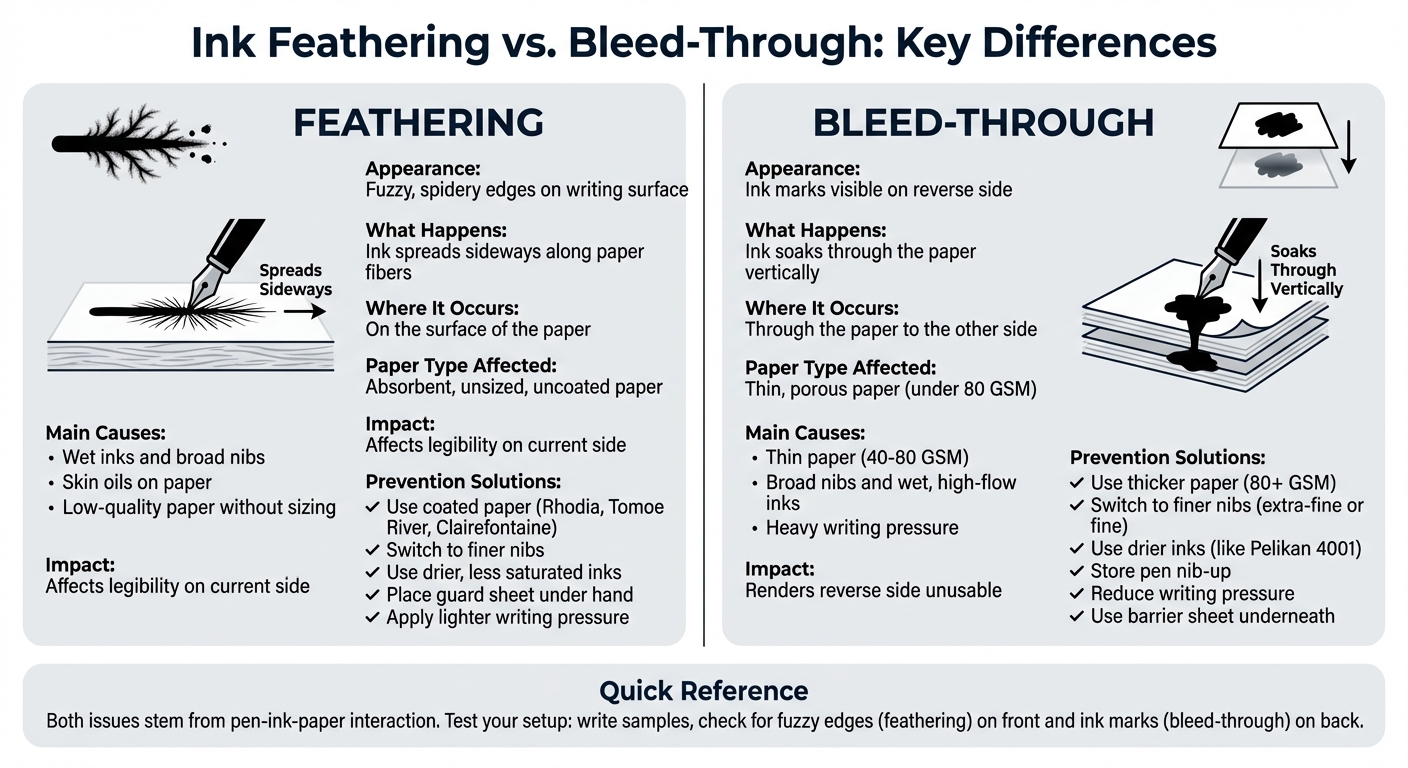
Ink Feathering vs Bleed-Through: Visual Comparison Guide
When 📓paper gets 😠unfriendly to ✒️fountain pens
sbb-itb-1dd4fe9
What Is Ink Bleed-Through?
Ink bleed-through happens when ink seeps entirely through the paper, showing up on the other side as noticeable marks or spots rather than a faint shadow. This often makes the reverse side unusable for writing.
This issue frequently arises when jotting down notes in journals or notebooks, wasting valuable writing space. In more severe cases, the ink might even transfer onto the next sheet or stain the surface underneath. Several factors can lead to this problem.
Causes of Ink Bleed-Through
A few key factors contribute to ink bleed-through:
- Paper quality makes a big difference. Thin or unsized paper, like standard copy paper (40–80 GSM), tends to absorb ink deeply, leading to bleed-through. Even premium options, such as Tomoe River paper (available in 52 GSM or 68 GSM), may not be entirely resistant when too much ink is applied.
- The pen and ink combination matters too. Broad nibs and wet, high-flow inks deposit more ink onto the paper compared to fine nibs or drier ink formulations, such as Pelikan 4001.
- Writing pressure can also play a role. Pressing down hard forces extra ink into the paper, increasing the likelihood of localized bleeding. Fountain pens, which rely on capillary action for ink flow, don’t require the heavy pressure often associated with ballpoint pens.
What Is Feathering?
Feathering happens when ink spreads sideways along the fibers of paper, creating blurred or fuzzy edges. Ferris Wheel Press explains it well:
Feathering is when your crisp lines grow fuzzy edges, as if your letters have decided to put on a frilly coat.
This effect can make handwriting look spidery or smudged, ruining the sharpness and clarity of your work. Fine details lose their sharpness, and letters may appear thicker than intended - a real frustration for precise or formal writing.
Unlike bleed-through, where ink seeps through to the other side of the paper, feathering spreads outward. As John Bosley explains, this happens because absorbent paper fibers pull the ink laterally. Let’s break down why feathering happens.
Causes of Feathering
Feathering is most common on papers that are unsized and loosely woven - think newspaper, cheap printer paper, or paper towels. These types of paper don’t have a "surface sizing" treatment, which is a coating that helps keep ink from spreading. Without it, ink travels beyond the intended lines.
Certain factors make feathering worse:
- Wet inks and broad nibs: These deposit more ink, increasing the chance of spreading.
- Skin oils: Transferred oils can disrupt how ink interacts with the paper.
- Low-quality paper: Papers without sizing are particularly prone to feathering, as they absorb ink too quickly.
Understanding these causes can help you choose the right combination of paper, ink, and pen to avoid feathering.
Bleed-Through vs. Feathering: Key Differences
Both of these issues can interrupt your writing experience, but they aren't the same thing. Feathering happens on the surface of the paper, where the ink spreads out along the fibers, creating a fuzzy, branched effect. Bleed-through, on the other hand, occurs when ink soaks all the way through the paper, making the reverse side unusable.
Why does this distinction matter? Because fixing one issue often requires a completely different approach than fixing the other. Feathering is mostly tied to the paper's surface treatment - things like sizing or coating play a big role. Bleed-through, however, is more about the paper's thickness and density. Ferris Wheel Press cleverly explains it like this:
"A little show-through is normal (that's called ghosting), but bleedthrough is the rude cousin who arrives uninvited and stays too long." – Ferris Wheel Press
Knowing which problem you're dealing with is the first step to finding the right solution. Here's a quick comparison to make things clearer:
Comparison Table
| Dimension | Feathering | Bleed-Through |
|---|---|---|
| Visual Appearance | Fuzzy edges with branching lines | Ink marks visible on the reverse side |
| Primary Cause | Capillary action along absorbent fibers | Ink soaking through the paper |
| Paper Impact | Unsized or uncoated paper | Thin, porous paper |
| Ink Impact | Wet inks spread more easily | Wet, saturated inks penetrate deeper |
| Nib Impact | Broad, wet nibs deposit more ink | Broad nibs and wet feeds increase seepage |
| Severity | Affects legibility on the current side | Renders the reverse side unusable |
How to Fix Ink Bleed-Through
If you're dealing with ink bleed-through, there are several practical steps you can take to minimize or eliminate the issue:
Upgrade your paper. The thickness of your paper makes a big difference. Aim for paper with a GSM (grams per square meter) of at least 80. For instance, Rhodia pads (80 GSM) cost about $14.50 for 80 sheets, while Clairefontaine paper (90 GSM) is around $9.00 for 50 sheets. For heavier-duty needs, HP Premium Laser Paper (32 lb, roughly 120 GSM) offers excellent bleed-through protection at approximately $19.99 for a 500-sheet ream. If you prefer lightweight paper, Tomoe River paper (52 GSM) has a special coating that resists bleeding, though you might notice some ghosting.
Another factor to consider is your pen's nib. Switch to a finer nib. Finer nibs, like extra-fine or fine, release less ink, which helps reduce absorption. As Picky Pens explains:
By design, a medium, broad or double-broad nib will always be a wetter writer than an extra-fine, fine or fine-medium nib as more ink is required for the larger font.
If you're stuck with a broader nib, try writing with the pen upside down to limit ink flow.
Pay attention to your ink. The type of ink you're using can also play a role in bleed-through. Wet or heavily saturated inks tend to seep through paper fibers more quickly. Ferris Wheel Press highlights this issue:
If an ink is particularly wet or heavily saturated, it will be less forgiving on everyday paper. A different ink can transform the same pen and paper combination.
Before committing to a full writing session, test new inks on a spare sheet to see how they perform.
Finally, a couple of habits can help prevent bleed-through: store your pen nib-up to prevent ink from pooling in the feed and avoid pressing down too hard while writing, as extra pressure forces more ink onto the page. If you're using thinner paper that can't be replaced, place a barrier sheet underneath your writing page to protect the sheets below.
How to Fix Feathering
Feathering happens when ink spreads out and creates blurred lines instead of sharp edges. Thankfully, there are a few ways to tackle this problem and achieve cleaner results.
Start with the right paper. The quality of your paper plays a huge role in preventing feathering. Look for options like Rhodia Dot Pad ($5.69–$6.95), Tomoe River A4 paper ($12.50–$20.00), or Apica Premium CD Notebook ($11.00–$15.20). These papers are treated with surface sizing - materials like starch or rosin - that keep ink from soaking into the fibers. As Strathmore Artist Papers explains:
The best way to avoid feathering and get the crisp, clean lines you're looking for is to start with quality materials and use the proper surface for your mediums.
Check your nib size. A finer nib and lighter pressure can make all the difference. Large, wet nibs lay down more ink, which increases the chance of feathering. Switching to a fine nib can often resolve the issue, especially on more absorbent paper. If you are looking for a new pen with a reliable nib, consider some of the best fountain pens for beginners. Remember, fountain pens work best with a gentle touch - pressing too hard pushes extra ink into the paper fibers, worsening the problem.
Experiment with ink. Not all inks behave the same. Wet, highly saturated inks tend to feather more because they flow easily into the paper. A drier ink, such as Noodler's Black, can change how your pen performs. Ferris Wheel Press highlights this:
If an ink is particularly wet or heavily saturated, it will be less forgiving on everyday paper. A different ink can transform the same pen and paper combination.
Before starting an important project, test your ink on the paper you plan to use. This simple step can save you from unexpected feathering.
Protect your paper from skin oils. Oils from your hands can transfer onto the paper, creating spots where ink feathers more easily. To avoid this, place a scrap sheet of paper under your hand while you write. It’s a small precaution that can prevent smudges and ruined pages.
The Role of Paper in Preventing Both Issues
When it comes to avoiding ink-related problems like bleed-through and feathering, the paper you choose is just as important as the ink itself. As Ferris Wheel Press aptly states:
"The right paper doesn't merely hold ink - it hosts it."
The secret lies in a process called sizing, which controls how much ink the paper absorbs. High-quality fountain pen papers rely on surface sizing to keep the ink sitting on top of the paper fibers instead of soaking in. For instance, Tomoe River paper (52 g/m²) is known for its excellent surface treatment, which effectively resists bleed-through. While paper weight can reduce show-through (or ghosting), it's the coating that truly prevents ink from bleeding or spreading.
Other premium papers, like Clairefontaine (90 g/m²) and Rhodia (80 g/m²), also use surface sizing to combat ink issues. These papers feature coated surfaces that allow ink to pool and dry on top, preserving the shading and sheen that make fountain pen inks so visually appealing. This highlights the importance of pairing your pen and ink with the right paper for the best results.
Here’s a helpful tip: keep a sheet of reliable paper, such as Rhodia or Clairefontaine, as a "control" to figure out whether any writing problems are caused by your pen, ink, or the paper. This simple step ensures that your entire setup - pen, ink, and paper - works in harmony for a smooth writing experience. And don’t forget, even the best paper can struggle with oils from your skin. Using a guard sheet under your hand can protect the surface and prevent random feathering spots.
Testing Your Fountain Pen Setup
Figuring out if your pen, ink, and paper work well together is simple. Start by writing three samples on the front of a sheet: your usual handwriting, quick loops, and a heavy scribble block to see how the ink behaves. Use your normal writing pressure for accurate results.
Once you've written your samples, take a closer look at how the paper handles the ink. Check the front for any feathering - those fuzzy, spidery edges where the ink spreads. Then flip the page to see if there's ghosting (light ink showing through) or actual bleed-through (where ink soaks through the paper).
To test how quickly the ink dries, write a word and gently drag your finger across it at 5-second intervals. Keep track of when the smudging stops. Remember, drying times vary depending on the ink (some, like Noodler's X-Feather Black, are specifically formulated to resist spreading), so adjust your expectations based on what works best for your needs. Decide what matters most to you: sharp lines, minimal bleed-through, or faster drying times. Jot down your findings on a dedicated testing page to help fine-tune your pen, ink, and paper combo.
This process ensures your setup reduces both feathering and bleed-through effectively.
Conclusion
Knowing the difference between bleed-through and feathering can make a big difference in your fountain pen experience. Bleed-through happens when ink soaks vertically through the paper to the other side, while feathering occurs when ink spreads sideways along the paper fibers, causing fuzzy, uneven edges.
These issues arise from how your pen, ink, and paper interact, but the fixes are straightforward. To tackle bleed-through, opt for thicker paper and use a finer nib that releases less ink. For feathering, go for coated or smoother paper that resists ink absorption. Using a lighter hand while writing can help with both problems, as pressing harder pushes more ink into the paper fibers. Making these simple adjustments not only solves common writing problems but also improves your overall setup.
"Finding combinations of pen, ink, and paper that not only don't write poorly but also work exceptionally well is part of the fun!" - John Bosley, Fountain Pen Love
Experimenting is key to finding what works best for you. Test different setups and review how they perform. If you're ready to dive in, Fountain Pen Revolution offers starter sets starting at $35.00 and premium pens from $44.00, making it easy to explore various options without breaking the bank.
The right combination of tools can completely transform your writing experience. Start with better paper, adjust your writing pressure, and try different nibs or inks until you discover the setup that feels just right.
FAQs
How can I tell bleed-through from ghosting?
Bleed-through occurs when ink penetrates the paper, leaving dark, noticeable marks on the other side. Ghosting, on the other hand, appears as a faint, shadowy imprint on the reverse side, caused by thin paper, but without the ink fully soaking through. Bleed-through stands out more and is harder to ignore, while ghosting is less obvious. Opting for thicker, high-quality paper can reduce both problems.
Why does my ink feather only in certain spots?
Ink feathering in specific spots often happens due to the paper's absorbency, the ink's characteristics, or an overly generous ink flow from the pen. If the paper absorbs ink too quickly or the ink is particularly wet, feathering may stand out more in certain areas. To reduce this, consider switching to less absorbent paper or tweaking your pen's ink flow.
What’s the fastest way to test a pen-ink-paper combo?
The fastest way to check if your pen, ink, and paper work well together is to jot down a few lines or sketch a small design on the paper you intend to use. Let the ink dry for a moment, then look for signs of feathering, bleed-through, or ghosting. This quick test ensures your materials are compatible before diving into bigger writing or drawing tasks.