

Gold nibs are often seen as a luxury upgrade for calligraphy, offering flexibility, smooth writing, and corrosion resistance. However, they come with a high price tag and require careful handling. Here's what you need to know:
- Flexibility: Gold nibs provide better line variation due to their softer material, ideal for scripts like Copperplate or Spencerian.
- Smoothness: Perceived as smoother than steel, though polishing quality matters more than material.
- Durability: Gold resists corrosion well but is more delicate under pressure compared to steel.
- Cost: Prices range from $175 to over $300, far exceeding steel nibs, which often cost under $30.
Who should buy gold nibs? Advanced calligraphers who value expressive line variation and write often with traditional inks. Beginners may find steel nibs more practical and forgiving. Starting with a beginner-friendly calligraphy set is often the most cost-effective way to learn.
| Feature | Gold Nibs | Steel Nibs |
|---|---|---|
| Flexibility | Soft, allows line variation | Rigid, less expressive |
| Smoothness | Often smoother, responsive | Can match smoothness if polished |
| Durability | Corrosion-resistant, delicate | Tougher but prone to rust |
| Cost | $175–$300+ | Under $30 |
Gold nibs are an investment for serious calligraphers. If you're just starting out, steel nibs are a better choice. Upgrade only when your skills and needs justify the expense.
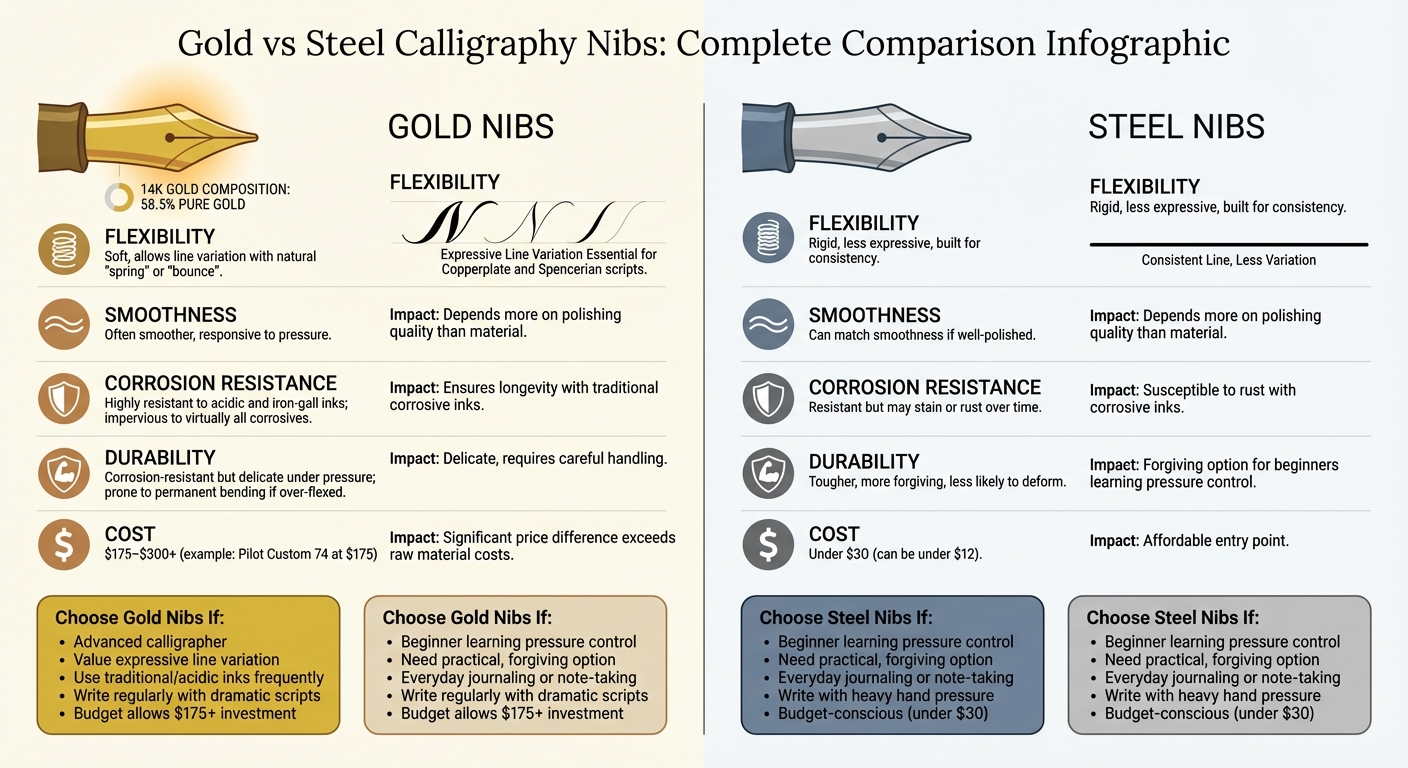
Gold vs Steel Calligraphy Nibs: Complete Comparison Guide
The Truth About Gold Nibs: Are They REALLY Better Than Steel?
sbb-itb-1dd4fe9
Common Issues with Steel Nibs for Calligraphy
Steel nibs are reliable for everyday writing, but they often struggle to meet the demands of calligraphy, especially when it comes to expressive line variation. Their rigidity is the main culprit. Unlike gold nibs, steel lacks the natural "spring" or "bounce" that allows for smooth transitions between thick and thin strokes - an essential feature for scripts like Copperplate or Spencerian.
Modern steel nibs are built for consistency, which makes them great for beginners. However, this same consistency limits their flexibility, which is crucial for advanced calligraphy. As nib expert Richard Binder explains:
"Modern nib manufacturers do not make steel nibs that are truly flexible"
This stiffness can also make extended creative sessions challenging. Trying to force line variation on a steel nib can lead to permanent damage, known as "springing", because steel lacks the elastic memory found in gold alloys.
Historically, steel nibs offered more flexibility, but modern designs focus on durability over artistic expression. While there are specialty steel nibs designed to emulate the flexibility of gold, these are rare and not widely available. For most calligraphers, standard steel nibs simply don't deliver the responsiveness needed for more advanced techniques.
Understanding these limitations highlights why many calligraphers turn to gold nibs, often upgrading to 14k gold nibs for their superior performance, which we'll explore next to see how they address these challenges.
Gold Nibs vs. Steel Nibs: How Material Affects Performance
The choice between gold and steel nibs can significantly influence your writing experience. Gold nibs are naturally softer and more pliable, which gives them a "springy" or cushioned feel. This quality allows the nib to absorb pressure and adapt slightly to your hand movements, creating a more dynamic writing experience. On the other hand, steel nibs are firm and rigid, offering consistent lines and a noticeable tactile feedback as you write.
One major distinction lies in flexibility. Gold's softness allows the nib's tines to spread more easily under pressure, which enhances line variation - something especially valued in calligraphy. However, not all gold nibs are inherently flexible. Many modern gold nibs are designed to be relatively stiff, suitable for everyday writing rather than decorative strokes. Achieving true flexibility requires specific design features, such as longer tines or a thinner nib profile.
Durability also plays a key role in the comparison. Gold is highly resistant to corrosion, making it an excellent choice for use with traditional iron-gall or acidic calligraphy inks. As nib expert Richard Binder explains:
"Gold is impervious to virtually all corrosives - only hot chlorine bleach and a few rare acids can touch it".
While stainless steel nibs resist corrosion reasonably well, they are more susceptible to staining or rusting over time.
Another factor to consider is pressure tolerance. Gold nibs, due to their softness, are more delicate and can be permanently bent if subjected to excessive force. Interestingly, 14k gold, which is 58.5% pure, is often preferred over 18k gold (75% pure) for its balance of flexibility and resilience. This composition allows the nib to return to its original shape more effectively. In contrast, steel nibs are sturdier and more forgiving, making them a practical option for beginners who might apply too much pressure.
Comparison Table: Gold Nibs vs. Steel Nibs
| Property | Gold Nibs | Steel Nibs | Impact on Calligraphy |
|---|---|---|---|
| Flexibility | Naturally softer; offers "spring" or "bounce" | Generally rigid and firm | Enables expressive line variation |
| Smoothness | Often perceived as smoother due to responsive pressure | Can be equally smooth when well-polished | Supports fluid, fatigue-free writing |
| Corrosion Resistance | Highly resistant to acidic and iron-gall inks | Resistant but may stain or rust over time | Ensures longevity with corrosive inks |
| Durability | More delicate; prone to permanent damage if over-flexed | Robust and less likely to deform | Steel offers a forgiving option for pressure control |
Benefits of Gold Nibs for Calligraphy
Gold nibs stand out for their ability to provide superior line variation, thanks to their natural softness. This softness allows the nib's tines to spread more easily under pressure, creating the dramatic contrast between bold downstrokes and fine hairlines that traditional calligraphic scripts demand. A great example of this is the Fountain Pen Revolution 14k Gold Ultra Flex nib, which delivers an impressive flex range of 2.5–3 mm and hairlines as thin as 0.4–0.5 mm.
The springy quality of gold further adds to the writing experience, offering a sense of responsiveness and control. As The Hamilton Pen Company puts it:
"The malleability of gold... provides a pliable feel and more bounce and flex during use as opposed to steel which is more commonly stiffer".
Another advantage of gold nibs is their resistance to corrosion, a critical factor when using traditional inks like iron-gall, which are known for their acidic properties. Gold is highly resistant to corrosive elements, withstanding nearly all substances except for hot chlorine bleach and a few rare acids, ensuring durability over time.
Additionally, the softness of gold allows the nib to adapt to a writer's unique handwriting style over time, adding a personal touch to the writing experience. The 14k gold alloy, containing about 58.5% pure gold, strikes a balance between flexibility for expressive strokes and resilience to maintain its shape even after repeated flexing.
While these advantages are compelling, it's important to weigh them against factors like cost and durability, which will be discussed in the next section.
Downsides and Costs of Gold Nibs
One of the biggest hurdles to owning a gold-nib pen is the price. For example, a Pilot Custom 74 with a gold nib costs around $175, while a steel-nib pen can be purchased for less than $12. That steep price difference far exceeds the cost of the raw materials alone.
Another issue is the misunderstanding surrounding gold nibs' performance and upkeep. Many assume gold nibs are inherently smoother than steel, but smoothness actually depends on the quality of the iridium tip and how well it's ground. As Gary Lehrer, a fountain pen expert and owner of GoPens.com, points out:
"I can say from experience that neither gold or non-gold nibs have the edge on smoothness".
In fact, a well-polished steel nib can deliver a writing experience that feels just as smooth as gold.
Gold flex nibs, such as the FPR 14k Gold Ultra Flex, come with their own set of challenges. These nibs tend to write wet, which can lead to ink pooling. They often require slower writing speeds, drier inks, and an ebonite feed to perform optimally. Additionally, maintaining the fine, needlepoint hairlines they produce may involve professional regrinding from time to time.
However, gold nibs do have a notable advantage when it comes to repairs. If a gold nib gets bent or suffers damage like a chipped tip, it can often be restored by a professional, which adds to its long-term value. When considering gold nibs, it's essential to weigh these factors - higher costs, maintenance needs, and repairability - before making an investment.
Pricing Table: Fountain Pen Revolution Gold Nib Options
| Plan Name (Nib/Unit Type) | Starting Price (USD) | Nib Material | Suitability for Calligraphy |
|---|---|---|---|
| FPR #5.5 14k Gold (Fine/Medium) | $225 | 14k Solid Gold | Beginners |
| FPR #5.5 14k Gold Ultra Flex | $245 | 14k Solid Gold | Experts |
| FPR #6 14k Gold (Fine/Medium/Flex) | $260 | 14k Solid Gold | Beginners to Intermediate |
| FPR #6 14k Gold Ultra Flex | $275 | 14k Solid Gold | Experts |
| FPR-FNF 14k Gold #6 Ultra Flex Unit | $315 | 14k Solid Gold | Experts (Custom Builds) |
Deciding If Gold Nibs Are Right for You
When deciding whether gold nibs are the right choice, consider your skill level, how often you practice, your budget, and your calligraphy style. These factors will help you find a nib that complements both your technique and artistic vision.
For beginners, starting with a quality steel nib is a smart move. Steel nibs are more forgiving as you learn to control pressure, and they’re less likely to bend if you press too hard. As Frank puts it:
"I'd recommend starting with a fine or extra-fine nib to achieve noticeable line variance without stressing the nib".
Once you’ve gained confidence and mastered the basics, you might want to explore gold nibs for their ability to create more expressive line variations.
Your calligraphy style also plays a big role. If you’re crafting dramatic scripts with bold thick-and-thin strokes, gold nibs offer the flexibility and control needed for such artistry. On the other hand, for everyday journaling or note-taking, steel nibs are more practical due to their consistent performance and durability. If you tend to write with a heavy hand, steel remains the better option regardless of your skill level - it’s simply tougher and less prone to damage.
Lastly, think about your budget. Gold nibs are a worthwhile investment only if calligraphy is a regular and serious part of your routine.
Conclusion
Gold vs steel nibs each bring distinct perks to the world of calligraphy - they're flexible, resist corrosion, and gradually adjust to your writing style. The "springy" quality of 14k gold makes it a favorite for achieving expressive line variation, a feature many calligraphers appreciate. However, these advantages come with a higher price tag, and gold nibs may not suit everyone.
As Gary Lehrer from GoPens.com puts it:
"There's really no one-size-fits-all approach to choosing your nib material. It all depends on your preference and your vision of how your pen should write".
Interestingly, the smoothness of a nib often depends more on its polishing and tuning than the material itself. Many gold nibs today are quite rigid unless specifically engineered for flex, so it’s important not to assume that any gold nib will automatically deliver dramatic line variation.
If gold nibs align with your artistic goals and budget, Fountain Pen Revolution provides a range of 14k gold nibs, offering options from beginner-friendly fine points to ultra-flex nibs for advanced techniques.
Ultimately, the "best" nib is the one that suits your skill level, writing style, and calligraphy aspirations. Begin with what feels right for your needs, and upgrade when your practice and passion call for it. This way, your choice will reflect both your creative vision and practical priorities.
FAQs
How do I know if a gold nib is truly flexible?
A gold nib’s ability to flex largely hinges on how it’s designed and built. Genuine flexibility is usually a hallmark of nibs crafted with this feature in mind - think vintage nibs or select premium models. On the other hand, most modern gold nibs prioritize durability and uniform performance, which often makes them quite firm. If you’re aiming for a nib suited for calligraphy, focus on those explicitly labeled as flexible to ensure they deliver the performance you need.
What inks can damage steel nibs over time?
Inks containing iron gall or other corrosive components can damage steel nibs, causing rust and wear over time. To keep your nibs in good condition, make sure to clean them frequently and limit their exposure to these types of inks.
What maintenance do gold flex nibs require?
Gold flex nibs require regular cleaning to keep ink buildup at bay and ensure they remain flexible. It's important to handle them with care to protect the delicate gold surface. Stick to gentle cleaning techniques and steer clear of harsh chemicals to maintain their condition over time.