

Short answer: mostly no. If your pen has ebonite, I’d keep barrels, caps, vintage parts, sacs, and whole pens out of an ultrasonic cleaner. The only low-risk case in this article is a modern, removable ebonite feed, and even then I’d use room-temperature water and a short 1 to 2 minute cycle only for a bad clog.
Here’s the article in plain terms:
- Safe default: I’d hand-clean ebonite with cool or room-temperature water.
- Usually unsafe: raw or polished black ebonite, older hard rubber, barrels, caps, plated trim, sacs, and assembled pens.
- Possible last-resort use: modern removable ebonite feeds, and some modern sections only if fully disassembled and only for blocked ink paths.
- Main risk: water and ultrasonic action can leave ebonite dull, brown, green, gray, or blotchy. That change can be permanent.
- Time matters: even 30 to 120 seconds can be too much for the wrong part.
- Age matters: older hard rubber is more likely to discolor, crack, or flake.
My rule: if I’m not 100% sure the part is modern, removable, and sound, I skip the ultrasonic cleaner.
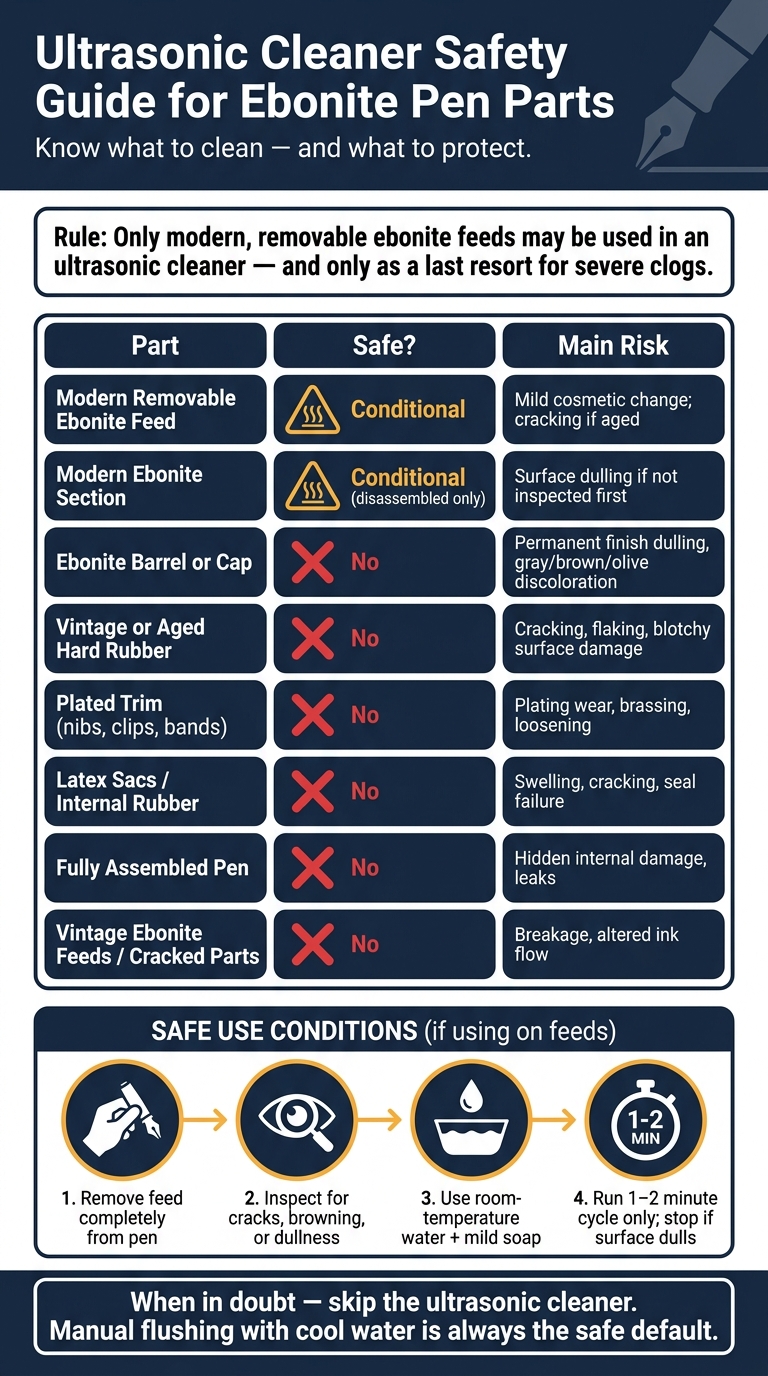
| Part | Should I use an ultrasonic cleaner? | Why |
|---|---|---|
| Modern removable ebonite feed | Maybe, rarely | Short cycle may clear a hard clog |
| Modern ebonite section | Only in limited cases | Must be disassembled and inspected first |
| Ebonite barrel or cap | No | Finish can dull or discolor |
| Vintage hard rubber part | No | More prone to cracking and surface damage |
| Plated trim | No | Plating can wear or loosen |
| Latex sac or internal rubber | No | Can swell, crack, or fail |
| Fully assembled pen | No | Hidden damage risk |
So if you want the shortest possible takeaway, it’s this: ultrasonic cleaning and ebonite usually do not mix.
Ultrasonic Cleaner Safety Guide for Ebonite Pen Parts
Using an Ultrasonic Cleaner with Your Pens | FP Basics
sbb-itb-1dd4fe9
When Ultrasonic Cleaning Works for Ebonite Pen Parts
For modern pens, ultrasonic cleaning has a very narrow use case here: removable feeds. Even then, it’s best saved for rare blockage problems, not routine cleaning.
Removable Modern Ebonite Feeds
Modern ebonite feeds are the safest ebonite parts to put in an ultrasonic cleaner, but only after you fully remove them from the pen. Before the feed goes into the bath, check it closely under good light. If you see cracks, chips, browning, chalkiness, or a dull surface, don’t use ultrasonics on it.
If the feed looks sound, use room-temperature water with a drop of mild soap. Put the feed in a basket or holder so it doesn’t rest on the tank bottom. Run a short cycle for 1 to 2 minutes, then stop and inspect the surface again. If it looks duller or more matte than it did before, stop there and switch to manual cleaning and maintenance from that point on.
Modern Ebonite Sections in Careful Cases
Sections are trickier. They’re larger, more exposed, and harder to inspect well, so the margin for error is smaller.
Use ultrasonic cleaning on modern ebonite sections only when dried ink has built up inside the internal channels and repeated flushing still hasn’t cleared it.
The section must be fully separated from the barrel, cap, sac, and any converter before it goes near the bath. It also needs to be modern ebonite, not vintage hard rubber, and it should have no visible cracks, deep browning, or oxidation. Keep the cycle short, around 30 to 120 seconds, in room-temperature water. Stop at once if you notice any dulling or color shift. Even under those conditions, ultrasonic cleaning should stay a last-resort option for severe internal clogs.
When Ultrasonic Cleaning Does Not Work for Ebonite Pens
Outside the small safe exceptions above, the no-go list is pretty clear: barrels, caps, aged hard rubber, sacs, and fully assembled pens should stay out. Put simply, only the narrow removable-part cases belong in the cleaner.
Raw or Polished Ebonite Barrels and Caps
Do not put ebonite barrels or caps in an ultrasonic cleaner. Black ebonite can discolor fast, and that change is often permanent. Surface sulfates can also dull the shine and stain the finish.
And age only makes that risk worse.
Vintage or Aged Hard Rubber Parts
Vintage hard rubber that is brittle, chalky, or already discolored should not go into an ultrasonic cleaner. Older material is more likely to crack or suffer surface damage.
Plated Trim and Non-Removable or Aged Feeds
Hidden parts come with their own set of problems. Plated trim and non-removable or aged feeds should also stay out of the bath. Ultrasonic vibration can loosen weak plating, and older feeds are usually better cleaned by hand using a fountain pen cleaning kit unless they fall under the narrow safe case already covered above.
Assembled Pens, Sacs, and Internal Parts
Do not clean a fully assembled pen in an ultrasonic bath. Take the section out first, and keep sacs, converters, and other internal rubber parts out of the water.
Which Parts Carry the Most Risk
Not every part faces the same level of danger. This risk map helps separate clear no-go parts from the small group of components that might handle very limited ultrasonic cleaning.
| Part | Ultrasonic Safe? | Main Risk | Recommended Practice |
|---|---|---|---|
| Raw ebonite barrels/caps | No | Rapid oxidation, color shift to gray/brown/olive | Avoid ultrasound; clean gently by hand and keep moisture exposure minimal |
| Polished hard rubber barrels/caps | No | Loss of gloss, irreversible dulling, faded imprints | Do not ultrasonically clean; use mild surface cleaning only |
| Aged/oxidized hard rubber surfaces | No | Severe blotchy discoloration, material loss | Keep out of the tank; restore by hand |
| Latex sacs and internal rubber parts | No | Swelling, cracking, loss of sealing ability | Remove and replace rather than clean; clean housings by hand |
| Plated nibs, clips, cap bands | No | Plating wear, brassing, loosening of trim | Prefer manual cleaning; if ultrasound is used, keep cycles very short |
| Modern removable ebonite feeds | Conditional | Mild cosmetic change, cracking if already aged | Brief, gentle cycles only for severe clogs; otherwise flush manually |
| Vintage ebonite feeds and cracked parts | No | Breakage, flaking, altered ink flow | Avoid ultrasound; rely on soaking and careful flushing with a dedicated pen flush |
| Non-removable or aged internal parts | No | Hidden internal damage, leaks, misalignment | Disassemble first; only known-safe solid parts in the tank |
The parts with the most danger are the ones with exposed finish, thin plating, or rubber hidden inside.
Raw Ebonite, Polished Hard Rubber, and Aged Surfaces
These surfaces face the biggest cosmetic danger. A short ultrasonic cycle can do permanent damage to the finish. A glossy black barrel may come out matte, gray, or olive-toned after just one brief pass, and restorers note that getting the shine back usually means abrasive polishing. That can remove material and weaken or erase imprints.
Older or already-discolored hard rubber is even touchier. Ultrasonic action can lift oxidized layers unevenly, which leaves a blotchy finish that may not be fixable.
Plated Trim, Sacs, and Internal Rubber Components
Thin plating on nibs, clips, and cap bands can wear down in an ultrasonic cleaner. The cavitation hits the surface over and over, slowly stripping plating and exposing the base metal underneath. On lightly plated nibs, brassing may show up around the breather hole or slit. Clips can also loosen at press-fit points.
Latex sacs and other rubber parts inside the pen bring a different kind of trouble. They may swell, crack, or fail after ultrasonic exposure, and the damage might not show up right away. Later, it can turn into leaks or a filling system that no longer works.
Feeds and Other Small Components
Feeds sit at the low end of the ebonite risk scale only when they're modern, removable, and fully intact. Even then, manual flushing is still the safer default.
Vintage feeds, along with any part that's already cracked or brittle, should stay out of the tank. Cavitation can widen cracks, snap fins, and change ink flow in ways that are hard to spot until the pen is back together. Even tiny non-ebonite parts, like thin spacers, can shift or loosen if they were already a little weak before cleaning.
Conclusion: The Safe Default for Ebonite Pen Cleaning
The rule is pretty simple: save ultrasonic cleaning for removable modern feeds. And only use it on modern ebonite sections if the maker clearly says it's safe. Keep ultrasonic cleaners away from ebonite barrels, caps, whole pens, vintage hard rubber, rubber sacs, and plated trim.
The risk isn't small, and it doesn't take long. A polished hard rubber surface can turn matte or blotchy in one short cycle, and that change may be permanent. Age makes the problem worse. Older hard rubber tends to be more brittle and more exposed to damage from vibration and heat.
Manual flushing is the safe default. For routine cleaning, use cool water and repeat the rinse cycle as needed. So if you're cleaning a modern ebonite pen from Fountain Pen Revolution, remove the feed, clean that part separately with water, and leave the barrel and cap out of the ultrasonic cleaner.
When you're unsure, skip the ultrasonic cleaner. In most cases, the risk just isn't worth the result.
FAQs
How can I tell if my pen part is ebonite or hard rubber?
Ebonite, also known as hard rubber, usually feels smooth, a bit warm to the touch, and less cold than metal or many plastics. It often shows up in glossy black, orange, or red.
Older hard rubber tends to look more dull, matte, or slightly rough. In many cases, it also develops a brownish or greenish oxidation film over time. On vintage parts, engraved “chasing” patterns are common. If you look closely, you may also spot lathe-machined marks instead of the smoother finish you’d expect from injection-molded plastic.
What should I try before using an ultrasonic cleaner on a clogged feed?
Before you use an ultrasonic cleaner, start with the basics. Flush the feed with a bulb syringe and room-temperature water until the water runs clear. If that doesn’t do the trick, soak the front section in room-temperature water for a few hours.
If the ink is still stuck, take the nib and feed apart and gently clean the grooves with a soft-bristled toothbrush. Save the ultrasonic cleaner for after you’ve tried these standard cleaning steps.
Can oxidation or dulling on ebonite be reversed after ultrasonic cleaning?
No. Ultrasonic cleaning cannot reverse oxidation or dulling on ebonite.
Oxidation is a chemical change caused by light, heat, and moisture. An ultrasonic cleaner can remove surface debris and dried ink, but it can't bring back the original color. To fix oxidation, you need to remove the damaged outer layer through polishing or a professional chemical treatment.