

Fountain pen journaling offers a smoother, more comfortable writing experience compared to ballpoint pens. These pens use capillary action for effortless ink flow, reducing hand strain during long sessions. They also allow for creative expression with a variety of ink colors, shading, and sheen. Plus, their refillable design makes them a sustainable choice.
Here’s what you’ll learn:
- How to choose the right fountain pen based on nib size, weight, and filling systems.
- Tips for selecting inks and paper to avoid smudging, feathering, and bleed-through.
- Writing techniques for better comfort and handwriting improvement.
- Maintenance tips to keep your pen in excellent working condition.
Whether you're a beginner or seasoned writer, this guide covers everything to help you enjoy the art of fountain pen journaling.
How to Choose a Fountain Pen for Journaling
Key Features to Consider
When selecting a fountain pen for journaling, nib size is a crucial factor. Fine nibs are ideal for compact handwriting and everyday notes, offering precision and control. Medium nibs strike a balance, providing smooth lines while showcasing ink characteristics like shading and sheen. Broad nibs, on the other hand, create bold, expressive strokes but may require high-quality paper to avoid feathering.
The weight of the pen also plays a significant role in comfort. Lighter pens are better suited for extended writing sessions as they reduce hand fatigue. Heavier pens, while offering more stability, are often preferred for shorter tasks like signing documents. Additionally, a wider barrel can make the pen easier to grip and reduce hand strain, though this largely depends on the size of your hand.
Consider the filling mechanism as it impacts both convenience and long-term cost. Cartridges are easy to use and great for travel but tend to be more expensive over time. Piston systems, with their built-in ink reservoirs, hold more ink and are straightforward to maintain. Converters allow you to use bottled ink, offering a wider range of colors, though they require more frequent cleaning.
The material of the nib affects both the writing experience and the price. Steel nibs are durable and budget-friendly. Gold nibs, typically available in 14k, 18k, or 21k, provide a softer, springier feel, absorbing minor imperfections in the paper for a smoother experience. It's also worth noting that Japanese brands like Pilot and Platinum produce nibs that write finer than their Western counterparts - so a Japanese Medium nib is comparable to a Western Fine.
By keeping these features in mind, you'll be better equipped to choose a pen that suits your journaling style and preferences. You can also use a nib size calculator to find your perfect match.
Starter Sets and Premium Options from Fountain Pen Revolution

Fountain Pen Revolution offers a range of options tailored to journaling enthusiasts. Their starter sets, starting at $35, come with a pen, ink, and essential accessories, making it easy to get started.
For those looking for something more refined, premium pens start at $44 and feature handmade designs crafted from high-quality materials. If you're seeking value, bundles starting at $29 combine pens and accessories into a cost-effective package. For a luxurious writing experience, the Gold Nib Collection showcases pens equipped with 14k gold nibs, delivering the smooth, cushioned feel that seasoned fountain pen users appreciate.
sbb-itb-1dd4fe9
Comprehensive guide to fountain pen friendly notebooks
Choosing Inks and Paper for Better Writing
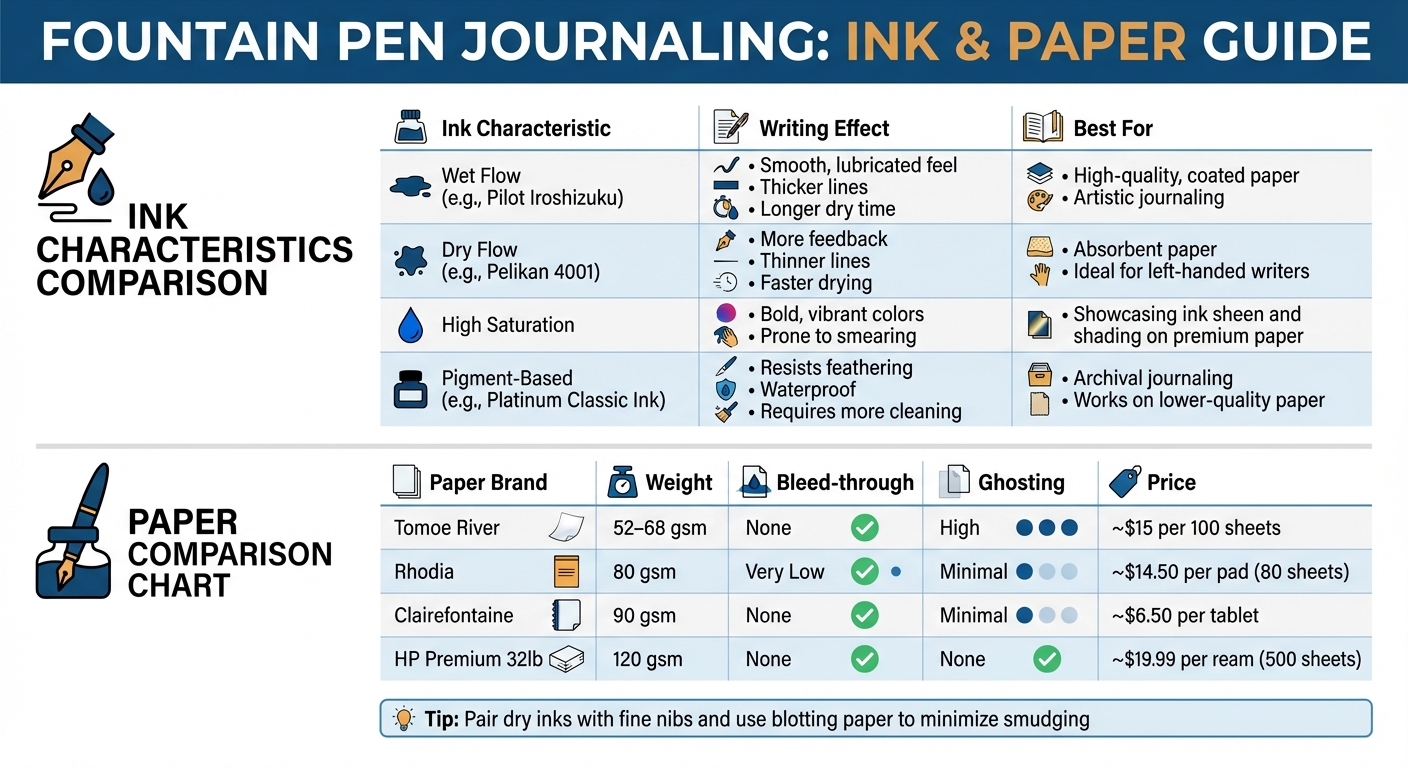
Fountain Pen Ink and Paper Comparison Guide for Journaling
Once you've selected the perfect pen, the right ink and paper can elevate your journaling experience to the next level. As Brian Goulet, Founder of The Goulet Pen Company, puts it:
There's a relationship between the fountain pen, the ink that flows through it, and the paper it's written on that will influence the overall enjoyment of your writing experience. This is both a blessing and a curse.
Finding the right combination is key to making your journaling sessions enjoyable and seamless.
What to Look for in Fountain Pen Ink
The flow of your ink matters, and choosing the right one is a key part of improving your handwriting. Wet inks, like Pilot Iroshizuku, provide smooth, well-lubricated lines, but they dry slowly and can smudge. On the other hand, dry inks, such as Pelikan 4001, dry faster and are less likely to feather.
Saturation is another factor to consider. Highly saturated inks produce bold, vibrant colors but can take longer to dry and are more prone to smearing. If this becomes an issue, you can dilute these inks with distilled water (try a 2:1 ink-to-water ratio) to speed up drying and reduce smudging.
The composition of the ink also plays a role. Most inks are dye-based, making them easier to clean but more likely to feather or bleed through lower-quality paper. For better resistance to feathering and bleed-through, pigment-based or iron gall inks, like Platinum Classic Ink, are excellent choices. However, these inks often require more frequent cleaning and maintenance.
To minimize smudging, pair "dry" inks with finer nibs, such as extra fine or fine, and use a sheet of blotting paper under your hand while writing. This simple trick absorbs excess moisture and keeps your writing clean.
Once you've chosen your ink, the next step is selecting paper that complements its properties for a smooth and enjoyable writing experience.
Best Paper Types for Fountain Pens
The type of paper you use can make or break your journaling experience. Paper absorbency is crucial - standard copy paper or Moleskine notebooks often lead to feathering and bleed-through. Opt for fountain pen–friendly papers that are coated to keep ink on the surface, preserving crisp lines and enhancing sheen and shading.
Paper weight, measured in GSM (grams per square meter), also impacts performance. Good fountain pen papers typically range from 52 gsm to 120 gsm. For example, Tomoe River paper, with its thin 52 gsm sheets, resists bleed-through remarkably well due to its coating, though it may show more ghosting. For a balance of smoothness, ink resistance, and drying times, papers like Rhodia (80 gsm) and Clairefontaine (90 gsm) are highly recommended.
If you're looking to showcase ink sheen, Tomoe River is often considered the gold standard, priced around $15 for 100 sheets. For a more economical option, HP Premium 32lb Laser Paper offers excellent performance at roughly $19.99 for a ream of 500 sheets.
Felix Jen of Inks and Pens highlights the importance of paper texture:
Fountain pens generally pair well with papers that are very smooth, as the nib will just glide over the paper.
Smooth papers like Clairefontaine allow the nib to glide effortlessly, while textured papers provide more feedback, which some writers prefer for better control. However, many fountain pen users avoid Moleskine paper due to its high absorbency, which can cause feathering and bleed-through unless paired with an extra fine nib.
Choosing the right paper not only preserves the quality of your ink but also enhances the tactile pleasure of journaling.
Ink and Paper Comparison Chart
Here’s a quick summary of key ink and paper attributes to help you make informed choices:
| Ink Characteristic | Writing Effect | Best For |
|---|---|---|
| Wet Flow | Smooth, lubricated feel; thicker lines; longer dry time | High-quality, coated paper; artistic journaling |
| Dry Flow | More feedback; thinner lines; faster drying | Absorbent paper; ideal for left-handed writers |
| High Saturation | Bold, vibrant colors; prone to smearing | Showcasing ink sheen and shading on premium paper |
| Pigment-Based | Resists feathering; waterproof; requires more cleaning | Archival journaling; works on lower-quality paper |
| Paper Brand | Weight | Bleed-through | Ghosting | Price |
|---|---|---|---|---|
| Tomoe River | 52–68 gsm | None | High | ~$15 per 100 sheets |
| Rhodia | 80 gsm | Very Low | Minimal | ~$14.50 per pad (80 sheets) |
| Clairefontaine | 90 gsm | None | Minimal | ~$6.50 per tablet |
| HP Premium 32lb | 120 gsm | None | None | ~$19.99 per ream (500 sheets) |
Writing Techniques for Fountain Pen Journaling
Once you've chosen the best fountain pens for beginners and paper, refining your writing techniques can make your journaling sessions smoother and more enjoyable. Fountain pens work differently than ballpoints - they use capillary action and gravity, so there's no need to press down hard. Instead, focus on proper grip and positioning to maximize both comfort and control.
How to Hold Your Pen and Position It Correctly
Start with the tripod grip: hold the pen between your thumb and index finger, letting the barrel rest on the side of your middle finger, just near the last knuckle. Keep your grip light and relaxed. As Brian Goulet, Founder of The Goulet Pen Company, puts it:
Writing with your pen in a so-called "death grip" is not going to give you increased poise and control over how your writing turns out. If anything, you're just fatiguing your hand faster.
Position the pen at a 40–55° angle to the paper. The nib's top (where the brand logo is often engraved) should face directly upward. Finding the "sweet spot" - where the ink flows smoothly without skipping - is essential. If the ink skips, adjust your angle slightly.
Here's a helpful tip: rotate your journal about 15–20° toward your writing arm. This small adjustment aligns the paper with your natural forearm movement, making writing feel more fluid. If your pen feels short or unbalanced, try "posting" the cap onto the back of the barrel. This can help shift the weight and improve the balance.
Exercises to Improve Your Handwriting
Once you've mastered the grip, spend time on foundational strokes to build control and precision. Dedicate about five minutes daily to warm-ups like cursive loops, circles, waves, and parallel lines. These exercises help engage your arm muscles rather than relying solely on your fingers.
Yanning Li, CEO of Scriveiner London, explains:
Effective fountain pen writing engages your entire arm. Your shoulder guides broad movements, your forearm controls letter spacing and word flow, and your fingers provide fine detail control.
Take your time with each letter, ensuring the ink keeps up with your strokes. Rushing can lead to inconsistent lines and smudging.
How to Write Longer Without Hand Strain
For extended journaling sessions, the key is zero pressure - let the pen's weight do the work. Pressing down too hard not only tires your hand but can also damage the nib over time.
Use your shoulder and forearm to guide the pen. As Wood Fountain Pens points out:
Writing with the lower arm avoids strain within the little fingers and wrist, which isn't exceptional in extended/prolonged composing sessions.
Keep your hand and wrist mostly still, allowing the larger muscles in your arm to move the pen across the page. This technique not only prevents cramping but also ensures the nib maintains its optimal angle throughout your writing.
| Technique | Benefit | How to Implement |
|---|---|---|
| Arm Movement | Reduces hand strain; keeps nib angle steady | Use your shoulder to guide pen movement |
| Relaxed Grip | Prevents fatigue and cramping | Hold the pen lightly, about 2–3 cm from the nib |
| Correct Angle | Ensures smooth ink flow | Maintain a 40–55° angle to the paper |
| Zero Pressure | Protects the nib and minimizes effort | Let the pen's weight handle the writing |
If your pen is on the heavier side, like those made from solid brass (weighing 25–35 grams), take regular breaks to rest your hand muscles. Even with a well-balanced pen, short pauses can make a big difference during long writing sessions.
How to Maintain Your Fountain Pen
Taking care of your fountain pen is key to keeping it writing smoothly and ensuring it lasts for years. Regular upkeep doesn’t just preserve its functionality - it also keeps your journaling or writing experience as enjoyable as ever. Surprisingly, you don’t need much to maintain your pen; a glass of water, a towel, and a bulb syringe (around $4.25) will handle most cleaning tasks.
Cleaning Your Pen Properly
If you use your fountain pen regularly, aim to clean it about once a month. For those who write daily, cleaning every 2–3 weeks is a good rule of thumb. And whenever you switch ink colors, always flush the pen to avoid unwanted mixtures or chemical reactions. Brian Goulet, founder of The Goulet Pen Company, puts it best:
Cleaning a fountain pen is essentially rebooting it; you'll flush out any dried ink or blockages that may have developed over time, and you'll get that ink flowing again as it was originally intended!
The process is straightforward: first, empty any leftover ink. Then, flush the pen with cold or room-temperature water until it runs clear. Finally, dry it off with a lint-free cloth. Never use hot water, though - it can warp the nib or feed.
For tougher clogs or dried ink, soak the nib section in water with a drop of mild dish soap overnight. Afterward, stand the nib down in a glass with a folded paper towel for 12–24 hours to draw out any lingering moisture. A bulb syringe can make flushing faster for pens with cartridges or converters. If you encounter stubborn residue, try a solution of one part household ammonia to two parts water. However, avoid ammonia if your pen has aluminum, brass, or copper parts - it can corrode them. And steer clear of alcohol, bleach, or acetone, as they can ruin the feed and damage certain barrels.
Once your pen is clean, proper storage ensures it stays in great condition.
How to Store Your Fountain Pen
How you store your fountain pen matters just as much as cleaning it. For daily use, keep the pen horizontal on a flat surface with the cap on. This keeps the nib moist without letting ink pool inside the cap. For short-term storage (a few days), stand the pen upright with the nib pointing up so the ink drains back into the reservoir. As Sam Di Nardo from Dayspring Pens advises:
Never store a fountain pen nib pointing down... [it] is a sure fire way to end up with a cap full of ink and a gunky nib of half-dried ink.
If you’re putting the pen away for weeks or months, empty the ink reservoir, flush the pen with clean water, and let it dry completely before storing it in a cool, dark place. Keep it away from direct sunlight and extreme temperatures - heat can cause leaks by expanding the ink, while sunlight may damage the barrel. When traveling, either fully fill or completely empty the pen, and store it upright to avoid leaks.
For added protection, consider using a pen case. Fountain Pen Revolution offers options like leather slips or zippered cases to shield your pen from scratches and damage. Proper storage ensures your pen is always ready to write when inspiration strikes.
Even with regular cleaning and careful storage, minor issues can crop up. Here’s how to handle them.
Fixing Common Fountain Pen Problems
The occasional hiccup with your fountain pen is normal, and most problems are easy to fix. If your pen skips or won’t start, dried ink in the feed is likely the culprit. A quick rinse with room-temperature water or an overnight soak should solve the issue. For scratchy writing, debris caught between the nib tines might be to blame. Use a thin brass sheet (about $4.25) to gently “floss” out any fibers. As Wood Fountain Pens explains:
Dust, paper fibers, and dried ink flakes are the primary culprits that cause poor ink flow.
If the ink flow seems off, reseat the cartridge or converter and give it a gentle squeeze to help. Leaks or drips often happen due to overfilling. After filling, let a couple of drops fall back into the ink bottle, then create a small air gap by winding the piston slightly. This helps reduce pressure in the reservoir.
Here’s a quick reference for common issues:
| Issue | Common Cause | Quick Fix |
|---|---|---|
| Pen won’t start | Dried ink in the feed | Rinse with water or soak the nib overnight |
| Skipping mid-stroke | Debris in the tines | Floss the tines with a thin brass sheet |
| Leaking/Dripping | Overfilling or air pressure | Store nib-up and leave an air gap |
| Scratchy feel | Debris or excessive pressure | Clean the nib and write with a light touch |
Remember, fountain pens require almost no pressure to write. A gentle touch not only ensures smooth ink flow but also prevents damage to the nib.
Conclusion
This guide has brought together key tips on selecting the right pen, ink, paper, and technique to make fountain pen journaling an enjoyable and rewarding experience.
Fountain pen journaling transforms writing into a thoughtful and engaging ritual. The key to success lies in combining the right tools - your pen, ink, and paper - with proper technique. Writing at the correct angle, maintaining a relaxed grip, and applying minimal pressure can make your journaling sessions both comfortable and satisfying.
What makes fountain pens truly special is their personal touch. As mentioned earlier, your handwriting is as unique as your fingerprint, making every written word deeply personal. Ink+Volt captures this beautifully:
A person's handwriting is as unique as their fingerprint. How much more meaning does something hold when it has inked words you can hold in your hands?
Over time, your pen adapts to your hand, becoming a tool that feels uniquely yours. Regular maintenance is essential to keep it performing at its best. Store your pen horizontally when using it daily, and address minor issues like skipping or scratchy nibs promptly. These small habits ensure your pen is always ready when inspiration strikes.
Adrianne from The Goulet Pen Company's Customer Care Team reminds us:
Perfection is not the goal, usefulness is. No matter if you do this first thing with a new pen and ink... find what works for you and what is fun.
Start with the basics: proper technique, quality paper, and regular care. From there, explore different inks, nib sizes, and even ink journaling to discover what brings you the most joy.
Fountain pen journaling offers a hands-on, mindful alternative to the fast-paced world of digital communication. Grab your pen, find your rhythm, and let the words flow. With these insights, you’re ready to fully embrace the art of fountain pen journaling.
FAQs
Why should I use a fountain pen for journaling instead of other types of pens?
Using a fountain pen for journaling transforms the act of writing into a more enjoyable and fluid experience. Unlike ballpoint or gel pens, fountain pens allow the ink to flow naturally with very little effort, which means less strain on your hand. This makes it easier to write for extended periods without discomfort. On top of that, you can pick from various nib sizes to create distinct line styles, adding a personal touch to your journal entries.
There’s also something special about the design and feel of a fountain pen. Its refillable ink system not only makes it a more eco-friendly option but also adds a sense of durability and longevity. Writing with a fountain pen feels deliberate, almost meditative, turning what might seem like a routine task into a thoughtful ritual. Whether you're new to journaling or have been doing it for years, a fountain pen combines style and practicality, making it a perfect companion for your writing journey.
How can I avoid ink smudging or bleeding through the paper when journaling with a fountain pen?
To avoid ink smudging or bleeding, selecting the right combination of paper, ink, and nib is key - and giving the ink enough time to dry makes all the difference. Opt for fountain pen-friendly paper, like heavyweight or low-absorbency varieties, which help keep the ink on the surface and prevent it from seeping through. Pair this with a drier ink and a fine or extra-fine nib, as these apply less ink, allowing it to dry faster and maintain sharp lines.
Also, be patient - let the ink dry for a few seconds before turning the page or closing your notebook to steer clear of smudges. Testing your specific paper, ink, and nib setup ahead of time can save you from unexpected messes and ensure your writing stays clean and easy to read.
How can I keep my fountain pen in excellent condition?
To keep your fountain pen working smoothly, regular cleaning is essential. Aim to rinse it every 4–8 weeks or whenever you change ink colors. This helps prevent clogs caused by dried ink, dust, or paper fibers. Use lukewarm water for cleaning - never hot, as high temperatures can damage the pen’s seals. For stubborn residue, a drop of mild dish soap can work wonders.
Here’s an easy cleaning routine to follow:
- Take the pen apart by removing the cartridge or converter and separating the nib and feed.
- Rinse each piece under lukewarm water until the water runs clear. If stains persist, soak the nib and feed in water for a couple of hours.
- Gently pat the parts dry with a soft paper towel, then let them air-dry completely before putting the pen back together.
Using your pen regularly - just a few lines every few days - can also help maintain ink flow and keep the nib from drying out. Always store the pen capped and, if possible, with the nib pointing up to prevent leaks. If you’re in need of supplies like nibs, cartridges, or cleaning tools, Fountain Pen Revolution offers budget-friendly options to help you keep your pen in great condition for years of effortless writing.