

Stainless steel nibs have become a popular choice for fountain pen enthusiasts due to their durability, smooth performance, and affordability. These nibs are crafted from tough steel alloys like 316L, offering impressive strength and resistance to corrosion. Unlike gold nibs, which are more expensive and flexible, stainless steel nibs deliver a firm, consistent writing experience ideal for everyday use.
Key Takeaways:
- Durability: Stainless steel nibs are harder than gold nibs, with a tensile strength of 515 MPa, making them resistant to bending and damage.
- Smooth Writing: Both steel and gold nibs use the same hard-tipped material, ensuring similar smoothness on paper.
- Cost-Effective: High-quality steel nibs cost around $25, while gold nibs can add $100–$200 to a pen's price.
- Corrosion Resistance: Modern stainless steel alloys handle fountain pen inks without rusting, a significant improvement over older steel nibs.
- Variety: Available in sizes like Fine, Medium, and Broad, as well as specialty options like Italic and Flex nibs for creative writing styles.
Steel nibs are a practical, reliable choice for writers seeking high performance without the high price tag. Their firm feel, predictable ink flow, and durability make them perfect for daily writing tasks or exploring specialty writing styles.
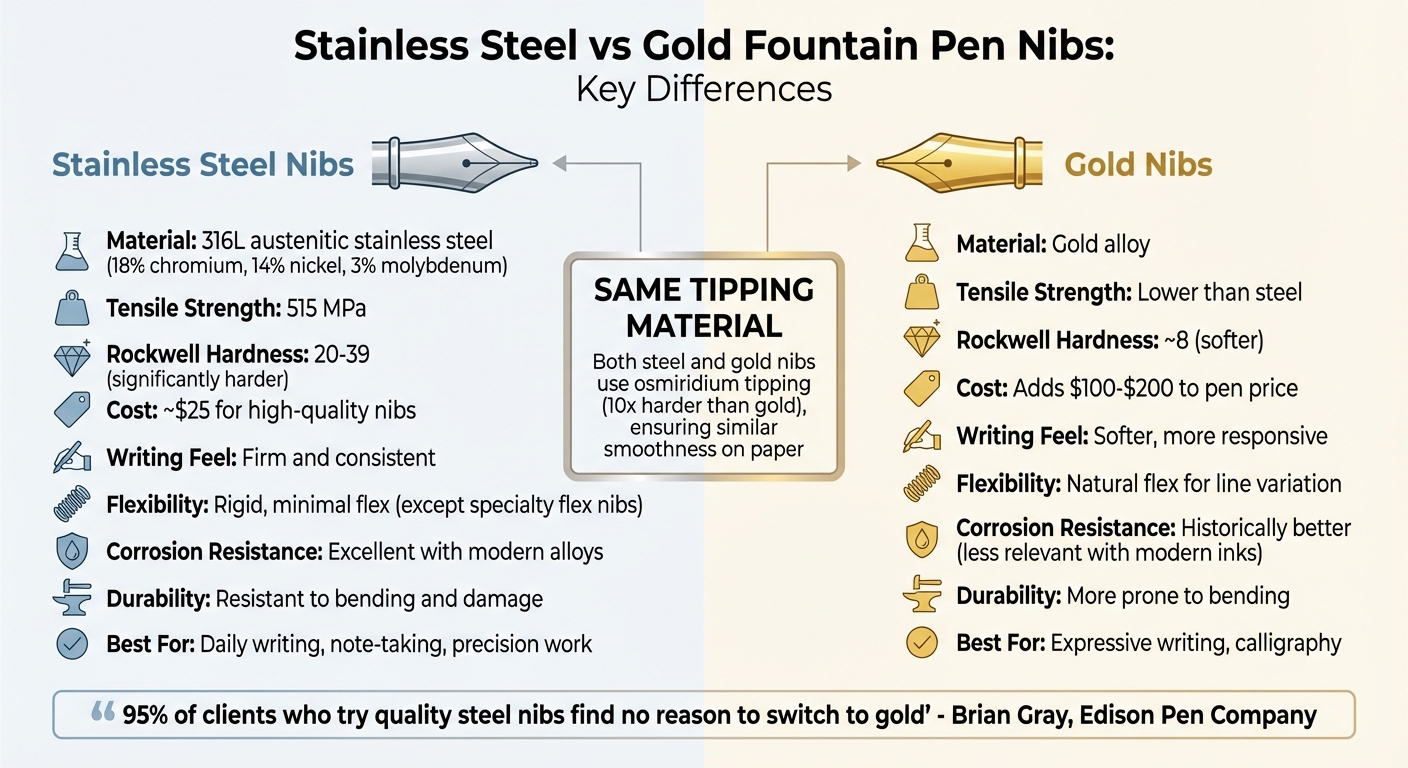
Stainless Steel vs Gold Fountain Pen Nibs Comparison
Gold VS Steel Nibs - Is It Worth The Upgrade?
How Stainless Steel Nibs Are Built
The craftsmanship behind stainless steel nibs highlights why they deliver such dependable performance. It all begins with 316L austenitic stainless steel, a material chosen for its durability and corrosion resistance. The steel is heated to 1,341°F (727°C) to create a stable crystalline structure, then quickly cooled. Afterward, it’s cold-rolled into precise strips, a process that strengthens the metal significantly - boosting its tensile strength from about 240 MPa to 760 MPa.
Next, the steel is stamped into blanks and shaped into the familiar nib form. One of the most intricate steps is tipping, where a small 1 mm bead of osmiridium is welded to the nib’s tip. This bead becomes the critical contact point with paper. Since the melting points of stainless steel (approximately 4,532°F) and osmiridium (approximately 4,450°F) are so close, the two metals fuse seamlessly, creating a durable and smooth writing surface.
After the tipping process, a precise slit is cut through the bead and into the nib body. The tip is then ground and polished to define the desired writing size - whether fine, medium, or broad. Finally, the nib undergoes a stamping process that prestresses the tines, ensuring they respond predictably to pressure and deliver a balanced writing experience.
These carefully engineered steps ensure that every stainless steel nib performs smoothly and reliably.
Main Parts of the Nib
A stainless steel nib consists of several essential components, all working together to deliver a dependable and enjoyable writing experience.
- Tines: These twin prongs form the nib’s tip and flex slightly under pressure, providing a tactile, responsive feel.
- Slit: Running between the tines, the slit uses capillary action to draw ink from the reservoir, ensuring a consistent flow.
At the base of the slit is the breather hole, or vent. This small but vital feature allows air to replace the ink as it flows out, preventing issues like flooding or splitting. As Lucy Williams, Lead Editor at The Pen Company, explains:
"The breather hole's function is to allow air to travel into the pen and replace the ink used. The hole also has a secondary function - to end the slit; if the breather hole didn't exist, nibs would split in half during use".
The tipping material, welded to the end of the tines, is incredibly hard - at least ten times harder than gold. This ensures the nib glides effortlessly across paper while protecting the softer stainless steel underneath from wear. Lastly, the shoulders - the widest part of the nib where the tines begin - provide structural support. They determine whether a nib feels firm and precise or offers a touch of flexibility for expressive writing.
Benefits of Stainless Steel Nibs
Stainless steel nibs are a go-to choice for those seeking durability, affordability, and reliable performance. Thanks to their precise construction and modern materials, they provide an excellent balance of cost and functionality.
Stainless steel nibs, especially those made from 316L austenitic stainless steel (a blend of 18% chromium, 14% nickel, and 3% molybdenum), are designed to resist rust and staining. This eliminates the historical advantage gold nibs had when dealing with acidic inks.
When it comes to cost, the difference is striking. Gold nibs often add $100–$200 to a pen's price, while high-quality steel nibs are available for around $25. As Brian Gray, Founder of Edison Pen Company, explains:
"A quality modern steel nib will offer virtually everything that a modern gold nib can, with the exception of flex to provide line variation."
Durability and Corrosion Resistance
One of the standout features of stainless steel nibs is their toughness. With a Rockwell C hardness rating of 20–39, they are significantly harder and more rigid than gold nibs, which typically have a hardness of about 8. This means they can handle daily writing tasks without bending or losing their shape. Even under heavy pressure or accidental drops, steel nibs maintain their structure and performance.
Modern stainless steel alloys also offer impressive resistance to corrosion, even when used with today's gentler inks. Brian Gray emphasizes this point:
"With today's stainless steel being fairly bulletproof, and most modern inks also being relatively gentle, it would take a very, very long time to actually corrode the nib significantly."
This resilience ensures a consistent writing experience over time, making steel nibs a dependable choice for long-term use.
Performance and Writing Experience
When it comes to writing quality, stainless steel nibs hold their own against gold nibs. Both types are tipped with the same hard alloy, often osmiridium, which is at least ten times harder than gold. Since the tip is the part that directly contacts the paper, the smoothness and ink flow depend more on the quality of the tipping and its polish than on the material of the nib body.
Steel nibs deliver a firm and consistent writing experience, with predictable ink flow and even line widths. This makes them ideal for tasks like fast note-taking, where reliability and precision are key. While they may lack the natural flex of gold nibs for creating line variation, their rigidity ensures accurate and steady strokes, making them a practical choice for everyday writing needs.
Nib Sizes and Styles
The nib size you choose directly influences how a pen feels in your hand and how your writing appears on paper. Stainless steel nibs come in a variety of standard sizes for everyday use and specialty options tailored to calligraphy or artistic endeavors.
Fine, Medium, and Broad Nibs
Stainless steel nibs are engineered to offer a variety of sizes and styles to meet different writing preferences. Fine nibs create precise, 0.6 mm lines, making them perfect for detailed writing. Medium nibs, measuring about 0.75 mm, strike a balance between precision and versatility. For those wanting bold strokes that highlight ink shading, Broad nibs (approximately 0.9 mm) are an excellent choice. Fine nibs are particularly practical as they lay down less ink, which helps with faster drying and reduces the chance of bleed-through. Stephanie, Editor at JetPens, explains:
"Fine nibs are the best choice for beginners to get used to writing with a fountain pen. The line widths created by fine nibs are similar to those made by typical ballpoint or gel pens".
Medium nibs adapt well to various writing styles and paper types, offering flexibility for everyday use. Broad nibs, on the other hand, provide a smooth and lubricated writing experience, ideal for showcasing ink properties like shading and sheen - though they work best with high-quality, fountain-pen-friendly paper to avoid feathering.
Japanese nibs differ from Western ones, typically running one size finer. For instance, a Japanese Medium nib (about 0.6 mm) compares to a Western Fine, while Japanese Extra Fine nibs produce ultra-thin lines around 0.3 mm. For those using absorbent or lower-grade paper, Fine or Extra Fine nibs are often the go-to choice, as they reduce ink spread. Left-handed writers particularly benefit from these finer nibs since the faster drying ink minimizes smudging.
In addition to these standard sizes, specialty nibs offer even more creative possibilities.
Specialty Nibs: Flex and Italic
For those looking to add flair to their writing, specialty nibs provide exciting options. Italic nibs feature flat tips with sharp edges, creating wide downstrokes and thin cross-strokes. They’re ideal for formal calligraphy or adding a decorative touch to handwriting. While they require holding the pen at a specific angle, the results can be stunning - perfect for certificates or artistic projects.
Stub nibs, similar to italic nibs but with rounded edges, offer smoother handling for everyday use. Available in widths like 1.1 mm, 1.5 mm, and 1.9 mm, stub nibs bring line variation - thicker downstrokes paired with thinner cross-strokes - while maintaining a comfortable writing experience. Flex nibs, with tines that spread under pressure, allow for dramatic line width changes, making them ideal for expressive scripts such as Copperplate or Spencerian. Modern stainless steel flex nibs deliver semi-flexibility, suitable for calligraphy, though they offer less dramatic variation compared to vintage models.
Other specialty nibs cater to specific artistic purposes:
- Architect nibs: Produce thin vertical strokes and thicker horizontal strokes, perfect for block-style lettering.
- Music nibs: Feature two slits and three tines, creating bold, wet lines ideal for musical notation or expressive writing.
- Fude nibs: Have bent tips that mimic the brush strokes of traditional calligraphy.
These specialty nibs often require high-quality paper to manage the increased ink flow effectively. Whether you’re writing a formal piece or exploring creative lettering, there’s a nib style to match your needs.
sbb-itb-1dd4fe9
Maintaining Your Stainless Steel Nib
Taking care of your stainless steel nib ensures it performs smoothly and lasts for years. These nibs are tough and need only a little attention to avoid most issues.
Cleaning and Maintenance Methods
For daily use, flush your nib every 1–2 weeks. If you’re switching ink colors or haven’t cleaned it in a while, give it a deeper flush every 4–8 weeks. A bulb syringe (around $4.25) is your best friend here. It pumps water through the nib and feed, clearing out dried ink. To clean, remove the cartridge or converter, and use the syringe to push cool or lukewarm water through the back of the nib section until the water runs clear.
If you’re dealing with stubborn clogs, soak the nib and feed overnight in water or a mild cleaning solution. A mix of one part household ammonia to two parts water works wonders for dissolving dried ink. Just remember: never use hot water - it can warp the pen’s internal components. Also, steer clear of acetone or rubbing alcohol, as they can damage the pen body and feed. If you’re putting your pen away for a while, empty and clean it first, then store it horizontally or with the nib facing up to prevent ink from settling in the feed.
If cleaning doesn’t solve the problem, it might be time to address specific issues, as outlined below.
Fixing Common Problems
When basic cleaning doesn’t fix the issue, take these steps to troubleshoot. Most problems are caused by either dried ink or misaligned tines. A 10x loupe (around $29.50) can help you inspect your nib closely. If one tine is higher than the other, gently realign them using your fingernail. For scratchy writing caused by tiny burrs, try drawing figure eights on a brown paper bag to smooth the nib tip.
If you notice poor ink flow, paper fibers or dried ink might be blocking the slit. Use a thin brass sheet (about 0.002 inches thick, typically sold in sets for around $4.25) to clear out the blockage. For skipping or hard starts, an overnight soak can help dissolve any impacted ink. Most issues can be resolved by ensuring the pen is thoroughly clean.
| Problem | Likely Cause | Solution |
|---|---|---|
| Scratchy Writing | Misaligned tines | Realign tines with gentle finger pressure |
| Poor Ink Flow | Dried ink or paper fibers | Floss the slit with a brass sheet |
| Skipping/Hard Starts | Clogged feed or residue | Deep clean with ammonia solution or overnight soak |
| Ink Leaking | Loose nib/feed | Ensure nib and feed are fully seated in the section |
Fountain Pen Revolution: Affordable Stainless Steel Nibs
Fountain Pen Revolution (FPR) operates with a clear mission: "Crafted by passionate pen lovers. Priced for the everyday writer." This philosophy brings reliable stainless steel nibs to the market at prices that won't break the bank. Standard nibs, available in Extra Fine, Fine, Medium, and Broad, are priced between $3.20 and $5.00. Specialty nibs, like Ultra Flex, Architect, and Stub, fall in the $5.60 to $15.20 range. If you’re looking for complete nib units (which include the nib, housing, and feed), they’re available for about $9.60 to $17.60.
FPR offers two primary nib sizes, #5.5 and #6, which are compatible with their own pens and many other brands. Some specialty nibs come paired with ebonite feeds (available in 6.3 mm or 5.1 mm sizes) to improve ink flow, an essential feature for flex writing. These technical details underscore the brand’s focus on delivering affordable, quality-driven products.
Starter Sets for Beginners
FPR doesn’t just cater to seasoned fountain pen users - it’s also a great starting point for beginners. Models like the FPR Darjeeling (around $18.00) and FPR Indus (around $20.00) provide an excellent introduction to fountain pens, featuring quality stainless steel nibs. The Darjeeling, in particular, has earned high praise for its performance. For those ready to dive deeper, the Ambassador Ultra Flex Nib Fountain Pen Set (around $62.00) includes everything you need: a pen, cartridges, and a converter.
If you’re curious about different writing styles, FPR’s nib sampler packs let you explore without committing to multiple pens. A 5-nib pack starts at $16.80, while 8-nib packs range from $36.80 to $44.80. On top of that, U.S. orders over $65 qualify for free shipping, and larger purchases might include bonuses like a free Muft pen or a leather case.
Premium Pens with Stainless Steel Nibs
For those seeking a step up, FPR offers premium pens that combine performance with craftsmanship. The FPR Himalaya V2-Chrome is a fan favorite, boasting 131 glowing reviews. Other standout models include the FPR Tanoshii Urushi Art ($149.00) and the FPR Duet Handmade ($119.00), which showcase intricate designs and high-quality materials. The FPR-Ranga Madras ($89.00) reflects a collaboration with Indian artisans, blending artistry with functionality. These pens prove that stainless steel nibs can deliver both elegance and exceptional writing performance.
Bundles and Accessories
FPR also offers value-packed bundles like the #6 Steel Nib with Ebonite Flex Feed Combo (around $16.00). For those looking to accessorize, they provide leather roll-up pouches (around $39.00) and branded inks. U.S. orders over $65 and international orders above $149 qualify for free shipping, making it easier to stock up on your favorite writing tools.
Conclusion
Stainless steel nibs offer a reliable and smooth writing experience at a much lower cost than gold. Thanks to modern steel alloys, these nibs are tough enough to handle daily use with most fountain pen inks. What's more, both steel and gold nibs are tipped with the same material - at least ten times harder than gold - ensuring that a well-tuned steel nib can deliver a writing experience on par with its gold counterpart.
When it comes to performance, steel nibs shine in their own right. Their firm and consistent feel allows for precise control, making them ideal for detailed handwriting. Specialty grinds, such as Ultra Flex and Architect, add a layer of versatility for those who enjoy expressive line variation. Brian Gray, founder of Edison Pen Company, highlights this appeal, stating that about 95% of clients who try a high-quality steel nib find no reason to switch to gold.
With replacement costs around $25 compared to $100–$200 for gold nibs, steel nibs provide a dependable and cost-effective option for everyday writing, making them an excellent choice for writers of all kinds.
FAQs
Are stainless steel nibs less flexible than gold nibs?
Yes, stainless steel nibs tend to be less flexible than gold nibs. Gold nibs, particularly those crafted from 18k gold, are softer and more responsive to pressure, allowing for more line variation and a dynamic, expressive writing experience. On the other hand, stainless steel nibs are firmer, offering consistent feedback that works well for everyday writing tasks.
While gold nibs are often chosen for their smoothness and adaptability, stainless steel nibs stand out for their toughness and dependability. If you’re looking for fluid, expressive strokes, gold nibs are a great option. But if you need something sturdy and reliable, stainless steel nibs are hard to beat.
How do I maintain a stainless steel nib to ensure it lasts and writes smoothly?
To keep your stainless steel nib in great shape, regular maintenance is essential. After each use, flush the nib with water or a pen cleaning solution to clear away ink residue and prevent buildup or corrosion. Steer clear of harsh chemicals or exposing the nib to extreme temperatures, as these can harm the metal.
When storing your pen, place it horizontally or with the nib pointing upward. This helps prevent ink from drying out or clogging the feed. If you notice the nib writing unevenly or becoming misaligned, it may need a gentle adjustment - or, in some cases, professional servicing. With consistent cleaning and careful handling, your nib will stay durable and deliver a smooth writing experience every time.
What specialty stainless steel nibs are available for creative writing?
Stainless steel nibs offer a range of specialty options perfect for adding flair to your writing. Some popular choices include:
- Flex nibs: Ideal for creating expressive strokes with varying line widths.
- Stub nibs: Great for bold, dramatic line variations that stand out.
- Italic nibs: Perfect for achieving a refined, calligraphic touch.
These nibs provide an opportunity to experiment with different styles and infuse your handwriting with character. Whether you're just starting out or have been using fountain pens for years, stainless steel specialty nibs combine durability and versatility to elevate your writing experience.