

Feathering is when fountain pen ink spreads uncontrollably on paper, creating blurry, messy lines. It happens due to the paper's absorbency, ink properties, or excessive ink flow from the nib. To fix this:
- Use Fountain Pen-Friendly Paper: Opt for high-quality, coated papers like Rhodia or Clairefontaine. Avoid thin or absorbent papers such as standard copy paper or Moleskine notebooks.
- Switch to Drier Inks: Choose inks like Waterman Black or Blue to reduce oversaturation.
- Try Finer Nibs: Fine or extra-fine nibs release less ink, minimizing feathering.
- Maintain Your Pen: Regularly clean the nib and feed to prevent clogs and uneven ink flow.
Proper adjustments to your paper, ink, and nib can help you achieve sharp, clean writing without feathering.
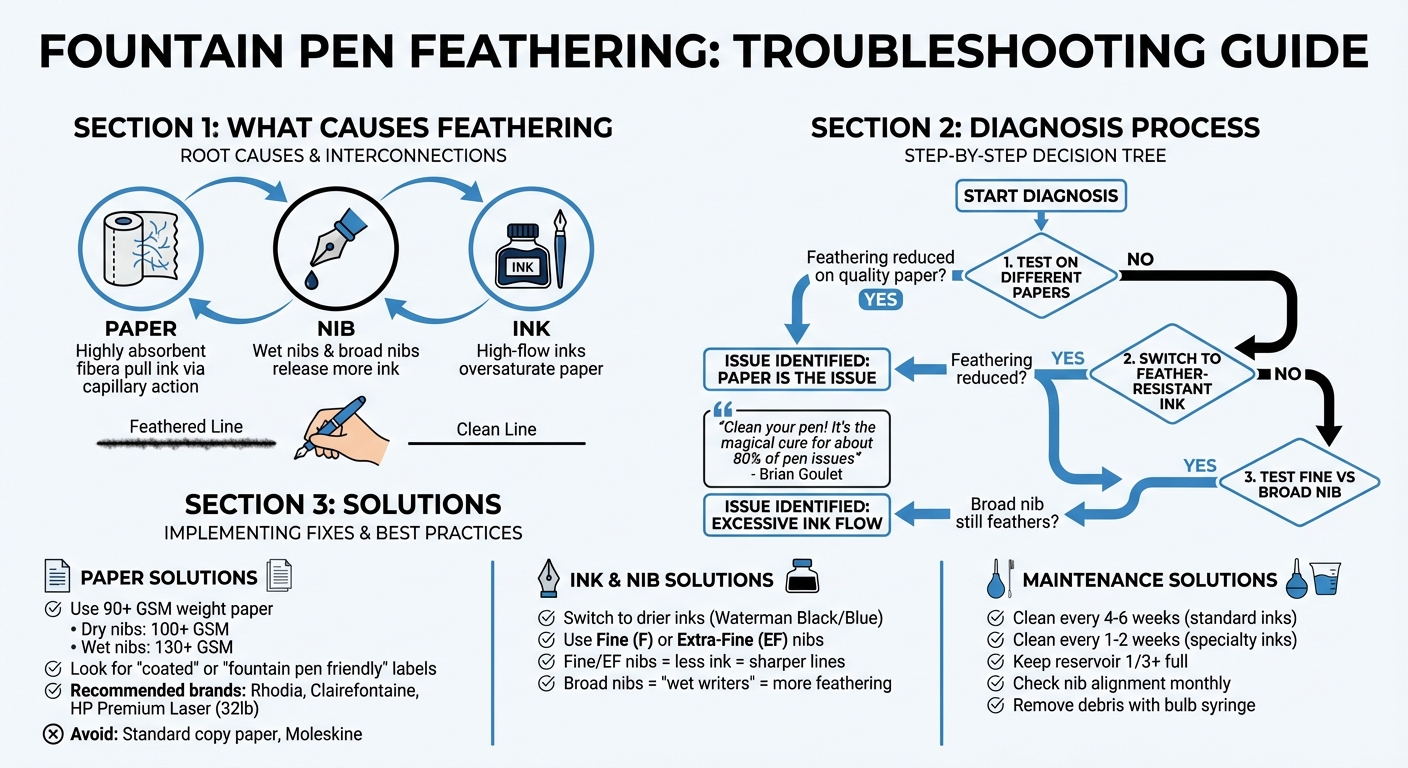
How to Diagnose and Fix Fountain Pen Feathering: A Step-by-Step Guide
Struggling with Tomoe River Paper? Tips and Tricks to Fix Feathering, Bleed-Through & More!
sbb-itb-1dd4fe9
What Causes Feathering?
Feathering happens when ink spreads unpredictably on paper, creating fuzzy or irregular lines. This issue stems from the interaction of three main factors: the ink flow from your nib, the ink's properties, and the type of paper you're using. By understanding how these elements influence each other, you can identify the root cause of the problem. Let’s dive into how paper characteristics and nib performance play a role in feathering.
Paper and Ink Compatibility Problems
More often than not, the paper is to blame. Papers with highly absorbent fibers pull ink away from the nib through capillary action, causing it to spread uncontrollably. Lower-quality office or recycled papers are particularly prone to this because their fibers are inconsistent, pulling ink in random directions.
"Feathering occurs when paper has fibers that are highly absorbent, which means they more readily pull ink from your pen via capillary action."
The way a paper's surface is treated also matters. Many modern office papers are optimized for ballpoint pens or printers, not for fountain pen ink. Even premium papers like aquarelle (watercolor) paper, which are designed to absorb water, can cause severe feathering when used with fountain pens.
Wet Nibs and High-Flow Inks
The amount of ink a nib deposits on the page plays a big role in feathering. Wet nibs and broad or double-broad nibs release more ink, increasing the likelihood of feathering, especially on absorbent paper. When a nib releases too much ink, the paper struggles to contain it, leading to ink spread.
"A juicy, wet nib that lays down a lot of ink has a higher chance of feathering than a dry, fine nib."
- Fountain Pen Love
Generally, finer nibs produce drier lines, while broader nibs are wetter writers. The feed mechanism also affects ink flow. For example, ebonite feeds often create a wetter flow due to their superior capillary action compared to plastic feeds. This means that both nib size and feed type influence how ink interacts with the paper.
Poor Quality or Thin Paper
Thin, low-grade paper often can’t handle fountain pen ink properly. For nibs with a dry flow, using paper with a weight of at least 100 GSM is recommended to minimize feathering. Wet nibs, on the other hand, benefit from heavier paper - 130 GSM or more. Standard copy paper typically falls below these thresholds and lacks the structure to keep ink from spreading. While paper absorbency is a major factor, the combination of ink flow and nib design amplifies the issue, making feathering a result of multiple interacting elements.
How to Identify Feathering
Feathering shows up as fuzzy, uneven edges on your writing instead of sharp, clean lines. You might spot fine, hair-like strands - often called capillary lines - spreading out from your strokes. The ink may also spread beyond the intended area, making your handwriting appear thicker or wider than it should. In severe cases, the text can blur, especially if you’re writing small. To pinpoint the cause, try some simple tests with different papers and nib settings.
Test on Different Papers
Start by testing your pen on various types of paper. Write a line in your usual style, another with quick loops, and a scribbled line, keeping your pressure steady to avoid forcing extra ink into the paper. Compare standard copy paper with fountain pen-friendly options like Rhodia or Clairefontaine. If feathering is less noticeable on the higher-quality paper, the paper itself may be the issue.
Here’s another quick test: touch your forehead, then lightly touch the paper, and write over that spot. If the ink feathers only where you touched, skin oils might be affecting the paper’s surface. To prevent this, place a clean sheet of paper under your hand while writing.
Check Your Ink Flow and Nib Size
If the feathering happens on most papers, the problem might be excessive ink flow. Try switching to a well-regarded, feather-resistant ink like Waterman Black or Blue. If the feathering continues on quality paper, test the same ink with a fine nib and a broad nib. If the broader nib still causes feathering, it’s likely due to too much ink flow. Broad nibs, often called "wet writers", lay down more ink, while fine and extra-fine nibs produce drier, sharper lines that are less prone to feathering.
Choosing Paper That Prevents Feathering
Once you've pinpointed feathering issues and adjusted your settings, selecting the right paper becomes essential. Switching to fountain pen-friendly paper can make all the difference. This type of paper keeps ink on the surface rather than letting it seep into the fibers, resulting in crisp, clean lines. Remember, surface treatment is more important than thickness - even thin, well-coated papers can perform exceptionally well.
Use Heavier, High-Quality Paper
For a better writing experience, opt for paper that's at least 90 gsm. Heavier paper not only reduces ghosting (where ink shows through the page) but also tends to be of higher quality. If you use a dry-writing nib, or need to replace your fountain pen nib, paper over 100 gsm works well, while wet-writing nibs perform best with paper over 130 gsm.
That said, surface treatment can sometimes trump weight. A great example is Tomoe River paper, which is only 52 gsm but offers excellent resistance to feathering. This ultra-thin paper, priced around $15 for 100 loose sheets, is particularly loved for showcasing ink shading and sheen, though it does require more drying time.
For everyday use, Rhodia and Clairefontaine are highly recommended. If you're looking for a budget-friendly option, HP Premium Laser paper (32 lb, roughly 120 gsm) is an excellent choice. It costs about $19.99 for 500 sheets and performs surprisingly well, despite being designed for printers. On the flip side, steer clear of Moleskine notebooks, as their paper is infamous for heavy feathering with fountain pens.
Choose Surface-Treated Paper
Surface treatment plays a critical role in preventing feathering. Coated papers keep ink on the surface, ensuring sharp, well-defined lines and avoiding the blurred edges that feathering creates. Look for labels like "coated", "ink-resistant", or "fountain pen friendly" on the packaging.
"A paper that greatly resists bleed and feathering will tend to take longer to dry, as the ink must evaporate instead of being absorbed." - Felix Jen, Inks and Pens
The downside of coated paper is a longer drying time, which can lead to smudging if you're not cautious. However, the tradeoff is worth it for the clean and professional appearance of your writing. Papers like Clairefontaine and Rhodia have a smooth, silky feel that sets them apart from regular copy paper. When shopping, check for terms like "matte", "vellum", or "semi-smooth finish", as these often indicate the kind of surface treatment that works well with fountain pens.
With the right paper in hand, you can also tweak your ink and nib sizes to further minimize feathering.
Adjusting Your Ink and Nib to Reduce Feathering
Upgrading your paper is a great first step to combat feathering, but if the issue persists, your pen's ink flow and nib size might be the culprits. The way ink interacts with the nib determines how much liquid reaches the page. Too much ink can lead to those frustrating, blurry lines. Opting for drier inks and finer nibs can significantly minimize feathering, even on paper that's not ideal. Combining these adjustments with better paper ensures your writing tools work together seamlessly.
Use Drier Inks
Inks aren't all created equal. Wet inks, which have a higher flow, tend to oversaturate the page, leading to feathering. Drier inks, on the other hand, release less liquid, reducing the chances of the ink spreading into the paper fibers.
"A 'wet writer' is one that puts a lot of ink down on the page. Wet writing pens tend to have more feathering problems because more ink flows onto the page when you make a stroke." – Executive Essentials
Consider inks like Waterman Black or Waterman Blue, which are known for their balanced flow. Before testing new inks, thoroughly rinse and dry your nib and feed to remove any residue that might interfere with performance. Keeping a test page handy is also helpful for tracking how different ink and pen combinations behave on various types of paper.
Switch to Finer Nibs
Nib size plays a big role in how much ink ends up on the page. Broad and medium nibs tend to be "wet writers", delivering a heavy flow of ink, which can exacerbate feathering. In contrast, fine (F) and extra-fine (EF) nibs release much less ink, resulting in sharper, more precise lines.
"If you have to switch over to a dry writing nib then the lower amount of ink able to work its way down the ink path to your paper helps to reduce the chance of feathering." – Picky Pens
If feathering is a persistent issue, try switching to a fine or extra-fine nib. These nibs naturally limit ink flow, making them a great choice for more absorbent paper. Even if you're using a wet ink, pairing it with an extra-fine nib can help strike a better balance and keep your lines crisp and clean.
Maintaining Your Pen to Prevent Feathering
Even if you've chosen high-quality paper and ink, keeping your pen in good condition is just as important. Issues like dried ink, trapped fibers, or misaligned parts can lead to oversaturation and blurred writing. Regular cleaning and upkeep are essential for smooth performance and to avoid feathering.
Clean and Align Your Nib and Feed
Clogs and debris are often to blame for inconsistent ink flow. Dried ink particles, paper fibers, or leftover machining oils can block the feed channels or lodge between the nib tines. When fibers get stuck in the nib slit, they act like a wick, pulling excess ink onto the page and causing it to spread.
"Anything that impedes the movement of ink through the pen, as well as the air needed to displace it, will hamper proper flow." – Lekz, Author, EndlessPens
To keep your pen functioning properly, flush it regularly. For standard inks, this means every four to six weeks, while specialty inks like shimmering or pigment-based varieties require cleaning every one to two weeks. For new pens, always start by flushing with clean water to remove any machining oils that could disrupt ink flow. A bulb syringe works well for flushing, and thin brass sheets (0.002 inches thick) can help clear stubborn debris.
Proper alignment is equally important. The nib should sit flush against the feed, with the nib slit perfectly aligned with the feed's ink channel. Use a magnifying glass for a quick inspection - misaligned tines can often be adjusted by hand in less than a minute. These steps ensure that your pen writes consistently and complements any adjustments you've made to your ink and nib preferences.
Check for Too Much Ink Flow
Another key part of maintenance is regulating ink flow. If too much ink is flowing, it can overwhelm the paper. A loose nib or feed can cause this, so make sure they're securely in place.
Keep your ink reservoir at least one-third full to avoid "burping", which happens when air expands due to the warmth of your hand. If you notice sudden ink leaks or irregular flow, inspect the barrel and grip sections for cracks, especially in piston or vacuum-filling pens. Cracks can allow air to leak in, disrupting proper ink delivery.
| Maintenance Task | Frequency | Purpose |
|---|---|---|
| Standard Cleaning | Every 4–6 weeks | Remove dried ink and fibers |
| Specialty Ink Cleaning | Every 1–2 weeks | Prevent clogs from shimmer or pigment inks |
| Reservoir Check | Ongoing | Keep more than one-third full to prevent burping |
| Nib Inspection | Monthly | Check for misaligned tines and debris |
Products from Fountain Pen Revolution

If you're working on eliminating feathering in your writing, Fountain Pen Revolution offers a range of pens and accessories designed to minimize ink spread. These products incorporate features like fine nibs and controlled ink flow to ensure smooth, feather-free results. Here's a breakdown of their offerings to help you find the right fit for your needs.
Starter Sets for Beginners (from $35)
New to fountain pens? Check out the starter sets, perfect for those learning the art of precise writing. Options like the FPR Quickdraw (starting at $32.00) and FPR Quickdraw Flex (from $35.00) come with fine nibs to deliver clean, sharp lines on various types of paper. Their budget-friendly prices make them a great choice for beginners.
Premium Handmade Pens (from $44)
For those seeking a step up, the FPR Himalaya V2 (starting at $44.00), FPR Jaipur V2 (from $59.00), and FPR Triveni Ebonite (from $65.00) are excellent options. These pens are crafted with precision and feature tighter ink flow, which helps reduce feathering, especially when used with coated paper. You can also customize your writing experience by purchasing separate nibs and feeds to match your preferred paper and style.
Bundles and Accessories
Fountain Pen Revolution goes beyond pens with a range of complementary products. Their inks, such as Noodler's Black, Diamine Chocolate Brown, and Noodler's Lexington Grey, are formulated for balanced flow and reduced spreading. To keep your collection organized, consider the FPR Leather 6 Pen Roll-Up Pouch ($39.00). Plus, enjoy free US shipping on orders over $65, and you might even snag a special gift like a free Muft pen or leather case as a bonus for larger purchases.
Conclusion
Feathering can be resolved by finding the right balance between your pen, ink, and paper. As Fountain Pen Love explains, "With fountain pens there are three things that matter: the pen you use, the ink you use, and the paper you use". Making adjustments to one of these elements can often offset issues with another.
A great starting point is upgrading to fountain-pen-friendly paper like Rhodia or Clairefontaine, which are designed with surface treatments to prevent ink from soaking into the fibers. If you're stuck using lower-quality paper, consider switching to a finer nib, such as Extra-Fine or Fine, or opting for drier inks like Waterman Black to reduce the amount of ink applied to the page.
Regular maintenance is another key to avoiding feathering. Brian Goulet, founder of The Goulet Pen Company, emphasizes the importance of cleaning: "Clean your pen! Seriously, it's the magical cure for about 80% of pen issues". A monthly cleaning routine can clear blockages and ensure smoother performance.
Simple daily habits also make a difference. For instance, place a scrap piece of paper under your writing hand to prevent skin oils from transferring to the page, which can cause random feathering spots - even on high-quality paper. Experimenting with different writing setups and techniques on various types of paper can help you discover what works best for your style.
FAQs
What kind of paper helps prevent feathering when using fountain pens?
To keep your fountain pen writing crisp and avoid feathering, choose high-quality, smooth, coated paper with a weight of at least 120 gsm (grams per square meter). This type of paper is less absorbent, helping the ink stay put and preventing those frustrating fuzzy edges.
Steer clear of cheaper, highly absorbent options like standard copy paper or newspaper. These papers soak up ink too quickly, causing it to spread. By sticking to smooth, heavier paper, you’ll enjoy cleaner, more precise lines every time you write with your fountain pen.
How can I stop my fountain pen from feathering on paper?
Feathering occurs when ink spreads uncontrollably on paper, but you can manage it with a few simple adjustments. Start by addressing your fountain pen's ink flow. Often, a nib that's too wet can lead to feathering. Cleaning or fine-tuning the nib can help create a slightly drier ink output, reducing the problem.
The type of paper you use also plays a big role. Opt for high-quality, fountain pen-friendly paper with a smooth surface. These papers are designed to absorb ink evenly, preventing unwanted spreading. If feathering continues, experimenting with a different ink formula might help, as some inks interact better with specific papers.
With a well-adjusted pen and the right paper, you can achieve crisp, clean lines and an overall better writing experience.
Why is my fountain pen feathering even on high-quality paper?
Feathering can happen even on high-quality paper, and it often comes down to a mix of factors like the ink, the nib, or the paper's unique characteristics. Ink properties are a major player here - things like viscosity, flow, and saturation make a difference. For example, wetter inks or those with heavy saturation are more likely to feather.
Nib size also plays a part. Broader or wetter nibs deposit more ink on the page, which can increase the chances of ink spreading. And even with premium paper, differences in texture, coating, or absorbency can influence how the ink interacts with the surface.
To cut down on feathering, try switching to a finer nib, opting for a drier ink, or using paper specifically made for fountain pens. The trick is finding the right balance between these elements for a smooth, clean writing experience.