

When writing a formal letter, the ink color you choose matters. Black ink is the most professional and widely accepted choice, especially for legal or official documents. Blue ink, on the other hand, offers a personal touch and is often used for signatures to distinguish originals from copies. Alternatives like blue-black, navy blue, or dark brown can add subtle personality while maintaining professionalism. Here’s a quick overview of the best options:
- Black Ink: Best for legal documents, scanning, and photocopying. Highly professional and universally accepted.
- Blue Ink: Ideal for signatures and personal correspondence. Helps verify authenticity.
- Blue-Black Ink: A blend of authority and uniqueness, suitable for legal and financial paperwork.
- Navy Blue Ink: Combines professionalism with warmth, great for formal letters and signatures.
- Dark Teal, Green, or Brown Inks: Subtle yet professional options for adding individuality without compromising formality.
- Grey or Dark Red Inks: Modern and polished choices for specific occasions or personal flair.
Each ink color has unique strengths, from readability and drying time to suitability for formal contexts. For the best results, pair your chosen ink with quality paper and writing tools.
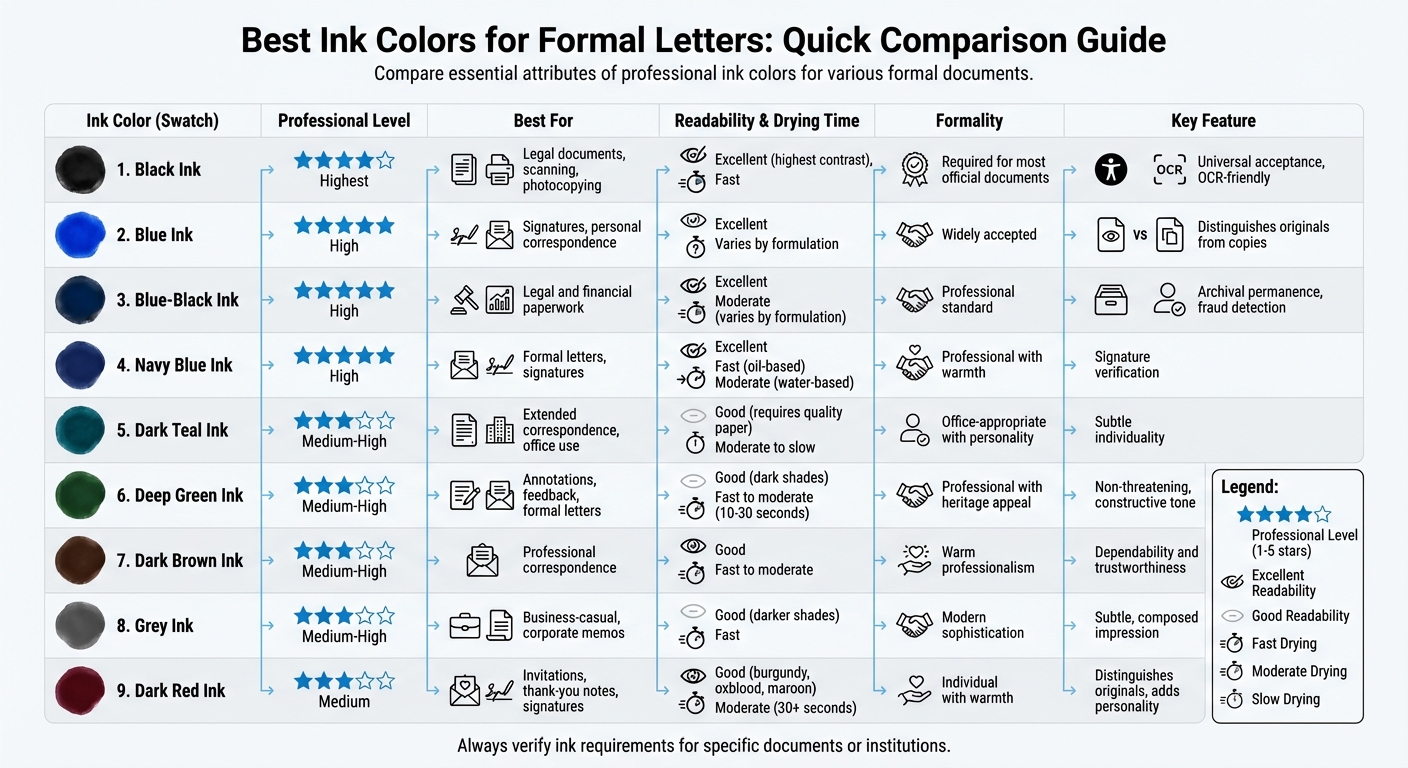
Best Ink Colors for Formal Letters: Quick Comparison Guide
1. Classic Black Ink
Professional Appearance
Black ink carries an undeniable sense of authority and professionalism. It’s the go-to choice when you want your message to convey seriousness. Gareth Parkin, Product Marketing Director at GoPromotional, emphasizes its importance:
"Black ink is still the best pen for signature on most legal documents."
This color not only communicates confidence but also avoids the potential for misinterpretation that other ink colors might introduce.
Readability on Paper
One of black ink's standout qualities is its superior readability. Its sharp contrast against light-colored paper ensures text is crystal clear, making it ideal for both reading and reproduction. Karleen Wise Andersen, Small Business Resource Specialist at Pens.com, highlights this advantage:
"Black ink tends to copy and scan better than any other ink color. Go with black and save everyone the hassle of hard-to-read documents."
Whether you’re photocopying or scanning, black ink ensures your documents remain legible and professional.
Suitability for Formal Contexts
Black ink isn’t just a stylistic choice - it’s often a requirement. Many legal and governmental institutions insist on black ink for official documents. For example, in the United Kingdom, passport signatures must be completed using a black ballpoint pen, with rollerball or gel pens often being rejected. Similarly, countries like China strictly enforce black ink usage for official forms. This preference also aligns with the capabilities of optical character recognition (OCR) software, which processes black ink with the highest accuracy during document digitization. These practical benefits make black ink indispensable for formal correspondence.
Drying Time and Smudge Resistance
Archival-quality black inks are designed to dry quickly, reducing the likelihood of smudges during signing. Inks meeting ISO 12758-2 standards offer additional benefits, such as being lightfast, waterproof, and resistant to chemicals or erasure. For instance, waterproof inks like Graf Von Faber Castell Carbon Black ensure signatures remain intact even when exposed to moisture. Moreover, on absorbent or recycled paper, formulations like Noodler's X-Feather prevent feathering, keeping your writing crisp and clean. Brands like Fountain Pen Revolution provide an array of high-performing black inks suitable for various paper types, ensuring reliability in formal settings.
Blue Ink vs. Black Ink: An explanation - Law Office of Andy I. Chen
2. Blue-Black Ink
Blue-black ink builds on the reliable qualities of classic black ink while offering some added benefits that suit modern verification and professional needs.
Professional Appearance
Blue-black ink combines the authority of black with a touch of depth, making it stand out in formal documents. It’s especially helpful in legal and financial paperwork, where it can clearly distinguish original signatures from printed text. As Pens.com explains:
"When you want to see that signature easily against a sea of black print, and confirm the signature's not a copy, blue is best."
The subtle blue tones in this ink are often linked to feelings of sincerity and calmness, which can enhance its professional appeal in formal correspondence.
Suitability for Formal Contexts
Blue-black ink has become a staple in professional environments. After a 2013 repeal of the law requiring notary public signatures to be in black ink, many notaries began using blue or blue-black ink to make original documents easier to verify. This ink is also preferred for credit card applications and other financial paperwork, as it helps fraud detection teams confirm authentic signatures.
However, keep in mind that if forms are processed using Optical Character Recognition (OCR) software, black ink is often a better choice. Some lighter blue-black inks may not scan as clearly, which could cause issues during automated processing.
Archival Permanence
Certain blue-black inks, such as iron-gall and nano-pigmented varieties, are known for their exceptional durability. These inks are lightfast, water-resistant, and archival, meaning they can preserve records for centuries. Iron-gall inks are particularly interesting - they darken over time to a rich purple-black shade due to the oxidation of iron (II) ions as they dry.
Drying Time and Smudge Resistance
The drying performance of blue-black ink depends on its formulation and the type of paper being used. For high-quality stationery, "wet" blue-black inks deliver better shading and a more refined look. On the other hand, "dry" inks, like LAMY blue-black, work better on standard office paper by reducing feathering and speeding up drying times. This quick-drying feature also makes dry formulations ideal for left-handed writers, as it minimizes smudging.
If you’re using permanent blue-black inks, like pigmented or iron-gall types, remember to clean your pen regularly with water. This helps prevent clogging or corrosion caused by solid particles or acidic components in the ink.
3. Navy Blue Ink
Professional Appearance
Navy blue ink strikes the perfect balance between the authority of black and the warmth of blue. Its deeper tone adds a professional edge while standing out subtly from standard black text. Lucy Williams, Lead Editor at The Pen Company, explains:
"Blue ink embodies sincerity, serenity, and compassion. It's the colour of choice when you wish to convey heartfelt thoughts."
This calming shade not only projects trust but also reinforces a polished, professional image.
Readability on Paper
Navy blue provides excellent contrast on white or cream-colored paper, ensuring your text remains easy to read. Its rich saturation helps maintain sharp, clean lines, even on standard office paper where lighter inks might bleed or feather. When used on absorbent paper, the depth of the color compensates for minor spreading, keeping your writing crisp and legible.
On ink-resistant stationery, navy blue ink typically sits on the surface, preserving both its vibrant hue and the clarity of your handwriting. For standard paper, combining navy blue ink with a fine nib can further reduce feathering and keep your writing neat.
Suitability for Formal Contexts
Navy blue has gained popularity in professional and legal environments, especially for signatures. Its distinct color makes it easier to verify original signatures, as it contrasts clearly with black printed text. This feature makes it a practical choice for signature verification in settings like banks and legal offices. However, it’s worth noting that some formal applications may still require black ink.
Drying Time and Smudge Resistance
The drying time for navy blue ink varies depending on the type of pen and ink formulation. Oil-based navy inks in ballpoint pens dry quickly and resist smudging, making them a dependable option for daily business use. On the other hand, water-based navy inks, commonly used in fountain pens, offer a smoother writing experience but take longer to dry and may smudge on glossy surfaces.
If you write frequently or are left-handed, look for "quick-dry" navy blue inks designed to dry faster and reduce smudging.
Next, we’ll dive into another ink color that brings its own formal elegance to the table.
4. Dark Teal Ink
Professional Appearance
Dark teal provides a polished alternative to the usual black or blue inks. It blends the trustworthiness of blue with the calming and natural feel of green, creating a color that feels both reliable and refreshing. Its muted tone ensures it remains professional, making it a great choice for formal, extended correspondence. The natural shading and slight sheen add a touch of character without sacrificing the formality required in professional settings. For formal use, darker shades of teal are best, as they maintain a grounded and authoritative look.
Readability on Paper
Dark teal’s high saturation ensures strong contrast on white or cream paper, making it easy to read and excellent for highlighting original signatures. However, many dark teal inks tend to be wetter, which can lead to feathering on standard paper. To avoid this, using fountain-pen-friendly paper is recommended, as it helps preserve the ink's clean lines and rich color depth.
Suitability for Formal Contexts
Dark teal is widely accepted as an office-appropriate ink, offering a subtle way to express individuality while maintaining a formal tone. Its connection to themes of renewal and clarity makes it a fitting choice for formal letters or professional documents. The dark hue ensures excellent readability while giving your writing a distinctive yet understated flair.
Drying Time and Smudge Resistance
Most professional dark teal inks are water-based, ensuring a smooth writing experience with moderate drying times. However, inks with a high sheen often flow wetter, which can increase drying time. As Goldspot Pens explains:
"Inks with high amounts of sheen tend to flow a bit wetter and take longer to dry on the page. Smearing tends to be a concern with sheen inks. Even if the ink dried a month ago, all it takes is a clammy hand to reactivate the dye and smear your writing."
For quicker drying, left-handed writers might prefer "dry" formulations of dark teal ink to reduce smudging risks. On fountain-pen-friendly paper, drying times for saturated medium teals like Lamy Turmaline typically average around 20 seconds.
Next, we’ll explore another timeless ink choice that balances elegance and practicality.
sbb-itb-1dd4fe9
5. Deep Green Ink
Professional Appearance
Deep green ink offers a sophisticated blend of heritage and modernity, making it a polished alternative to traditional black or blue. Shades like forest green and green-black strike the right balance between formality and individuality. Their darker tones closely mimic black, adding a subtle but distinct character to your writing without being overly bold or distracting.
This color carries a historical association with prestige, having been a favorite of MI6 and British intelligence. As The Gentleman Stationer notes:
"There is also a tradition of green ink being used by MI6 and the British intelligence services, so you're not necessarily labeling yourself as a nut by signing that memo to your boss in green".
Green also evokes feelings of calm and renewal, which can create a more pleasant reading experience.
Readability on Paper
Dark green inks, like Robert Oster River of Fire, provide excellent contrast on white and cream-colored paper, ensuring clear legibility. Options such as Pelikan 4001 Dark Green are particularly effective on fountain-pen-friendly and standard paper, offering minimal feathering and quick drying times. Green-black shades maintain the readability of black ink while adding a touch of individuality.
However, lighter greens, such as lime or yellow-green, can strain the eyes when used in longer text blocks. Additionally, deep green ink may not be ideal for documents requiring scanning, as automated systems might struggle to capture its nuances.
Suitability for Formal Contexts
Deep green ink is highly regarded in professional environments, especially for annotations and feedback. Lucy Williams, Lead Editor at The Pen Company, highlights its constructive tone:
"Green ink is a wise selection. Its non-threatening air encourages constructive feedback".
For formal correspondence, darker shades like green-black or deep forest green maintain a professional tone while offering a hint of distinction. Medium or broad nibs are recommended to showcase the ink’s depth and shading. Popular options include Pilot Iroshizuku Shin-ryoku, Pelikan 4001 Dark Green (priced around $8.00 per bottle), and Montblanc Irish Green.
Drying Time and Smudge Resistance
Drying times for deep green inks depend on the formulation. Fast-drying options like De Atramentis Document Dark Green dry in under 10 seconds, making them perfect for left-handed writers or quick notes. Graf von Faber-Castell Moss Green typically dries in about 30 seconds on standard paper, while Pelikan 4001 Dark Green performs well on fountain-pen-friendly surfaces.
For added smudge resistance, pigment-based or iron-gall inks are excellent choices. These formulas bond with paper fibers and become waterproof once dry, ensuring lasting permanence. However, they do require regular pen maintenance to avoid clogging. For instance, Platinum Classic Forest Black becomes water-resistant and permanent after oxidation.
6. Dark Brown Ink
Professional Appearance
Dark brown ink offers a formal yet warm alternative to traditional colors. It combines professionalism with a touch of approachability, making it a solid choice for professional correspondence. As Lucy Williams, Lead Editor at The Pen Company, puts it:
"Brown ink, with its undertones of dependability and trustworthiness, finds a natural place in the correspondence between employers and employees. This choice lends an air of professionalism and sincerity to your message."
When matched with cream or ivory paper, shades like chestnut or chocolate brown add a timeless elegance. For a more understated look, gray-brown tones provide a subtle and sophisticated option.
Readability on Paper
Dark brown inks stand out well on white or cream paper, offering strong contrast and clear legibility akin to black or blue ink. Brian Goulet of The Goulet Pen Company highlights Diamine Chocolate Brown as an example of an ink that balances richness with readability, creating a professional yet welcoming feel.
The type of paper used can influence performance. For instance, Noodler's #41 Brown (priced at $17.00 for 3 oz) resists feathering on standard office paper, ensuring clean lines. However, brighter russet or red-leaning browns should be avoided for lengthy text, as they can strain the reader's eyes. Overall, dark brown inks maintain clarity, making them suitable for formal documents where precision matters.
Suitability for Formal Contexts
Dark brown ink works well for formal settings, especially when there’s a need to distinguish original documents from photocopies. Medium and gray-brown shades are ideal for the main text of letters, while deeper tones like walnut or chocolate brown convey seriousness without the starkness of black.
Drying Time and Smudge Resistance
Drying times can vary significantly depending on the ink formulation. Noodler's Polar Brown stands out for its fast-drying properties and freeze resistance down to –40°F. Pelikan 4001 Brilliant Brown also dries quickly and performs reliably across various paper types.
For enhanced durability, permanent inks like De Atramentis Document Brown (priced at $24.00 for 45 ml) and Noodler's #41 Brown offer excellent water resistance. Once dry, these inks are virtually waterproof, protecting against smudging and tampering. De Atramentis Document Brown even meets ISO standards for permanence and scores highly on the Blue Wool Scale for lightfastness, ensuring documents remain readable for decades. On the other hand, standard dye-based inks like Pelikan 4001 Brilliant Brown lack strong water resistance, making them less suitable for documents exposed to moisture. Additionally, reddish-brown inks may develop a crust on the nib over time, which can affect performance.
7. Grey Ink
Professional Appearance
Grey ink offers a modern alternative to traditional hues like deep green or dark brown. It strikes a balance, bringing a sense of sophistication without the starkness of black. Darker shades, such as charcoal, convey a serious, professional tone - qualities often associated with polished, high-level communication. Lucy Williams, Lead Editor at The Pen Company, puts it well:
"Grey ink offers a subtle, business-casual aura without strong emotional cues. It's the ink of choice when you want to deliver a relaxed yet composed impression."
For a more casual yet professional vibe, medium grey tones are a great choice. On the other hand, deeper charcoal shades emphasize formality and can be ideal for corporate memos, legal documents, or other official uses. This versatility makes grey ink a favorite for those looking to balance professionalism with a touch of modern flair.
Readability on Paper
When it comes to readability, darker greys stand out. They create enough contrast on white or cream paper to remain easy on the eyes. Ryan from JetPens sums it up, saying, "gray ink can add refinement and subtle depth". A standout example is Pilot Iroshizuku Kiri-same, which combines a rich, dark tone with warm undertones and shading for added character. However, very light grey inks can be challenging for extended reading, especially in smaller fonts. Pairing these inks with broader nibs can help highlight their shading variations, adding a unique touch to your writing.
Suitability for Formal Contexts
Grey ink’s understated elegance makes it an excellent choice for formal communication. Its modern yet subtle appearance helps your writing stand out without compromising professionalism, making it suitable for everything from business letters to legal documents.
Drying Time and Smudge Resistance
For formal writing, quick-drying ink is a must, and many grey inks are designed to meet this need. Noodler's Lexington Gray, for instance, is celebrated as a "bulletproof" ink, resistant to water, solvents, and fading. Similarly, Kaweco Smokey Grey offers fast drying and above-average water resistance, making it particularly helpful for left-handed writers. Permanent grey inks that bond with paper fibers ensure your text remains smudge-free and long-lasting, perfect for important documents.
8. Dark Red Ink
Professional Appearance
Dark red ink provides a polished alternative to traditional black or blue, offering warmth and individuality while maintaining a professional tone. Selecting the right shade - such as burgundy, oxblood, or maroon - is key. These deeper tones project authority and refinement, unlike bright reds, which can come across as harsh or reminiscent of school corrections. Lucy Williams, Lead Editor at The Pen Company, highlights this point:
"Red ink can be perceived as aggressive, so you'd do best to avoid that."
For a formal touch, consider "red-black" or "oxblood" inks that blend red with brown or black hues, steering clear of overly vibrant tones like fire-engine red.
Readability on Paper
Dark red inks, such as Diamine Oxblood or Noodler's Red Black, offer excellent contrast on white or cream-colored paper, ensuring clear and legible writing. These shades replicate the richness of traditional inks, making them an elegant choice for handwritten notes or letters. However, for documents requiring scanning or photocopying, black ink remains the preferred standard, as red tones can sometimes hinder optical clarity. Still, the distinctiveness of dark red ink can enhance the authenticity of a signature, setting it apart from standard black or blue.
Suitability for Formal Contexts
Dark red ink brings a touch of individuality to formal correspondence. It strikes a balance between personality and professionalism, making it suitable for settings where a hint of warmth is appreciated. Some dark red formulations, like De Atramentis Document Ink Dark Red, are specifically designed for official use. These "Document Inks" are permanent, lightfast, and ideal for important records or signatures. Using dark red ink for signatures also serves a practical purpose, as it helps distinguish original documents from black-and-white photocopies, similar to blue ink. This makes it a great choice for formal invitations, thank-you notes, or even sympathy cards, where a subtle, warm tone complements the occasion.
Drying Time and Smudge Resistance
The drying time for dark red inks can vary depending on the formulation. For instance, Diamine Syrah becomes smear-proof in about 30 seconds, though it may take slightly longer compared to standard inks. Many dark red inks offer medium water resistance, ensuring that text remains readable even when exposed to moisture. For those seeking high durability, document-grade options like De Atramentis Document Ink Dark Red ($24.00 for 45ml) provide waterproof and smudge-resistant properties. However, because darker, more saturated inks often have a wetter consistency, it's wise to allow extra drying time or use a blotter when working with formal stationery. Popular choices include Diamine Oxblood ($9.00 for 30ml), Noodler's Red Black ($17.00 for 3oz), and Jacques Herbin 1670 Rouge Hematite ($36.00 for 50ml).
Conclusion
Picking the right ink color for formal letters is about finding the balance between professionalism and a touch of personal style. Black ink is a staple for legal documents, offering permanence and clarity, while blue ink, often used for signatures, helps distinguish originals from copies. As business professional Saad Nyroze Shariff explains:
"Black ink is often required for legal documents because of its permanence and high contrast."
The choice of ink color also depends on the purpose. For government forms, tax documents, or job applications, black ink ensures smooth scanning and processing. On the other hand, blue ink adds a sense of trust and authenticity to signatures. If you'd like to infuse a bit of personality, consider darker alternatives like blue-black, navy blue, dark teal, deep green, dark brown, gray, or even dark red - just be mindful of the expectations of your audience.
High-quality fountain pen inks not only enhance the writing experience but also encourage a more thoughtful approach to your correspondence. As Jim Evers, owner of iPenstore, puts it:
"You slow down because the ink is actually flowing, so you kind of develop a relationship with the writing."
Elevate your formal letters by pairing the right color with quality tools. Fountain Pen Revolution offers a wide selection of fountain pens and inks, perfect for both beginners and seasoned writers. With starter sets starting at $35 and premium options featuring 14k gold nibs, their collection makes it easy to find professional-grade tools without overspending. Their variety of inks also lets you experiment with colors while maintaining the standards required for formal communication.
Whether you opt for classic black, reliable blue, or a refined alternative, your ink choice should reflect both professionalism and your unique style.
FAQs
Why is black ink commonly used for signing legal documents?
Black ink is a popular choice for legal documents because it’s seen as permanent and harder to alter or tamper with. This helps maintain the document’s authenticity and enforceability. Plus, black ink reproduces more clearly in photocopies and scans, making it a dependable option for official records.
Why is blue ink commonly used to verify the authenticity of documents?
Blue ink is commonly chosen for verifying the authenticity of documents because it contrasts sharply with the black ink used in most photocopies. This contrast makes it easier to spot original signatures at a glance. Moreover, standard copying machines struggle to replicate blue ink accurately, making it a reliable indicator of originality. These qualities make blue ink a practical option for formal and legal documents.
Why is navy blue ink a good choice for formal letters?
Navy blue ink is a great option for formal letters because it provides a clean, professional look while being just different enough from black ink to catch the eye. It communicates a sense of reliability and trust, which makes it especially suited for legal, financial, and business-related documents. Plus, navy blue ink can make it easier to identify original documents compared to photocopies, giving your letters an added touch of authenticity.