

The Sheaffer PFM (Pen For Men), launched in 1959, was a bold departure from the slim pens of its time. Designed for professionals, it featured a larger, sturdier profile, an advanced Snorkel filling system, and Sheaffer’s iconic inlaid nib. Marketed as a premium writing instrument, the PFM came in five models, priced from $10 to $25. Despite its engineering excellence, it struggled commercially and was discontinued in 1968. Today, it’s a prized collectible, admired for its craftsmanship and unique design.
Key Points:
- Launch Year: 1959
- Defining Features: Oversized design, inlaid nib, Snorkel filling system
- Models: PFM I to PFM V, priced $10–$25
- Production Period: 1959–1968
- Legacy: Highly sought after by collectors for its rarity and design.
The PFM’s influence endures, inspiring later Sheaffer models like the Legacy and Imperial lines.
Pen Resurrection Sunday Ep 56 1960 Sheaffer PFM
sbb-itb-1dd4fe9
The Sheaffer Company: A History of American Pen Making
Sheaffer Company Innovation Timeline 1912-1968
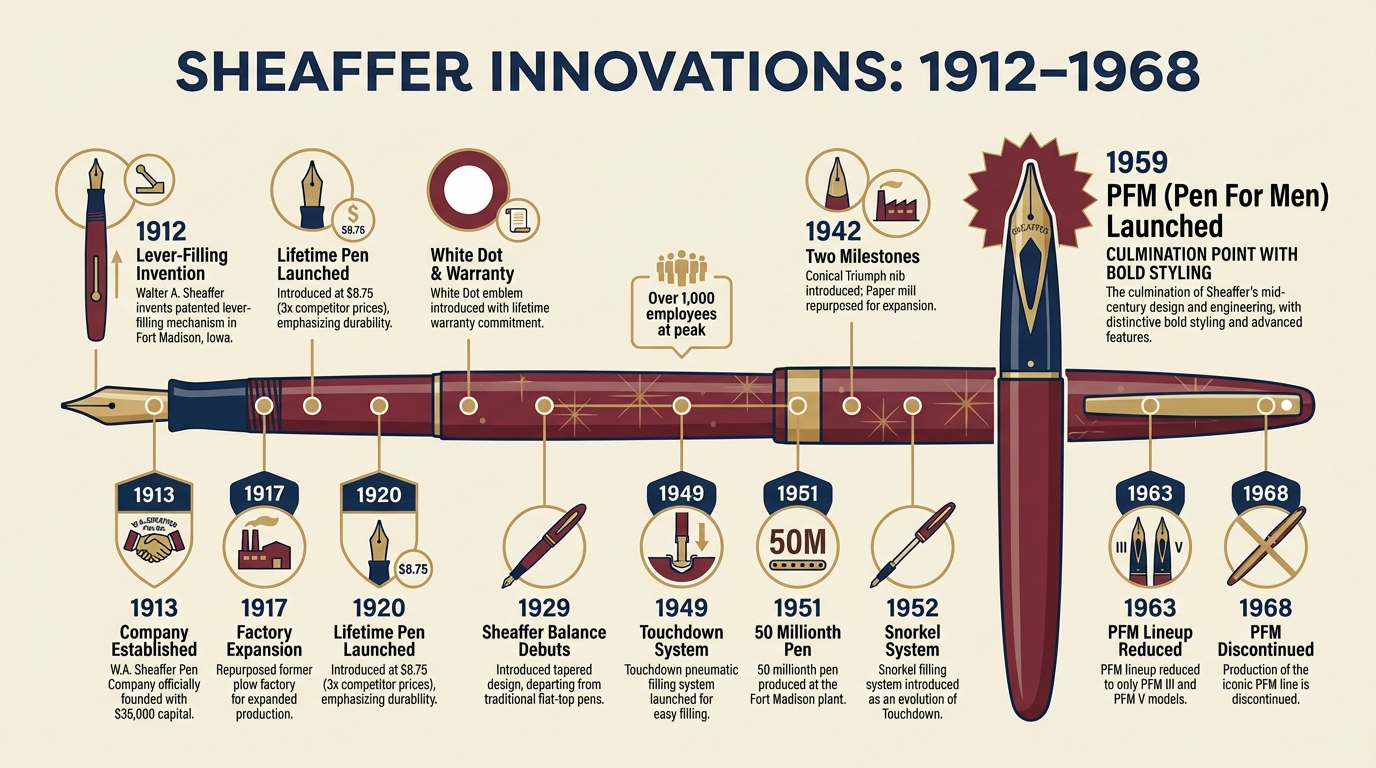
In 1912, Walter A. Sheaffer revolutionized pen refills at his jewelry store in Fort Madison, Iowa, by inventing a patented lever-filling mechanism. Just a year later, in January 1913, he officially established the W.A. Sheaffer Pen Company with $35,000 in capital [[6]](https://www.sheaffertarga.com/Sheaffer History/History of sheaffer.html).
What started as a modest workshop grew into a thriving industrial operation, employing over 1,000 people at its height. By November 1951, the Fort Madison plant celebrated an incredible milestone - the production of its 50 millionth pen [[6]](https://www.sheaffertarga.com/Sheaffer History/History of sheaffer.html). To keep up with global demand, the facility expanded multiple times, including repurposing a former plow factory in 1917 and a paper mill in 1942 [[6]](https://www.sheaffertarga.com/Sheaffer History/History of sheaffer.html).
Major Innovations Before the PFM
In 1924, Sheaffer introduced the White Dot, a small emblem that became synonymous with quality and came with a lifetime warranty. The 1920 Lifetime Pen, priced at $8.75 - three times the cost of competing pens - proved that customers were willing to pay more for unmatched reliability [[6]](https://www.sheaffertarga.com/Sheaffer History/History of sheaffer.html).
The 1929 Sheaffer Balance marked a departure from the traditional cylindrical "flat-top" design, opting for a sleeker, tapered shape that felt more comfortable in the hand. In 1942, the company debuted the conical Triumph nib, showcasing its willingness to push the boundaries of conventional fountain pen nib design. This innovation laid the foundation for the PFM's signature inlaid nib nearly two decades later.
In 1952, Sheaffer introduced the Snorkel filling system, an evolution of the 1949 Touchdown pneumatic design. The Snorkel used a retractable tube for mess-free ink filling. These advancements paved the way for the bold redesign that culminated in the PFM.
The Vision Behind the PFM
By the 1950s, Sheaffer sought to challenge the era’s trend of slim pens. Drawing on its expertise with the Snorkel mechanism and innovative nib designs, the company envisioned a pen that showcased both technical sophistication and a commanding aesthetic. The result was the PFM - an oversized pen crafted for mid-century professionals who wanted more than just a writing instrument; they wanted a statement piece. Combining the advanced Snorkel system with a larger ink bladder and the groundbreaking inlaid nib, the PFM broke new ground in pen design.
Jim Mamoulides of PenHero.com described the PFM as:
a bold step in a new direction... a classic design that, like other landmark pens, captures the design influences of the times.
The PFM encapsulated decades of Sheaffer’s expertise, from the original lever-filler to the cutting-edge Snorkel system, all wrapped in a design that defied the norms of its time.
Design Features and Technical Specifications
The Snorkel Filling Mechanism
One of the standout features of the PFM is its Snorkel filling system - a clever pneumatic mechanism that extends a thin tube from below the nib when you twist the plunger cap. To refill the pen, you simply dip this tube into your ink bottle and press the plunger down once. This action draws ink directly into an internal bladder, skipping the need for the nib to touch the ink. The result? A mess-free experience with no wiping or blotting required. This design also made it easy to access ink at the bottom of nearly empty bottles. Thanks to the PFM's larger barrel, it housed a bigger internal bladder compared to the thinner Thin Model pens, offering a greater ink capacity. This thoughtful engineering reflects Sheaffer's focus on practicality and innovation. As pen expert Jim Mamoulides explained:
The Snorkel tube extends quite far past the end of the nib... so filling requires no wiping.
This ingenious system became a hallmark of the PFM's design, setting a new standard for functionality.
Design Elements and Materials
With a capped length of 5 3/8 inches and 5 3/4 inches when posted, the PFM made a bold statement in an era dominated by slim pens. Its oversized design stood out, while the inlaid nib - sitting flush with the section - gave the pen a sleek, modern look that broke away from traditional styles.
The PFM series included five models, each crafted with high-quality materials. The PFM I and II featured palladium-silver nibs, while the PFM III, IV, and V boasted gold vs steel nibs. Caps varied by model, ranging from durable plastic on entry-level versions to brushed stainless steel on the PFM II and IV, and gold-filled metal on the premium PFM V. Interestingly, the PFM I was the only model in the lineup that lacked Sheaffer's iconic White Dot, which symbolized a lifetime warranty.
Cap and Clip Design
The PFM's cap and clip design added another layer of sophistication to its overall appeal. Departing from the traditional screw-on cap, Sheaffer introduced a three-peg friction fit system. Inside the cap, a ridge snapped securely onto three small metal pegs on the section, allowing for quick and easy one-handed operation. The spring-loaded clip had a squared-off, heavy-duty design, ensuring a firm grip on pocket fabric. This solid construction reinforced the pen's reputation as a reliable tool for professionals.
PFM Models and Variants
Overview of PFM 1 to PFM 5
The PFM series includes five distinct models designed to suit various budgets and preferences. The PFM I served as the entry-level option, priced at $10.00. It featured a palladium-silver nib, a plastic cap with polished stainless steel trim, and notably lacked Sheaffer's White Dot - a symbol of quality and lifetime warranty. The PFM II introduced a brushed stainless steel cap, maintaining the palladium-silver nib, and offered a more polished, professional appearance. Stepping up, the PFM III included a 14K gold nib, a plastic cap, and gold-filled trim, delivering a premium feel for around $17.50.
For those seeking a blend of durability and sophistication, the PFM IV combined a stainless steel cap, gold-filled trim, and a 14K gold nib, priced at approximately $20.00. At the top of the range, the PFM V featured a gold-plated cap, gold-filled trim, and a 14K gold nib, retailing at $25.00. This model was geared toward executives looking for a standout writing instrument.
All models came in five core colors - black, blue, burgundy, green, and gray - with blue, green, and gray being particularly popular among collectors.
Special Variants: The Autograph Model
The Autograph version of the PFM III stood out with its solid 14K gold cap band, designed for engraving. While it shared the PFM III's 14K gold nib and black plastic cap, it was further enhanced by a gold-filled clip and a gold-filled plunger cap end plate. This model reflected Sheaffer's tradition of creating "Autograph" editions tailored for gifting or personalized luxury. Pen expert Jim Mamoulides highlighted its rarity:
Autographs are very uncommon and command a significantly higher price than the PFM III.
These unique features made the Autograph model a sought-after choice for those prioritizing exclusivity.
Comparison of Models
| Model | Nib Material | Cap Material | Trim Material | Original Price |
|---|---|---|---|---|
| PFM I | Palladium-Silver | Plastic | Polished Stainless Steel | $10.00 |
| PFM II | Palladium-Silver | Brushed Stainless Steel | Polished Stainless Steel | ~$15.00 |
| PFM III | 14K Gold | Plastic | Gold Filled | ~$17.50 |
| PFM IV | 14K Gold | Stainless Steel | Gold Filled | ~$20.00 |
| PFM V | 14K Gold | Gold Plated | Gold Filled | $25.00 |
| Autograph | 14K Gold | Black Plastic | 14K Gold Band | Premium |
The PFM lineup remained in production until 1963, after which only the PFM III and PFM V continued until they were discontinued around 1968 [[11]](http://www.sheaffertarga.com/Inlaid Nib Write Up/Inlaid nib write up.html). Matching pen and pencil sets were also available, priced between $14.95 and $35.00.
Production Timeline and Market Reception
Sheaffer introduced the PFM in 1959, during a period when the company dominated pen sales in the market. Building on the popularity of its Snorkel line, the PFM was designed as a sturdy alternative to the slim Thin Model pens that were popular in the 1950s. Marketed as the ultimate writing tool for the modern gentleman, prices ranged from $10.00 for the entry-level PFM I to $25.00 for the premium PFM V.
However, the PFM's bold design didn’t resonate with consumers as expected. David Nishimura of VintagePens.com remarked:
Reception of this new pen was not enthusiastic, however, and PFM production appears to have ended in 1968.
Despite its innovative approach, buyers continued to prefer the sleek, slender pens of the era, leaving the PFM's robust design less appealing. This lukewarm reception led Sheaffer to trim the lineup significantly by 1963, leaving only the PFM III and PFM V in production. These two models remained available until the line was discontinued in 1968. Pen historian Jim Mamoulides offered this perspective:
Like another now highly collectible pen, the Parker Duofold Mandarin, the PFM was not a great success, with the line being pared of models later in the production run.
The PFM's production run lasted nine years, overlapping with Sheaffer's 1963 launch of the Imperial line. The Imperial featured the favored inlaid nib in a smaller, more stylish design. Additionally, the PFM's complex Snorkel filling system was seen as less practical compared to the simpler cartridge systems that were gaining traction. When choosing a pen today, it is helpful to use a fountain pen buying checklist to evaluate these features. Although the PFM's advanced design didn’t align with the tastes of its time, it has since become a cherished piece among collectors, celebrated for its bold vision and craftsmanship.
The Sheaffer PFM's Lasting Impact
PFM's Place in Fountain Pen History
The Sheaffer PFM marked a turning point in fountain pen design, blending decades of innovation with bold new features. Its iconic inlaid nib became a hallmark of Sheaffer’s craftsmanship, influencing future models like the Imperial, Targa, Legacy, and Intrigue. Paired with the advanced Snorkel filling system, the PFM stood out as a technical marvel.
At a time when slim "Thin Model" pens dominated the 1950s market, the PFM challenged the trend with its oversized design. This bold aesthetic choice not only set it apart but also shaped the look of modern luxury pens. The design’s influence resurfaced in the 1990s with the Legacy line, which retained the PFM’s visual appeal while simplifying its mechanics.
As Abby Egunjobi put it:
The PFM represented the pinnacle of pen engineering and design during its production from 1959 to 1968.
These innovations cemented the PFM's status as a defining piece of American pen-making history, leaving a legacy that continues to resonate with enthusiasts and collectors.
Why Collectors Prize the PFM
For collectors, the PFM is a treasure due to its rarity and exceptional craftsmanship. Produced for just nine years (1959–1968), it’s far less common than many other vintage pens. Special editions, such as the Autograph model with its 14K gold cap band, and the transparent Demonstrator models, are especially coveted and command premium prices.
Color variations also add to the PFM’s allure. While black and burgundy are more commonly found, rare colors like gray, blue, and green are highly sought after by collectors. Back in 1959, the PFM’s retail price ranged from $10.00 to $25.00. Today, restored examples can fetch significantly higher prices, reflecting their enduring appeal and collectible status.
Conclusion
The Sheaffer PFM, created between 1959 and 1968, reshaped American pen design with its bold, oversized look and the advanced Snorkel filling system. Paired with its innovative inlaid nib, the PFM represented a high point in fountain pen engineering before the rise of cartridge-based systems. This model not only showcased technical brilliance but also set the stage for future developments in the industry.
Breaking away from tradition, the PFM brought forward technical ingenuity. Its inlaid nib design influenced later Sheaffer lines like the Imperial, Targa, and Legacy, while the dependable and clean Snorkel system highlighted its impressive engineering.
Even today, the PFM's influence is unmistakable. The 1990s Legacy line revived its aesthetic, proving that what was once bold has become timeless. As Jim Mamoulides aptly put it:
The PFM is a classic design that, like other landmark pens, captures the design influences of the times.
From its debut to its enduring admiration, the PFM remains a standout in the world of fountain pens. For collectors, it represents a piece of history, with rare color options and special editions - like the Autograph model - emphasizing its craftsmanship and enduring appeal. The PFM stands as proof that daring design and technical mastery can create something truly lasting, continuing to captivate pen enthusiasts even decades later.
FAQs
How does the Snorkel filling system work?
The Sheaffer Snorkel filling system is a clever design that features a retractable tube extending through the feed. This allows you to fill the pen without submerging the nib into the ink. The mechanism works by using air pressure to empty the ink sac, which then refills when the pressure is released.
How can I tell which PFM model I have?
You can figure out which PFM model you have by examining the nib and cap details:
- PFM I: Features a palladium-silver nib, a plastic cap, and a stainless steel band.
- PFM II: Comes with a palladium-silver nib and a brushed stainless steel cap.
- PFM III: Includes a 14K gold nib, a plastic cap, and a gold-filled band.
- PFM IV: Has a 14K gold nib, a stainless steel cap, and a gold-filled band.
- PFM V: Offers a 14K gold nib and a gold-filled cap with a lined pattern and clip.
What should I check before buying a vintage Sheaffer PFM?
Before buying a vintage Sheaffer PFM, take a close look at the filling system, particularly the Snorkel tube, to make sure it works properly. Examine the nib, cap, and overall condition for any signs of wear or damage. Since these pens have complex mechanisms, repairs can get expensive if something's wrong. A thorough inspection can save you from unexpected repair costs.