

Want to create pens that are eco-friendly and high-performing? This guide breaks down the essentials for choosing recycled materials that ensure durability, smooth writing, and minimal environmental impact. Here’s what you need to know:
- Recycled plastics like PET and HDPE offer strength comparable to new materials, cutting CO2 emissions by 2-3 kg per pen.
- Certifications like GRS or FSC help verify material quality and authenticity, avoiding greenwashing.
- Testing durability ensures your pens handle daily use without cracking or warping.
- Material compatibility with nibs, feeds, and barrels is key to smooth ink flow and a better writing experience.
- Recycled metals like stainless steel and aluminum save energy and can be reused indefinitely.
- Balance cost and quality by sourcing from trusted suppliers with strong certifications.
This guide walks you through verifying recycled content, testing materials, and sourcing from reliable suppliers. Let’s dive into the details to help you make informed, sustainable choices for fountain pens.
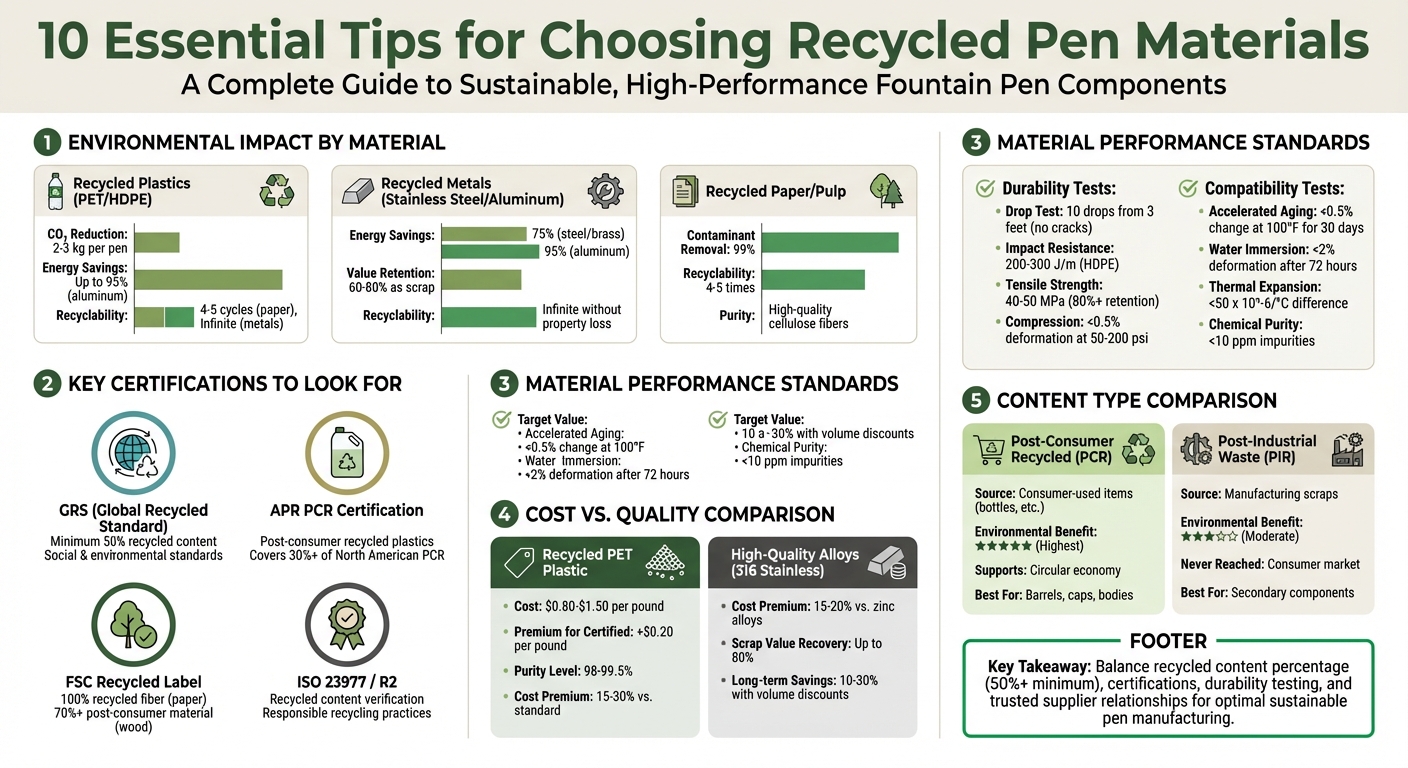
Recycled Pen Materials Comparison: Environmental Impact and Properties
Scrap wood cast into an Elegant Fountain pen
sbb-itb-1dd4fe9
1. Check Recycled Content Percentage
When choosing recycled materials for fountain pens, it’s important to verify the percentage of recycled content in the product. Higher recycled content means less reliance on new plastics and a smaller carbon footprint. This step is key to ensuring your materials align with sustainability goals.
Ask your supplier for detailed technical datasheets (TDS) and product specifications that clearly state the recycled content percentage. Avoid suppliers who provide vague claims without specific numbers. Be sure to clarify if the percentage applies to the entire pen or just specific parts, like the barrel resin. To further confirm accuracy, look for third-party certifications from trusted organizations. Cross-check certificate serial numbers in public databases, and request chain-of-custody documents - such as transaction certificates - that explain how the recycled material was handled. These documents will also indicate whether the material uses segregation (physical recycled content), mass balance (mathematical allocation), or book and claim (credit-based systems).
It’s also vital to distinguish between post-consumer recycled (PCR) content and post-industrial waste. PCR comes from items used by consumers, like recycled water bottles, and offers stronger environmental benefits. In contrast, post-industrial waste consists of leftover manufacturing scraps that never made it to market. For pen components like barrels and caps, PCR is the better choice.
If your supplier can’t provide sufficient documentation, you can still verify materials. Check resin identification codes, such as Code 1 for rPET or Code 2 for rHDPE. Look for physical signs like surface irregularities or slight color variations compared to new plastics. You can also trace lot numbers on delivery notes to ensure recycled materials were properly assigned to the final product. Proper verification ensures your pens meet sustainability standards without sacrificing quality.
2. Verify Material Compatibility with Fountain Pen Components
Making sure all parts of the fountain pen work well together is key to keeping the pen functional while sticking to sustainable practices. Recycled materials must integrate smoothly with components like the nib, feed, and cap. If the materials don’t align, you could face issues like cracking, warping, or disrupted ink flow - problems that can ruin the writing experience. That’s why it’s essential to test compatibility before fully committing to any recycled material.
Start by examining how recycled plastics interact with nib materials. Some plastics may release additives that could harm the nib or mess with ink flow. A good way to test this is by conducting an accelerated aging test. Store the material at 100°F for 30 days and ensure any changes stay under 0.5%. Additionally, measure the contact angle to assess wettability; this helps determine if the material will support smooth ink delivery.
The feed is particularly sensitive to issues like warping or cracking when made from recycled materials. For example, recycled PET or HDPE might absorb moisture, leading to blocked ink channels or cracks caused by the pressure of nib insertion. To test durability, immerse the feed in water or ink for 72 hours and then perform ASTM D790 flexural tests. Deformation should stay below 2%. Recycled ebonite alternatives - crafted from vulcanized rubber, often sourced from tires - are a great option for feeds because they naturally work well with ink.
For parts like the section or grip, watch for dimensional instability. Materials like recycled PLA should maintain shrinkage within 1-3%. Prototype assembly tests can verify this by ensuring nib-section fits remain secure, with gaps no larger than 0.1 mm. For the pen body and cap, it’s important to assess thermal expansion properties. Use differential scanning calorimetry (DSC) to check if the materials expand at similar rates. If they don’t, you might end up with sticking caps or cracked bodies when temperatures range from 32°F to 104°F. Aim for a CTE (coefficient of thermal expansion) difference of less than 50 x 10^-6/°C between the body and cap materials.
Lastly, focus on chemical purity. Choose materials that meet FDA food-contact or USP Class VI standards. Impurities should be kept below 10 ppm, and extractables should remain under 0.5%, verified through HPLC testing. Recycled rPET, like that used in Pilot’s eco-series pens, is a solid choice for pen bodies when stabilized - it showed no warping even after six months of use. Post-consumer ABS blends also perform well in feeds if their purity exceeds 95%, maintaining ink flow rates of 0.02-0.05 ml/min without issues. These tests and standards will help guide you toward the right materials for your pen design.
3. Look for Certifications and Labels
When sourcing recycled materials for pen manufacturing, certifications and labels are your go-to tools for ensuring authenticity. Instead of trusting vague claims like "made with recycled materials", these certifications provide independent verification, confirming that the materials meet rigorous environmental standards. This transparency helps you steer clear of greenwashing while ensuring you're using genuinely sustainable resources.
One of the most respected certifications is the Global Recycled Standard (GRS), which applies to recycled plastics, metals, and paper. GRS-certified materials must contain at least 50% recycled content. Beyond verifying recycled content, the GRS also enforces strict social, environmental, and chemical standards, as highlighted by Troika Germany.
For pen bodies and caps made from post-consumer recycled (PCR) plastics like PET, PP, or HDPE, look for APR PCR Certification from the Association of Plastic Recyclers. This certification covers roughly 30% or more of the post-consumer plastics produced in North America. It's important to distinguish PCR from post-industrial resin (PIR): PCR materials come from items already used by consumers and diverted from landfills, supporting a circular economy. PIR, on the other hand, consists of leftover materials from manufacturing processes.
If you're opting for recycled paper or wood components for pen barrels, the FSC Recycled label is your assurance of quality. This label guarantees that paper products contain 100% verified recycled fiber, while wood products must include at least 70% post-consumer reclaimed material. According to the Forest Stewardship Council, "unlike general 'recycled' claims, which require no verification, the FSC Recycled label provides assurance that all the wood or paper in a product has been verified as genuinely recycled". These certifications work hand-in-hand with technical tests to ensure both sustainability and quality.
Additionally, request Scope Certificates or Transaction Certificates to confirm the chain of custody. These documents trace the material's journey through the supply chain, offering further transparency. For bio-based materials like corn or potato starch, the OK Compost (EN 13432) certification ensures the material will biodegrade by at least 90% within six months under industrial composting conditions.
4. Test Durability and Strength
While certifications confirm the recycled content of materials, they don't guarantee durability. Recycled plastics can lose 15–20% of their strength, so physical testing is essential before using them in fountain pen designs. These tests will help ensure your materials can handle the demands of daily use.
Start with a drop test: drop the pen prototype from 3 feet onto a concrete surface 10 times, checking for cracks or deformation after each drop. To measure energy absorption, use the Izod impact test (ASTM D256). For instance, recycled HDPE should withstand 200–300 J/m, while reinforced recycled PLA should maintain up to 95% of its integrity after 50 drops from 4 feet.
Compression and flexural strength are also critical. Apply 50–200 psi in a compression test and confirm deformation stays below 0.5%. For nib feeds, conduct a flexural strength test, aiming for a modulus above 2,500 MPa. Additionally, recycled ABS should retain at least 80% of its typical tensile strength, which ranges from 40–50 MPa. These metrics ensure the pen remains durable while providing a smooth writing experience.
Evaluate wear resistance by inserting and removing the nib 500 times, ensuring wear stays under 0.1 mm after 1,000 cycles. If specialized equipment isn't available, try a hand bend test: flex the material beyond 10° and monitor it for 30 days to spot any cracking.
For pen barrels, wall thickness matters. Opt for walls between 0.08 and 0.12 inches to boost drop resistance by 50%. Avoid thicknesses over 0.15 inches, as they can add unnecessary weight. Interestingly, a 0.06-inch impact-modified recycled acrylic can improve resistance by 25–40%.
(All test parameters and data are based on industry guidelines.)
5. Evaluate Impact on Writing Experience
Once you've confirmed that the materials are durable and compatible, the next step is to focus on the pen's ergonomics. After all, a pen’s design plays a huge role in creating a comfortable and enjoyable writing experience.
Even though recycled materials can be sturdy, their ergonomic qualities are equally important. Durability alone won’t cut it - a pen’s weight, texture, and balance are what truly determine its comfort. These factors combine to create what’s often referred to as "hand feel." This tactile experience can mean the difference between a smooth, pleasant writing session and one that feels cumbersome. Paying attention to these details ensures both sustainability and user satisfaction, much like following a fountain pen buying checklist to ensure all quality factors are met.
For a full-size fountain pen made from recycled materials, the ideal weight falls between 20–30 grams. A pen that’s too light might feel flimsy and lack control, while one that’s too heavy can cause wrist strain. Balance is just as crucial as weight. To test this, hold the pen horizontally between your thumb and forefinger at the grip. It should feel stable, with the balance point sitting roughly 1–1.5 inches from the nib tip. If the pen feels off-balance, your hand may need to compensate by using extra muscle tension, which can lead to fatigue and less precise writing.
Surface texture is another key factor in comfort. Recycled plastics should have a slightly textured surface, which helps prevent the pen from slipping or rotating in your hand. Matte finishes are particularly effective - they reduce slipperiness and can also hide minor surface flaws. On the other hand, smooth or glossy finishes can feel cold and slippery, forcing you to grip harder and potentially causing discomfort. Make sure to test the pen under different conditions, such as with dry hands and slightly moist hands, to see how the material performs when hands perspire.
Flexibility in the material is another consideration. If the recycled plastic is too flexible, it might cause the nib to shift, leading to scratchy or uneven ink flow. To ensure consistent performance, try writing continuously for 15–20 minutes on various types of paper. Pay attention to whether your grip changes to compensate for imbalance or if the pen slips in your hand - these are signs of potential long-term issues that could diminish the writing experience.
6. Check Source and Purity of Recycled Plastics
After material testing, it’s crucial to confirm where your recycled plastics come from and how pure they are. The origin of the material directly impacts how well your pens perform. For example, post-industrial waste tends to be cleaner and more uniform compared to post-consumer plastics like beverage bottles, which might contain leftover food particles, adhesives, or fragments of incompatible polymers.
Contaminants such as food residues or mixed polymers can lead to issues like unpleasant odors, inconsistent ink flow, or weak structural points in the pen. Reliable suppliers address these risks by using advanced sorting and washing processes to remove impurities, ensuring the plastic maintains the durability and precision needed for long-term use.
Ask for chain-of-custody documentation to trace the plastic’s origin, collection, and processing techniques. Certifications like ISO 23977 (for recycled content verification) or R2 (Responsible Recycling) signal responsible sourcing. Additionally, request material data sheets that include test results for properties like tensile strength, impact resistance, and chemical compatibility with fountain pen inks.
Recycled plastics with a high purity level (98–99.5%) can match or even outperform virgin plastics in terms of durability, often lasting over a decade. While these high-purity options may cost 15–30% more, they help minimize manufacturing defects and reduce warranty claims. It’s also essential to ensure the materials resist water, oil-based, and specialty inks commonly used in fountain pens.
Materials like HDPE (high-density polyethylene) and ABS (acrylonitrile butadiene styrene) are excellent choices for pen components. HDPE is known for its resistance to contamination and its strong, durable properties, making it ideal for pen bodies. Recycled ABS, when carefully sourced, offers superior strength and aesthetic appeal. To avoid surprises, always request samples for independent testing before committing to bulk orders. These steps ensure the recycled plastics meet both performance and environmental goals, providing confidence in the material’s quality while supporting sustainable manufacturing efforts.
7. Consider Recycled Paper and Pulp Options
Using recycled paper-based composites is a smart way to incorporate eco-friendly materials into pen components. These composites are crafted through advanced coating techniques, resulting in durable and protective finishes. Modern recycling methods effectively remove 99% of contaminants, ensuring the cellulose fibers remain intact and high in quality.
It’s important to confirm that recycled pulp undergoes chlorine-free whitening and up-to-date deinking processes. These steps are crucial for maintaining the purity and strength of the fibers. Keep in mind, though, that cellulose fibers can only be recycled about 4–5 times before they lose the length needed for quality papermaking.
When paired with recycled plastics and metals, paper-based composites can play a key role in creating a fully sustainable pen. Adding this option broadens the range of eco-friendly materials, complementing the recycled plastics and metals discussed earlier.
8. Review Metal Recyclability for Hardware
Metal parts like clips, bands, and nibs are essential to the structure of a fountain pen, much like essential fountain pen accessories, and using recycled metals ensures durability without compromising quality. Metals such as stainless steel, aluminum, and solid brass can be recycled endlessly without losing their core properties.
"Metals like steel, aluminum, and brass can be recycled infinitely without losing their essential properties. This concept, known as 'permanent materials,' is the backbone of the circular economy." – Metal Insight Editorial Team
This ability to recycle aligns well with energy-saving and eco-conscious design principles. For example, recycling aluminum conserves up to 95% of the energy required to produce it from raw materials, while stainless steel and solid brass recycling can save around 75% of energy. To ensure metals meet sustainability standards, check for specific alloy designations like "Solid Brass C3604" or "Stainless Steel 316", rather than vague labels like "gold-tone metal." This specificity ensures the material is recyclable and simplifies the recycling process. A simple scratch test can also help - if scratching reveals different colors, the material is likely a non-recyclable plated composite. Additionally, avoid lacquered finishes, as they complicate recycling. If a coating is necessary, Physical Vapor Deposition (PVD) is a better choice, offering durability while maintaining recyclability.
Recyclable metals also provide long-term economic and environmental advantages. While high-quality alloys like 316 stainless steel may cost 15–20% more than cheaper options like zinc alloys, they retain up to 80% of their value as scrap. Similarly, pure metals like copper and aluminum can recover 60–80% of their material value at the end of their lifecycle. This makes them a wise investment for crafting premium fountain pen hardware that supports sustainable practices.
9. Test for Ink and Refill Compatibility
After durability tests, it’s important to verify how well the ink works with the pen's materials. Fountain pen inks are made with a mix of dyes, solvents, and other compounds, so thorough testing is necessary to ensure recycled components don’t leak, clog, or cause stains.
Start by checking for any defects and making sure all materials are properly cleaned. Residues left behind can lead to problems like ink leakage, staining, or clogging. Beyond strength and eco-certifications, good ink compatibility is key to providing a smooth writing experience.
Compare recycled components to OEM (Original Equipment Manufacturer) standards to confirm they perform as well as - or better than - new materials. Problems like streaking, smudging, or uneven ink flow can signal compatibility issues that need addressing.
Work with suppliers who enforce strict quality checks. This ensures recycled materials maintain consistent performance and don’t void warranties, which are protected under laws like the Magnuson-Moss Warranty Act.
10. Balance Cost with Quality from Trusted Suppliers
Finding the right balance between cost and quality is key when sourcing materials. Start by comparing prices from 3-5 suppliers using platforms like ThomasNet or RecycleNet. Keep an eye on metrics like cost per pound, U.S. shipping rates, and minimum order requirements. For instance, recycled PET plastic typically costs between $0.80 and $1.50 per pound, depending on purity. By analyzing these factors, you could uncover savings of 10-20% without compromising material performance. This groundwork helps pave the way for evaluating supplier credentials effectively in the next step.
Certifications are critical when choosing suppliers. Look for credentials such as GRS (Global Recycled Standard) or ISO 9001. These certifications ensure at least 50% recycled content and consistent material quality. While certified materials may cost an additional $0.20 per pound, they reduce risks like ink clogs or weak pen barrels - common problems with lower-quality options. Suppliers with over five years of experience and strong reviews often deliver nearly flawless consistency, while uncertified sources can have rejection rates up to 20% higher.
Before committing to bulk orders, request material spec sheets, samples for hands-on testing, and third-party lab reports. A 2024 case study highlights this approach: a pen manufacturer partnered with Meridian Materials, a U.S.-based supplier, to source recycled polymers. This move reduced costs by 18% (saving $0.12 per pound) while maintaining ISO 9001 standards. The result? A flawless 10,000-unit production run with zero product returns.
Once material quality is confirmed, focus on long-term sourcing strategies. Negotiate volume-based discounts after testing samples. Starting with minimum orders of around 500 pounds can unlock savings of 10-30%, especially when contracts include quality compliance clauses. Building strong relationships with established suppliers can also lead to perks like extended payment terms and bundled testing services, which protect your investment.
In the world of sustainable pen manufacturing, balancing cost and quality is just as important as ensuring material performance. Working with reliable suppliers who understand the demands of precision manufacturing ensures top-notch materials that align with environmental goals. Companies like Fountain Pen Revolution showcase how using quality recycled materials can create exceptional writing tools at accessible price points, proving that trusted suppliers are essential for both sustainability and superior performance.
Conclusion
When selecting recycled materials, focus on those with high recycled content and reliable certifications like GRS or FSC. These certifications help confirm the material's authenticity and quality. Additionally, test the compatibility of these materials with nibs and feeds and barrels to ensure they meet durability standards and maintain smooth ink flow. For hardware, consider sustainable options such as recycled paper, pulp, or metals that can be easily recycled. These choices allow you to balance performance with a reduced environmental footprint.
Certified recycled plastics are another excellent option, offering durability and strength comparable to virgin materials. They help minimize environmental impact while still delivering the precision required for crafting high-quality fountain pens.
FAQs
How can I prove a pen material is truly recycled?
To ensure a pen is made from recycled materials, look for components crafted from items like reclaimed wood, recycled plastics, or vintage pen blanks. These materials come from discarded products or waste that have been reprocessed into durable, reusable parts.
Which recycled plastics work best for fountain pens?
Recycled plastics, such as colorful resins and impact-resistant acrylic resin, are excellent choices for fountain pens. These materials provide durability, vivid colors, and the opportunity to craft unique, visually striking designs. With these features, your pen becomes both a reliable tool and a stylish accessory.
What quick tests catch recycled-material failures early?
When assessing recycled materials, focusing on durability and quality is key. Start by checking the material's resistance to scratches - does it hold up under pressure? Next, examine its color and pattern for consistency. Any variations could hint at underlying issues.
Be sure to inspect for cracks, warping, or other irregularities. For items like fountain pens made from recycled plastics or wood, visual checks combined with tests for structural integrity are crucial to ensure the material can withstand regular use without compromising performance.