

If you want bright color, clear bodies, and a glossy finish, I’d pick resin. If you want a warmer feel, softer shine, and a pen that changes with use, I’d pick ebonite.
Here’s the short version:
- Resin gives me more color choices, more pattern types, and a mirror-like polish.
- Ebonite gives me a warmer touch, more grip, and a softer satin look.
- Resin is usually easier to live with day to day because it resists moisture and indoor wear.
- Ebonite needs more care because UV, heat, and air can dull or shift the surface over time.
- The main comparison comes down to 5 points: color depth, pattern range, surface feel, polish response, and long-term care.
A few facts stand out fast. Resin can be cast clear or translucent, which is why demonstrator pens exist. Ebonite stays opaque and usually comes in darker shades like black, green, oxblood, and navy. Resin also tends to keep its finish with less work, while ebonite can form patina and show oxidation as it ages.
Quick Comparison
| Factor | Resin | Ebonite |
|---|---|---|
| Color look | Bold, bright, high saturation | Softer, muted, low-key |
| Pattern options | Solids, swirls, shimmer, sparkle, clear, translucent | Solids, marbling, mottled looks, stripes |
| Feel in hand | Cool and smooth | Warm and slightly grippy |
| Finish | High-gloss, glass-like | Satin to low-gloss |
| Aging | Usually stable indoors | Can oxidize with sun, heat, and air |
| Care level | Lower | Higher |
So if looks first is your goal, resin often wins. If feel first is your goal, ebonite often makes more sense.
Resin vs Ebonite Pens: Color, Finish & Care Comparison
Resin: Bright Color, Wide Pattern Range, High Gloss
Color Depth and Pattern Options in Resin
Resin gives you the broadest visual range of the common pen materials. It can be made in solid colors, translucent shades, fully clear bodies, swirls, metallic shimmer, and sparkle - all in the same base material. And unlike ebonite, which stays opaque, resin can be cast clear enough to show the ink inside. That’s what makes demonstrator pens possible.
There’s also a big difference between factory acrylic and small-batch artisan resin. Factory acrylics are consistent and repeatable, so a production run usually looks uniform from pen to pen. Small-batch hand-poured resins are different. With layered pours and mica pigments, makers get one-off results where no two blanks match exactly. That bit of unpredictability is a big part of the draw for custom pens.
Surface Feel and Polish Behavior of Resin
In the hand, resin feels cool, smooth, and hard, with a glassy finish. It looks polished and refined. The tradeoff is simple: finger oils can make the grip feel slick during long writing sessions.
Getting resin to a mirror finish takes a step-by-step polishing process. Makers work through finer and finer abrasives, then finish with a plastic polish. The payoff is easy to see. The surface reflects light well and makes the color look deeper. Once that finish is in place, it tends to hold up with very little upkeep.
Long-Term Care and Color Stability of Resin
Resin is non-porous, so it resists oxidation and moisture. Under normal indoor use, the color stays stable. UV-stabilized acrylics can resist yellowing for years, though direct sun and a hot car can still cause damage.
The main risk is abrasion from keys, coins, or other pens rubbing against it in a bag. A soft-lined case helps. So does a quick wipe with a microfiber cloth. If light scratches show up, you can polish them out.
Ebonite goes in another direction: softer color, a warmer feel, and a finish that changes over time.
Fountain Pen Shootout #41: Resin Konrad vs. Ebonite Konrad
Ebonite: Warm Feel, Subtle Depth, Character Over Time
Where resin tends to look bold and bright, ebonite is quieter. It feels warmer, looks more restrained, and tends to gain personality as you use it. Its appeal comes from subtle color depth, a tactile surface, and a finish that changes in a pleasing way over time.
Color Depth and Pattern Style in Ebonite
Ebonite usually stays in a classic palette: black, dark green, oxblood, and navy. Its patterns are often solid, mottled, marbled, or striped, with two or three colors flowing together in smooth, organic waves. Instead of sharp contrast or sparkle, ebonite leans toward deep, muted tones and gentle marbling.
That depth is easy to miss at first glance. In good light, though, the material shows small shifts in tone that give it quiet visual interest. If you write in a professional or formal setting, that lower-key look can feel more at home than a louder resin pattern.
Kaweco describes ebonite's highly polished surface as evoking the appearance of valuable exotic wood.
That same sense of restraint shows up in the way the material feels during use.
Surface Feel and Polish Response of Ebonite
Ebonite feels warm in the hand rather than cold. Since it's a vulcanized rubber material, it warms up fast and has a slightly grippy, almost velvety texture. That bit of friction can help reduce grip pressure in long writing sessions.
It can also take on a polished luster, but not the glass-like mirror finish that resin can reach. That’s part of the point. Ebonite is meant to feel organic and refined, not slick or ultra-reflective. As the pen gets used, the surface often settles into a soft satin look that many enthusiasts like more than high gloss.
And because the finish is softer, wear tends to show more clearly over time.
Aging, Sun Sensitivity, and Routine Care for Ebonite
Ebonite’s main weak spot is oxidation. UV light, heat, and air can shift its color over time, especially on exposed areas. A black pen, for example, may start to show brownish or olive undertones. Vintagepens notes that faded hard rubber can sometimes be improved by polishing away the affected outer layer, which exposes darker material underneath.
For day-to-day care, keep it simple:
- Wipe the pen with a soft microfiber cloth after use.
- Use a small amount of plastic-safe polish only when needed.
- Keep it out of hot cars and direct sun.
- Store it in a closed case or drawer when you’re not using it.
Next, compare ebonite and resin side by side for finish, care, and visual impact.
sbb-itb-1dd4fe9
Resin vs Ebonite: Side-by-Side Comparison for Color and Finish
Here’s the quick read on resin and ebonite when color, finish, and upkeep are the main things you care about.
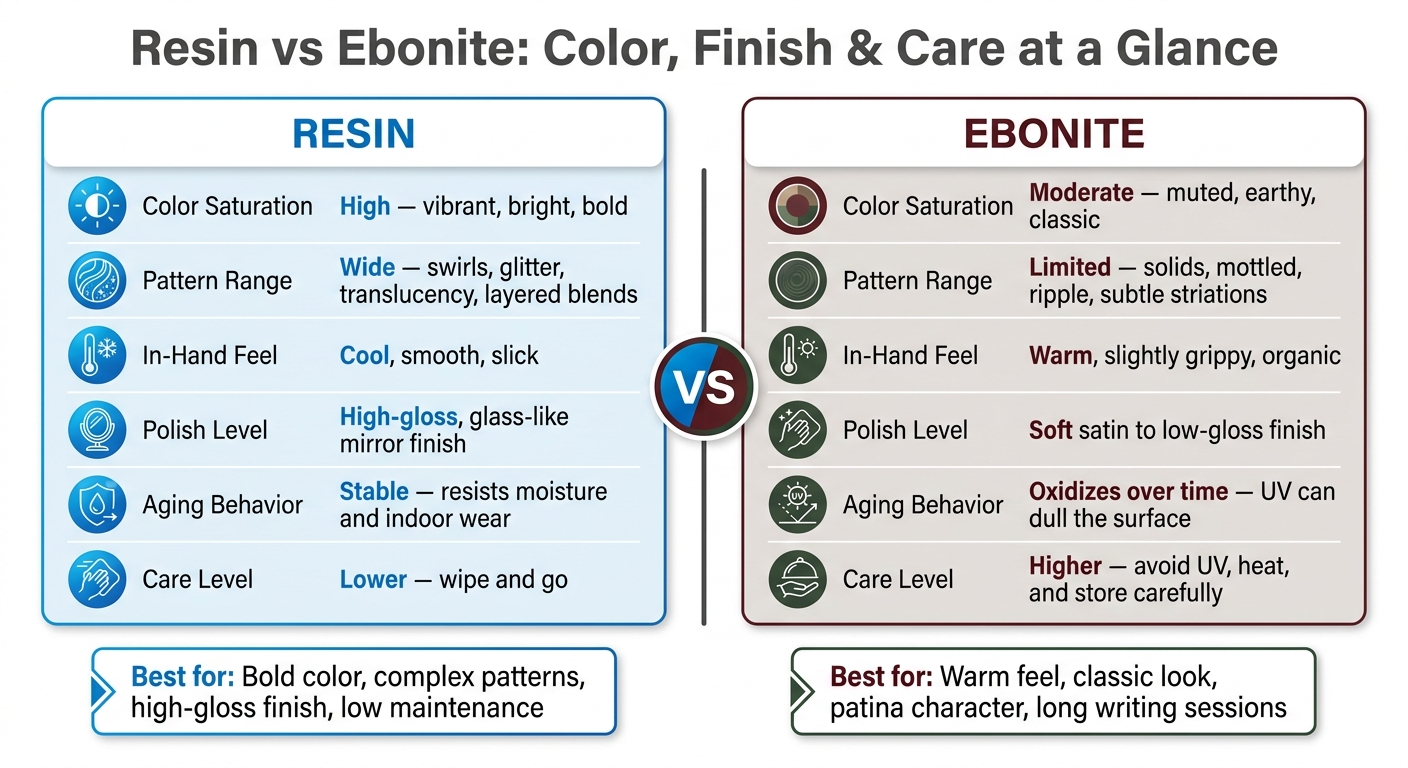
| Criterion | Resin | Ebonite |
|---|---|---|
| Color Saturation | High; vibrant, bright, and bold | Moderate; muted, earthy, and classic |
| Pattern Range | Wide; swirls, glitter, translucency, layered blends | Limited; solids, mottled, ripple, or subtle striations |
| In-Hand Feel | Cool, smooth, and slick | Warm, slightly grippy, and organic |
| Polish Level | High-gloss, glass-like mirror finish | Soft satin to low-gloss finish |
| Aging Behavior | Stable; resists moisture and indoor wear | Oxidizes over time; UV can dull the surface |
At a glance, the split is pretty simple: resin leans into color and shine, while ebonite leans into warmth and age-based character.
Where Resin Has the Edge
Resin stands out most in pure visual appeal. Colors look brighter, patterns have more range, and the glossy finish gives the material that polished, almost glass-like look. Swirls, glitter, translucency, and layered blends also show up more clearly, so the design tends to pop.
If you want a pen that looks bold on a desk, in photos, or in a display case, resin usually has the upper hand.
Where Ebonite Has the Edge
Ebonite shines in the hand. It feels warmer, less slick, and a bit more natural during long writing sessions. Its softer finish also gives it a quieter look, which some people prefer over high shine.
Over time, ebonite develops patina, and that lived-in quality is a big part of the appeal for many enthusiasts. If touch matters more than brightness, ebonite often feels like the better fit.
Use this comparison to match the material to your routine - whether you want bold color and gloss, or a warmer feel with a surface that changes over time.
Choosing the Right Material for Your Pen and Finish Goals
Now that the finish differences are clear, the choice mostly comes down to how you use the pen. Go with resin if you want color and shine. Pick ebonite if you care more about warmth in the hand and the way the material changes with age.
Resin or Ebonite: A Simple Decision Guide
Choose resin if you want bold colors, complex patterns, and a high-gloss finish without much upkeep. Resin is low-maintenance and stable over time, which makes it a good grab-and-go option for daily use or display. If hand feel and aging matter more to you than shine, ebonite is probably the better match.
Choose ebonite if you like a warmer, slightly grippy feel, especially during long writing sessions, and don't mind a bit of extra care. Its softer luster and slowly developing patina tend to appeal to writers who want a classic look instead of visual brightness.
Key Takeaways
Choose resin for color and gloss. Choose ebonite for warmth and character.
FAQs
Which material is better for daily carry?
For daily carry, modern resins like acrylic and plastic are usually the better pick. They hold up well to bumps, resist impact, and don’t ask for much upkeep.
Ebonite has a warm feel in the hand and a look that stands out. But it’s also more brittle and needs extra care, including protection from UV light and moisture. For most people, resin is the easier everyday option.
Does ebonite always change color over time?
Not always. Ebonite can oxidize as it ages, which may dull the finish or leave behind a brown, greenish, or gray patina. And it doesn’t happen the same way with every pen - some change more than others.
Good care can slow that process down. If you store ebonite pens in a cool, dark, dry place, they’re more likely to keep their original color and luster for decades.
Can scratches be polished out of both materials?
Yes. Resin scratches can usually be polished out. The usual fix is wet-sanding with micro-surface pads, then using a plastic polish on a buffing wheel to bring the gloss back.
Ebonite scratches can also be removed by working through micro-mesh grits and finishing with a 12,000-grit sheet for a glossy surface.
With both materials, go slowly and polish with care. If you get too aggressive, you can wear away decorative imprints or alter the pen’s shape.