

Most custom fountain pen clogs start with three things: poor fit, dry time, and the wrong ink. If I want a modified pen to keep writing, I need to flush it every 3 to 4 weeks, use cleaner-flowing dye ink in tight grinds, and store it the right way for the nib setup.
Here’s the short version:
- Custom pens clog more often because swapped nibs, custom grinds, feed changes, and eyedropper conversions can disrupt ink flow.
- Early signs show up first: hard starts, skipping, lighter lines, railroading, and crust around the nib.
- Idle time is a big problem because ink evaporates, thickens, and leaves residue in the feed.
- Routine flushing stops many clogs before they turn into a full blockage.
- Ink choice matters: standard dye inks are usually the safest; shimmer, pigmented, iron gall, and heavy-sheen inks need more care.
- Storage matters too: some pens do better nib-up, while others do better flat.
A few facts stand out: flushing every 3 to 4 weeks is a good baseline for pens in regular use, and custom needlepoints or extra-fine grinds often need even more care because their ink path is so tight.
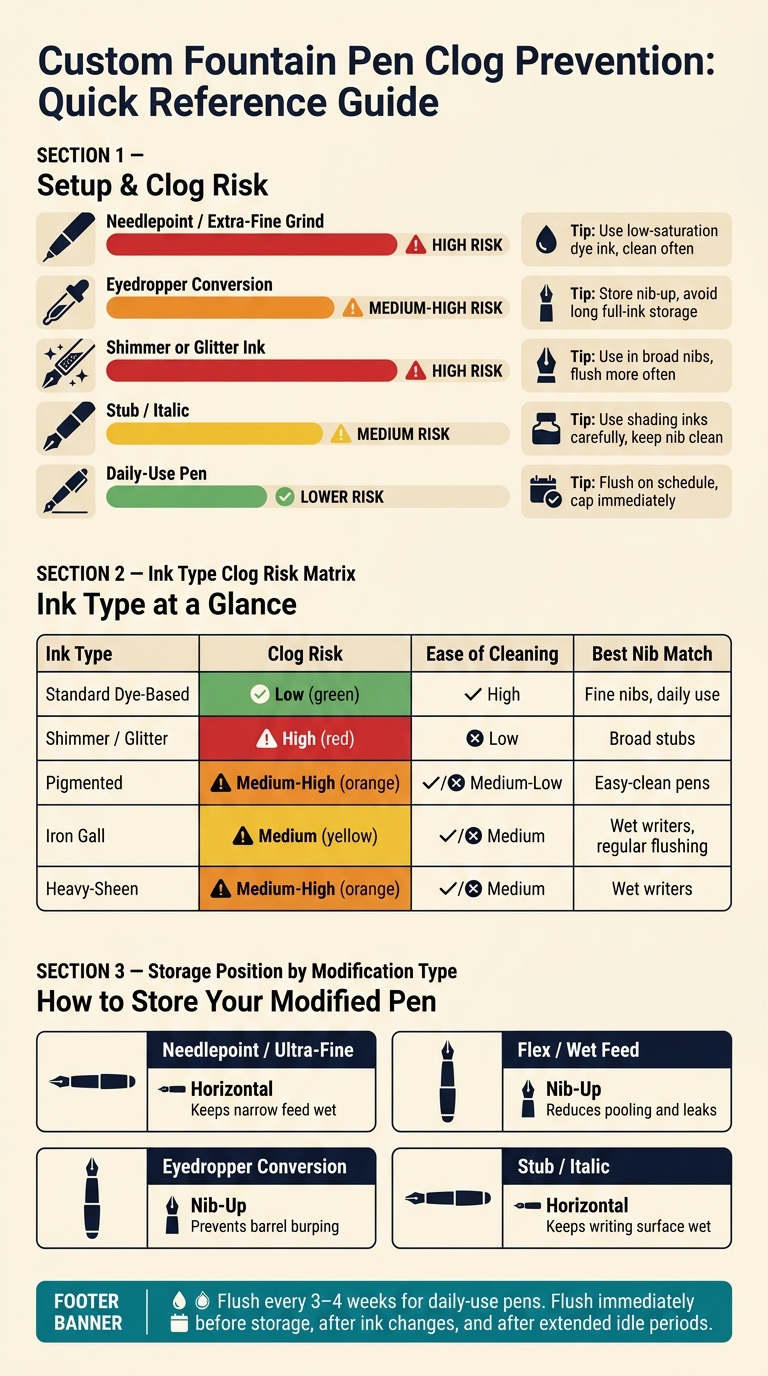
Custom Fountain Pen Clog Risk: Ink Types vs. Nib Setups at a Glance
Clogged ink???😩 long term TEST of thick & shimmer inks
If your pens are struggling with these heavy inks, a fountain pen cleaning kit can help clear stubborn clogs.
sbb-itb-1dd4fe9
Quick Comparison
| Setup or Factor | Clog Risk | What I’d Do |
|---|---|---|
| Needlepoint / extra-fine grind | High | Use low-saturation dye ink and clean often |
| Stub / italic | Medium | Use shading inks with care and keep the nib clean |
| Eyedropper conversion | Medium-High | Store nib-up and avoid long periods full of ink |
| Shimmer or glitter ink | High | Use in broader, wetter nibs and flush more often |
| Daily-use pen | Lower | Flush on schedule and cap it right away |
| Pen left unused for weeks | High | Clean before reuse and don’t store it inked |
If I keep ink moving, clean before residue hardens, and match the ink to the nib, I can avoid most clog problems before they start.
How Ink Flow Works and What Raises Clog Risk
Flow Basics in the Nib and Feed
Those early warning signs often begin with a flow problem inside the feed. In a fountain pen, ink moves by capillary action. It travels from the reservoir, through the feed’s ink channels, and into the nib. At the same time, air moves back in to replace that ink, which keeps flow steady and pressure in check.
When that balance gets thrown off - say, from a misaligned nib or a blocked breather hole - ink can stop moving the way it should. It may stall in the feed instead of reaching the tip cleanly. If the pen then sits unused, moisture starts to evaporate. The ink gets thicker, and residue begins building inside the feed. As Art Brown explains:
"As the moisture evaporates, the remaining ink becomes thicker and eventually forms residue inside the feed. Once enough ink dries there, the flow slows and the pen starts skipping - or stops writing altogether."
That balancing act gets tougher in modified pens.
Why Eyedroppers, Custom Grinds, and Nib Swaps Clog Faster
Custom pens tend to clog sooner when the nib and feed do not fit together quite right or when the air path is disrupted. A tiny gap can be enough to affect flow. So can a narrow grind or an altered feed. When ink slows down before it reaches the nib, it spends more time sitting in the feed. And when ink sits, it dries. That dried ink can then collect and harden inside the channels.
Environmental and Usage Factors That Dry Ink Out
Even a well-tuned custom pen can clog if it sits for too long. One of the biggest risk factors is simple: not using it often enough. Regular writing keeps ink moving, which helps slow residue buildup. Long idle periods do the opposite. They give ink time to evaporate and leave hardened residue in the feed, which makes drying out much more likely.
That’s why regular flushing matters before residue turns into a full clog. Routine flushing is the simplest way to break that drying cycle.
Cleaning Routines That Stop Clogs Before They Start
Once residue starts to slow ink flow, flushing is the fastest fix. It also does the most to stop a clog before it forms. A simple rinse now and then keeps dried ink from turning into a bigger problem.
How Often to Flush Based on Ink Type and Use
For pens you use every day, or almost every day, flush them every 3 to 4 weeks. If you use shimmer inks, highly saturated inks, or waterproof inks, clean them more often.
A few cases call for immediate cleaning:
- Changing ink colors - flush first so colors don't mix and leftover particles don't stay behind
- After extended storage - if a pen has been unused for several weeks or months, clean it before refilling
- Before putting a pen away for more than a few days
Safe Preventive Cleaning Steps for Custom Pens
Flush the nib and feed with cool or lukewarm water using the pen's normal fill system. Keep going until the water runs clear. If the rinse still looks tinted after a few cycles, let the nib section soak in a small cup of clean water for several minutes. That can help loosen trapped particles.
After that, gently shake out the extra water. Let the pen air-dry fully on a lint-free cloth before you refill it. And with any custom pen, don't force disassembly past what the pen is built to allow. If parts aren't meant to come apart, pushing them can cause permanent damage.
When to Use Water, Soap, or Distilled Water
Use the mildest cleaning method that gets the feed clear without putting stress on the pen.
| Cleaning Method | Best Use Case | Safety Notes |
|---|---|---|
| Plain water | Routine flushes and ink changeovers | Use room-temperature or lukewarm water only; hot water can damage seals and pen materials |
| Mild dish soap solution | Stubborn ink residue after standard rinsing | Use a small drop and rinse thoroughly until no soap remains |
| Filtered or distilled water | Pens used in hard-water areas | Helps prevent mineral deposits inside the feed |
Choosing Inks That Keep Custom Pens Writing Reliably
Ink Types That Clog More Easily
Once the feed is clean, ink choice is the next big call if you want to avoid clogs. At the core, it comes down to one thing: does the ink leave particles or deposits behind?
Standard dye-based inks are usually the safest pick. Shimmer, glitter, pigmented, and iron gall inks clog more easily because they can leave particles or deposits in tight feeds.
Heavy-sheen inks are still dye-based, but their high dye load can crust on the nib and feed. That doesn’t mean they’re off-limits. It just means they ask more from the pen.
Matching Ink to Needlepoint, Stub, Italic, and Eyedropper Setups
The best ink depends on how your nib was modified.
Needlepoint and extra-fine grinds have the tightest tolerances of any custom setup. Small margins mean less room for error. These grinds do best with the cleanest inks, so stick to well-lubricated, low-saturation dye inks. If a needlepoint feels dry or scratchy, try a more lubricated dye ink before jumping to pigmented or iron gall formulas.
Stubs and italics have wider tipping surfaces and usually move ink more freely. Because of that, they can handle shading inks and moderate sheeners with fewer issues. Shimmer inks are still safer in medium or broader, wetter nibs than in ultra-fine customs. A small habit helps too: gently invert or roll the pen before writing to re-mix settled particles.
Eyedropper conversions hold a lot of ink in direct contact with the barrel. That setup makes residue buildup, evaporation, and barrel staining more likely over time. Low-staining dye inks are the practical pick, especially if you want to keep the barrel clear.
Ink Changeovers, Fill Volume, and Rotation Habits
Different ink families leave different residue, so flush well between changes. Always do a full water flush between ink types.
Fill volume matters more than many writers think. If a pen isn’t in daily use, fill only what you expect to use soon. Less idle ink means less evaporation and less thickening.
| Ink Type | Clog Risk | Ease of Cleaning | Best Custom Match |
|---|---|---|---|
| Standard Dye-Based | Low | High | Fine nibs, daily use |
| Shimmer/Glitter | High | Low | Broad stubs |
| Pigmented | Medium-High | Medium-Low | Pens that can be cleaned easily |
| Iron Gall | Medium | Medium | Wet writers with regular flushing |
| Heavy-Sheen | Medium-High | Medium | Wet writers |
Storage, Daily Handling, and Early Action
Daily Habits That Cut Down on Evaporation and Debris
Once the feed is clean and the ink is a good match, daily handling helps stop residue from building up again.
Cap the pen right after each pause. Needlepoints, stubs, and eyedroppers gain the most from quick capping and gentle use. Use light pressure. If you press too hard, you can splay the tines on a modified nib, and that can trap paper fibers and slow the ink flow. Low-lint paper also helps keep debris out of narrow feeds. After each writing session, wipe the nib and section with a lint-free cloth so ink on the nib doesn't dry into residue.
How to Store Modified Pens Short Term and Long Term
When the pen isn't being used, storage is your next line of defense against clogs.
| Modification Type | Recommended Storage | Why It Helps |
|---|---|---|
| Needlepoint / Ultra-Fine | Horizontal | Keeps the narrow feed wet |
| Flex / Wet Feed | Nib-Up | Reduces pooling and leaks |
| Eyedropper Conversion | Nib-Up | Reduces "burping" caused by air expansion in the barrel |
| Stub / Italic Grinds | Horizontal | Keeps the writing surface wet for clean starts |
Modified feeds and eyedroppers hold residue longer, so storage habits matter more here than they do with standard pens. If you're storing a pen for more than a week, flush it all the way and store it empty. Keep pens away from heat vents and direct sunlight. Temperature swings can make the air inside an eyedropper barrel expand and push ink out through the feed.
If a pen starts drying between fills, step in early. At the first sign of a dry start or a darker, drier-looking line, touch the nib briefly to distilled water to rehydrate the feed.
Conclusion: Core Rules for Preventing Ink Clogs
Every modification changes how a pen moves ink, so prevention works best when your habits fit the setup. If you're using a needlepoint, an eyedropper, a stub, or another modified nib, adjust your cleaning schedule, ink choice, and storage position to match. Flush on a set schedule, not only when trouble shows up. Store pens in steady conditions, cap them right away, and respond to early signs like common nib issues including a hard start, a color shift, or a thinner line before residue hardens. Most clogs can be avoided, and early action makes them much easier to clear.
FAQs
How do I know if my custom pen needs flushing sooner?
Your pen likely needs flushing if you notice hard starts, skipping, stuttering, ink starvation, or railroading.
You might also spot trapped paper fibers or dark residue between the tines under bright light. And if you have to press harder than usual to keep the ink flowing, it’s time for a flush.
Can a clogged pen be fixed without taking it apart?
Yes. Mild clogs can often be cleared without taking out the nib and feed.
Start by flushing the pen with lukewarm water. A bulb syringe helps here, since you can push water through the feed until it runs clear. Simple, but it often does the job.
If that still doesn't work, soak the nib and feed section in room-temperature water with either:
- a drop of dish soap
- a mild ammonia solution
Let it soak for 12 to 24 hours, then flush it again.
Which inks are safest for extra-fine or needlepoint nibs?
Use fountain pen-specific, water-based inks. They have the right viscosity to flow well through delicate extra-fine or needlepoint nibs.
Avoid calligraphy or India inks. They’re thicker, and they can clog the nib and feed fast. Ink made for fountain pens helps keep writing smooth and reduces the risk of damage.