

Smudging ink is a common problem, especially for fountain pen users. It happens when ink doesn't dry fast enough and gets disturbed by your hand or other factors. Here's how you can avoid it:
- Use smaller nibs (Extra Fine or Fine) to reduce the amount of ink on the page.
- Choose fast-drying inks like Waterman Serenity Blue or Noodler's Dark Matter.
- Pick the right paper - uncoated or lightly coated options like Midori MD absorb ink faster while maintaining clean lines.
- Adjust your writing technique by keeping your hand behind the fresh ink and slowing down your speed.
- Test your setup with a simple smudge test to find the best combination of nib, ink, and paper.
For left-handed writers, rotating the page can help prevent your hand from dragging through wet ink. Regular pen cleaning also ensures steady ink flow, reducing excess wetness. By fine-tuning these elements, you can enjoy smudge-free writing.
How to Use a Fountain Pen: A Beginner’s Guide (No Smudges, No Stress) | Cloth & Paper
Why Ink Smudges When You Write
Ink smudging happens when the ink is disrupted before it has a chance to dry. This can be caused by your hand, environmental factors like humidity, or even the type of paper you're using.
Main Factors That Cause Smudging
There are four main culprits behind ink smudging: ink drying time, nib size, paper absorbency, and writing habits.
Nib size plays a big role in smudging. Larger nibs - like Broad, Stub, or wet Medium - release more ink onto the paper, which means more drying time is needed. On the other hand, smaller nibs like Extra Fine or Fine deposit less ink, reducing the risk of smearing. Here's a quick breakdown of how nib size impacts smudging:
| Nib Size | Smearing Risk | Best Use Case |
|---|---|---|
| Extra Fine | Lowest | Fast notes, small handwriting, office paper |
| Fine | Low | Everyday writing and note-taking |
| Medium | Moderate | Smooth daily writing and journaling |
| Broad / Stub | Highest | Signatures, expressive writing, ink effects |
The type of paper also matters. Smooth, high-quality paper may prevent issues like feathering or bleed-through but slows down ink absorption, increasing the chance of smudging. And don't overlook the environment. As Ferris Wheel Press notes:
"In humid conditions, the air already contains a high level of moisture. This slows down evaporation, which is the process that allows ink to dry."
Types of Ink Smudging
Smudging doesn't always look the same. There are two main types to keep in mind:
Hand-dragging: This happens when your hand or fingers move across a freshly written line before the ink has dried. It's especially common for left-handed writers since their hand naturally follows the pen's path across the page.
Friction smearing: This is sneakier because it occurs after the ink seems dry. Inks that are highly saturated or have sheening properties can leave a layer of dye or particles on the paper's surface. These can rub off later due to pressure from a hand, clothing, or even the opposite page of a notebook. As one source humorously puts it:
"Highly saturated dyes stay slick. They smear if you look at them the wrong way."
Quick Smudging Diagnosis Checklist
If you're trying to figure out why you're dealing with smudges, ask yourself these questions about your setup:
- Ink: Are you using a sheening, shimmer, or highly saturated ink?
- Nib: Is your nib size Medium or larger, or does your pen have a high flow rate?
- Paper: Is the paper smooth, coated, or labeled as "fountain pen friendly"?
- Environment: Is the room hot or humid right now?
- Technique: Does your hand or palm drag over the ink as you write?
- Skin: Are your hands particularly sweaty or oily today?
If you answered "yes" to two or more of these, you've likely found the cause - or a combination of factors contributing to the problem. Understanding these elements can help you tweak your approach and reduce smudging in the future.
Writing Technique Adjustments to Reduce Smudging
Once you’ve figured out what’s causing those annoying smudges, it’s time to tweak how you write. A few adjustments to your grip, hand position, and writing speed can make a big difference - no fancy tools required.
Pen Angle and Grip
The angle and grip of your pen play a huge role in how smoothly ink flows. Aim to hold your pen at a 40–55° angle. This encourages steady ink flow and reduces ink pooling. To keep that angle naturally, try a relaxed tripod grip: lightly hold the pen between your thumb and index finger, with the barrel resting on your middle finger. Avoid gripping too tightly - excess pressure can mess with gravity and capillary action, leading to uneven ink flow. Also, focus on moving your pen from your forearm rather than just your fingers; this helps maintain a consistent angle as you write across the page.
Hand Position and Page Orientation
Positioning your hand correctly can also cut down on smudging. Keep your hand behind the ink instead of resting it on fresh marks. For left-handed writers, hand position is especially important. You’re likely either an underwriter (wrist straight, hand below the writing line) or an overwriter (wrist curled over the line). Underwriting is ideal since it mimics the posture of right-handed writers and avoids dragging your hand through wet ink.
If you’re an overwriter, pen expert Ella Samson from Jespers of Harrogate suggests:
"If you're an overwriter, try rotating your paper 45-90 degrees clockwise. This lets you pull the pen at an angle rather than pushing it straight across."
To keep your paper steady, consider using a clipboard or a non-slip mat - especially if you’re working on a smooth surface.
Writing Speed and Blotting
Fast writing with a wet nib often leads to smudging. Slowing down can give the ink more time to dry, but if that’s not practical, try placing a blotting sheet under your hand. This technique is particularly useful during lengthy writing sessions or when using broader nibs that lay down more ink with each stroke.
| Situation | Dry Time | Preferred Ink Traits |
|---|---|---|
| Fast meeting notes | 5–15 seconds | Moderate flow, low smear |
| Long study sessions | 5–20 seconds | Quick-dry, low feathering |
| Travel journaling | 15–30 seconds | Controlled flow, lubrication |
Up next, we’ll dive into choosing tools that can help reduce smudging even further.
sbb-itb-1dd4fe9
Choosing the Right Tools to Avoid Smudging
Once you've honed your writing technique, selecting the right tools can significantly reduce smudging. The combination of nib size, ink, and paper plays a big role in minimizing drying time and ensuring a smoother writing experience.
Nibs and Inks That Dry Faster
Smaller nibs, such as Extra Fine (EF) or Fine (F), release less ink onto the page, which helps the ink dry faster. On the other hand, broad and stub nibs lay down more ink, which takes longer to dry. Here's a quick breakdown of how nib size and ink volume impact performance:
| Nib Size | Ink Volume | Tool Performance Benefit |
|---|---|---|
| Extra Fine | Minimal | Dries the fastest; works well with quick-dry inks |
| Fine | Low | Reliable for everyday use with most inks |
| Medium | Moderate | Balanced flow; pairs nicely with fast-drying inks |
| Broad / Stub | High | Best for slower, intentional writing due to longer drying times |
For daily use, stick to standard inks rather than those with special effects, as these tend to dry faster. A popular choice is Waterman Serenity Blue, which offers consistent performance. If you prefer darker tones, Noodler's Dark Matter is a reliable, fast-drying option. For left-handed writers or those who write quickly, pairing an EF or F nib with a quick-dry ink is one of the best ways to combat smudging.
"Highly saturated dyes stay slick. They smear if you look at them the wrong way." - Yonkey Donkey
Keeping Your Pen Clean for Steady Ink Flow
A dirty pen can lead to ink pooling, which increases wetness and smudging, regardless of how fast the ink is supposed to dry. Regular cleaning is essential to maintain steady ink flow and prevent issues.
"Fountain pen ink smears when it has not fully dried or when too much ink sits on the paper surface. Wet inks, broad nibs, coated paper, and hand contact can all increase smearing." - Pen Chalet Team
To keep your pen in top shape, rinse it every few weeks to remove ink buildup. If you frequently switch inks or use pigmented formulas, clean it even more often. For those looking for easy-to-maintain pens, Fountain Pen Revolution offers affordable options starting at $29, including pens designed for simple disassembly and cleaning.
How Paper Affects Ink Drying and Smudging
The type of paper you use also has a major impact on ink drying time. Smooth, coated papers like Rhodia are great for producing crisp, vibrant lines, but they keep the ink on the surface longer, increasing the likelihood of smudging.
"Coated paper helps ink sit on top of the page longer, so it doesn't feather and bleed. The inks tend to be more vibrant and crisp, but the dry time can be slower, so smudging is more likely if you're not careful." - Riya, Riyaswritingroom.com
For everyday writing, where smudging is a concern, lightly coated or uncoated papers like Midori MD strike a good balance. These papers absorb just enough ink to speed up drying while maintaining clean lines. On the other hand, highly absorbent papers, such as standard copy paper, dry ink quickly but can cause fuzzy edges due to excessive absorption.
Testing Your Setup for Smudge-Free Writing
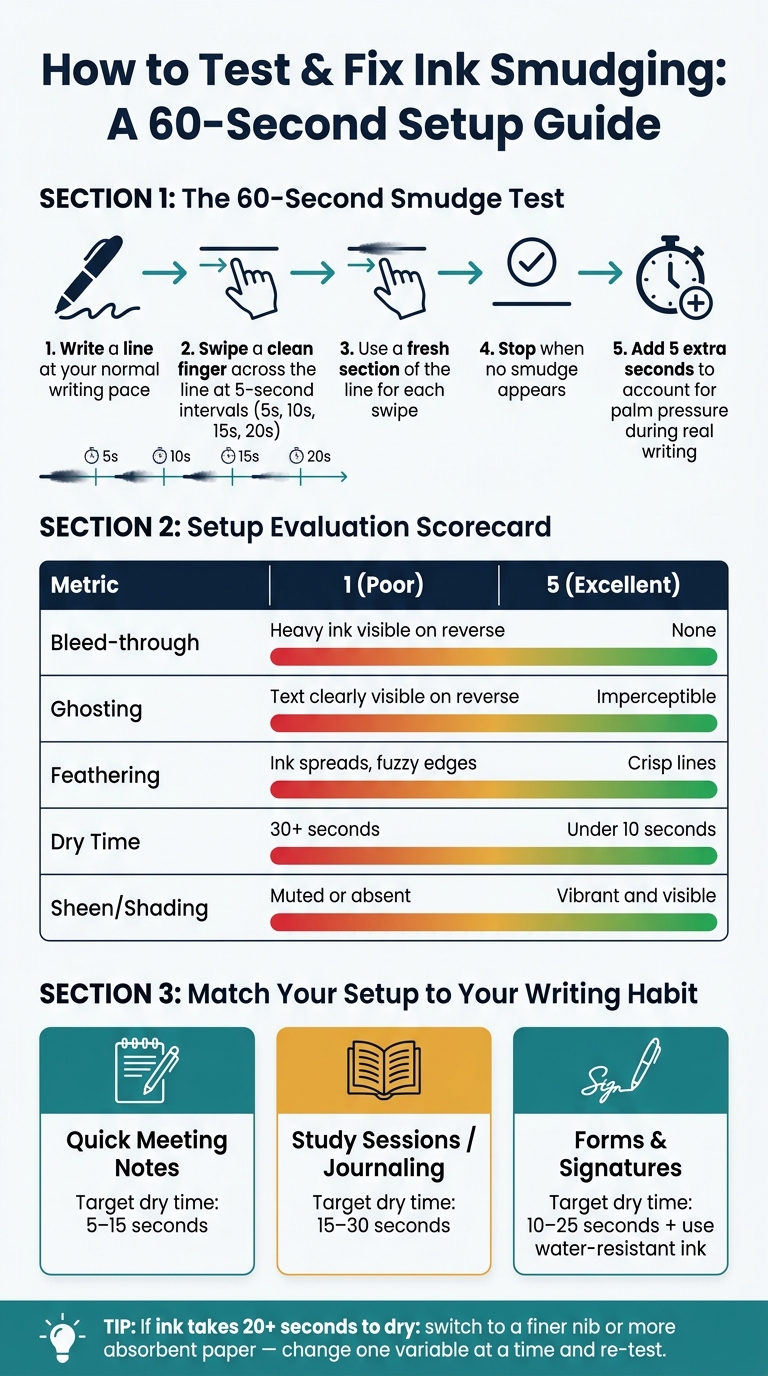
How to Test & Fix Ink Smudging: A 60-Second Setup Guide
Before smudges ruin your notes, test your ink setup with a simple, structured approach. This method helps you understand how your ink, nib, and paper interact, so you can make adjustments before committing to important writing tasks.
How to Conduct a 60-Second Smudge Test
Start by writing a line at your usual pace. Then, swipe a clean finger across a section of the line at 5-second intervals: first at 5 seconds, then 10, 15, and 20 seconds. Use a fresh section of the line for each swipe. Stop testing as soon as you see no smudge.
To account for heavier palm pressure during actual writing, add an extra 5 seconds to the time it takes for the ink to dry completely.
"Dry time isn't a single number. It's a chain reaction." - Yonkey Donkey
Dry time is influenced by the wetness of the nib, the absorbency of the paper, and the saturation of the ink. If you adjust any one of these factors, the dry time will change. Keep track of your results to help guide future tweaks.
Tracking and Reading Your Test Results
Write down the ink type, nib size, and paper used during your test. This way, you won’t have to repeat the process for the same combination later.
When analyzing your results, look for smearing, which occurs when the ink remains wet. Also, check for feathering - this happens when the ink spreads, creating fuzzy edges. While they may look similar, they stem from different issues, so distinguishing between the two is important.
For a more complete evaluation, score your setup across five key metrics using a 1–5 scale:
| Evaluation Metric | 1 (Poor) | 5 (Excellent) |
|---|---|---|
| Bleed-through | Heavy; ink visible on reverse | None |
| Ghosting | Text clearly visible on reverse | Imperceptible |
| Feathering | Ink spreads; fuzzy edges | Crisp lines |
| Dry Time | 30+ seconds | Under 10 seconds |
| Sheen/Shading | Muted or absent | Vibrant and visible |
These scores will help you determine whether your current setup aligns with your writing needs.
Applying Test Results to Daily Writing
Once you’ve tested your setup, use the findings to match your tools to your writing habits. For quick meeting notes, aim for a setup where the ink dries in 5–15 seconds. If you’re journaling and have time to pause between lines, 15–30 seconds may work fine. For forms or signatures, aim for 10–25 seconds with a water-resistant ink.
If your ink takes longer than 20 seconds to dry, start troubleshooting by changing one variable at a time. For example, switch to a finer nib to reduce the amount of ink on the page, or choose a more absorbent paper. Re-test after each adjustment to pinpoint the root of the issue.
"The page doesn't forgive. Wet ink keeps receipts. One lazy pass of your palm, and your notes turn into a fingerprinted confession." - Yonkey Donkey
Left-handed writers often face smudging even after testing. To avoid this, try rotating the page clockwise and writing with your hand below the line. This technique keeps your hand away from freshly written ink, reducing the chance of smears.
Conclusion: Steps to Smudge-Free Writing
Achieving smudge-free writing is all about fine-tuning your tools, technique, and testing approach.
Start by selecting an Extra Fine or Fine nib to reduce the amount of ink applied to the page. Pair this with fast-drying inks and moderately absorbent paper to ensure shorter drying times. Once you've set up your writing essentials, run a simple smudge test to check if it aligns with your writing style and speed. Adjusting one element at a time - whether it's the nib size, ink, or paper - can help you pinpoint and address any smudging issues.
If you're still exploring options, check out Fountain Pen Revolution. They offer affordable fountain pens starting at $29, with a variety of nib sizes like Extra Fine and Fine, making it easier to refine your setup and achieve clean, smudge-free pages.
FAQs
How can I tell if my ink is “wet” or my pen is writing too wet?
To figure out if your ink or pen is "wet", pay attention to how the ink interacts with the paper. Wet inks or pens with high ink flow tend to leave more liquid, which can result in longer drying times, thicker lines, or even feathering (those blurry edges around your writing). Here's a quick test: after writing, wait about 30 seconds and gently drag your finger across the text. If it smudges, your ink or pen might be too wet. Brands like Fountain Pen Revolution provide inks and nibs that can help you achieve a better balance.
What should I change first if my ink still smudges after 20 seconds?
If your ink still smudges after 20 seconds, it might be time to reevaluate your paper and nib choices. Smooth, coated paper tends to slow down ink drying, so opting for more absorbent paper could make a difference. Similarly, broad nibs release more ink, which naturally takes longer to dry. Switching to a finer nib can help speed up the drying process.
Another option is to try a faster-drying ink. Brands like Fountain Pen Revolution offer a variety of inks and nibs, making it easier to find the perfect combination for your writing style.
How do I prevent smudging without giving up broader or stub nibs?
To keep smudging at bay when using broad or stub nibs, opt for drier-flowing ink and slightly absorbent paper to help ink dry faster. Place blotting paper under your hand to catch any extra ink and reduce the chance of accidental smears. Finally, give the ink enough time to dry completely before handling or flipping the page.