

Fountain pen nibs are made from different alloys, and the material affects how a pen writes, feels, and lasts. Gold vs steel nibs differ significantly; gold is softer and more flexible, while stainless steel is firmer and more durable, ideal for everyday use. Titanium offers a balance between the two, with some flexibility and unique feedback. Palladium is highly flexible but delicate, suited for light, expressive writing.
Key factors to consider when choosing a nib alloy include:
- Flexibility: Gold and palladium offer more flex for line variation; steel is firm and consistent.
- Durability: Steel is the most robust, while gold and titanium resist corrosion.
- Ink Flow: Softer alloys like gold and palladium provide wetter, smoother ink flow.
- Writing Style: Steel suits heavy-handed writers; gold and titanium cater to lighter, longer writing sessions.
Ultimately, the alloy impacts the nib’s feel, but the tipping material and polish determine smoothness.
Understanding Nib Alloys
What Are Nib Alloys?
A fountain pen nib is made up of two key metal components: the body alloy and the tipping alloy. The body alloy - the larger, visible part that gives the nib its shape - is typically made from materials like stainless steel, gold, titanium, or palladium. This part defines how the nib feels during use, influencing factors like flexibility, springiness, and how it absorbs impact. On the other hand, the tipping alloy - a small, hard pellet bonded to the nib’s tip - is what actually touches the paper. This material needs to be extremely durable to resist friction and wear from writing.
"Ultimately, it is the 'iridium' material that is in contact with the surface of the paper and neither the gold or steel nib body material." - Glenn Abramczyk
While many nibs are stamped with "Iridium Point", actual iridium is rarely used today because of its scarcity. Instead, modern manufacturers use blends of hard metals like tungsten, cobalt, or ruthenium, which deliver comparable durability and resistance to wear.
Let’s explore how these materials influence the nib’s flexibility, durability, and resistance to chemical damage.
Core Properties of Nib Alloys
Three key properties of nib body alloys shape the writing experience:
Flexibility
Flexibility refers to how much the tines - the two prongs at the nib’s tip - spread apart under pressure. Softer materials like gold and palladium allow the tines to flex more, creating varied line widths and releasing extra ink when pressed. Stiffer alloys, such as stainless steel, keep the tines tight for consistent strokes. As Bottle and Plume explains:
"Gold's softness does give a different feedback or cushioned feel, but if you take two nibs with identical tipping shape, one steel and one gold, and write normally, both can be equally smooth."
Wear Resistance
The tipping alloy plays the most significant role in wear resistance, as it endures constant friction against the paper. Modern tipping materials are engineered to last for years without significant wear. However, the body alloy also plays a part - softer metals like gold can deform or develop small bends if exposed to excessive pressure over time.
Corrosion Resistance
Corrosion resistance is especially critical when using acidic inks like iron gall ink, which can be highly corrosive. Gold is naturally resistant to chemical reactions, which is why it has long been a preferred material for nibs. While modern stainless steel alloys have improved significantly and can handle most inks, gold and titanium still provide superior protection against chemical damage over extended use.
Each of these properties contributes to the overall performance and longevity of a fountain pen nib, making material choice an essential consideration for both casual writers and enthusiasts.
sbb-itb-1dd4fe9
FOUNTAIN PEN NIBS DEMYSTIFIED- A COMPREHENSIVE OVERVIEW- PART 2
Common Nib Alloys Explained
Let’s dive into how different nib materials - stainless steel, gold, titanium, and rarer options like palladium - affect the writing experience.
Stainless Steel Nibs
Stainless steel is the go-to material for many fountain pen nibs, prized for its durability and reliability. These nibs deliver a consistent, firm line with minimal flex, making them ideal for writers who value control and predictability. If you're still refining your writing style and nib size preference, a steel nib can be a great choice.
"A well-tuned steel nib can outperform a poorly finished gold nib." - Bottle and Plume
Modern stainless steel alloys, such as type 316L, are incredibly strong, with a yield strength of up to 760 MPa thanks to work-hardening during production. This strength makes them resistant to bending while keeping them affordable, with prices typically ranging from $15 to $80 depending on the pen. It's a practical option that balances performance and cost.
Gold Nibs
Gold nibs are often seen as the pinnacle of fountain pen craftsmanship. They offer a softer, more flexible writing experience, which can reduce hand strain during extended writing sessions.
Gold nibs are available in different purities: 14k (58.5% gold), 18k (75% gold), and 21k (87.5% gold). Each has its own characteristics:
- 14k nibs: A good mix of flexibility and strength, suitable for everyday use.
- 18k nibs: Softer and more cushioned, perfect for journaling or relaxed writing.
- 21k nibs: Known for their refined feedback, often described as pencil-like, with Sailor being a notable maker of these.
Gold is also naturally resistant to corrosion, which explains why some gold nibs from over a century ago still write beautifully today. This durability and premium feel make gold nibs a favorite among enthusiasts.
Titanium Nibs
Titanium nibs sit between steel and gold in terms of performance. They offer more flexibility than steel but remain sturdier than gold, providing a unique, brush-like feedback that rewards a gentle touch.
However, titanium nibs require some care. They can warp or "spring" if too much pressure is applied during flex writing. A lighter hand not only preserves their shape but also enhances their distinctive feel. For writers seeking a blend of rigidity and expressiveness, titanium is an intriguing option.
Exotic Alloys (e.g., Palladium)
Palladium nibs are a rarity, offering an exceptionally soft and flexible writing experience. With a purity level of about 95% (comparable to 23k gold), these nibs produce wet, expressive lines with minimal effort. Writing with a palladium nib often feels effortless, as if the nib glides across the page.
However, their softness is also a drawback. Palladium nibs are delicate and prone to permanent deformation if flexed too aggressively. They’re best suited for light, flowing strokes and are more of a specialty tool than a daily writing companion.
How to Choose the Right Nib Alloy
Matching Alloys to Writing Styles
Your writing style plays a major role in selecting the right nib alloy. If you're someone who applies a lot of pressure when writing, stainless steel nibs are your best bet. They’re durable, resist bending, and maintain their shape even with heavy use. Plus, their firm and consistent line makes them ideal for quick note-taking or fast-paced writing.
For those with a lighter touch, gold and titanium nibs offer a more comfortable experience. Gold nibs reduce hand fatigue, while titanium nibs respond beautifully to subtle pressure adjustments. If you're looking for line variation, search for nibs labeled "Soft" (SF, SM) or "Flex", as these are designed to respond to pressure rather than resist it.
The type of paper you use also matters. On lower-quality paper that tends to feather, harder nibs with fine tips produce cleaner lines. On the other hand, premium smooth paper pairs wonderfully with softer alloys like 18k gold, allowing the nib to glide effortlessly while providing generous ink flow.
Testing and Evaluating Nib Performance
You don’t need special tools to test a nib - just write as you normally would. Pay attention to the tines (the two tips of the nib) and how they spread under pressure. Titanium and palladium nibs show noticeable tine spread with minimal effort, while steel nibs require more force to achieve the same effect.
Next, evaluate the ink flow. Write a continuous line and check for skips or dry spots, which could indicate the feed isn’t keeping up with the nib. Write for 10–15 minutes to see how the nib feels over time. If you experience hand fatigue, the nib might be too stiff for your writing style.
"Gold's softness does give a different feedback or cushioned feel, but if you take two nibs with identical tipping shape, one steel and one gold, and write normally, both can be equally smooth." - Bottle and Plume
These simple tests can help you determine which nib alloy is right for you.
Fountain Pen Revolution Options
Once you’ve evaluated your nib needs, Fountain Pen Revolution offers a range of options to suit different preferences and budgets. Their stainless steel nibs are an affordable starting point, priced between $4.00 and $22.00. These nibs are perfect for writers who use moderate to heavy pressure or want to try flex writing without spending too much.
"Understandably, the steel isn't silky smooth like the gold nib, but it's a great value... Plus I'm willing to push a $15 nib to the limit, while I doubt I would have the courage to do that with one that costs 10x." - Justus Pang, Reviewer
For those who value a luxurious writing experience, Fountain Pen Revolution’s 14k gold nibs range from $240.00 to $340.00. These nibs are crafted with high-quality German tipping material, offering a smooth and refined feel. The #6 14k gold Fine nib, for instance, boasts a perfect 5.0/5 user rating and is highly praised for its compatibility with premium pens (or consider a fine JoWo compatible nib unit for other setups).
| FPR Steel Nibs | FPR 14k Gold Nibs | |
|---|---|---|
| Price Range | $4.00–$22.00 | $240.00–$340.00 |
| Best For | Note-taking, heavy pressure, flex practice | Journaling, long-form writing, smooth feel |
| Flex Options | Flex and Ultra Flex | Flex and Ultra Flex |
| Feel | Firm, feedback-heavy | Soft, silky, responsive |
Nib Alloy Comparison Table
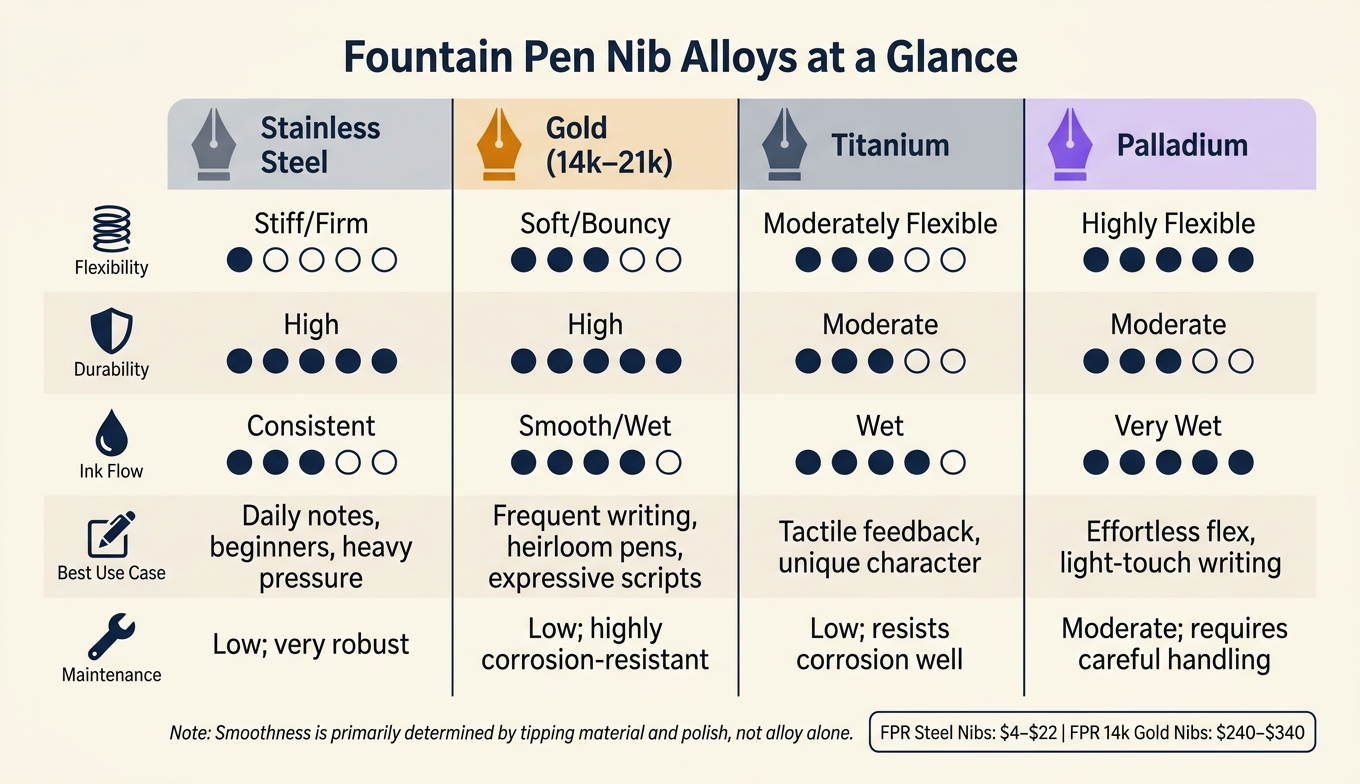
Fountain Pen Nib Alloys Compared: Steel vs Gold vs Titanium vs Palladium
How to Read the Comparison Table
This table breaks down four common nib alloys across five important attributes: flexibility, durability, ink flow, best use case, and maintenance. It's designed to help you quickly match a nib's traits to your writing preferences before making a decision.
Note: While the alloy impacts how the nib feels during use, factors like tipping material and polish ultimately determine its smoothness. Consider this table a quick guide to simplify your choice.
| Alloy Type | Flexibility | Durability | Ink Flow | Best Use Case | Maintenance |
|---|---|---|---|---|---|
| Stainless Steel | Stiff / Firm | High | Consistent | Daily notes, beginners, heavy pressure | Low; very robust |
| Gold (14k–21k) | Soft / Bouncy | High | Smooth / Wet | Frequent writing, heirloom pens, expressive scripts | Low; highly corrosion-resistant |
| Titanium | Moderately flexible | Moderate | Wet | Tactile feedback, unique character | Low; resists corrosion well |
| Palladium | Highly flexible | Moderate | Very Wet | Effortless flex, light-touch writing | Moderate; requires careful handling |
Key Takeaways
- Stainless Steel: A reliable choice for those who prefer a firm, consistent feel. It's perfect for heavy-handed writers or those just starting out, thanks to its durability and low maintenance.
- Gold: Known for its soft, bouncy feel and excellent corrosion resistance, gold nibs are ideal for long writing sessions, expressive scripts, and even heirloom pens. Within this category, the karat level matters - 14k gold offers more structure and durability, while 18k gold is softer and more flexible.
- Titanium: A great middle ground. It provides moderate flexibility, a wetter ink flow, and a unique springy feedback that feels somewhat like writing with a pencil.
- Palladium: The most flexible and expressive option, delivering stunning stroke variation. However, it requires a light touch and careful handling, making it better suited for experienced writers.
Conclusion
The material of your nib plays a big role in its firmness and how it delivers ink. Stainless steel nibs are firm and reliable, making them a great choice for beginners. If you're looking for a softer, more cushioned feel, gold nibs are ideal, especially for extended writing sessions. Titanium nibs stand out with their springy feedback, while palladium nibs are known for their exceptional softness, flexibility, and ability to produce a wet ink line with slight variation.
However, when it comes to smoothness, the tipping material and its finish matter more than the alloy itself.
FAQs
Does a gold nib write smoother than a steel nib?
The way a nib feels when writing is influenced more by the quality and grind of the tipping material than by whether it's made of gold or steel. Gold nibs, known for their flexibility, often offer a softer, smoother glide. On the other hand, steel nibs tend to have more tactile feedback, which many writers appreciate for greater precision. Both types can be polished to achieve impressive smoothness, so the overall performance comes down to the craftsmanship and your personal writing preferences.
Which nib alloy is best for heavy-handed writers?
Stainless steel nibs are a great choice for writers who tend to apply more pressure while writing. Their firm and sturdy build makes them resistant to bending, even under heavy-handed use. If gold nibs are more your style, opting for a 14k gold nib is a smarter move than going for an 18k one. Why? Because 14k gold nibs are firmer and more durable, making them better suited for long-term use. Fountain Pen Revolution offers a wide range of these reliable and budget-friendly nibs, catering to both beginners and seasoned fountain pen enthusiasts.
What inks are most likely to corrode a nib?
Highly acidic inks, such as traditional iron gall formulations, can be particularly harsh on fountain pen nibs. While modern stainless steel nibs are generally durable and can handle most mild inks, prolonged exposure to acidic inks may still lead to damage over time. Gold and titanium nibs, on the other hand, offer better resistance to these chemicals, making them a safer choice for use with iron gall inks.
To keep your fountain pen in top shape, it’s essential to flush the nib and feed regularly, no matter what material your nib is made from. This simple maintenance routine helps prevent buildup and ensures smooth writing performance.